


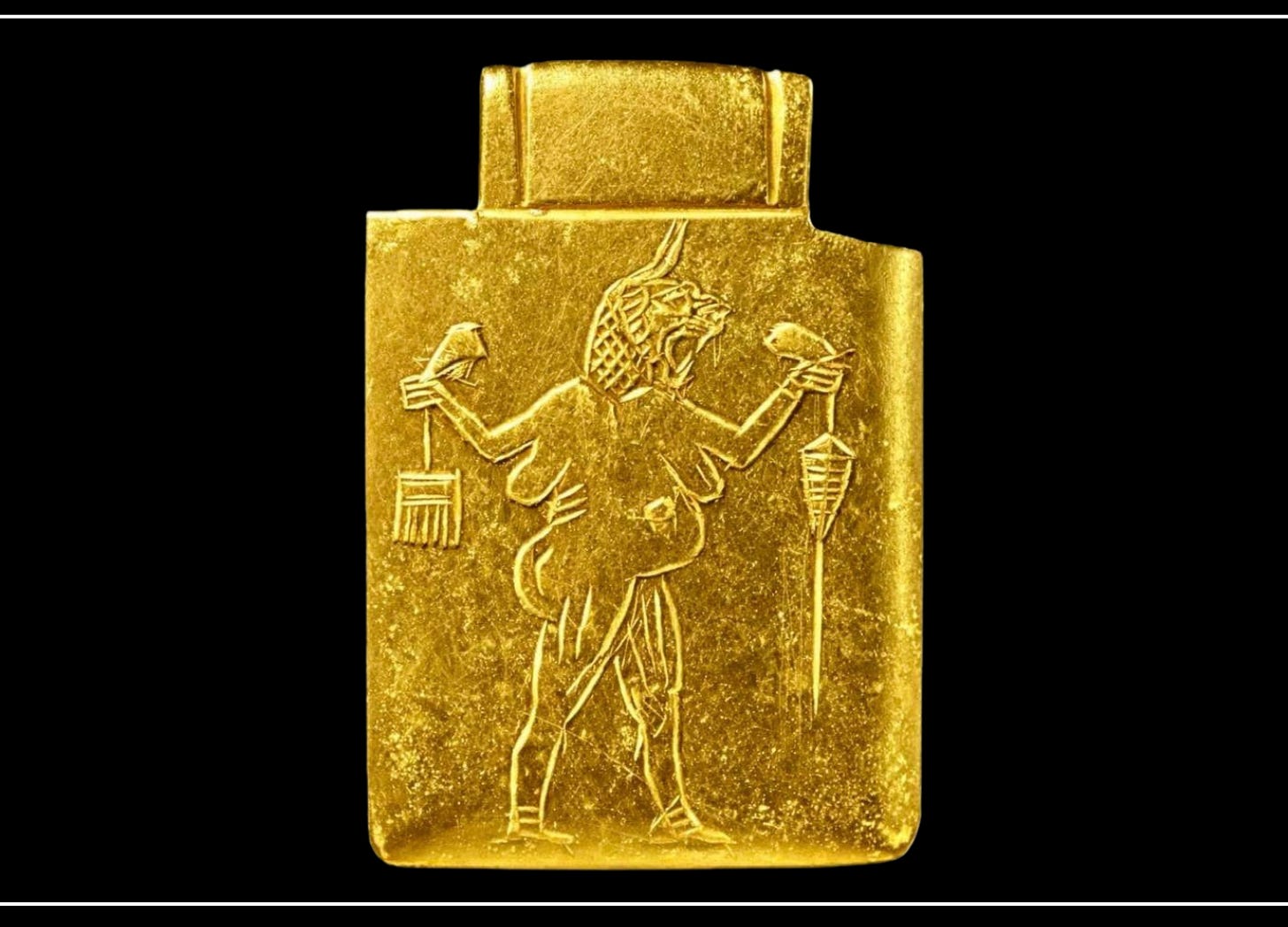
Stone amulet against the demon Lamashtu, from Assur, first half of the 1st millennium BC. Vorderasiatisches Museum, Staatliche Museen zu Berlin, inv. VA Ass 00991. The amulet shows Lamashtu surrounded by ritual objects and protective imagery.
A small amulet from ancient Assur shows one of the most feared figures in Mesopotamian religion: Lamashtu, the daughter of Anu.
She was imagined as a dangerous supernatural being who threatened pregnant women, unborn children, newborns, and infants. In cuneiform texts, she appears as a force connected with fever, crying infants, miscarriage, stillbirth, and sudden infant death. For families in ancient Mesopotamia, these were real and constant dangers. Lamashtu gave those dangers a name, a face, and a ritual enemy.
It belongs to the Vorderasiatisches Museum in Berlin, with the inventory number VA Ass 00991. It comes from Assur and dates to the first half of the 1st millennium BC. That means the object itself is around 2,500 to 3,000 years old, rather than 4,000 years old. The broader Lamashtu tradition, however, reaches back much earlier, into the second millennium BC through incantations, rituals, and related magical texts.
A demon made visible
Lamashtu was usually shown with a disturbing hybrid body. Her head could resemble a lion or lion-griffin. Her hands could appear as claws. Her feet could be bird talons. She is often naked or semi-naked, sometimes standing on a donkey, sometimes shown with animals such as a piglet and dog or jackal.
These details were part of a visual language. The amulet turned an invisible danger into a visible target. The demon could be named, pictured, surrounded by ritual objects, and addressed through an inscription. In Mesopotamian protective magic, image and text worked together.
The amulet from Assur shows Lamashtu with objects around her. Similar amulets include a comb, spindle, pin, food offerings, animals, and protective inscriptions. These were not decorative extras. The comb and spindle belonged to the domestic world of women and households. They could function as gifts or offerings meant to placate the demon and send her away.
This was the logic of the amulet: show the dangerous being, give her what she wants, invoke stronger divine powers, and force her out of the human space she threatens.
More than superstition
Modern readers often treat ancient demons as fantasy. For Mesopotamian families, Lamashtu belonged to the same world as medicine, diagnosis, ritual, and household protection.
Ancient Mesopotamian healing did not separate illness, divine anger, demons, omens, and ritual action in the same way modern medicine does. A crying infant, fever, sleeplessness, weakness, or a dangerous pregnancy could become a religious and medical crisis at the same time. The specialist called to help might use incantations, figurines, salves, knots, fumigation, drawings, offerings, and amulets.
This was a structured system. It had repeated texts, recognizable images, prescribed ritual actions, and materials chosen for protective effect.
Walter Farber’s edition of the Lamashtu incantation series gathers the textual side of this world. Frans Wiggermann’s work shows how Lamashtu developed into one of the clearest and most individualized demons in Mesopotamian religion. Unlike many vague hostile spirits, she had a name, genealogy, personality, body, habits, victims, and a ritual profile.
She was not merely “evil” in a general sense. She was specific. She came for mothers and children.
Why Pazuzu appears beside her
Lamashtu is often linked with Pazuzu, the famous wind demon. Pazuzu was dangerous too, but in protective magic he could be used against a greater danger. This is one of the most striking ideas in Mesopotamian apotropaic practice: a frightening power could be turned against another frightening power.
Pazuzu heads and pendants were worn or hung as protection. Lamashtu amulets sometimes show Pazuzu driving her away. The principle is direct: the image of one supernatural threat could protect the household from another.
This helps explain why ancient amulets often look frightening. They were not meant to comfort through beauty. They were meant to confront danger.
Ritual objects that fought back
Recent scholarship has emphasized that Lamashtu amulets were active ritual objects. Their power came from more than the picture alone.
The material mattered. Stone, obsidian, inscription, polish, scale, and portability all shaped how the amulet functioned. Miriam Said’s study of an obsidian Lamashtu amulet at the Metropolitan Museum of Art shows how light, surface, and materiality could change the way the demon’s image was experienced. The amulet was small enough to be held, worn, suspended, or used in ritual space, but its meaning was large.
The inscription mattered as well. On some amulets, cuneiform text surrounds the image, almost enclosing the demon. The written words call on divine powers to neutralize her. The amulet becomes a miniature battlefield: Lamashtu is present, but she is contained.
In this sense, the object does two things at once. It depicts the demon and acts against her.
Childbirth, grief, and fear
The Lamashtu tradition also reveals something deeper about ancient family life.
Infant loss was common in the ancient world, but Mesopotamian evidence shows that families cared deeply about infants and tried actively to protect them. Archaeology and texts point to concern, mourning, burial practices, rituals, and emotional responses. Jonathan Valk’s study of infant loss in ancient Mesopotamia argues strongly against the idea that high mortality produced parental indifference.
This is important for understanding Lamashtu. These amulets were not random magical objects from a strange world. They were part of a human response to pregnancy risk, infant illness, and grief.
A mother afraid for her unborn child, a family watching a newborn struggle, a household trying to protect a baby through the night: these are the social realities behind the demon.
Lamashtu is terrifying because the danger she represents was terrifying.
Did the tradition survive into modern Iraq?
There is documented 20th-century Iraqi folklore involving protective practices around pregnancy, miscarriage, birth, and children. E. S. Drower’s 1938 study, “Woman and Taboo in Iraq,” records a custom in which a woman who had suffered pregnancy loss could obtain iron for an anklet and vow to wear it for seven years. Iron also appears widely in Near Eastern protective practices, especially around childbirth and vulnerability.
This creates a meaningful comparison with older Mesopotamian protective traditions. Both ancient and later practices use objects worn on the body, protective materials, vows, and ritual action to guard pregnancy and children.
Direct continuity with Lamashtu as a named figure is difficult to demonstrate. A more cautious interpretation is that the ancient Lamashtu tradition and later Iraqi protective customs share a long regional concern: the dangerous threshold between pregnancy, birth, and early childhood.
The name of the demon faded from daily life. The fear she represented remained familiar.
What the amulet really shows
The Assur amulet should be understood as part of a long Mesopotamian system of protection. It belongs to the 1st millennium BC, while Lamashtu texts and rituals reach into the second millennium BC. It shows a demon feared for attacking mothers and infants. It combines image, inscription, offerings, and ritual logic into one compact object.
It also shows how ancient people responded to fragile moments in life.
Pregnancy and birth were dangerous. Newborns were vulnerable. Families used every available tool: medicine, ritual, prayer, amulets, household objects, divine names, and protective images.
Lamashtu was the face of a danger they knew well. The amulet was one way to fight back.
Support Independent Ancient Content :
Your support helps me create more archaeology posts, articles, and mini history videos:
Sources and further reading
Vorderasiatisches Museum / Staatliche Museen zu Berlin, object record for Lamashtu amulet VA Ass 00991.
The Metropolitan Museum of Art, “Amulet with a Lamashtu demon,” object 1984.348.
The British Museum, Lamashtu amulet, museum number 117759.
Walter Farber, Lamaštu: An Edition of the Canonical Series of Lamaštu Incantations and Rituals and Related Texts from the Second and First Millennia B.C., 2014.
F. A. M. Wiggermann, “Lamaštu, Daughter of Anu. A Profile,” in Birth in Babylonia and the Bible, 2000.
Miriam Said, “Radiance and the Power of Erasure in an Obsidian Lamaštu Amulet,” Metropolitan Museum Journal 55, 2020.
John Z. Wee, “The Lamashtu Amulet: A Portrait of the Caregiver as a Demoness,” Harvard Library Bulletin, 2021.
Jonathan Valk, “‘They Enjoy Syrup and Ghee at Tables of Silver and Gold’: Infant Loss in Ancient Mesopotamia,” Journal of the Economic and Social History of the Orient 59, 2016.
E. S. Drower, “Woman and Taboo in Iraq,” Iraq 5, 1938.