


Small stone points from Ushki V, a site on Kamchatka in the Russian Far East, show wear and paint residue that two Russian archaeologists read as evidence of tattooing about 13,000 years ago. No tattooed skin survives from that time, so the case rests on the tools, on experiments with pig skin and on comparison with later Aleut and Chukchi practice.
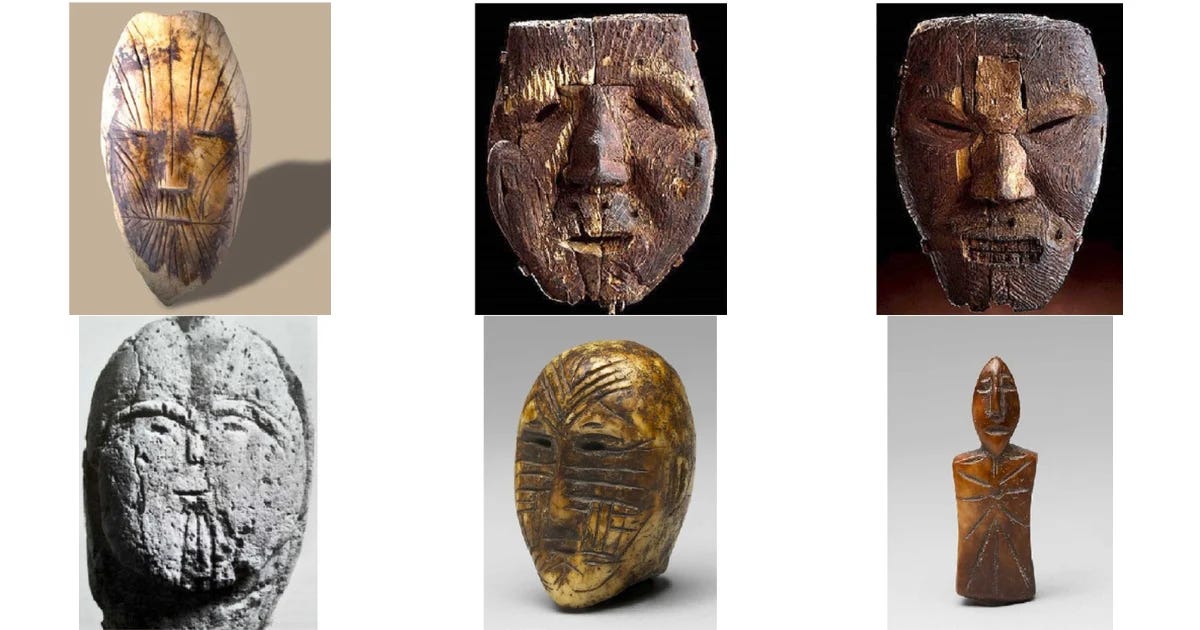
Faces with incised designs from North Pacific cultures. Top row, a Dorset walrus ivory mask about 3,500 years old and two Dorset wooden masks about 1,500 to 1,000 years old. Bottom row, a stone head from the Aleutian Islands, an Old Bering Sea head and a Punuk figure. Credit: Figure 3 from Ponkratova and Lbova, Quaternary Environments and Humans 4 (2026) 100109, CC BY 4.0. Objects from the Canadian Museum of History, The Metropolitan Museum of Art and other collections as credited in the paper.
The tools come from a Kamchatka layer dated to about 13,000 years ago
Ushki V is one of five prehistoric sites on the south shore of Ushki Lake, an abandoned bend of the Kamchatka River less than 200 kilometres inland from the Pacific. The Soviet archaeologist Nikolai Dikov found the first of them in the early 1960s and kept excavating at Ushki for almost thirty years. The tools in this story come from layer VII, which Goebel and colleagues dated in 2010 to about 13,000 calibrated years ago. They called it the earliest well-dated late-glacial human occupation in western Beringia.
