


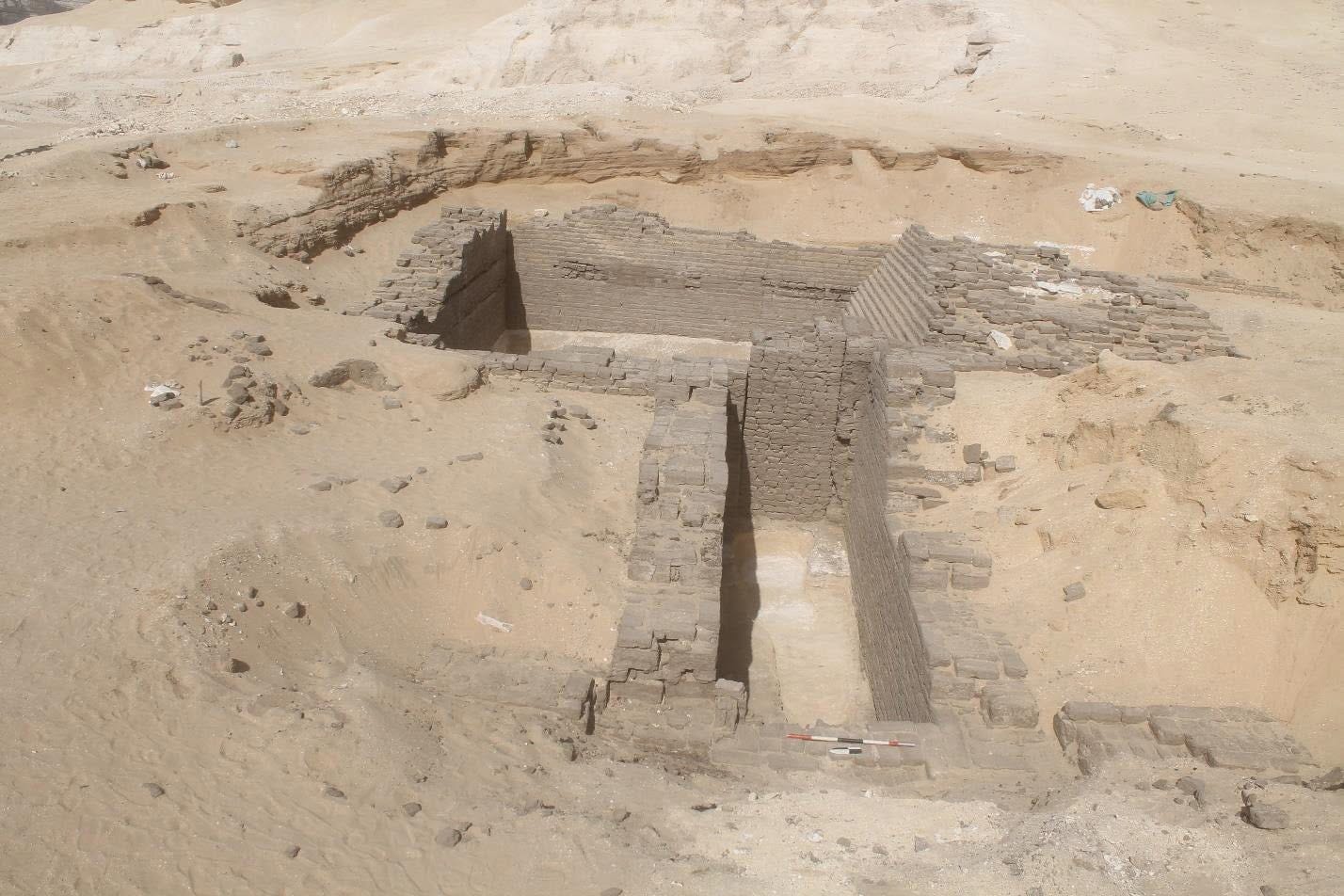
View of the newly uncovered structures. Credit: Ministry of Tourism and Antiquities وزارة السياحة والآثار
The find was announced by Egypt’s Ministry of Tourism and Antiquities after excavations by an Egyptian mission of the Supreme Council of Antiquities. The work took place in the Jabal al-Tayr area, near Samalut in Middle Egypt, a landscape already known for its religious and archaeological importance.
The newly uncovered tombs are especially important because of their unusual architectural design. Preliminary studies suggest that their layout resembles the tomb of King Den at Abydos, one of the most important rulers of Egypt’s First Dynasty. This connection gives the Jabal al-Tayr necropolis a major role in the study of early Egyptian tomb architecture and the gradual engineering developments that led toward pyramid building.
A new discovery in Minya
The Egyptian archaeological mission found two tombs dating to the Early Dynastic Period, the formative era that followed the unification of Egypt and preceded the Old Kingdom. This was the period when royal authority, state administration, writing, elite burial customs, and monumental architecture were all developing rapidly.
The discovery also included a number of burials from other periods. Some belong to the Predynastic era, before the formation of the unified Egyptian state. Others appear to date to the Late Period, showing that the same area remained in use as a burial ground for many centuries.
This long sequence is one of the most important aspects of the find. Jabal al-Tayr was not used for a single generation or one isolated elite burial. The evidence points to a necropolis with deep continuity, active from the Predynastic period through later phases of Egyptian history.
Egypt’s Minister of Tourism and Antiquities, Sherif Fathy, described the discovery as a significant addition to Egypt’s record of archaeological finds because it contributes to understanding the development of funerary architecture across different periods.
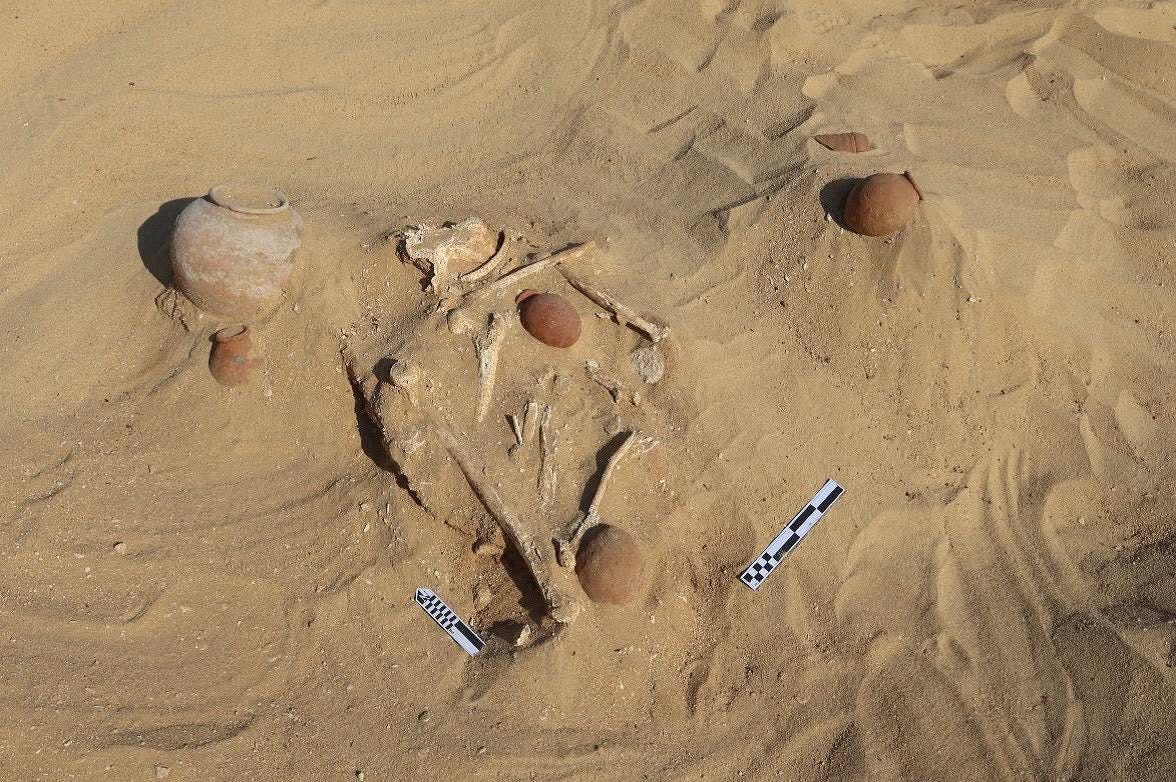
Finds uncovered in the Jabal al-Tayr necropolis. Credit: Ministry of Tourism and Antiquities.
Two Early Dynastic tombs
The most important part of the discovery is the pair of Early Dynastic tombs. According to the Supreme Council of Antiquities, the first tomb is a rare architectural find because of its distinctive geometric design. The second tomb is very similar in plan and has survived in better condition.
Dr. Hisham El-Leithy, Secretary-General of the Supreme Council of Antiquities, stated that early studies show a notable resemblance between the two Jabal al-Tayr tombs and the famous tomb of King Den at Abydos.
That comparison is important because Den’s tomb belongs to the First Dynasty and represents one of the most developed royal tombs of early Egypt. It included architectural innovations that show how elite burial structures were becoming more complex before the age of pyramids.
The resemblance does not mean the Jabal al-Tayr tombs were royal tombs. The current evidence points more carefully to shared architectural ideas and construction principles during the early stages of Egyptian state formation. The tombs show that architectural knowledge was circulating beyond the royal necropolis of Abydos and that regional elite cemeteries could preserve important evidence for early monumental design.
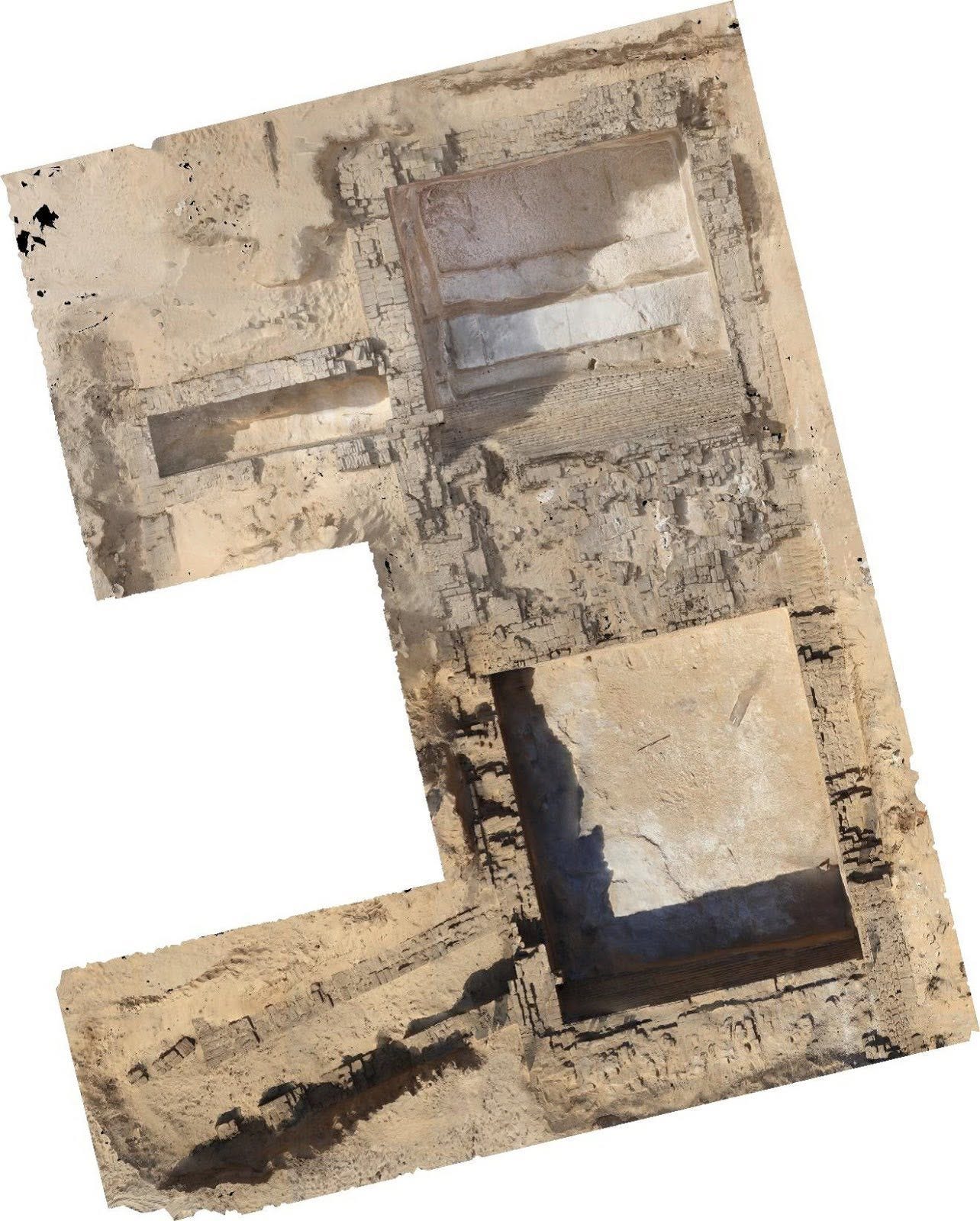
View of the structures. Credit: Ministry of Tourism and Antiquities
A design that may point toward pyramid engineering
The first tomb has drawn special attention because of its construction method. Its walls were built with a gradual change in thickness: heavier and thicker at the base, then narrower toward the top.
Mohamed Abdel Badie, Head of the Egyptian Antiquities Sector, noted that this approach may represent an early stage in the engineering logic that later contributed to the Step Pyramid and then to the true pyramid form.
This does not mean the tomb was a pyramid. Rather, it preserves a structural idea that later became central to monumental Egyptian architecture: stability through mass, tiered or tapering construction, and controlled distribution of weight.
The Step Pyramid of Djoser at Saqqara, built centuries later in the Third Dynasty, is widely considered the first pyramid in Egypt and a turning point in stone architecture. The Jabal al-Tayr tombs come from a much earlier architectural world, but their construction may help researchers trace how Egyptian builders experimented with form, support, and vertical mass before pyramid architecture fully emerged.
Evidence of ancient stoneworking
The first tomb appears to have suffered damage in later periods because some of its stone blocks were removed, probably for reuse. This kind of quarrying is common at ancient sites, where later communities often extracted stone from older monuments.
Even so, the surviving parts preserve valuable construction details. Archaeologists identified oxide lines on stone surfaces, which appear to show methods used for cutting and preparing blocks with precision.
The tomb also contained large wooden supports used to reinforce the walls. Some of these supports extended along the full length of the wall, while others were placed as separate straight sections.
These wooden elements are especially valuable because organic architectural materials rarely survive well. Their presence gives researchers a clearer view of how early builders stabilized large tomb structures and combined stone and wood in engineering solutions.
Together, the stone-cutting traces and wooden reinforcement show that early Egyptian tomb builders were already working with advanced technical planning. The tomb was not simply a burial pit lined with stone. It was a carefully engineered structure.
The better-preserved second tomb
The second tomb lies south of the first. It follows almost the same architectural plan, but unlike the first tomb, it appears not to have been heavily quarried in later times.
Because more of its original features survive, the second tomb may become especially useful for reconstructing the original appearance of both structures. Its preservation allows archaeologists to compare the two tombs directly and better understand their shared design.
The existence of two similar tombs also suggests that the design was not an isolated experiment. The builders may have been following a known architectural model, possibly one associated with elite status, regional authority, or early state administration.
Further excavation and study may clarify whether the tombs belonged to local rulers, high officials, or elite individuals connected with the expanding institutions of early Egypt.
Connection with King Den’s tomb at Abydos
The comparison with King Den’s tomb is one of the most important points in the announcement.
Den was one of the major kings of Egypt’s First Dynasty. His tomb at Umm el-Qaab, Abydos, is among the most important royal burials from early Egypt. It is known for its architectural complexity and for innovations that mark a major step in the development of royal funerary architecture.
The Jabal al-Tayr tombs appear to share architectural similarities with Den’s tomb, according to preliminary studies. This strengthens the interpretation of Jabal al-Tayr as a major necropolis with links to the architectural traditions of early royal and elite burial.
The discovery may therefore help researchers understand how tomb forms developed outside the best-known royal centers. Abydos remains central to the study of Egypt’s earliest kings, but the Jabal al-Tayr find shows that important architectural experimentation also occurred in Middle Egypt.
Predynastic burials at the site
The mission also uncovered part of a Predynastic cemetery. These burials included bodies placed in a crouched position and wrapped in deteriorated plant mats.
This type of burial belongs to a much earlier funerary tradition, before the full development of dynastic kingship. Crouched burials are common in Predynastic Egypt, where the dead were often placed in simple graves with pottery and other offerings.
Several of the Jabal al-Tayr burials were accompanied by black-topped pottery vessels. These vessels are strongly associated with Predynastic Egypt, especially the Naqada II and Naqada III periods.
The presence of black-topped pottery is important for dating and cultural interpretation. It shows that the necropolis was already active before the Early Dynastic tombs were built. It also connects Jabal al-Tayr with the wider cultural world of late Predynastic Upper Egypt, when local communities were developing increasingly complex social and ritual practices.
Naqada II and Naqada III context
The Naqada II and Naqada III periods were crucial in the formation of ancient Egyptian civilization. During these phases, elite burials became more elaborate, long-distance exchange intensified, administrative practices developed, and political power became more centralized.
Naqada III is especially important because it overlaps with the final steps toward state formation and the beginning of dynastic kingship.
The discovery of Naqada II and III material at Jabal al-Tayr suggests that the area was part of this wider process. The site may preserve evidence for local communities participating in the cultural and political transformations that eventually led to the unified Egyptian state.
The transition from simple Predynastic burials to more complex Early Dynastic tombs at the same location is one of the strongest aspects of the discovery. It shows architectural and social change across time within one burial landscape.
Late Period burials and continued use
The site also produced individual and collective human burials that are believed to date to the Late Period. Some of these burials were found inside the remains of decayed wooden coffins.
The Late Period, more than two thousand years after the Early Dynastic Period, saw Egypt ruled by native dynasties, foreign powers, and renewed religious traditions. The continued use of Jabal al-Tayr as a cemetery during this era shows the long-term importance of the location.
This continuity matters. The necropolis was not abandoned after the Early Dynastic tombs. It remained meaningful enough for later communities to bury their dead there, even after the original tomb builders were long gone.
The presence of Predynastic, Early Dynastic, and Late Period burials in the same area makes Jabal al-Tayr a valuable site for studying how sacred and funerary landscapes could remain active across thousands of years.
Jabal al-Tayr as a major necropolis
The new finds strengthen the idea that Jabal al-Tayr was one of Middle Egypt’s important burial areas.
Its location in Minya, on the eastern side of the Nile, places it within a region that connected Upper and Lower Egypt and served as a corridor for movement, settlement, and cultural exchange.
Today, Jabal al-Tayr is also known as an important religious destination connected with the traditional route of the Holy Family in Egypt. The area contains remains from several historical periods, including Pharaonic, Greek, and Roman phases. The new discovery adds much earlier depth to that already complex landscape.
The evidence now suggests that Jabal al-Tayr’s importance began deep in prehistory and continued through many later periods.
Why this discovery could reshape understanding of pyramid development
The discovery matters because it helps fill the gap between early elite tombs and later monumental pyramids.
Egyptian pyramid architecture did not appear suddenly from nowhere. It developed from earlier burial traditions, especially mastabas and elite tombs, which gradually became larger, more formalized, and more technically ambitious.
The Jabal al-Tayr tombs appear to preserve one of these experimental stages. Their thick lower walls, tapering upper design, stoneworking traces, and wooden reinforcements all show a concern with stability, weight, and structural control.
These are the same broad engineering concerns that later shaped monumental stone architecture. The Step Pyramid of Djoser transformed the royal tomb into a massive stone superstructure. The true pyramids of the Fourth Dynasty then pushed that development further.
The Jabal al-Tayr tombs do not replace the importance of Saqqara, Abydos, or Giza. Instead, they add another regional piece to the story. They show that the road toward pyramid architecture included many steps, experiments, and local traditions.
A rare architectural survival
Early Dynastic tombs are often difficult to study because many were looted, damaged, quarried, or reused over thousands of years. The survival of two related tombs at Jabal al-Tayr is therefore important.
The first tomb preserves clues about construction and later stone removal. The second tomb preserves more of the original architecture. Together, they allow archaeologists to study both design and later transformation.
The comparison between the two may also reveal how builders planned repeated or paired tomb forms. This could help answer questions about standardization, architectural knowledge, and the social identity of the people buried there.
The find is still in an early stage of study, so future excavation may reveal more about burial goods, associated structures, inscriptions, human remains, or the wider cemetery layout.
A layered history beneath the desert
The Jabal al-Tayr discovery is important because it brings together several different periods of Egyptian history in one place.
The Predynastic burials show local funerary traditions before the state. The Early Dynastic tombs show advanced architectural experimentation during the formation of Egyptian kingship. The Late Period burials show that the cemetery retained meaning across many later centuries.
This layered use gives archaeologists a rare opportunity to study continuity, change, and memory within a single necropolis.
The site also shows how much remains to be learned outside Egypt’s most famous archaeological zones. While the pyramids of Giza, the Step Pyramid of Saqqara, and the royal tombs of Abydos dominate public attention, discoveries in places like Minya can reshape the details of the wider story.
Ongoing excavations
Excavation at Jabal al-Tayr is continuing. Archaeologists expect that further work may reveal additional tombs, burial goods, architectural traces, or evidence for how the necropolis was organized.
Future study will likely focus on several questions: who was buried in the Early Dynastic tombs, how closely their design relates to Abydos, what construction techniques were used, how the Predynastic cemetery developed, and how the site was reused in later periods.
The discovery is already significant. It gives researchers new material for understanding how Egyptian funerary architecture evolved from early tombs toward the monumental pyramid tradition.
At Jabal al-Tayr, the path toward the pyramid can be seen not in a finished monument, but in the engineering choices of early tomb builders: thick walls, careful stonework, structural support, and a growing ambition to make burial architecture stronger, larger, and more permanent.