


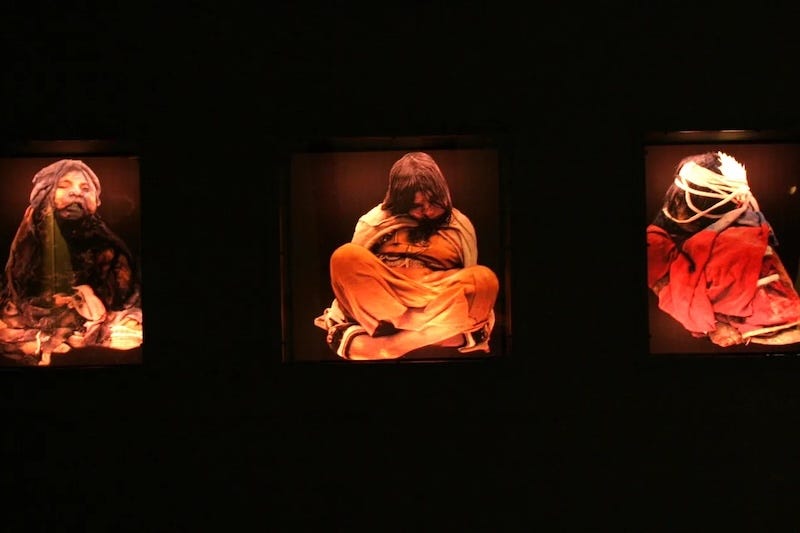
Photos of the three “Children of Llullaillaco,” sacrificed by the Inca Empire more than five centuries ago.
The famous child mummies found high in the Andes may now be tied more closely to one of the most important political moments in Inca history. A new study of plant remains buried with the Llullaillaco Maiden suggests that the children were sacrificed during the reign of Huayna Capac, one of the last great rulers of the Inca Empire.
The discovery gives archaeologists a sharper date for the ritual and a stronger historical context for why it may have happened. Rather than being understood only as a religious offering, the Llullaillaco burial may also reflect the way the Inca state used sacred ceremonies to strengthen its authority in newly incorporated territories.
The Children of Llullaillaco
In 1999, archaeologists discovered three naturally mummified Inca children just below the summit of Llullaillaco, a volcano on the border region between Argentina and Chile. The site sits more than 6,700 meters above sea level, making it one of the highest archaeological discoveries in the world.
The children became known as the “Children of Llullaillaco.” They included a teenage girl, now widely called the Llullaillaco Maiden or La Doncella, and two younger children, a boy and a girl, both around seven years old. The cold, dry, high-altitude environment preserved their bodies with extraordinary detail.
Their clothing, hair, skin, internal organs, and burial objects survived in a condition rarely seen in archaeology. Because of this, the mummies have become one of the most important sources for understanding Inca ritual life, especially the state-sponsored child sacrifice ceremony known as capacocha.
A State Ritual, a Sacred Mountain
Capacocha was among the most important ceremonies of the Inca world. These rituals were usually connected with major political, dynastic, religious, or environmental events. Children chosen for sacrifice could be sent from distant regions of the empire to Cuzco and later taken to sacred mountains, where they were offered to the gods.
High mountains were deeply sacred in Andean belief systems. They were associated with powerful divine beings, local identities, water, fertility, ancestry, and imperial authority. By placing offerings on remote peaks, the Inca state connected political power with sacred geography.
The Llullaillaco burial fits this broader pattern. The children were placed in a high-altitude shrine with rich offerings, including textiles, figurines, ceramics, food, and plant remains. The teenage girl appears to have been the central figure in the ritual, while the two younger children may have accompanied her as attendants in death.
What Earlier Studies Revealed
Previous scientific studies of the Llullaillaco mummies showed that the children’s lives changed significantly before their deaths. Hair analysis indicated that they were given higher-status foods during the final months of life. This likely included maize-based products and other foods associated with elite Inca society.
Researchers also found evidence that coca and alcohol played a role in the final stages of the ceremony. Coca leaves had important ritual and practical uses in the Andes, especially at high altitude. Alcohol, probably in the form of chicha, was also important in Inca ceremonies.
These findings suggested that the children underwent a long preparation process before the final journey to the mountain shrine. The ritual appears to have been carefully planned, formal, and connected with state ideology.
One major question remained unresolved: when exactly did the sacrifice take place?
The Problem with the Old Date
A radiocarbon analysis carried out in 2007 on hair samples from the mummies placed the children’s deaths between 1430 and 1520 CE. That date range was useful, but it covered almost a century of Inca history.
For archaeologists, that was too broad to connect the sacrifice confidently with a particular ruler, military expansion, political event, or period of imperial consolidation. The Inca Empire expanded rapidly during the 15th century, and a difference of several decades can change the historical interpretation of a site.
To refine the date, the new research focused on short-lived organic material buried with the Llullaillaco Maiden.
Why Plants Were Key
The new study analyzed botanical remains found among the burial offerings. These included maize, cassava, and coca. Because these plants would likely have been harvested and placed in the burial close to the time of the ceremony, they offered a more direct chronological link to the ritual event.
The research team used radiocarbon dating on the plant remains and combined the results with stable isotope analysis and chronological modeling. This multi-step method helped narrow the possible date of the burial more precisely than earlier work based on the mummies’ hair.
The results placed the sacrifice between 1462 and 1507 CE, with the most likely date around 1499.
A Date in the Reign of Huayna Capac
The date around 1499 is historically significant. It falls during the reign of Huayna Capac, who ruled from about 1493 to around 1525. He was one of the last major rulers of the Inca Empire before the upheavals that followed European contact.
Under Huayna Capac, the empire reached one of its greatest territorial extents. His father, Tupac Inca, had expanded Inca power southward into Chile, while Huayna Capac extended imperial authority northward into parts of present-day Ecuador and Colombia.
By the late 15th century, the region around Llullaillaco had likely been incorporated into the Inca world relatively recently. That matters because a major state ritual in such a location would have had both religious and political meaning.
Sacrifice and Imperial Authority
The researchers argue that the Llullaillaco sacrifice may have helped ritually anchor Inca presence in the region. In other words, the ceremony may have served as a sacred act that marked the landscape as part of the empire.
This interpretation fits the broader role of capacocha rituals. These ceremonies connected local communities, provincial elites, sacred places, and imperial power. A sacrifice on a major mountain would have created a permanent ritual statement in the landscape.
The children’s deaths may therefore have been part of a wider campaign of state-sponsored offerings. Such ceremonies could reinforce loyalty, commemorate political events, and present Inca rule as part of a cosmic order.
The sacrifice of the three Llullaillaco children may have supported Huayna Capac’s effort to maintain unity across a vast and diverse empire.
Colonial Chronicles and the Southern Provinces
Colonial-era accounts also mention that Huayna Capac traveled through southern parts of the empire, including the northwest of what is now Argentina. These accounts describe rich offerings made to the gods, including child sacrifices.
The new dating evidence does not prove a direct link between those written accounts and the Llullaillaco burial. Still, the timing places the ceremony in a period that matches the political world described in the chronicles.
This gives the burial a stronger historical setting. The children may have been sacrificed during a time when the empire was expanding, integrating new regions, and using ritual to project authority far from Cuzco.
A Ceremony Before a Period of Crisis
The early 16th century was a period of growing instability for the Inca world. The empire was large, diverse, and difficult to manage. Soon after Huayna Capac’s reign, disease introduced from Europe and internal conflict would weaken the empire before the Spanish conquest.
The Llullaillaco sacrifice may therefore belong to a moment when Inca rulers were working to preserve order, reinforce divine legitimacy, and maintain cosmic balance. The ceremony may have been both a religious offering and a political act.
In Inca ideology, the sacred and the political were closely connected. A mountaintop sacrifice could honor divine forces while also confirming the authority of the ruler and the state.
What the New Study Reveals
The study shows how small botanical remains can change the interpretation of a famous archaeological discovery. Maize, cassava, and coca leaves buried with the Llullaillaco Maiden helped refine a date that had remained uncertain for years.
By narrowing the sacrifice to 1462–1507 CE, and most likely around 1499, researchers can now connect the burial more closely with the reign of Huayna Capac and the final expansion phase of the Inca Empire.
The findings also show why similar analyses may be valuable at other Inca high-altitude ritual sites. If other capacocha sacrifices can be dated with the same level of precision, archaeologists may be able to reconstruct broader patterns of imperial ceremony, political expansion, and sacred geography across the Andes.
The Llullaillaco children remain among the most haunting archaeological finds of the Inca world. Their burial now appears more clearly tied to a moment when the empire was trying to secure its presence across newly absorbed lands, using ritual as a powerful instrument of state authority.
Sources:
Live Science, Kristina Killgrove, “Famous child mummies in Andes may belong to kids who were sacrificed to ‘ritually anchor’ the Inca’s presence as their empire expanded,” 14 June 2026.
Sieczkowska-Jacyna, D., Recagno Browning, G., Bernaski, M., et al. 2026. “Timing the Sacred: A Multi-Step Chronological Framework for the Llullaillaco Inca Burial.” Archaeometry. DOI: 10.1111/arcm.70172.
Archaeology News Online Magazine, “Child sacrifice atop Llullaillaco volcano linked to Inca imperial expansion, study finds,” 14 June 2026.Arkeofili, “Bu İnka Çocukları, İmparatorluğun Devamı için Kurban Edilmiş,” 15 June 2026.