


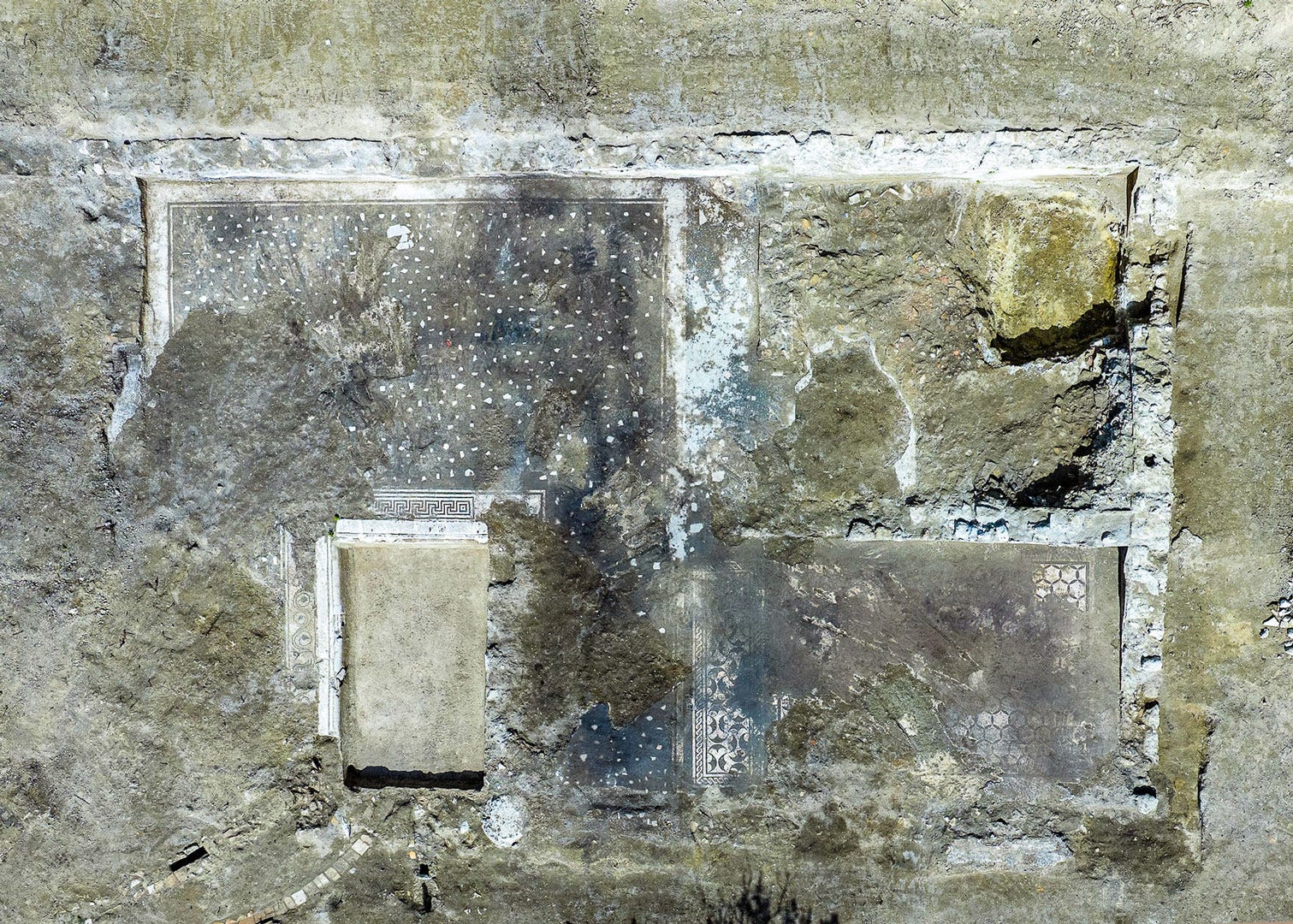
The discovery was made after reports of illegal digging led the Soprintendenza Speciale di Roma, under Italy’s Ministry of Culture, to intervene at the site.
What began as an emergency protection operation quickly became a major archaeological investigation. The excavation revealed part of a wealthy suburban villa, decorated with mosaics, painted plaster, an atrium with an impluvium, and a fragmentary marble statue that may depict Silvanus, the Roman god associated with fields, woodland, boundaries, and rural life.
The find is especially important because the villa lies in the landscape of ancient Lorium, an area connected with the imperial estates of the Antonine dynasty and associated with Hadrian, Antoninus Pius, and Marcus Aurelius.
A discovery triggered by illegal excavation
The story began when unauthorized excavations were reported on land belonging to the Lazio Region, within the agricultural estate of Castel di Guido. The area lies outside Rome’s historic center, in a rural landscape that still preserves important archaeological remains beneath fields, estates, and protected natural zones.
After the report, the Soprintendenza Speciale di Roma acted with the Carabinieri’s Cultural Heritage Protection Unit to stop the clandestine activity, secure the area, and begin a proper archaeological investigation.
The illegal digging had already damaged part of the site. Mechanical excavation had cut into ancient remains, exposing structures and leaving disturbed soil around the area. Archaeologists then expanded the work in a controlled way, documenting the remains, protecting the structures, and turning the emergency into a scientific excavation.
Italy’s Minister of Culture, Alessandro Giuli, described the operation as an example of rapid heritage protection. In only a few days, officials and the Carabinieri were able to stop the illegal work, safeguard the archaeological area, and bring to light the remains of a Roman villa from the imperial period.
A large suburban villa near the ancient Via Aurelia
The excavation revealed part of a large suburban villa, probably connected to the ancient Via Aurelia by a secondary road. The Via Aurelia was one of the major roads leading out of Rome toward the northwest, and the surrounding countryside was dotted with estates, villas, agricultural installations, and imperial properties.
The villa belongs to the wider territory of ancient Lorium. Ancient sources place Lorium along the Via Aurelia, about twelve miles from Rome. The area became particularly important in the 2nd century AD because of its association with Antoninus Pius.
Antoninus Pius spent part of his youth at Lorium and later built a residence there. The area was also frequented by Hadrian and Marcus Aurelius. This imperial connection gives the newly discovered villa a wider historical significance. It may have belonged to members of the Roman aristocracy who were close to the imperial estate, or to elite families linked to the political and social world of the Antonine period.
At this stage, archaeologists remain cautious. The villa has not yet been completely excavated, and its exact ownership is still unknown. However, the quality of the architecture and decoration points clearly to a high-status residence.
Well-preserved rooms, walls, and mosaics
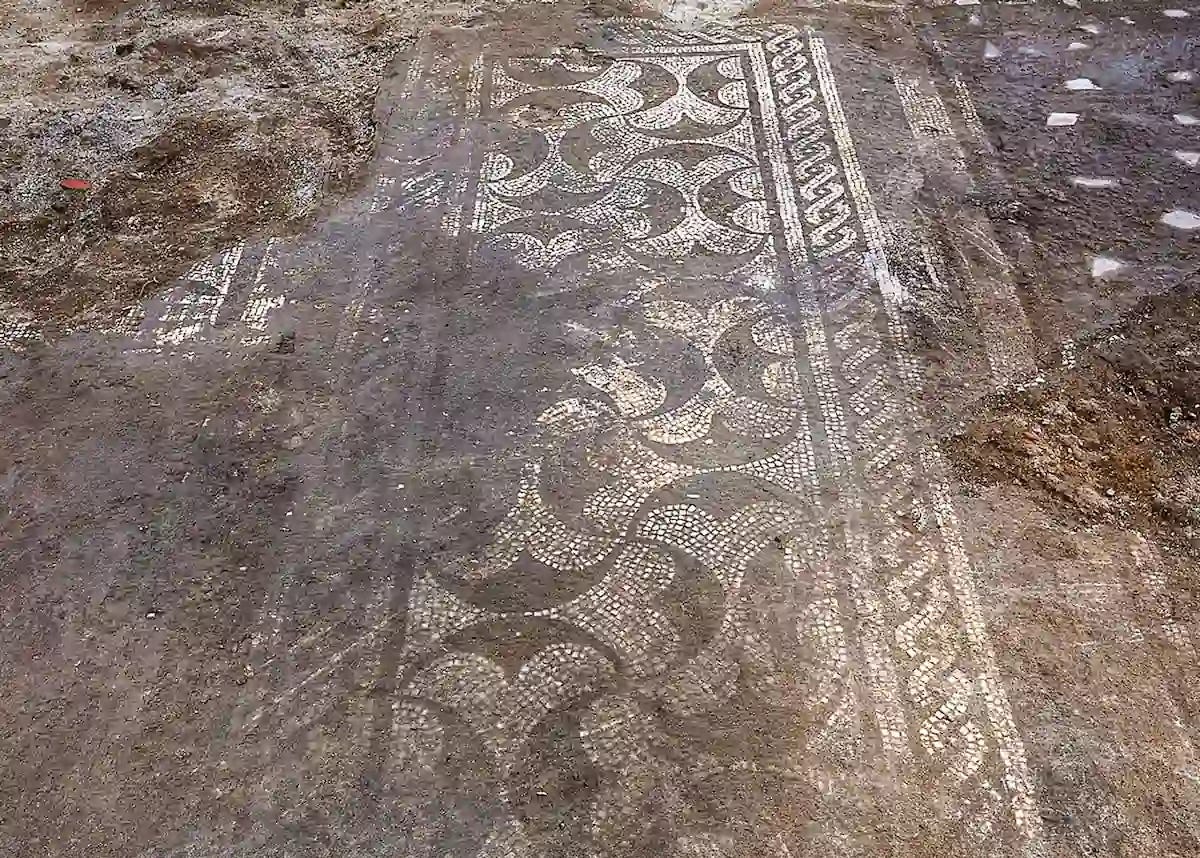
The investigation is being carried out under the scientific direction of archaeologist Alessia Contino of the Soprintendenza Speciale di Roma. The excavation has uncovered rooms preserved to an impressive degree, with walls surviving up to around 1.5 meters in height.
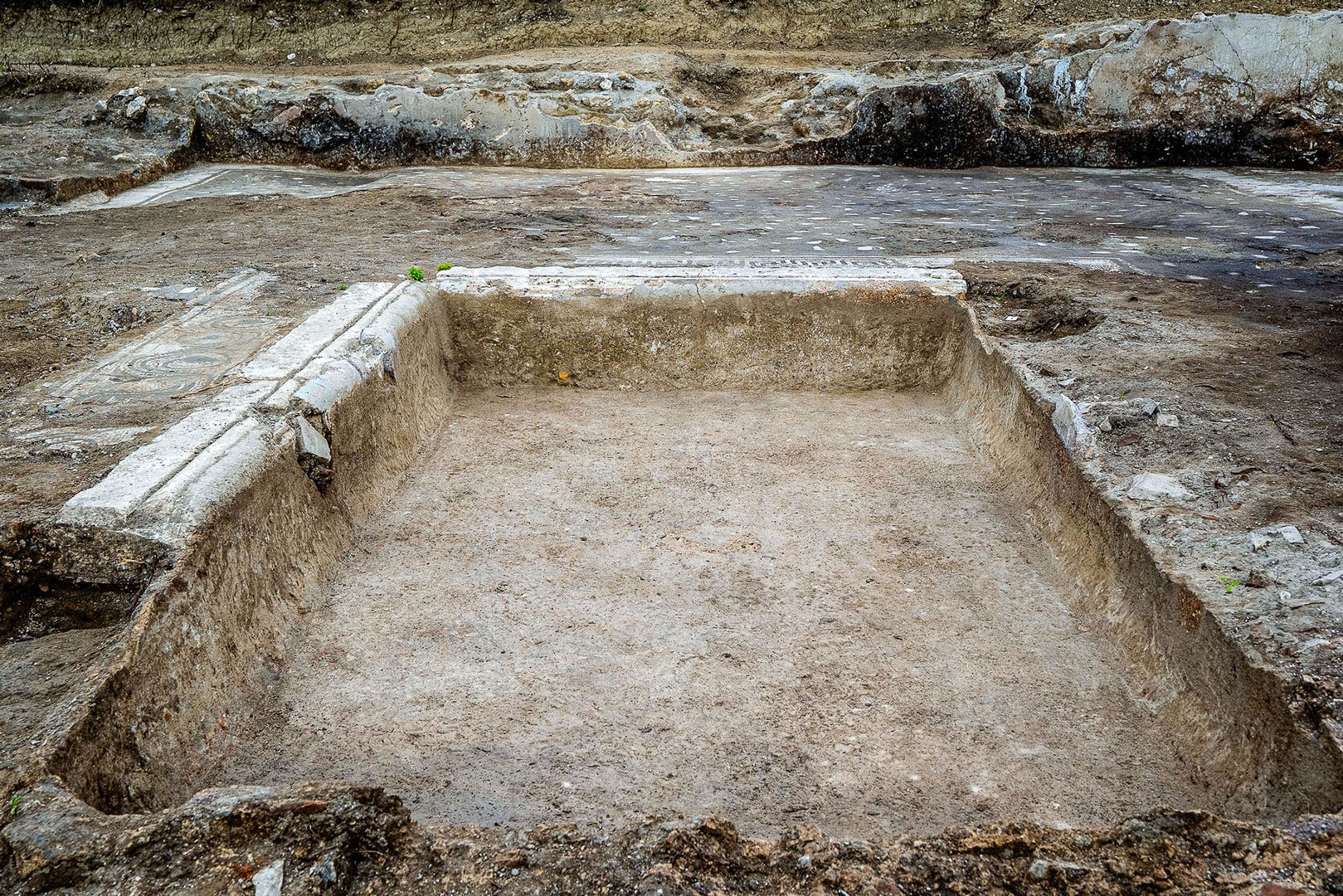
Among the most important architectural elements identified so far is the atrium. This was the central reception space of many Roman houses and villas. At Castel di Guido, the atrium contained a central impluvium, a basin designed to collect rainwater from the roof opening above.
Around this central feature, the floors were decorated with refined mosaic designs. The decoration included geometric and vegetal motifs, black tesserae, and colored marble inserts. A large threshold also survived, decorated with a braided frame and black pelta motifs set against a white background.
The mosaics show the careful planning and expense invested in the residence. They also help date and interpret the villa as part of the culture of elite Roman domestic architecture.
Painted walls and collapsed decoration
The villa also preserved evidence of painted wall decoration. Archaeologists found traces of a red-painted lower band still in place. Other fragments recovered from disturbed soil suggest that the upper walls once included yellow and probably blue panels.
Some of these painted fragments appear to have included human figures and plant motifs. The fragments most likely collapsed during the ancient abandonment of the building and were later disturbed by the illegal excavation.
These painted surfaces are important because they show that the villa was decorated as a refined domestic space, not simply as a rural working estate. The owners invested in both architectural layout and visual display, using mosaics, color, and figural decoration to create a sophisticated interior environment.
Rooms arranged around the atrium
Several rooms developed around the atrium. Some preserved mosaic floors, each with different decorative schemes.
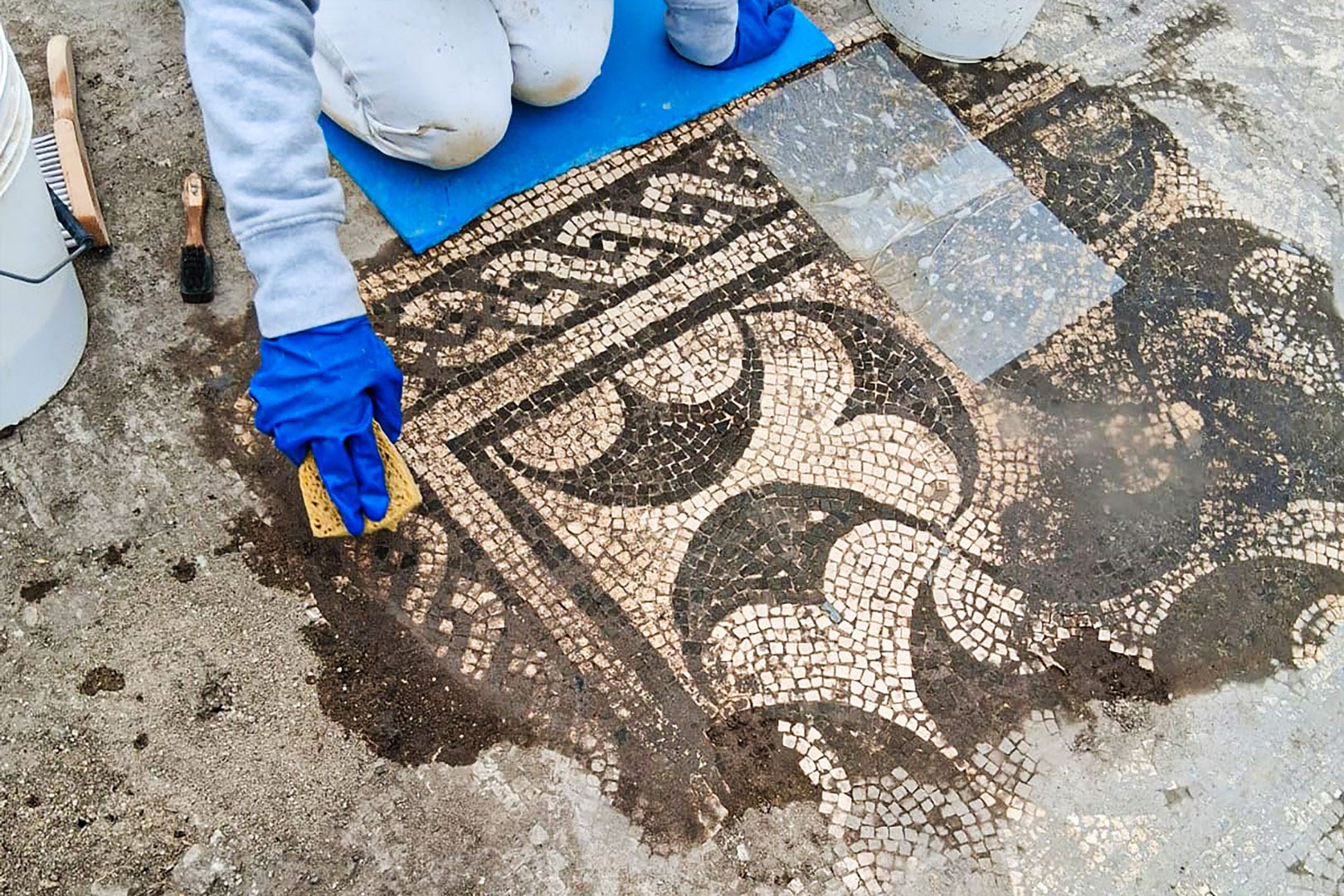
One room had a black-and-white mosaic divided into square panels with geometric patterns. Another included black octagons on a white background. A third used a design of black rectangles with curved sides, a type of pattern associated with refined Roman domestic decoration.
These rooms may have served different functions within the residence, including reception, living, and private spaces. Their arrangement around the atrium suggests a planned architectural composition, with the impluvium and decorated entrance area forming the visual center of the house.
The excavation also identified structures linked to the productive activities of the villa. This is important because Roman villas often combined elite residence with agricultural management. They were places of status, but also centers of land ownership, production, storage, and economic control.
A marble statue from the villa
One of the most valuable finds from the excavation is a fragmentary statue carved from fine white marble. The figure represents a bearded male carrying a small domestic animal, possibly a calf or piglet.
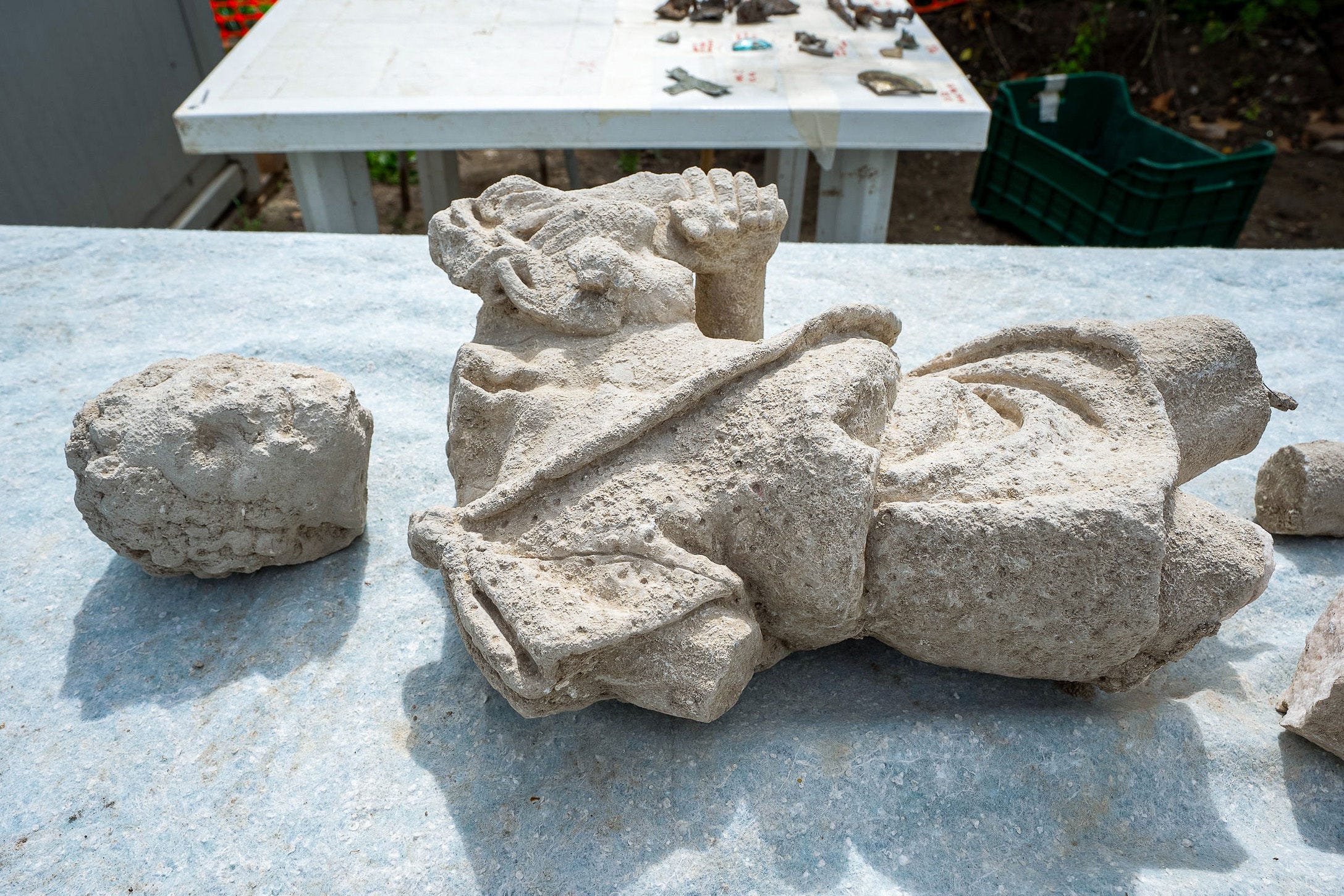
The statue is now under study, but archaeologists have suggested that it may depict Silvanus. In Roman religion, Silvanus was a rural deity connected with woods, fields, boundaries, flocks, and agricultural protection. Such a figure would fit well in a villa set within a productive rural estate.
Other interpretations may still be considered as research continues, but the connection with Silvanus is significant. A rural god placed in a wealthy countryside villa would have carried both religious and symbolic meaning. It would have reflected the agricultural identity of the estate while also serving as a marker of elite taste.
The statue also reinforces the high social status of the villa’s owners. Imported marble sculpture was expensive, and its presence in a suburban villa near Rome points to wealth, cultural ambition, and access to high-quality artistic production.
A villa connected to the elite world of Lorium
The location of the villa is one of the most important aspects of the discovery. Castel di Guido lies in the area of Lorium, a territory known from ancient sources and linked to imperial property.
Antoninus Pius is especially connected with Lorium. He was raised there and later had a residence in the area. He also died at Lorium in AD 161. Marcus Aurelius is known to have spent time there as well, and Hadrian had earlier connections with the region.
This historical background makes the new villa more than a local discovery. It adds another piece to the map of Rome’s western suburbs during the imperial period, when aristocratic and imperial residences were spread through the countryside along major roads.
The villa may have belonged to wealthy patricians or high-ranking Roman elites close to the imperial estate. Its mosaics, painted walls, marble sculpture, and architectural quality all support that possibility. Further excavation will be needed to clarify its full plan, chronology, and ownership.
A landscape changed by modern development
The area around Castel di Guido has changed significantly in recent decades, especially because of urban expansion around Rome. However, large sections beyond the Grande Raccordo Anulare still preserve rural landscapes and archaeological potential.
The Castel di Guido estate and the surrounding area of the Litorale Romano Nature Reserve remain important for understanding the countryside of ancient Rome. The new discovery shows that major archaeological remains can still survive outside the monumental center of the city.
Daniela Porro, Special Superintendent of Rome, emphasized that the discovery demonstrates the archaeological richness of Rome beyond the historic center. It also shows the importance of cooperation and rapid intervention in protecting cultural heritage.
Public access and restoration
The Soprintendenza Speciale di Roma announced that the site would be opened to the public through a free archaeological trek on June 20, 2026. Two guided visits were scheduled, one at 5:00 p.m. and another at 6:15 p.m.
The route was planned to last around one and a half to two hours and included a walk of approximately one kilometer to reach the excavation. Visitors were expected to see the remains of the villa and the mosaics undergoing restoration.
The event was designed to return the results of the excavation to the public and show how an operation that began with the prevention of illegal activity became an opportunity for research, conservation, and public engagement.
What this Roman villa reveals about life outside ancient Rome
The Castel di Guido villa is significant for several reasons. First, it reveals a previously undocumented imperial-period villa in the countryside west of Rome. Second, it adds new evidence to the study of Lorium, a district strongly linked with the Antonine emperors. Third, it preserves a high-quality decorative context, including mosaics, painted plaster, and marble sculpture.
The discovery also highlights the vulnerability of archaeological sites to illegal excavation. Without the initial report and rapid intervention, more of the villa could have been damaged or lost.
Instead, archaeologists were able to secure the area, record the remains, begin conservation, and open a new chapter in the study of Rome’s imperial countryside.
The villa’s final story is still being written. Future research may clarify when it was built, how long it remained in use, whether it changed function over time, and how closely it was connected to the imperial estates of Lorium. For now, the find offers a rare view of elite life, rural production, and artistic display on the edge of ancient Rome.
Sources:
Italian Ministry of Culture / Soprintendenza Speciale di Roma — official press release on the Castel di Guido discovery, published June 15, 2026.
Finestre sull’Arte — report with additional excavation context, including the illegal excavation timeline, decorative details, and the Lorium background.
Tabula Peutingeriana / KU Eichstätt database — background on ancient Lorium, its location along the Via Aurelia, and literary references connecting it with Antoninus Pius and Marcus Aurelius.