


Between about 23,500 and 21,700 years ago, people walked repeatedly across the muddy eastern edge of a lake in southern New Mexico. A study published on 14 October 2026 in Science Advances reconstructs what that landscape was doing while they walked, at intervals of roughly 50 years, and finds that it changed fast enough to be noticed within a single lifetime.
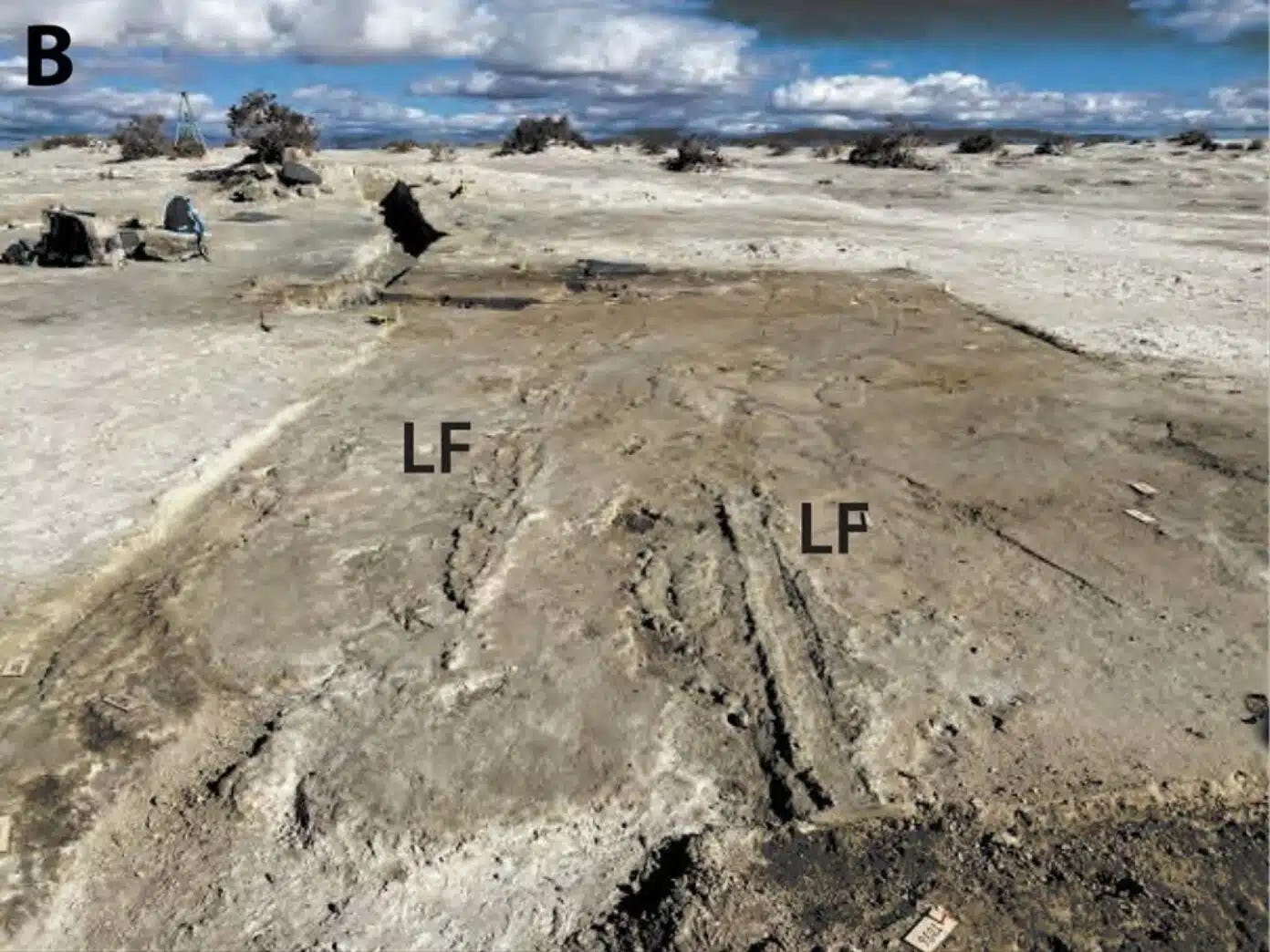
Possible travois drag marks at White Sands. Credit: K.B. Springer, USGS, in Springer et al., Science Advances (2026)
The paper has 15 authors. The first author is USGS research geologist Kathleen Springer, and her co-authors come from the US Geological Survey, the National Park Service, the University of Arizona, Bournemouth University and other institutions. It draws on expanded excavations at Locality 2 in White Sands National Park, the site the team regards as holding the oldest human footprints in the Americas.
Twenty footprint layers and 152 measured tracks
The team extended the trench first described in 2021. They found 20 stratigraphic horizons with human footprints preserved in place, together with megafauna trackways and linear marks attributed to travois. They measured 152 human footprints in the gypsum-rich sediment. The authors did not build profiles of individuals. They pooled the track data to make broad observations and caution that their estimates of the track-makers’ ages are only approximate.
The preservation is striking. Co-author Jessica Tierney of the University of Arizona said that after more than 20,000 years in gypsum mud the prints “look like someone walked out on the playa yesterday.”
The drag marks have a history of their own. Matthew Bennett of Bournemouth University led a study published in Quaternary Science Advances that described parallel and single-line drag traces at White Sands in February 2025. To test the idea, the team built replica travois and pulled them across mudflats in Dorset and on the coast of Maine, and the marks they left resembled the fossil traces. The new paper illustrates linear features on horizon TH2 and interprets them as travois pulled by people, probably while moving resources.
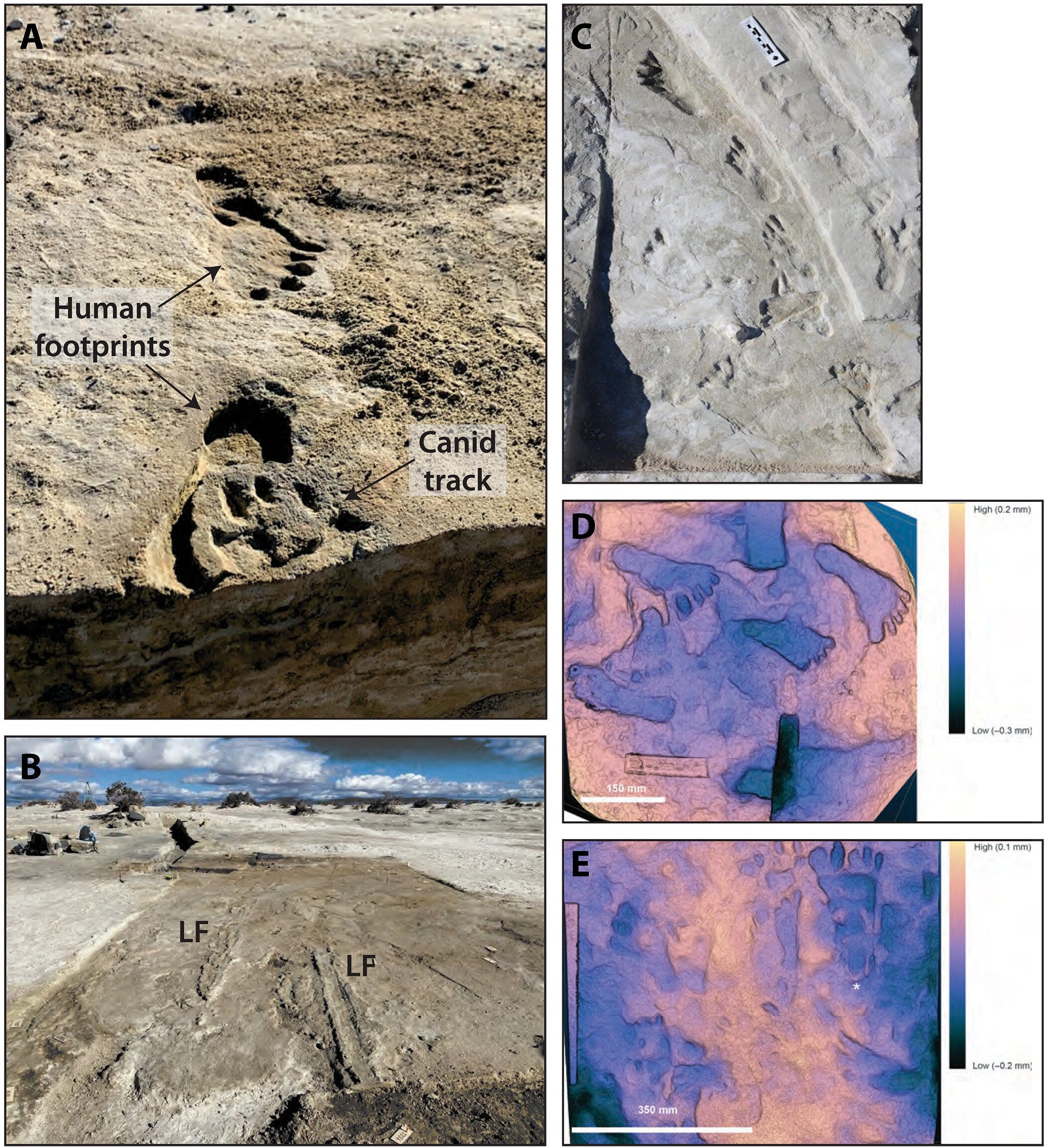
Human footprints and a canid track. Credit: Springer et al., Science Advances (2026)
Pollen dating narrows the age to 23,500 to 21,700 years
The 2021 dates came from seeds of the aquatic plant Ruppia. Critics argued that lake water carrying old dissolved carbon could make such seeds read too old. In 2023 the group published radiocarbon dates on terrestrial pollen from the same layers as the seeds, plus optically stimulated luminescence ages, and concluded the original chronology held.
The new study refines that pollen work. According to the University of Arizona, the team developed procedures to isolate up to 75,000 pollen grains per sample and refined its measurements at the USGS Radiocarbon Laboratory. The paper reports that the uncertainties on pollen radiocarbon ages at Locality 2 fell fivefold, which let the researchers test the accuracy of the Ruppia seed ages. Combining conifer pollen with aquatic seed ages puts the footprint-bearing sequence between 23.5 and 21.7 thousand years ago. That falls inside the Last Glacial Maximum, which Live Science dates to between 26,500 and 19,000 years ago.
The tighter chronology allowed the team to examine climate at roughly 50-year steps, about one human generation. The university describes that resolution as rare for land-based climate records of this age in the American Southwest.
Lake Otero retreated as forest gave way to oak and sagebrush
Around 24,200 years ago a large lake filled the basin, and the surrounding mountains carried pine, fir and spruce, Live Science reports from the study. Bennett and Sally Reynolds, both co-authors, wrote in The Conversation that average annual temperatures were then about 4°C below today’s.
From about 23,600 years ago temperatures rose and the lake began to shrink. Over the following two millennia conifer forest declined while oak and sagebrush spread.
Tierney’s group measured hydrogen isotopes in fossil leaf waxes and combined them with the pollen record to track temperature, rainfall and aridity. They found swings in water availability within a single century. At one point, according to the university, vegetation shifted from pine forest to pinyon and juniper in about 100 years. Pollen from Ruppia rises and falls through the sequence, showing that the lake level fluctuated over about 1,500 years before Lake Otero dried to a flat playa.
A drought around 23,200 years ago matches a Greenland warming event
The sharpest swing came around 23,200 years ago. Rainfall dropped, the lake grew saltier and drought-tolerant plants expanded, Bennett and Reynolds write. The paper links this major aridification to Dansgaard-Oeschger event 2 at 23.2 thousand years ago and says the drying shrank Lake Otero, opening the old shoreline to people for nearly two millennia. Dansgaard-Oeschger events are abrupt warmings recorded in Greenland ice cores.
The earliest footprint horizon in the expanded sequence sits close to that transition. Further horizons appear at intervals as the shoreline retreated. Springer said the people in the basin witnessed rapid environmental change within their own lifetimes. Tierney said aridity at White Sands tracked global climate shifts closely, and the team now wants to establish how warming over Greenland could have dried out the Southwest.
A computer model shows footprint layers record moments of preservation
Live Science reports that the researchers raised the possibility that people returned to the basin when a shrinking lake concentrated animals and plants. Bennett and Reynolds also set out why that reading needs care.
In August 2026 they published an agent-based computer model in the journal Fossil Studies. It simulates people moving around a fluctuating lake. Most tracks in the model fade from the mud, and a surface becomes fossil when rising water buries it at the right moment. Population size had comparatively little influence on how many footprints survived. The timing of climate swings, the shape of the basin and the way people moved across it mattered more.
When the authors compared the model with White Sands, the real footprint horizons appeared as irregular pulses clustered around periods of climatic and hydrological change, which matches the model’s prediction. Each horizon confirms that people were present at that moment. The gaps between horizons can hide times when people were also there, and a crowded surface can come from a handful of people crossing soft ground many times. “Footprints are snapshots, not a movie,” Bennett and Reynolds write.
Reynolds told Live Science that people continued to visit and live in the area through all these changes.
Co-author Ed Jolie connects the tracks to living Indigenous peoples
Ed Jolie, an anthropologist at the University of Arizona and associate curator of ethnology at the Arizona State Museum, is Oglala Lakota and Hodulgee Muscogee. In the university’s release he said the findings bring a human face to the deep Indigenous past of the Americas, and that these ancient populations are the ancestors of today’s Indigenous peoples.
Critics and supporters continue to test the White Sands dates
The dates still have critics. In a 2024 paper in PaleoAmerica, David Rhode and colleagues argued that hard-water effects in the dated plants, reworked pollen and partially bleached quartz grains could all push the ages too old. Pigati, Springer and colleagues replied in the same journal, rejecting each objection and declaring the Locality 2 chronology resolved.
In June 2025, Vance Holliday and colleagues published independent radiocarbon dates from new sites around the old lake in Science Advances, and their stratigraphy closely matched the earlier work. Live Science notes that the footprints remain debated because they are far older than most accepted sites in the Americas.
Subscribe for a few dollars a month and get every long read, the short documentaries and the full archive. Cancel anytime.
Sources:
Primary
Springer, K. B., Pigati, J. S., Tierney, J. E., Honke, J. S., Jiménez-Moreno, G., Bustos, D., Urban, T. M., Odess, D., Jolie, E. A., Smith, A. J., Hunt, A. J., Martinez, P. J., Santucci, V. L., Reynolds, S. C. and Bennett, M. R. (2026). Humans experienced abrupt environmental changes at White Sands during the Last Glacial Maximum. Science Advances 12(42). Published 14 October 2026. DOI 10.1126/sciadv.aeh0707
Springer, K. B., Pigati, J. S., Tierney, J. E. et al. (2026). Data release for Humans experienced abrupt environmental changes at White Sands during the Last Glacial Maximum. U.S. Geological Survey. DOI 10.5066/P13W7HTM (CC0)
Bennett, M. R. and Reynolds, S. C. (2026). Tracks of Coincidence. How Climate and Human Presence Shape the Fossil Footprint Record. Fossil Studies 4(3), 22. Published 11 August 2026. DOI 10.3390/fossils4030022
Earlier White Sands studies and the dating debate
Bennett, M. R. et al. (2021). Evidence of humans in North America during the Last Glacial Maximum. Science 373, 1528–1531. DOI 10.1126/science.abg7586
Pigati, J. S. et al. (2023). Independent age estimates resolve the controversy of ancient human footprints at White Sands. Science. DOI 10.1126/science.adh5007
Rhode, D., Neudorf, C. M., Rachal, D., Davis, L. G., Madsen, D. B. and Dello-Russo, R. (2024). Unresolved. Persistent Problems with the White Sands Locality 2 Geochronology. PaleoAmerica
Pigati, J. S., Springer, K. B., Gray, H. J., Bennett, M. R. and Bustos, D. (2024). The geochronology of White Sands Locality 2 is resolved. PaleoAmerica 10(1), 28–44. DOI 10.1080/20555563.2024.2376298
Holliday, V. T., Windingstad, J. D., Bright, J., Phillips, B. G., Butler, J. B., Breslawski, R. and Bowman, J. E. (2025). Paleolake geochronology supports Last Glacial Maximum (LGM) age for human tracks at White Sands, New Mexico. Science Advances 11(25), eadv4951. DOI 10.1126/sciadv.adv4951
Bennett, M. R., Urban, T. M., Bustos, D. F., Reynolds, S. C., Jolie, E. A., Strehlau, H. C., Odess, D., Springer, K. B. and Pigati, J. S. (2025). The ichnology of White Sands (New Mexico). Linear traces and human footprints, evidence of transport technology? Quaternary Science Advances 17, 100274
Secondary
University of Arizona (14 October 2026). Footprints in the (white) sand. Humans experienced abrupt environmental shifts during the last ice age. EurekAlert. https://www.eurekalert.org/news-releases/1147806
Bennett, M. R. and Reynolds, S. C. (October 2026). Early humans in America endured climate chaos, new research. The Conversation, republished by Mirage News. https://www.miragenews.com/early-americans-endured-climate-chaos-study-1761173/
Pester, P. (14 October 2026). Ancient Indigenous people in New Mexico lived through extreme climate change 23,000 years ago, study suggests. Live Science
The timeline of human history in the Americas continues to be extended further into the past.
I find these discoveries absolutely fascinating!
There's something extraordinary about looking at a footprint made more than 20,000 years ago and realizing that somebody was simply going about their day, completely unaware that we'd be examining the evidence thousands of generations later.
The possible travois marks are intriguing, too. We spend so much time discussing when people arrived in the Americas that it's easy to overlook what their everyday lives might actually have looked like.
And the idea that the landscape was changing noticeably within a single human lifetime makes these people seem considerably less remote.
Wonderful research, and thank you for bringing it to our attention!