


On weathered granite outcrops scattered across the coast and river valleys of northern Portugal and southwest Galicia, prehistoric people pecked images of boats into the stone.
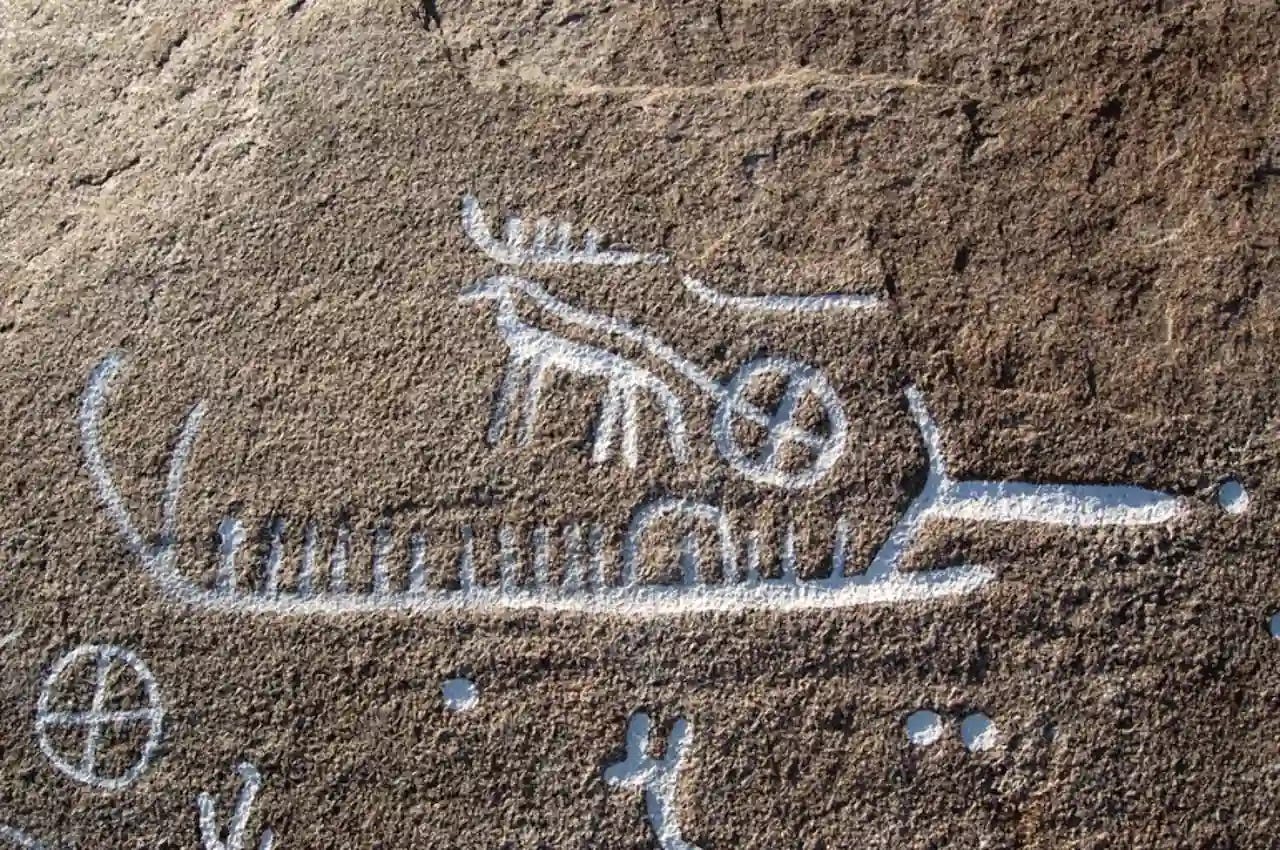
Ship carvings at Kelleby. Credit: Gerhard Milstreu.
For decades these carvings drew far less attention than the spectacular boat art of southern Scandinavia, where more than 20,000 ship images survive. Now a new study argues that the two traditions, separated by some 3,000 kilometers of Atlantic coastline, are unmistakably related, and that the resemblance points to a Bronze Age Europe knit together by long-distance seafaring far tighter than once assumed.
The research, led by Durham University’s Department of Archaeology and published on June 9, 2026, in the open-access journal PLOS ONE, compared boat petroglyphs at sites in Northwest Iberia with the well-documented corpus of Nordic ship carvings in Sweden and Denmark. Its central finding is that the vessels share a precise vocabulary of design, down to details that would be hard to explain by coincidence.
A shared design language
When the team set the Iberian carvings beside their Scandinavian counterparts, the same distinctive features kept appearing in both. The boats carry matching end-ship decorations, including bird shapes and s-shapes at prow and stern. They show rigging, oars, masts, and sail-like elements rendered in comparable ways. In several cases the parallels are nearly identical, such as a “mushroom” or “cult-axe” shape placed at the center of the vessel that recurs in the same position in both regions.
To the researchers, this is not a matter of two cultures independently drawing boats in roughly similar ways. The specificity of the overlap suggests that ideas, symbols, and shipbuilding knowledge were moving across Europe along maritime routes. As the team frames it, the carvings record technologies and beliefs being shared between distant coastal communities rather than invented separately in each place.
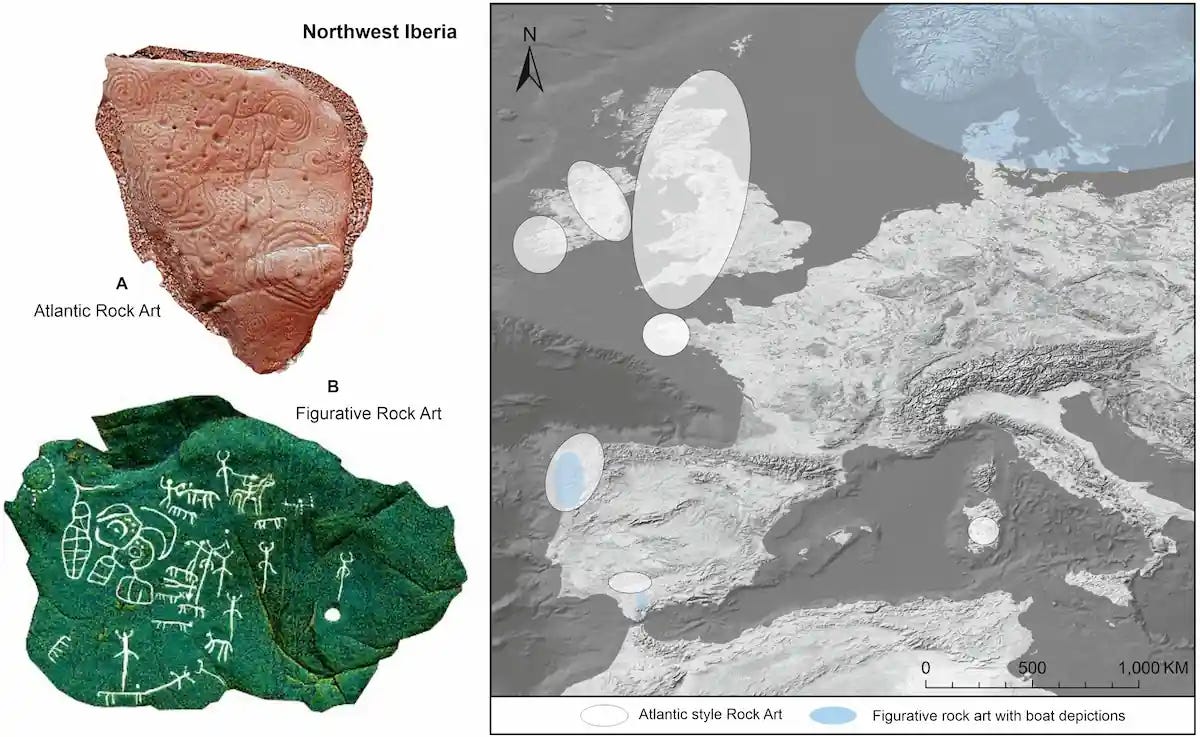
Examples of Atlantic and Figurative rock art traditions in northwestern Iberia: (A) Tapada do Ozão, Valença, and (B) Monte de Porreiras 6, Paredes de Coura, Portugal. Credit: Luís Coutinho / Marta Díaz-Guardamino.
How the carvings were dated
The Iberian boat art has long resisted firm dating, because rock carvings rarely sit in contexts that can be pinned to a calendar. The Scandinavian material, by contrast, is anchored by securely dated finds, including ship images on bronze objects and on stone slabs from closed grave contexts. The accepted Nordic chronology uses the shape of a boat’s two end-ships as its main dating criterion, tracing the tradition across the Bronze Age from roughly 1700 to 500 BCE.
By matching the Iberian vessels to these dated Scandinavian forms, the team proposed a Late Bronze Age range of about 1300 to 800 BCE for the Iberian carvings. That placement is significant, because it lines the Iberian images up chronologically with known Nordic maritime technology, and with a period when Atlantic exchange networks were intensifying. The dating holds, the authors note, whether the engravings were left by visiting foreign crews or by local sailors who had adopted foreign naval technology. Either way, the communities of Northwest Iberia were plainly enmeshed in expansive, long-distance maritime networks.
Boats placed in a watery landscape
Alongside the iconography, the team studied where the carvings sit. Using high-resolution 3D laser scanning and photogrammetry, they built detailed digital models of the Iberian panels, then used Geographic Information Systems to map each site and analyze its relationship to coastlines, rivers, and estuaries.
The pattern was consistent. Almost every Iberian boat-art site lay near the sea or a river, or was positioned so that water was visible from it. Even sites deep inland kept a clear visual or physical link to navigable water. At one upland location in southern Galicia, more than 100 kilometers from the coast, the carved panels still command views over the creeks and river below. The placement looks deliberate, the researchers argue, as though these were meant to be maritime places, set apart from ordinary domestic life and tied to the routes of seafarers.
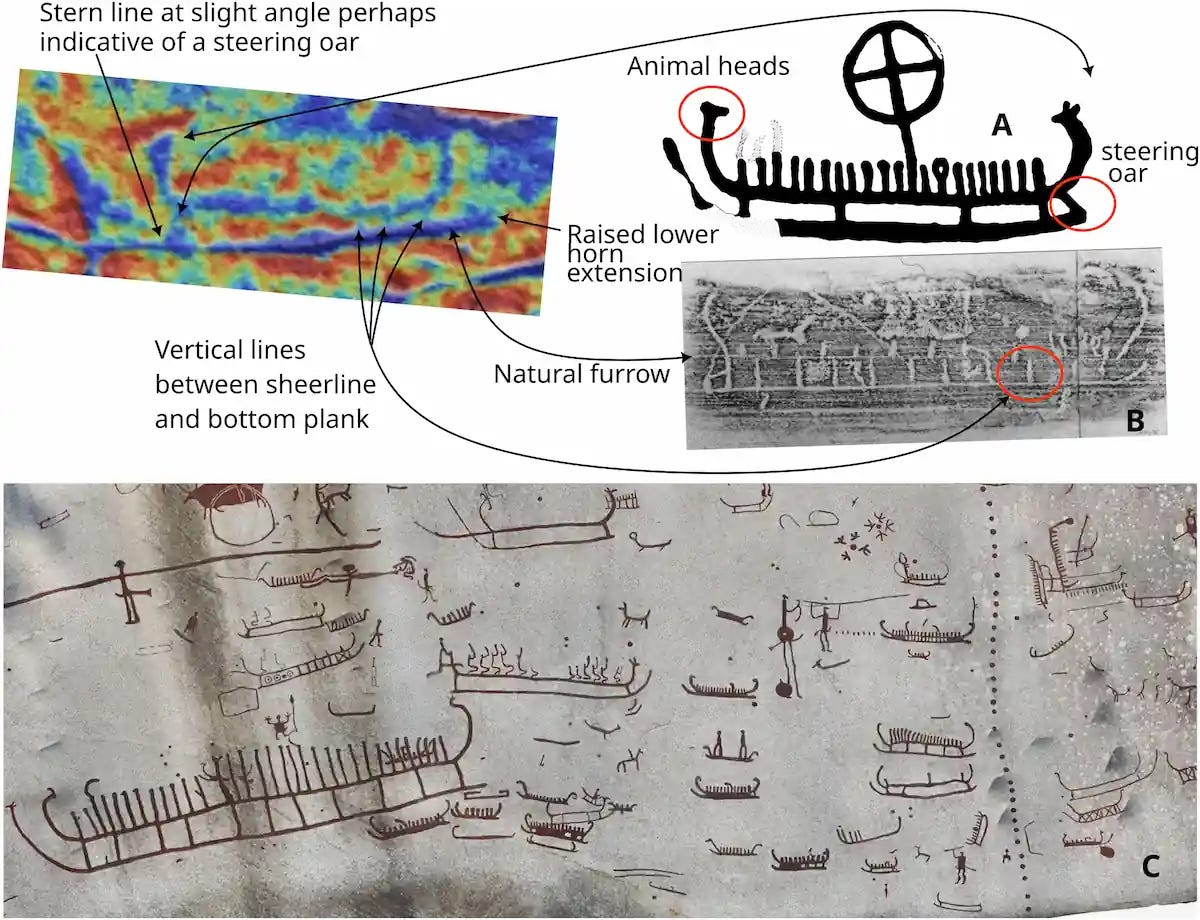
Boat 3 from Panel 2 at Santo Adrião, showing details that closely parallel southern Scandinavian boat imagery: (A) boat carving from Bottna, western Sweden, (B) rubbing of a boat carving from Himmelstalund, eastern Sweden, and (C) part of a rock art panel from Tanum, western Sweden. Credit: Boel Bengtsson.
Sun crosses and a shared mythology
The connection may run deeper than trade and technology. On both the Iberian and the Scandinavian panels, the team identified cosmological motifs accompanying the ships, in particular sun crosses placed near or even inside boats. In Scandinavian rock art the pairing of vessels and solar symbols is common, and has been linked to the importance of the sun in navigation and belief. Finding the same association in Iberia hints at a shared focus on solar mythology, and suggests that boats in this art were not merely transport but carried symbolic weight bound up with ritual and cosmology.
A review cited in the study found that sun crosses, known in Portugal as segmented circles, are relatively common in Northwest Iberia, with more than 100 depictions across twenty-nine rock art sites. At Laje da Churra in northern Portugal, a sun cross overlays the hull of one carved boat, echoing Scandinavian examples where solar signs ride inside the vessels.
Metals, trade, and a connected Bronze Age
Behind the carvings lies a question about metals. The Late Bronze Age saw copper, silver, and probably tin moving across Atlantic Europe, and Northwest Iberia sat at a junction of those flows, channeling goods from southern Iberia outward toward western France, southern England, and the north Atlantic, and onward to Scandinavia. Boats were the means by which that economy functioned, and the shared ship imagery fits neatly with the idea of Iberia as a hub mediating Atlantic exchange.
Some of the boat depictions, the authors suggest, may even record local communities trying to make sense of foreign travelers arriving in an era of early “globalization.” Whether Nordic crews physically reached these Atlantic shores, or whether local sailors absorbed northern designs through down-the-line contact, the carvings testify that the people of Bronze Age Iberia were looking outward across the water.
The broader message is that Bronze Age communities were far less isolated than the old picture allowed. Maritime travel carried not just cargo but cultural ideas across thousands of kilometers, leaving a trace in stone that we are only now reading clearly, with the help of lasers, 3D models, and a careful eye for the shape of an ancient prow.
Sources. Durham University; Díaz-Guardamino M, Bengtsson B, Newton E, Bettencourt AMS, Ling J, Latorre-Ruiz J, et al. (2026) “Boats on the rocks. Late prehistoric nautical iconography and landscape, from Northwest Iberia to Scandinavia.” PLOS ONE 21(6), e0349417. doi.org/10.1371/journal.pone.0349417