


A new study of Homo naledi has added fresh detail to one of the most debated questions in human evolution: how much can brain size really tell us about behavior?
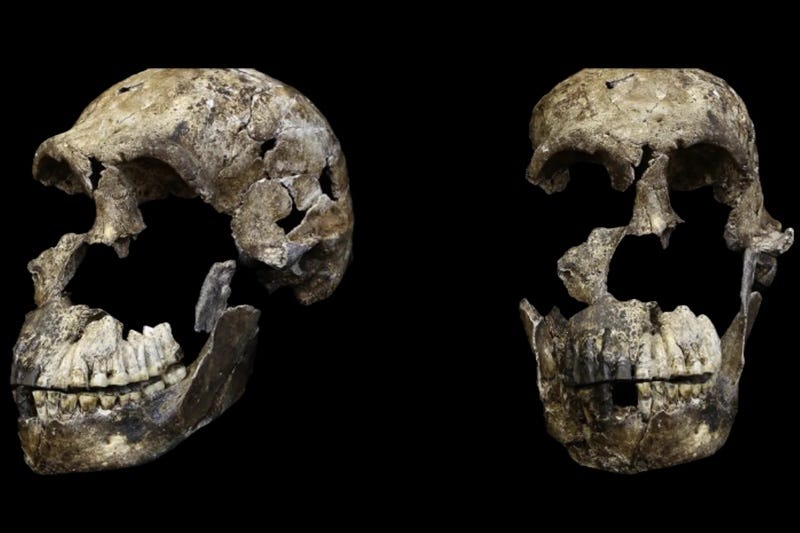
Despite its small size, the brain of Homo naledi may have been organized to support more complex cognitive abilities. Credit: Wikimedia Commons.
The research, published in Brain Structure and Function, examined the brain structure of Homo naledi, the extinct hominin discovered in South Africa’s Rising Star cave system. Although Homo naledi had a brain much smaller than that of modern humans, the new work suggests that parts of its frontal lobe had a more human-like organization than its overall brain size would suggest.
The most discussed finding concerns the inferior frontal gyrus, or IFG, a brain region associated in modern humans with language, planning, vocal production, and tool use. In the reconstructed Homo naledi endocast, this region appears relatively expanded and anatomically derived. That finding does not prove that Homo naledi had language, buried its dead, or made symbolic art. But it does show that its brain was not simply primitive because it was small.
A small-brained hominin at the center of a major debate
Homo naledi was announced in 2015 after the discovery of an unusually large collection of fossils in the Rising Star cave system, part of the Cradle of Humankind in South Africa. The remains were recovered from deep underground chambers, especially the Dinaledi Chamber, where hundreds of bones belonging to multiple individuals were found.
The species immediately drew attention because of its strange combination of traits. Its hands, feet, teeth, shoulders, body proportions, and skull showed a mosaic of primitive and more human-like features. Some parts looked unexpectedly modern, while others seemed closer to earlier hominins.
One of the most striking features was brain size. The known Homo naledi endocasts show endocranial volumes in the range of roughly 465 to 610 milliliters. That is much smaller than the average modern human brain and closer in absolute size to some earlier hominins.
This created a major interpretive problem. Homo naledi’s fossils were later dated to between about 335,000 and 236,000 years ago, meaning the species lived surprisingly late, at a time when early Homo sapiens were also emerging in Africa. A small-brained hominin was therefore living in the same broad period as larger-brained humans.
The Rising Star cave system
The Rising Star cave system lies in South Africa’s Cradle of Humankind, a region famous for its rich fossil record. The Homo naledi remains were found in deep chambers that are difficult to access, with narrow passages, vertical drops, and areas without natural light.
The context of the fossils has been central to the debate. Some researchers have argued that Homo naledi deliberately entered the cave system and placed dead individuals in remote chambers. If correct, that would represent a form of mortuary behavior far earlier than many scholars once expected for a small-brained hominin.
The claim remains controversial. Critics have questioned whether the evidence is strong enough to demonstrate intentional burial or funerary behavior. Other researchers argue that geological, taphonomic, and spatial evidence supports deliberate body disposal in the cave.
Because of this debate, Homo naledi’s brain has become especially important. If the species really carried bodies into dark, difficult cave spaces, researchers want to understand whether its brain anatomy could have supported planning, navigation, cooperation, memory, and complex action sequences.
What is an endocast?
The new study focuses on endocasts. An endocast is a cast or digital reconstruction of the inner surface of the skull. Since the brain presses against the inside of the cranial bones during life, the inner skull surface can preserve traces of brain shape, blood vessel impressions, and some surface anatomy.
Endocasts do not preserve the brain itself. They cannot reveal thoughts, intelligence, language, or behavior directly. But they are one of the few ways researchers can study the brains of extinct species.
For Homo naledi, endocasts are especially valuable because several partial crania are available. Earlier work reconstructed endocasts from Dinaledi Chamber skull fragments. The new 2026 study focused especially on the more complete Lesedi Chamber skull, known as LES1.
LES1 is associated with the partial skeleton nicknamed Neo, meaning “gift” in Sesotho. The specimen is one of the most complete Homo naledi individuals yet found and provides the best opportunity to reconstruct the overall shape of the species’ brain.
Reconstructing the Homo naledi brain
The study was carried out by Zachary Cofran, Shawn Hurst, and John Hawks. The authors used geometric morphometric methods to reconstruct the full shape of the LES1 endocast and compare it with modern humans and fossil hominins.
Because the fossil is incomplete, the team did not rely on a single reconstruction. Instead, they used multiple reference specimens and statistical methods to estimate missing regions. This approach allowed them to test how sensitive the results were to missing data and different reconstruction assumptions.
The comparative sample included 80 adult modern humans and 13 fossil hominin specimens, including Homo habilis, Homo rudolfensis, African Homo erectus, Indonesian Homo erectus, and Australopithecus africanus.
The goal was not simply to measure brain size. The researchers wanted to understand brain shape and organization, especially in areas that may relate to cognition, planning, tool use, and social behavior.
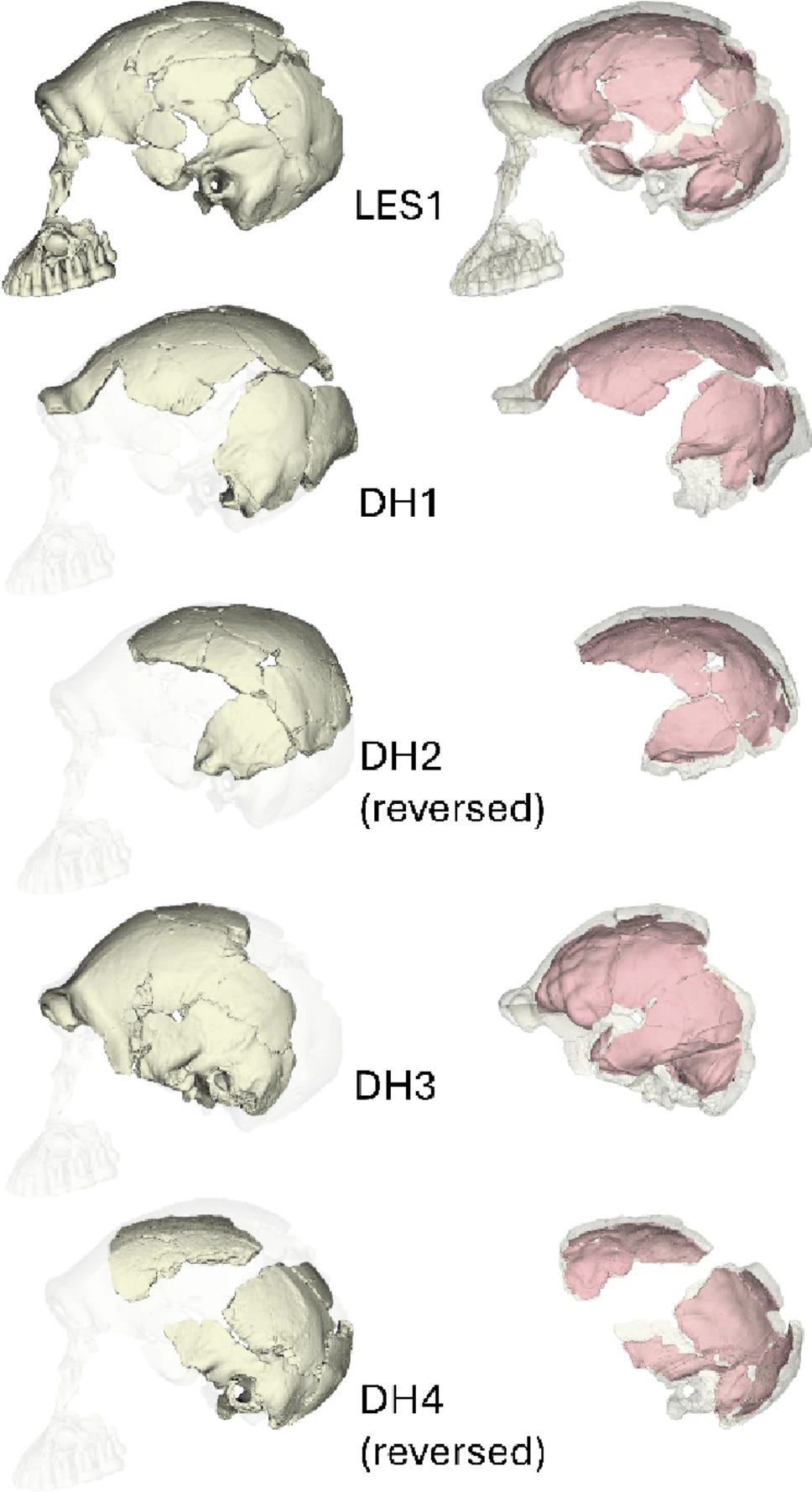
Partial skulls of Homo naledi shown on the left, with reconstructed endocasts on the right. The fossils are scaled to a similar visual size and aligned to the same antero-posterior anatomical position as LES1. DH2 and DH4 preserve the right side of the skull and are mirrored here for comparison.
A brain close in size to early Homo
The LES1 endocast has an estimated volume of around 610 milliliters. That is larger than the smaller Dinaledi Chamber estimates, but still small compared with modern humans.
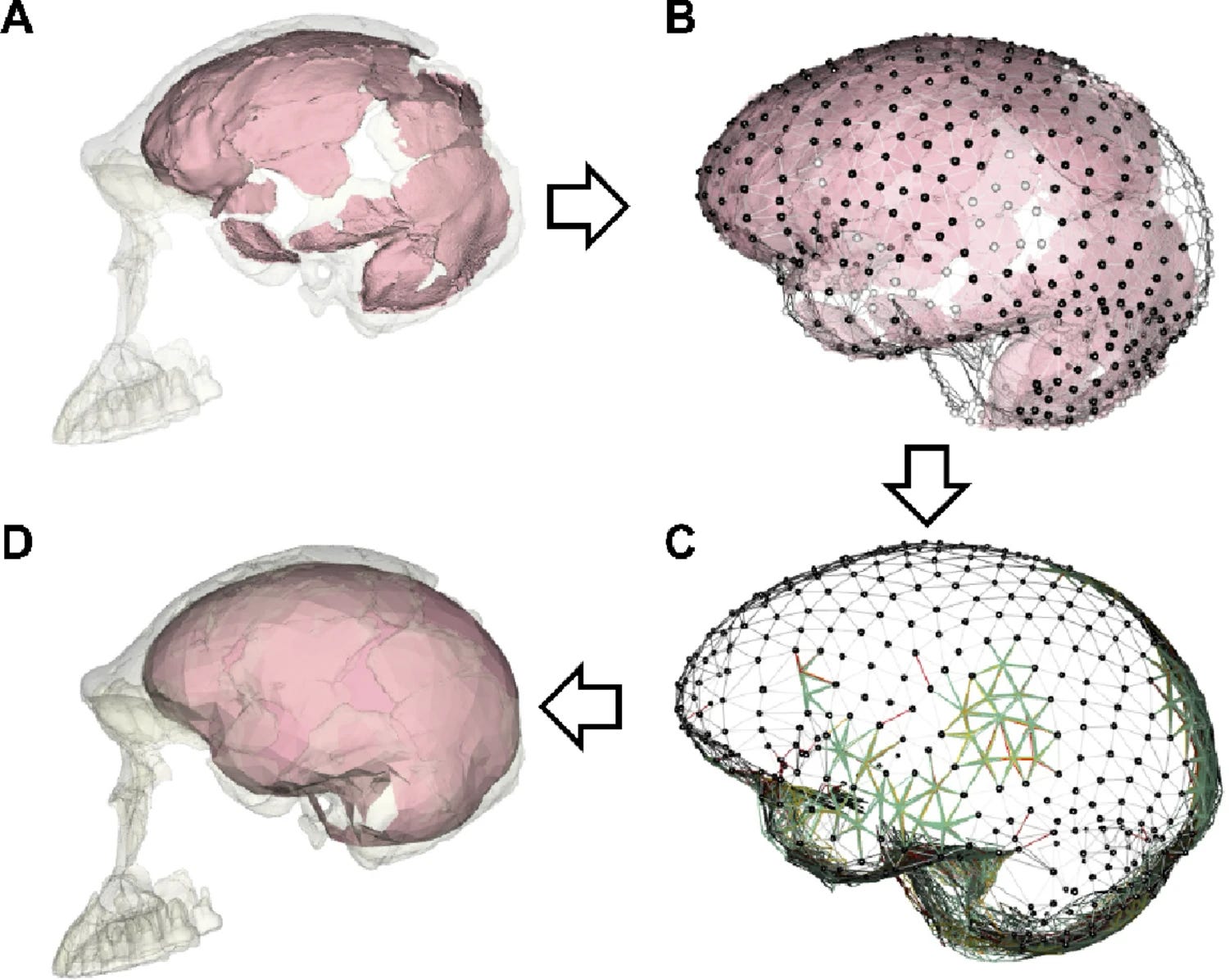
Virtual reconstruction workflow for the LES1 endocast. The figure summarizes how multiple endocast reconstructions and endocranial volume estimates were produced. From top left, moving counterclockwise: A: the original LES1 cranium in left lateral view, with the preserved endocranial surface highlighted in pink. B: the landmark and semilandmark template shown over the preserved, mirror-imaged LES1 endocast; preserved points are shown in black and missing data in white. C: the full landmark template with fossil-based reconstructions of missing regions shown as color-coded wireframes according to reference fossil group. D: the solid triangle mesh representing the average LES1 virtual reconstruction inside the endocranial cavity.
The study found that Homo naledi’s absolute brain size was broadly comparable to some of the earliest fossil members of Homo. Its relative brain size, however, remained closer to australopith-like levels when considered against body size.
This is one reason Homo naledi is so interesting. It lived late in human evolution but retained a small brain. At the same time, its brain shape does not fit a simple primitive category.
The researchers emphasize that brain size alone is not enough to understand cognition. A larger brain can support more neurons and expanded networks, but organization also matters. Homo naledi forces researchers to separate the question of size from the question of structure.
A unique combination of ancestral and derived traits
The new study supports earlier findings that Homo naledi had a mixture of ancestral and derived brain features.
On one hand, its total brain size, cerebro-cerebellar proportions, and some aspects of morphology remained primitive compared with later Homo species. On the other hand, parts of the frontal lobe appear more derived and closer to the condition seen in humans and other later Homo lineages.
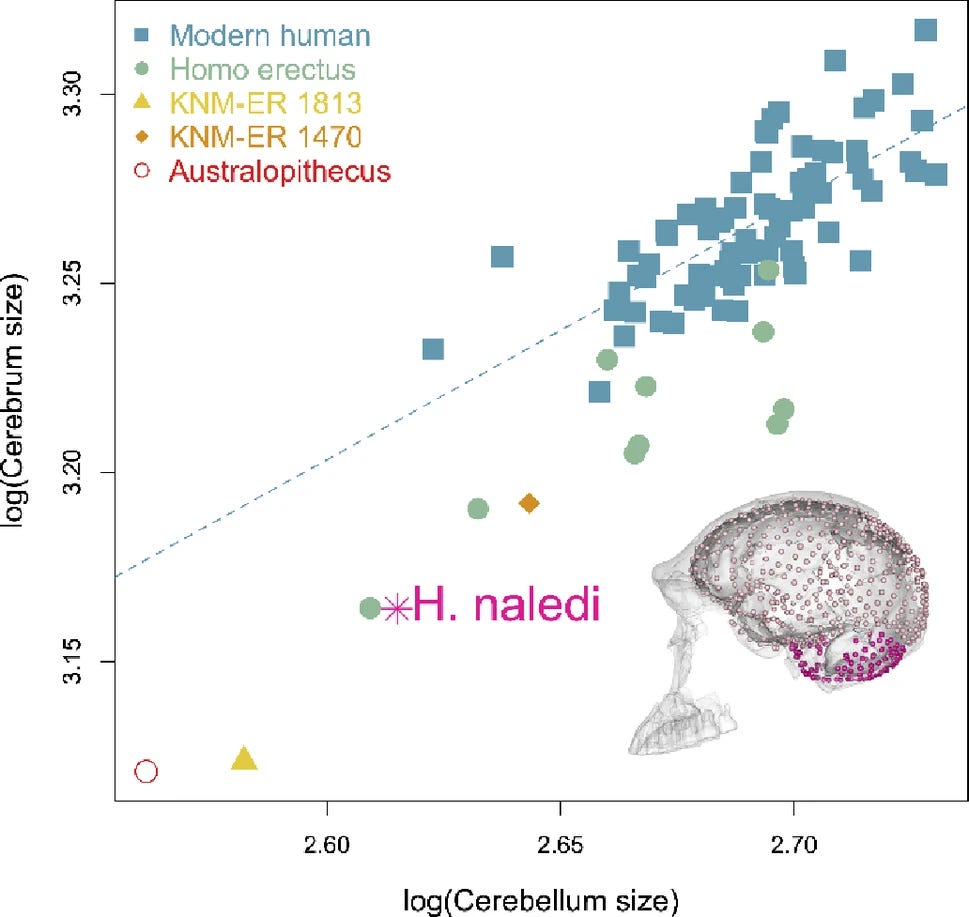
Comparison of cerebellar and cerebral size in Homo naledi and other samples. The two variables represent the log10 centroid sizes of landmark sets covering the cerebrum and cerebellum, shown on the LES1 endocast inset. The regression line is based only on the adult human sample, while colors and symbols follow the same sample categories used in the other figures.
This combination is important. Homo naledi was not simply an old-fashioned species surviving late with an unchanged ancestral brain. Its brain anatomy had its own evolutionary pattern.
The authors describe Homo naledi as having a derived frontal lobe while retaining ancestral brain size and proportions. That means its brain may have been reorganized in certain areas without undergoing the large-scale expansion seen in modern humans or Neanderthals.
The inferior frontal gyrus
The most important region discussed in the study is the inferior frontal gyrus, or IFG.
In modern humans, the IFG includes Brodmann areas 44 and 45. These areas are involved in spoken language and are also recruited during stone tool production. The IFG is one of the major regions where human brains differ morphologically from those of other apes.
In apes, the corresponding areas are usually arranged differently, often divided by a fronto-orbital sulcus. In humans, expansion and reorganization of the prefrontal cortex changed the position and configuration of these areas.
The Homo naledi endocast suggests that its IFG was relatively enlarged and anatomically derived. In other words, this small-brained hominin had a frontal-lobe configuration that appears more human-like than expected for its brain size.
This is the finding that has drawn attention because of its connection with language, toolmaking, and advanced action planning.
What an enlarged IFG might mean
An enlarged or derived IFG does not mean Homo naledi had language in the modern human sense. It also does not prove that the species created rock art or performed ritual burials.
The authors are careful about this point. Brain anatomy can suggest possible capacities, but it cannot directly prove behavior. The IFG is involved in many functions, including vocal production, sequencing, planning, and tool use. Its morphology may indicate neural systems capable of organizing complex actions.
The study proposes that Homo naledi’s enlarged orbitofrontal region and derived IFG anatomy could have supported behaviors that required imagining an outcome, planning a sequence, and carrying out extended actions.
That is an important but cautious interpretation. It gives researchers a biological reason to consider complex behavior plausible, but the evidence for any specific behavior must still come from archaeology.
Tool use and the missing archaeological record
One question remains unresolved: what tools did Homo naledi make or use?
Hand bones of Homo naledi suggest strong manipulative abilities, and recent research has argued that bone structure in the fingers may reflect habitual stone tool production or use. Yet no clear stone tool industry has been securely tied to Homo naledi inside the Rising Star cave system.
This creates another puzzle. The anatomy suggests the species may have been capable of tool-related behavior. Its brain organization may also fit with planning and action sequencing. But the archaeological signature remains uncertain.
It is possible that Homo naledi made tools elsewhere, outside the cave system, and that these tools have not yet been identified. It is also possible that tools in the broader Middle Stone Age landscape were made by more than one hominin species.
This uncertainty matters because researchers often assign stone tools to Homo sapiens by default when they come from the right period. Homo naledi shows why such assumptions can be risky.
Burial claims and the brain debate
The most controversial question surrounding Homo naledi is whether it deliberately disposed of its dead.
Some researchers argue that bodies were repeatedly carried into the dark zone of Rising Star cave and placed in chambers or shallow pits. If true, this would suggest that a small-brained hominin engaged in behavior involving memory, social meaning, and planned movement through a difficult underground environment.
Others remain cautious. They argue that the evidence does not yet prove intentional burial in the strictest sense and that more work is needed to rule out alternative explanations.
The new brain study does not settle this debate. Cofran and colleagues emphasize that whether Homo naledi buried its dead is primarily an archaeological question. Endocasts can inform discussions of anatomy and possible neural capacity, but they cannot by themselves demonstrate funerary behavior.
This distinction is crucial. The study adds nuance, but it does not turn a debated archaeological claim into a proven one.
Why brain size is not the whole story
The Homo naledi case challenges a long-standing assumption: that small brains necessarily mean simple behavior.
Modern humans have large brains, and brain expansion is a major feature of human evolution. But size is not the only variable. Brain organization, regional specialization, connectivity, development, and life history all matter.
Homo naledi appears to have combined a small brain with some derived frontal-lobe features. This shows that evolutionary change in the brain did not always happen through overall enlargement.
A small brain could still be reorganized in ways that affected behavior. Conversely, a large brain does not automatically reveal specific behaviors without archaeological evidence.
This is why Homo naledi has become such an important species for paleoneurology. It forces scientists to ask more precise questions about what brain fossils can and cannot tell us.
A comparison with Homo erectus
One of the notable observations from the new study is that the LES1 endocast appears most similar in shape to some fossils attributed to Indonesian Homo erectus.
This does not mean Homo naledi was simply a small version of Homo erectus. The authors explicitly reject that idea. Instead, they describe Homo naledi as having a distinctive combination of features: some ancestral, some more aligned with later members of Homo.
This comparison matters because Homo erectus is often seen as a major stage in the evolution of human body form, brain expansion, dispersal, and tool-related behavior. If Homo naledi’s brain shape resembles aspects of Homo erectus while retaining its own unusual features, it may represent a separate evolutionary experiment within the genus Homo.
The result complicates any simple linear story of human brain evolution.
The role of the orbitofrontal region
The study also draws attention to the orbitofrontal region, a part of the frontal lobe associated in modern humans with decision-making, evaluation, social behavior, and flexible responses.
In Homo naledi, this region appears relatively enlarged. Together with the derived IFG anatomy, this suggests that some frontal systems may have been more developed than overall brain size would predict.
The authors cautiously suggest that these neural substrates could have supported advanced behaviors involving planning and the execution of long action sequences.
That phrase is important. It does not specify language, ritual, or symbolic behavior. It points more generally to the ability to organize behavior over time.
For a species that may have entered deep cave chambers, such capacities would be relevant, though still not direct proof of the most debated claims.
What endocasts cannot tell us
Endocasts are powerful but limited.
They can preserve information about overall brain size, broad shape, asymmetry, and some surface impressions. They can sometimes show the location of major sulci and regions related to the frontal, parietal, or occipital lobes.
But they cannot show neural circuits, cell types, neurotransmitters, detailed internal organization, or actual behavior. They cannot tell us whether Homo naledi spoke, what it understood, what it intended, or whether it had symbolic thought.
This is why the authors repeatedly emphasize caution. The connection between fossil brain shape and behavior is indirect. Researchers must combine endocast data with anatomy, archaeology, cave context, taphonomy, dating, and comparative neuroscience.
Homo naledi’s brain may have been more complex than expected, but that conclusion must be kept separate from stronger claims about specific cultural practices.
A species living near the origin of Homo sapiens
The age of Homo naledi adds another layer to the discussion.
The fossils from the Dinaledi Chamber have been dated to between about 335,000 and 236,000 years ago. This places Homo naledi in the Middle Pleistocene, close to the period when early Homo sapiens were emerging in Africa.
This means that Africa at the time was not occupied by a single human form. Instead, different hominin species and populations may have lived side by side or at least in overlapping time ranges.
Homo naledi, with its small brain and unusual anatomy, shows that late Middle Pleistocene Africa contained more evolutionary diversity than once assumed.
The possibility that Homo naledi existed alongside early Homo sapiens makes the question of its behavior even more important. It raises the possibility that multiple human-like species contributed to Africa’s archaeological record.
A broader view of human evolution
The new study fits into a larger shift in paleoanthropology.
Older models often treated human evolution as a gradual line moving from small brains to large brains, from simple tools to complex culture, and from archaic bodies to modern humans. Discoveries like Homo naledi undermine that simple ladder.
Instead, evolution appears branching, mosaic, and uneven. Different species evolved different combinations of traits. Some had modern-looking hands and small brains. Others had large brains but different body forms. Some may have shared landscapes and perhaps behaviors.
Homo naledi is a strong example of mosaic evolution. Its body, brain, and chronology do not fit neatly into older expectations.
The 2026 brain study reinforces this point by showing that even a small-brained hominin could have a derived frontal lobe architecture.
The question remains open
The central lesson of the study is caution with openness.
Homo naledi had a small brain, but not a simple one. Its brain anatomy included features that may relate to planning, tool use, vocal behavior, and complex sequencing. At the same time, endocasts alone cannot prove what the species actually did.
The archaeology of Rising Star Cave must continue to answer the behavioral questions. The brain evidence adds context, but the claims about burial, fire use, toolmaking, and symbolic behavior still depend on material evidence.
For now, Homo naledi remains one of the most challenging discoveries in human evolution: a small-brained hominin living surprisingly late, with a brain organized in unexpected ways, and a cave context that continues to generate debate.
The new study does not close the discussion. It sharpens it.
Sources:
The main study is Zachary Cofran, Shawn Hurst, and John Hawks, “Brain structure and function in Homo naledi,” published open access in Brain Structure and Function in 2026. The paper reports that Homo naledi’s endocasts show a unique combination of ancestral and modern human-like characteristics, including a derived frontal lobe while retaining small brain size and ancestral proportions.
IFLScience’s 22 June 2026 article summarizes the public-facing significance of the study, including Cofran’s comments that the reconstructed Homo naledi endocast resembles Indonesian Homo erectus in some respects but is not simply a scaled-down Homo erectus brain
The 2017 eLife dating study established that Homo naledi fossils from Rising Star are most likely between 236,000 and 335,000 years old, placing the species surprisingly late in human evolution and broadly contemporary with early Homo sapiens in Africa.
The Australian Museum identifies LES1 as a relatively complete Homo naledi skull from the Lesedi Chamber, nicknamed Neo, with an estimated brain size of about 610 ml.
The other great apes have smaller brains than modern humans because they are mostly vegetarian. Large brains need lots of calories. When calories are scarce large brains are selected against. This may have been a factor in Neanderthal extinction.
Avian dinosaurs mostly fly, and their brains have been subject to millions of years of selection for aerodynamics. Thus despite their relatively small brain size, tool making has been observed in corvids. They can also recognize individual humans even through clothing changes. So small brain size doesn't mean less intelligence.
So H. Naledi may have been an intelligent vegetarian, and the associated technology may have been plant based, and just didn't survive the ages.