


Eight fossil teeth from two caves in Guangxi, southern China, show that Homo erectus was still living on the Asian mainland between about 324,000 and 184,000 years ago, and that it lived there in tropical rainforest. The results came out in two papers in Nature on 18 November 2026. The international team was led from the Institute of Vertebrate Paleontology and Paleoanthropology (IVPP) of the Chinese Academy of Sciences in Beijing, Macquarie University in Sydney and Southern Cross University in Lismore.
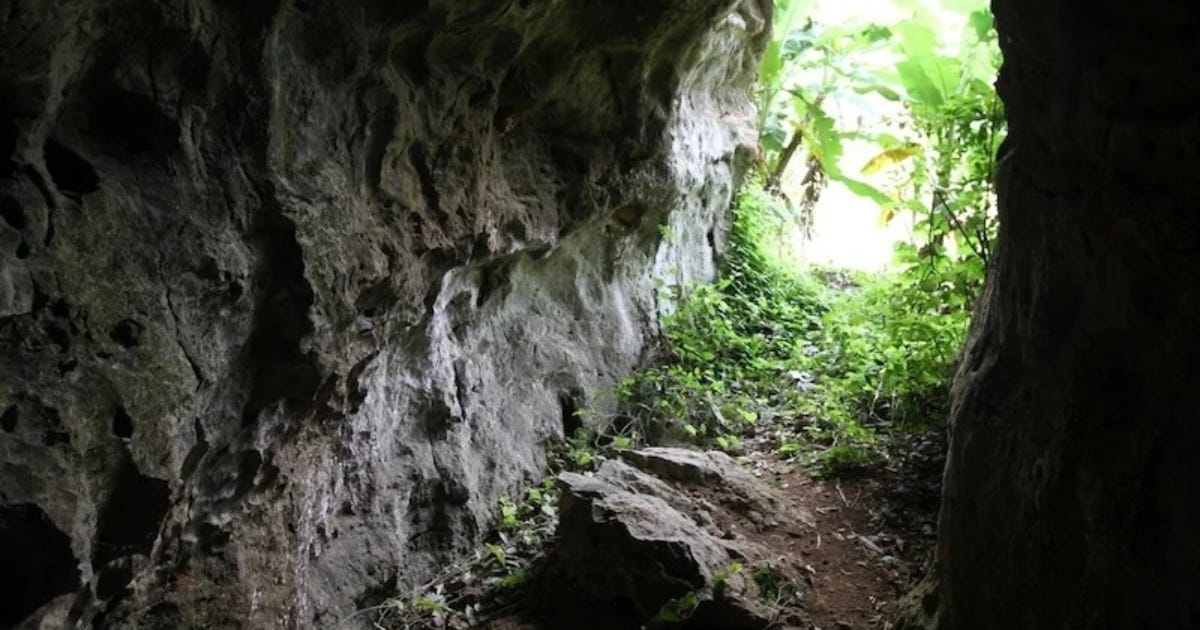
Naxian Cave in Guangxi, southern China. Credit Kira Westaway/Macquarie University
Until now, every mainland Chinese fossil securely assigned to H. erectus was older than about 400,000 years. Many researchers took that as roughly the point when the species disappeared from mainland Asia. The new teeth are the youngest securely dated evidence for it in mainland China.
Nine human teeth among 18,000 fossils from Baxian and Naxian caves
Baxian Cave and Naxian Cave lie about 15 kilometres apart in the limestone karst of the Guangxi Zhuang Autonomous Region. Chinese reporting places them in Chongzuo, a city close to the Vietnamese border. The IVPP found and studied Baxian. The Anthropology Museum of Guangxi found Naxian, and Shandong University studied it.
The caves held more than 18,000 fossils, many of them bones collected by porcupines that gathered and gnawed them. The animals include orangutans and other apes, an extinct forest elephant, rhinoceroses and several hoofed mammals. Nine human teeth were among them.
According to IVPP palaeontologist Yingqi Zhang, speaking to National Geographic, Baxian produced two premolars and Naxian six teeth, all attributed to H. erectus. A ninth tooth, an upper molar from Baxian catalogued as PA1796, is left unassigned.
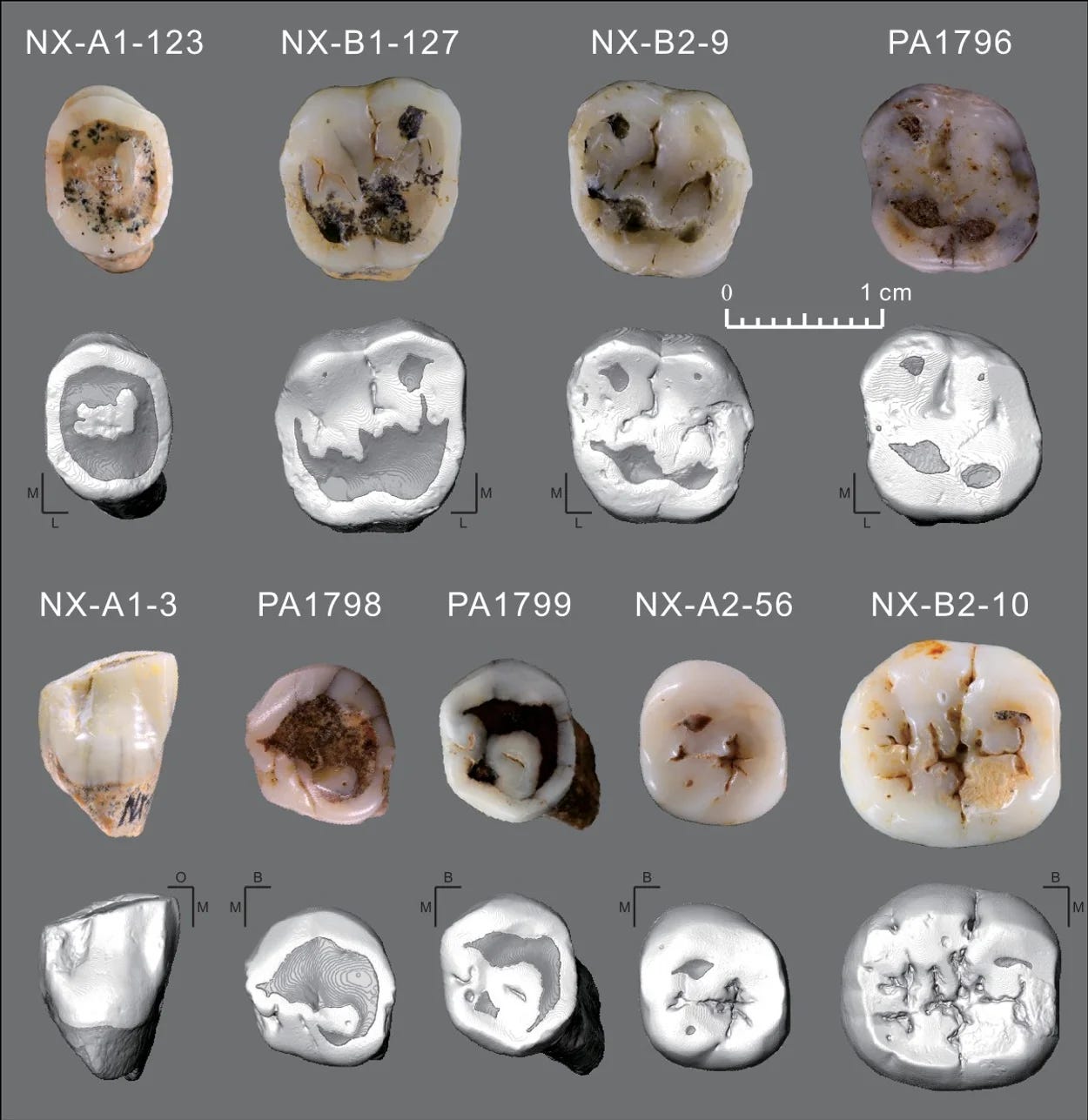
Nine fossil human teeth from Naxian and Baxian caves, eight of them Homo erectus. Credit Kira Westaway/Macquarie University
Tooth shape and ancient proteins both point to Homo erectus
The first paper, led by Wei Liao, compares the teeth with other hominins. One of the features it uses is the shape of the junction between enamel and dentine, which preserves fine anatomical detail.
The team also extracted ancient proteins from the enamel of five teeth, four from the H. erectus group and PA1796. Proteins last far longer than DNA in hot, humid conditions. The four H. erectus teeth carry an amino acid substitution also found in H. erectus teeth analysed earlier this year. “They have the same mutation,” co-author Qiaomei Fu of the IVPP told National Geographic. Frido Welker of the University of Copenhagen, a co-author, told Live Science that the proteomics nicely confirm the morphology.
The proteins also show sex. The amelogenin-Y protein shows three of the four H. erectus teeth came from males and one from a female. According to the IVPP account reported by Global Times, the Guangxi population is distinct from the H. erectus fossils of Zhoukoudian near Beijing and Hexian in Anhui.
Five dating methods give a range of 324,000 to 184,000 years
The ages come from five independent dating techniques applied to the teeth, the cave sediments and mineral crusts, according to Macquarie University. Kira Westaway, the Macquarie geochronologist who led the dating, measured sediments in the fossil chamber of Naxian Cave. National Geographic reports that the work included uranium-series dating of the teeth and of the mineral deposits that formed on them.
The resulting window runs from about 324,000 to 184,000 years ago. It is a broad range, and the papers place the fossils within it rather than giving a single date for the last H. erectus in the region.
Enamel chemistry shows a rainforest population that moved long distances
The second paper, led by Westaway and Renaud Joannes-Boyau of Southern Cross University, looks at the environment. Isotope signals in the enamel of every H. erectus tooth match dense or open-canopy rainforest, as do those of the animals from the same deposits. Nicolas Bourgon of the Max Planck Institute of Geoanthropology said the animal and human teeth tell the same story.
Strontium in tooth enamel reflects the geology where an individual grew up. Some of the Guangxi signatures come from well beyond the immediate cave area. Live Science reports that the team matched them to another karst landscape about 320 kilometres away in the Red River valley of northern Vietnam. Joannes-Boyau said this suggests these people were “far more mobile than previously recognised”.
The standard picture has long put H. erectus in open woodland and grassland, and treated rainforest as country that only Homo sapiens could exploit. Patrick Roberts of the Max Planck Institute of Geoanthropology called the Guangxi teeth the first clear, direct evidence of another hominin living in these habitats.
The ninth tooth may belong to a different hominin
PA1796 is the puzzle. Its proteins show it came from a male, but it lacks the H. erectus amino acid substitution, and its shape does not match H. erectus, Neanderthals or modern humans. The authors leave it unassigned and say they are still studying it.
Outside researchers have suggested a Denisovan, the group now often linked with the Harbin skull and the name Homo longi. Chris Stringer of the Natural History Museum in London said PA1796 could represent a longi or Denisovan individual, though it is relatively small. John Hawks of the University of Wisconsin-Madison thinks it is most likely Denisovan. He would have liked more comparisons with Denisovan teeth in the paper. If that identification holds, and if the dates overlap, two kinds of human lived in the same Guangxi rainforest. Welker described this as exciting. It remains a hypothesis built on one tooth.
The Guangxi dates narrow the gap with late Homo erectus on Java
H. erectus lasted longest on Java, where the Ngandong fossils date to between about 117,000 and 108,000 years ago. Stringer said the Guangxi results bring the East Asian record closer in age to those late Javanese examples. They also show a mainland rainforest population that could have been part of the same southern range.
Richard Potts, director of the Smithsonian’s Human Origins Program, who was not involved, told National Geographic that the identification looks really solid. He pointed to the agreement between tooth shape and proteins. Ben Marwick of the University of Washington said the results challenge the idea that only modern humans could survive in and cross rainforests.
The evidence rests on eight teeth from two caves with a wide date range. It extends the known mainland record of H. erectus by well over 100,000 years. It does not yet show when the species finally disappeared from southern China.
Subscribe for a few dollars a month and get every long read, the short documentaries and the full archive. Cancel anytime.
📍 Explore this discovery on the Ancient Content Atlas:
Sources:
Liao, W., Zanolli, C., Ásmundsdóttir, R. D., Wu, Z., Yi, Z. et al., incl. Fu, Q. and Welker, F. (2026). Evidence for late Middle Pleistocene Homo erectus in mainland East Asia. Nature, published 18 November 2026. https://doi.org/10.1038/s41586-026-11271-3 (author list taken from Live Science’s reference list, as I couldn’t open the paper or its Crossref record)
Westaway, K. E., Joannes-Boyau, R., Liao, W., Shao, Q., Yu, W., Quinn, M., Bacon, A.-M., Liang, H., Bourgon, N., Zhao, J.-x., Roberts, P., Kono, R., Pan, Y., Yang, L., Wang, Y., Jin, C., Wu, Z., Murray, S., Zanolli, C., Demeter, F., Welker, F., Ásmundsdóttir, R. D., Fu, Q., Balter, V., Wang, W. and Zhang, Y. (2026). Rainforest adaptation in late Homo erectus from southern China. Nature, published 18 November 2026. https://doi.org/10.1038/s41586-026-11155-6 (open access, CC BY-NC-ND 4.0)
Rizal, Y., Westaway, K. E., Zaim, Y. et al. (2020). Last appearance of Homo erectus at Ngandong, Java, 117,000–108,000 years ago. Nature 577, 381–385. https://doi.org/10.1038/s41586-019-1863-2
Macquarie University, Hidden in the rainforest. The surprising last chapter of Homo erectus in China, EurekAlert, 18 November 2026. https://www.eurekalert.org/news-releases/1151969
Chinese Academy of Sciences, Hidden in the rainforest. Fossils reveal last chapter of Homo erectus in China, EurekAlert, 18 November 2026. https://www.eurekalert.org/news-releases/1152246
Larson, C., National Geographic, 18 November 2026. https://www.nationalgeographic.com/history/article/homo-erectus-china-rainforest
Simms, C., Live Science, 18 November 2026. https://www.livescience.com/human-behavior/homo-erectus-and-denisovans-may-have-lived-alongside-each-other-in-china-study-suggests
Global Times, 19 November 2026. https://www.globaltimes.cn/page/202611/1374587.shtml
Arkeofili, 19 November 2026 (starting report). https://arkeofili.com/homo-erectus-cinde-sanildigindan-cok-daha-uzun-sure-yasamis/
This is what I love about archaeology. Every discovery adds another piece to the puzzle, and the picture just keeps getting more fascinating. Imagine what remains to be found!
They know all this from 9 teeth? hm. Excuse me for doubting...