


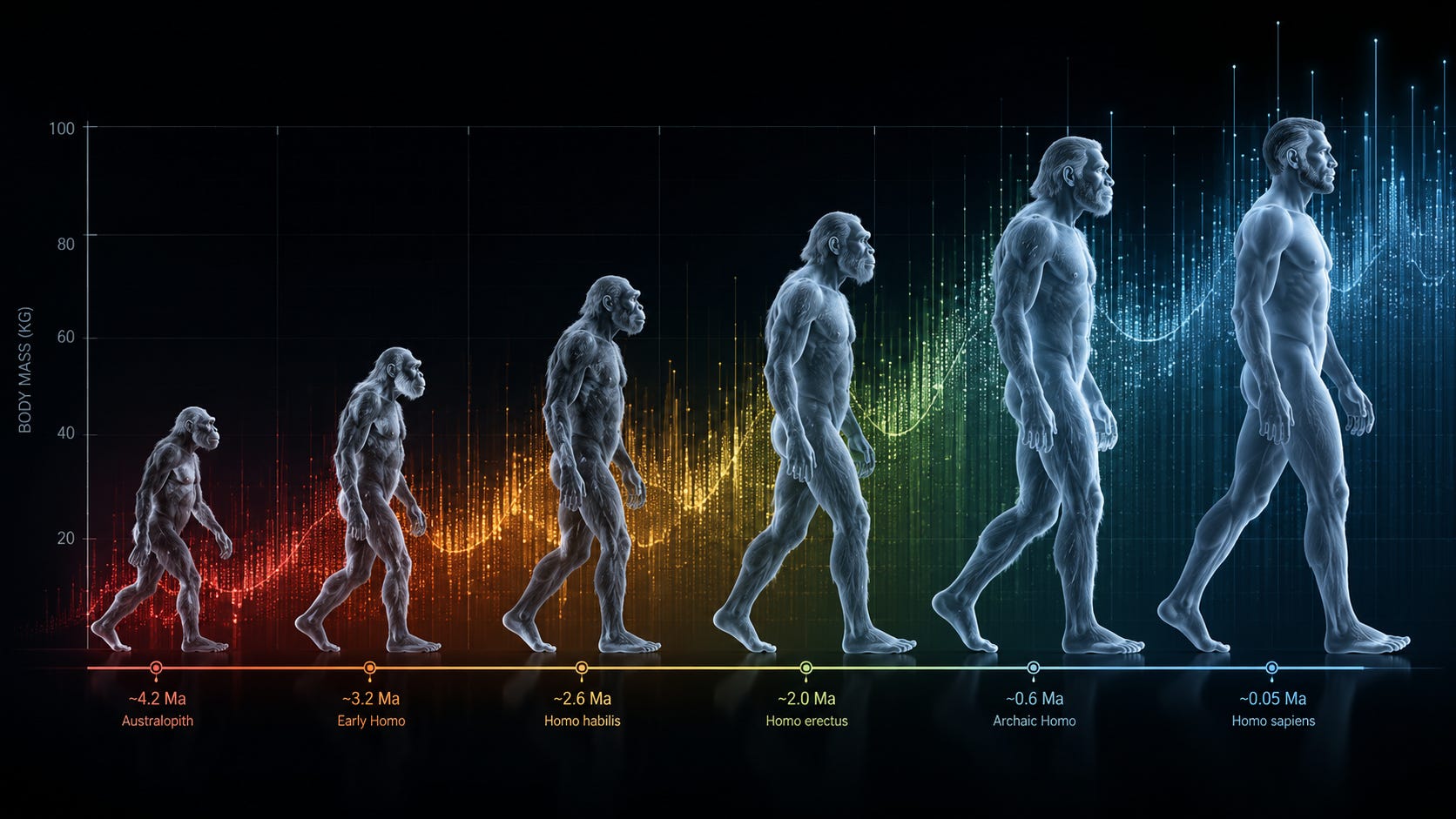
Illustration showing the evolution of hominin body size, with a major increase appearing in later Homo around 2 million years ago.
For decades, researchers have debated whether hominins slowly became larger over millions of years, or whether a major increase in body size happened at a specific point in the evolution of the genus Homo. The new research, published in Proceedings of the National Academy of Sciences in 2026, supports a mixed picture. Body size did increase across hominin evolution, but the strongest signal points to a major jump around 2 to 2.5 million years ago, especially with later members of Homo such as Homo erectus, Homo ergaster, and possibly Homo rudolfensis.
The study was carried out by Jacob D. Gardner, Thomas A. Püschel, Suzy White, Manabu Sakamoto, and Chris Venditti. By combining hundreds of fossil body-mass estimates with statistical models that account for evolutionary relationships and uncertainty, the team found that our ancestors did not simply grow larger in a straight line.
Instead, the human family tree shows both gradual trends and sharp changes. Some branches became larger and more mobile. Others, such as Homo floresiensis and Homo naledi, stayed small or moved in a very different evolutionary direction.
Biological Significance of Body Size in Human Evolution
Body size is one of the most important biological traits in any animal. It influences metabolism, movement, diet, reproduction, heat regulation, life history, ecological range, and survival strategies.
In human evolution, body size has been especially important because it is closely tied to other major changes. Larger bodies can affect walking efficiency, long-distance movement, energy needs, hunting and scavenging strategies, brain size, and the ability to live in different environments.
Early hominins were generally much smaller than many later humans. Some australopiths averaged around 40 kilograms, with stature closer to that of a modern child. By contrast, later species such as Homo erectus and Homo ergaster reached average body masses closer to 60 kilograms or more, placing them much nearer to the range of many modern humans.
This difference has long raised an important question: did hominins slowly grow larger over time, or did one part of the human lineage experience a more dramatic shift?
The new study suggests that both ideas contain part of the answer.
Historical Debate on Patterns of Body-Size Evolution
Paleoanthropologists have not agreed on the exact pattern of body-size evolution.
Some earlier studies supported a general increase through time, suggesting that hominins gradually became larger as evolution progressed. Other studies argued that the pattern was not so simple and that increases in body size were limited to certain lineages or specific evolutionary moments.
Part of the disagreement comes from the fossil record itself. Fossil hominins are rarely preserved as complete skeletons. Body mass often has to be estimated from fragments such as limb bones, pelvises, teeth, or other skeletal elements.
Different studies have used different fossil samples, different anatomical measurements, different species assignments, and different statistical methods. As a result, one study might emphasize a gradual increase, while another might highlight a sudden shift in later Homo.
Jacob Gardner of the University of Reading explained that these disagreements may have emerged because researchers were looking at different parts of a larger puzzle. When more fossils are examined together and competing hypotheses are tested in the same framework, a clearer and more complicated picture appears.
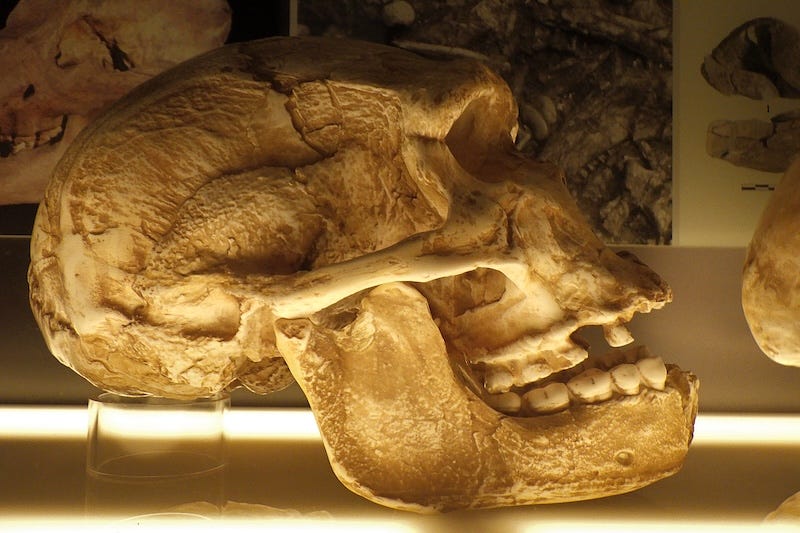
Cast of a Homo erectus skull from Tautavel, Pyrénées-Orientales, France. Dated to around 450,000 years ago, it represents one of the oldest human fossils found in the country. Credit: Wikimedia Commons.
Compilation and Scope of the Fossil Dataset
To address the problem, Gardner and colleagues assembled body-mass estimates from 386 fossil specimens representing 21 hominin taxa.
This sample ranged from ancient australopiths to members of Homo, including Homo sapiens. The goal was to test multiple models of body-size evolution at the same time rather than treating each hypothesis separately.
The team used Bayesian phylogenetic generalized linear mixed models. In simpler terms, this method allowed them to examine body-mass change while accounting for the fact that related species share evolutionary history. A fossil from one species cannot be treated as completely independent from a fossil belonging to a close evolutionary relative.
The method also allowed the researchers to account for several sources of uncertainty. These include uncertainty in body-mass estimates, variation within species, incomplete skeletal remains, and disagreement over how fossil specimens should be assigned to species.
This was important because body-mass reconstruction is not a simple measurement. It is an estimate built from fragmentary evidence. The new study tried to make that uncertainty part of the analysis rather than ignoring it.
Evaluation of Alternative Evolutionary Models
The researchers did not ask only whether hominins grew larger over time. They tested several possible explanations together.
One model considered a broad, gradual increase in body size across all hominins. Another tested whether a major shift occurred specifically in the genus Homo. A third tested whether the strongest change appeared in later members of Homo, excluding Homo habilis.
This distinction matters. Homo habilis is often treated as one of the earliest members of the genus Homo, but it retained a relatively small body and many primitive features. If Homo habilis is grouped with all later Homo species, it can blur the signal of later body-size expansion.
The study found strong evidence for a marked increase in body mass among later Homo species, especially after Homo habilis. It also found moderate support for a slower, general increase across hominin evolution as a whole.
In other words, hominin body size did trend upward over time, but the most important change happened later within Homo.
Timing and Nature of the Body-Size Increase
The strongest signal points to a body-size jump around 2 to 2.5 million years ago.
This is the period when species such as Homo erectus and Homo ergaster appear in the fossil record. Homo rudolfensis may also belong to this broader phase of body-size change, depending on taxonomy and interpretation.
These later Homo species were different from earlier hominins in several important ways. They were more committed to efficient bipedal walking. Their bodies were better suited for longer-distance movement. Their diets likely included more meat. Their geographic ranges expanded beyond the more restricted landscapes of earlier hominins.
A larger body may have supported these changes. Bigger bodies can improve walking efficiency over long distances, especially for a species moving across open or varied environments. They may also help with endurance, thermoregulation, and access to a broader range of foods.
This does not mean that larger size was automatically better in every situation. But for some later Homo lineages, increasing body mass appears to have been part of a wider ecological and behavioral transformation.
Anatomical Developments in Homo erectus
Homo erectus is especially important in this discussion because it is often associated with a more human-like body plan.
Compared with earlier hominins, Homo erectus generally had longer legs, a body more adapted to walking and running, and a larger average body size. This species also spread widely, eventually appearing outside Africa in parts of Eurasia.
The new study fits this broader picture. It suggests that the emergence of larger-bodied Homo was not just a minor change in anatomy. It may have been tied to a new way of living.
Larger bodies would have required more energy, but they could also support a more mobile lifestyle. A hominin that could walk efficiently across larger territories could search more widely for food, water, shelter, and suitable habitats. Such mobility may have become increasingly important as climates and landscapes changed.
The rise of Homo erectus and related forms therefore marks more than a body-size change. It marks a shift in ecology, movement, diet, and survival strategy.
Ecological and Dietary Implications of Increased Size
The timing of the size increase is significant because it coincides with broader changes in the behavior and ecology of later Homo.
Researchers have long linked larger body size in early Homo with changes in diet, especially greater reliance on animal foods. Meat and marrow are energy-rich resources, and access to them may have helped support larger bodies and, eventually, larger brains.
A larger body could also have helped hominins compete in more open environments. It may have improved endurance travel, made long-range foraging more efficient, and allowed early humans to exploit a wider range of habitats.
Thomas Püschel of the University of Oxford emphasized that the body-size shift coincided with changes in how our ancestors moved through landscapes and used their environments. This connection points to a close relationship between anatomy and behavior.
Body size, in this view, was not evolving in isolation. It was part of a larger adaptive package involving locomotion, diet, range expansion, and ecological flexibility.
Evidence for Gradual Trends in Body Size
Although the clearest signal is the later Homo size jump, the study also found moderate support for a broader increase in body mass through time.
The models suggest a possible general increase across all hominins of up to about 0.99 kilograms per million years. This is a modest trend compared with the sharper shift seen in later Homo.
This slower increase may fit with a wider biological pattern sometimes discussed as Cope’s rule. Cope’s rule refers to the tendency of some animal lineages to evolve larger body sizes over time.
Several explanations have been proposed for this pattern. Larger bodies can sometimes help animals compete for mates, deter predators, regulate temperature, or access new food resources. However, Cope’s rule is not universal, and the causes behind body-size increase are still debated.
The hominin evidence fits this complexity. There may have been a general tendency toward larger size, but that trend alone does not explain the full pattern.
Limitations of Cope’s Rule in Hominin Evolution
Cope’s rule is useful as a broad evolutionary concept, but it cannot explain every detail of human evolution.
In some lineages, increasing body size may provide advantages. In others, smaller size may be favored by island environments, restricted resources, ecological specialization, or other pressures.
The new study shows why a simple rule is not enough. Hominin evolution included both size increase and size reduction. Some branches grew larger, while others remained small even when living much later in time.
This is why the human family tree should not be imagined as a straight ladder from small to large, or from primitive to modern. It was a branching evolutionary landscape, with different species adapting in different ways.
The body-size story is therefore not a single trend. It is a combination of gradual change, lineage-specific shifts, and striking exceptions.
Homo floresiensis as a Case of Reduced Body Size
One of the most famous exceptions is Homo floresiensis, often nicknamed the “hobbit.”
Homo floresiensis lived on the Indonesian island of Flores and had a very small body size. Its small stature has often been discussed in relation to island dwarfism, a process in which large-bodied animals evolve smaller sizes on islands because of limited resources, ecological pressures, or reduced predator competition.
In the new study, Homo floresiensis falls well below the body-mass expectations produced by broader hominin trends.
This matters because Homo floresiensis lived much later than the early stages of Homo evolution. Its small size was not simply a survival from the distant past. It represents a separate evolutionary path in which one branch of the human family remained or became small while other Homo lineages had become larger.
Homo floresiensis is a strong reminder that human evolution was never moving in only one direction.
Homo naledi and Persistence of Small Body Forms
Homo naledi is another important exception.
Discovered in South Africa’s Rising Star cave system, Homo naledi lived surprisingly late, between about 335,000 and 236,000 years ago. Yet it retained a small body and a small brain compared with modern humans and many later Homo species.
Like Homo floresiensis, Homo naledi falls below the expected body size for its time period. Its presence shows that small-bodied hominins survived long after larger-bodied Homo species had appeared.
This is important because Homo naledi existed in Africa during a period close to the emergence of early Homo sapiens. Its anatomy does not fit a simple story in which all later hominins became larger and more modern-looking.
Instead, Homo naledi shows that different evolutionary experiments continued side by side. Some lineages became larger and more mobile; others retained small bodies and unusual anatomical combinations.
The Role of Homo habilis in Interpreting Size Trends
Homo habilis plays a central role in the study because it complicates the definition of body-size change within Homo.
If all Homo species are grouped together, the pattern of body-size increase becomes less clear. Homo habilis was relatively small and retained many traits closer to earlier hominins. Later Homo species, especially Homo erectus and Homo ergaster, show a more obvious increase in body mass.
The new study found less support for a distinct size increase across all of Homo. Instead, the stronger signal appears when Homo habilis is separated from later Homo species.
This matters for how researchers think about the early evolution of our genus. Homo may not have appeared fully formed with a modern-like body plan. Instead, early Homo included smaller forms, while the larger-bodied pattern emerged later.
The transition from Homo habilis to later Homo may therefore represent one of the key anatomical shifts in human evolution.
Challenges in Reconstructing Fossil Body Mass
The study also highlights a major challenge in paleoanthropology: estimating body size from incomplete fossils.
A complete skeleton can provide relatively strong evidence for body mass. But fossil hominins are usually fragmentary. Researchers may have only a femur, pelvis fragment, tooth, jaw, or partial skull.
Different bones can produce different estimates. A limb bone may suggest one body mass, while a tooth or joint surface may suggest another. Some fossils are difficult to assign confidently to a species. Others may represent individuals that were unusually large or small within their population.
These problems have contributed to disagreement in earlier studies.
Gardner and colleagues tried to address this by building uncertainty into their models. Rather than relying on one fixed value for each fossil, they considered a range of plausible body-mass estimates and multiple evolutionary relationships.
This approach does not remove uncertainty, but it makes the analysis more realistic.
Integrating Evidence from a Complex Fossil Record
The result is a more nuanced picture of hominin body-size evolution.
The study suggests that earlier researchers were not necessarily wrong when they saw different patterns. Those patterns may have depended on which fossils, species, and methods they used.
A study focused on early hominins might detect gradual growth. A study focused on later Homo might see a sharper jump. A study emphasizing small-bodied exceptions might conclude that the trend is weak or uneven.
By testing these possibilities together, the new analysis shows that several patterns can coexist.
There was likely a slow general increase across hominins, a stronger later shift in Homo, and notable exceptions that moved away from the main trend.
Relationship Between Body Size and Brain Evolution
Body size also matters because it is connected with brain evolution.
Larger bodies often require larger brains for basic bodily control, but brain size can also increase in response to cognition, social behavior, technology, and ecological demands. In hominins, larger body size and larger brain size are often discussed together, especially in later Homo.
However, the relationship is not simple. Homo naledi had a small brain and small body but may have had unexpected brain organization. Homo floresiensis also had a very small brain relative to later Homo species. Homo erectus had a larger body and a larger brain than earlier hominins, but not a modern human brain.
The new body-size study does not focus directly on brain evolution, but it helps clarify the anatomical background in which brain changes occurred.
The emergence of larger-bodied Homo may have created new energetic, ecological, and behavioral conditions that later shaped brain expansion.
Implications for Geographic Expansion
One of the most important implications of larger body size is geographic movement.
Later Homo species, especially Homo erectus, expanded across much larger areas than earlier hominins. Moving through open landscapes, following seasonal resources, and occupying varied habitats would have favored efficient locomotion.
Long legs, larger bodies, and improved bipedal walking likely made long-distance travel more practical.
This does not mean body size alone caused dispersal. Many factors were involved, including climate, tools, diet, social organization, and landscape change. But larger body size may have contributed to the ability of later Homo to occupy broader ranges.
In this sense, the body-size leap around 2 million years ago may be connected to one of the major turning points in human evolution: the expansion of Homo beyond earlier ecological limits.
A Branching Model of Human Evolution
The strongest message of the study is that human evolution was branching, not linear.
Some hominins became larger. Some stayed small. Some developed more efficient bipedal bodies. Some retained unexpected combinations of primitive and derived traits. Some spread widely, while others were restricted to islands or particular regions.
The human body did not evolve through a single upward path toward modern form. Instead, different lineages explored different possibilities.
Homo erectus and Homo ergaster show one path: larger bodies, wider ranges, and major ecological flexibility. Homo floresiensis and Homo naledi show another: small-bodied survival long after larger Homo forms had appeared.
This makes the human family tree more complex, but also more realistic.
Reassessment of Previous Interpretations
The study challenges the idea that human ancestors simply became larger and larger over time.
It shows that body mass did generally increase, but the most important change happened later within Homo. It also shows that some branches strongly resisted or reversed the trend.
The findings help explain why previous studies disagreed. The fossil record contains more than one signal. It contains gradual change, a later Homo shift, and small-bodied outliers.
By bringing these signals into one statistical framework, Gardner and colleagues provide a clearer way to understand the evolution of hominin body size.
The result is not a single simple answer. It is a more accurate model of a complicated process.
Broader Implications of the Findings
The study matters because body size is connected to many of the major themes in human evolution: walking, diet, energy, brain size, migration, ecology, and survival.
The major size increase around 2 to 2.5 million years ago appears to line up with a broader transformation in later Homo. These ancestors were moving differently, eating differently, and using landscapes in new ways.
At the same time, the small-bodied exceptions show that evolution did not produce one inevitable outcome. Homo floresiensis and Homo naledi demonstrate that other human relatives followed different paths and remained outside the larger-bodied trend.
Human body-size evolution was therefore not a smooth climb. It was a mixed process: gradual increase, sudden expansion, and evolutionary divergence.
Around 2 million years ago, one branch of the human family took a major step toward the body size familiar in humans today. Other branches kept their own forms, proving that the story of human evolution was never one straight line.
Sources
Gardner, J. D., Püschel, T. A., White, S., Sakamoto, M., & Venditti, C. (2026). Competing models of hominin body size evolution. Proceedings of the National Academy of Sciences, 123(27), e2521732123. DOI: 10.1073/pnas.2521732123
University of Reading. (2026, June 22). Bigger bodies were a late addition for humans. University of Reading Research News.
Arkeofili. (2026). İnsan Ataları 2 Milyon Yıl Önce Dikkat Çekici Biçimde Büyümüş. Arkeofili.
Sci.News. (2026). New Study Challenges Long-Held Idea That Our Ancestors Steadily Grew Bigger. Sci.News.
Discover Magazine. (2026). Human Ancestors Suddenly Got Bigger Around 2 Million Years Ago. Discover Magazine.
Neuroscience News. (2026). Why Human Body Size Leaped 2 Million Years Ago. Neuroscience News.
The data look good, but I think the artist cheated a little by showing the modern H. sap with less hair and beard than all the previous, who match.
Perhaps s/he thinks that's when we also evolved barbers? 😀