


A new study suggests that Paleolithic cave art in the Cantabrian region followed a structured visual system, with repeated patterns in how animals, signs, and figures were combined on cave walls.
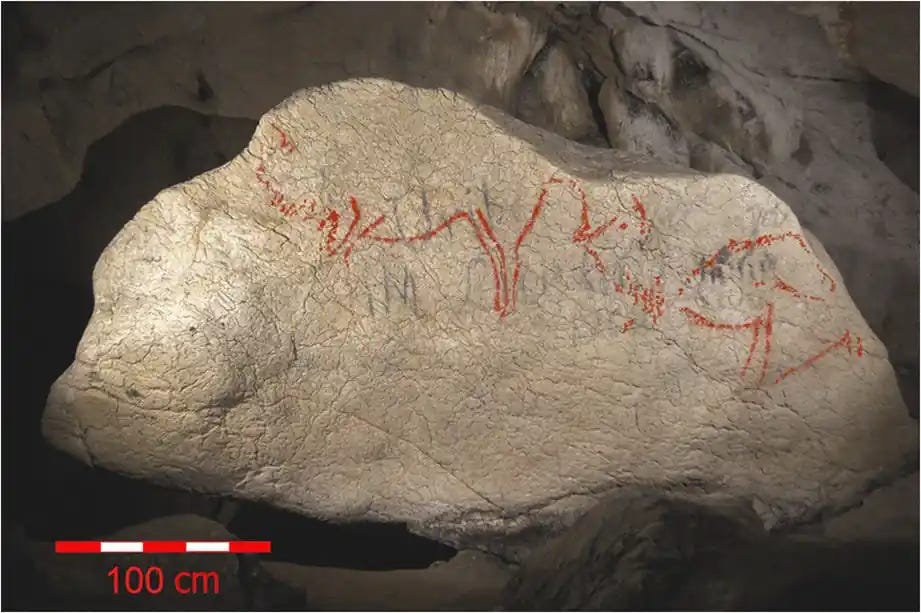
Panel Lum.D.II in Lumentxa Cave, showing two left-facing bison and a right-facing horse head. Credit: Garate et al. 2013 / I. Intxaurbe 2026.
The research, published in the Journal of Archaeological Method and Theory in 2026, was carried out by Iñaki Intxaurbe. It uses co-occurrence network analysis, multivariate statistics, and detailed spatial documentation to examine more than 500 graphic figures from nine decorated Magdalenian cave sites along the Bay of Biscay axis.
The study does not claim to decode the exact meaning of the images. Instead, it asks a different question: were Paleolithic artists arranging themes in a structured way?
The answer appears to be yes. Across the caves studied, certain motifs repeatedly appear together, certain animals occupy central positions in the visual system, and formal choices such as orientation and inclination show patterned distributions. The strongest organizing themes are large herbivores, especially bison, horse, and ibex.
Paleolithic art as a structured visual system
Paleolithic cave art has often been interpreted through symbolic, ritual, magical, or hunting-related explanations. Since the scientific recognition of cave art in the late 19th century, researchers have debated whether these images were connected with subsistence, belief, social identity, storytelling, memory, or ritual practice.
Earlier approaches often focused on the meaning of individual animals or the possible motivations behind image-making. Later structural approaches, especially in the mid-20th century, shifted attention toward the arrangement of figures, the relationship between themes, and the possibility that cave art worked as an organized system of signs.
The new study belongs to this second tradition, but with a modern computational method. Instead of beginning with a fixed interpretation, it examines the internal structure of the art itself: which figures occur together, which motifs become central, which remain peripheral, and how themes are distributed across panels.
This approach treats Paleolithic rock art as a semiotic system. In simple terms, that means the images are studied as organized visual signs. The goal is not to translate them like words, but to understand whether their combinations followed repeated conventions.
The Bay of Biscay and the Magdalenian world
The study focuses on Magdalenian parietal art along the Bay of Biscay axis, especially in the Basque region. This area forms a key transitional zone between the Iberian Peninsula and the rest of continental Europe.
During the Upper Paleolithic, the broader Cantabrian and Franco-Cantabrian region became one of the most important areas of cave art in the world. Decorated caves in northern Spain and southwestern France preserve paintings, engravings, signs, and sculptural traces created by Homo sapiens over many thousands of years.
The Magdalenian period, roughly between 17,000 and 12,000 years ago in broad terms, was one of the richest phases of European Paleolithic art. In the study’s dataset, most assemblages fall within the Late Middle and Upper Magdalenian, approximately 17,000 to 14,500 calibrated years before present.
This was a time of strong cultural networks across southwestern Europe. People moved through corridors linking the Cantabrian region, the Pyrenees, and southwestern France. Art, tools, raw materials, and symbolic practices all formed part of this wider world.
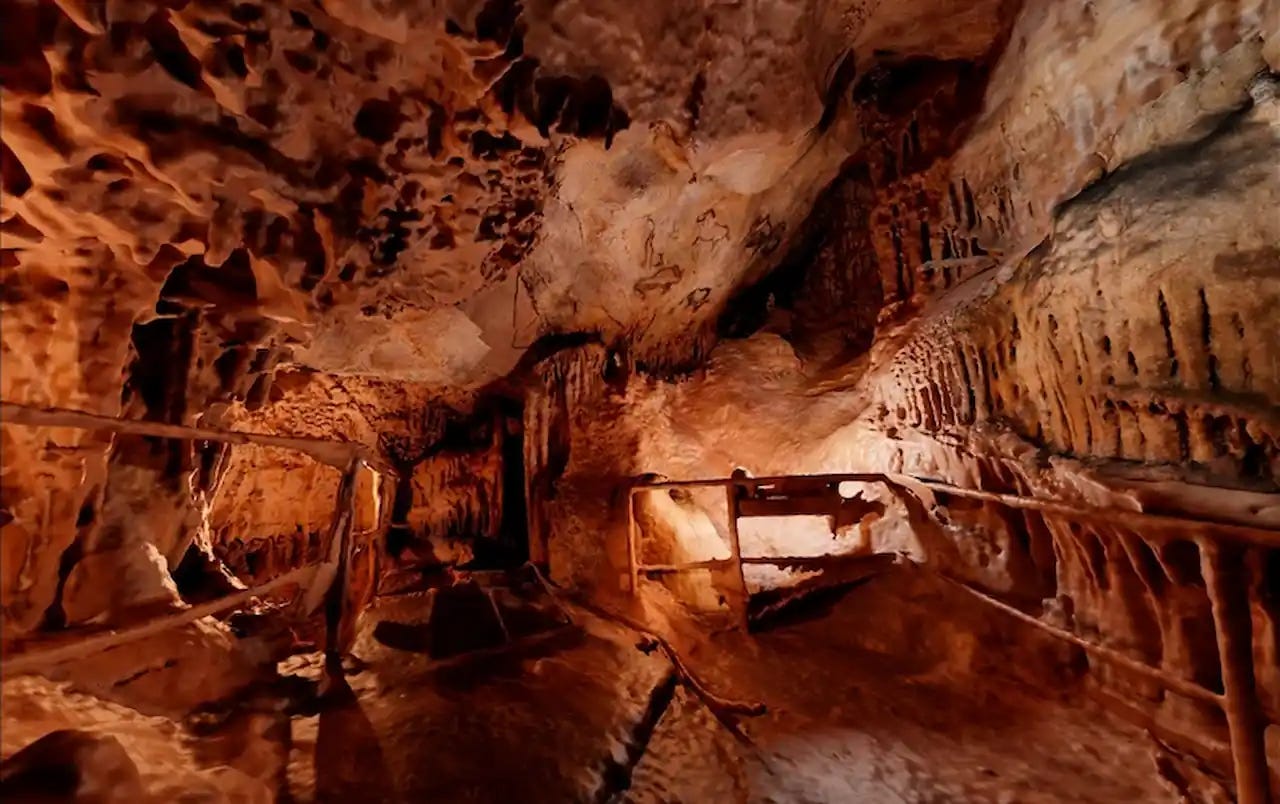
Reconstruction of the lighting conditions in Santimamiñe Cave before its closure to the public in 2007. Credit: I. Intxaurbe 2026.
Nine decorated caves
The study analyzes more than 500 graphic motifs from nine decorated caves.
The caves are Santimamiñe, Lumentxa, Atxurra, Ekain, Altxerri, Aitzbitarte IV, Aitzbitarte V, and Alkerdi 1 in Spain, along with Etxeberri in France.
Together, these caves preserve a wide range of Paleolithic imagery. The corpus includes zoomorphic figures, anthropomorphic figures, and complex non-figurative signs. Animals include bison, horses, ibex, deer, hinds, reindeer, and other species. Non-figurative motifs include dots, paired strokes, sinuous lines, rectangles, arrows, V-shaped motifs, crosses, and a possible claviform sign.
Very simple or unclear marks were excluded when their intentional character or chronological attribution could not be established with confidence. This matters because the study depends on a carefully controlled dataset rather than a loose collection of all visible traces.
The analyzed corpus represents 67.93 percent of the zoomorphic and anthropomorphic figures currently documented in the region. Four of the caves included in the study were discovered after 2010, adding more than 168 previously undocumented figures to the analytical base.
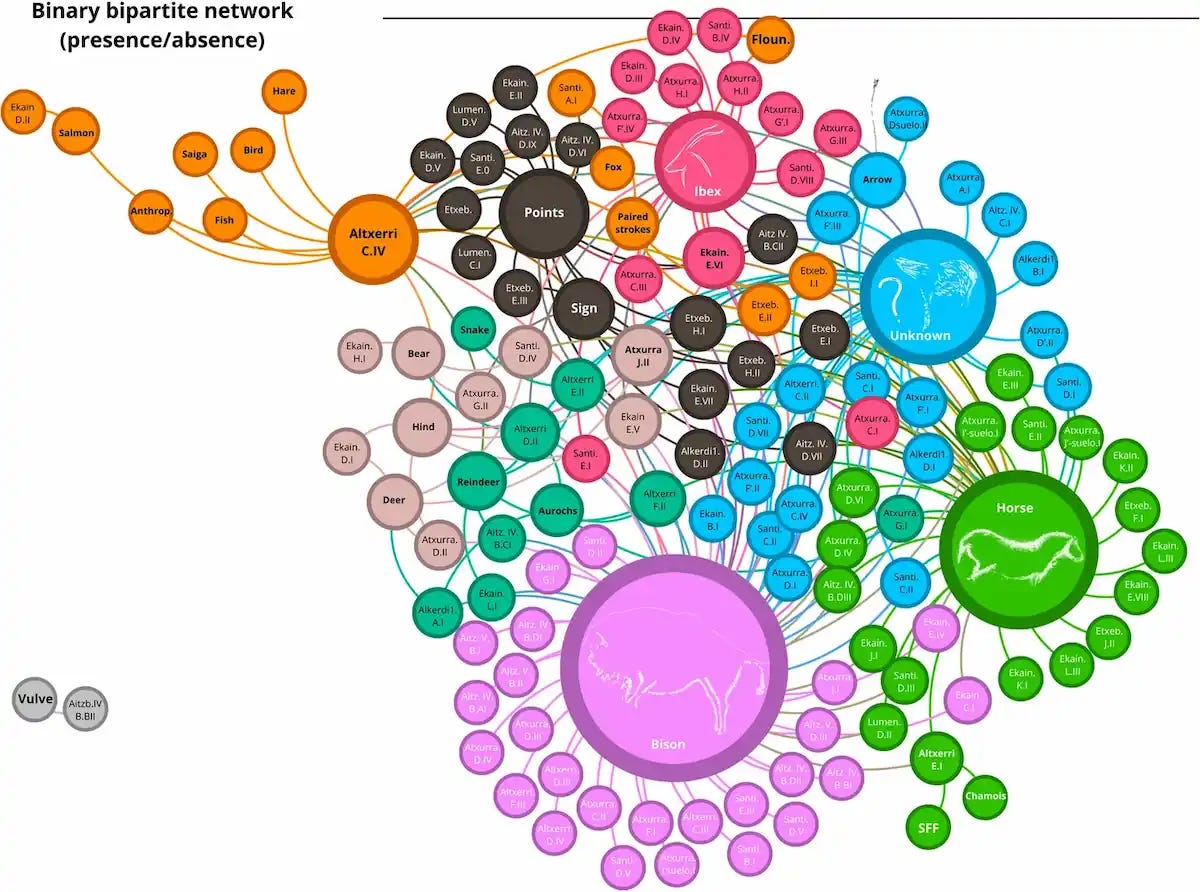
Binary bipartite network showing motif presence and absence. Credit: A. Ruiz-Redondo / O. Rivero / I. Intxaurbe.
Significance and Practical Applications of the Dataset
The strength of the study lies partly in the quality of the documentation.
Paleolithic cave art is difficult to analyze statistically because the surviving record is incomplete. Walls erode. Pigments fade. Engravings become hard to see. Sediment movement, water flow, calcite formation, human visitation, and modern damage can all affect what remains visible today.
For this reason, Intxaurbe’s work relies on systematic geomatic and geoarchaeological documentation. The caves were studied using methods such as terrestrial laser scanning, Structure-from-Motion photogrammetry, GNSS data, 3D modeling, cartography, and spatial analysis.
The study also considers taphonomy: the processes that affect preservation. This is important because a network analysis is only as reliable as the dataset behind it. If some panels are heavily damaged or if some motifs are missing, the resulting pattern could be distorted.
By integrating preservation assessment, 3D spatial documentation, and a transparent dataset, the study attempts to reduce one of the major problems in the study of cave art: the reuse of old, partial, or insufficiently contextualized records.
From panels to networks
The central method used in the study is co-occurrence network analysis.
The basic idea is straightforward. If two motifs appear together on the same panel, they are treated as connected. If they repeatedly appear together across many panels, their connection becomes stronger. Over time, a network emerges.
In this network, motifs are nodes. Connections between motifs are edges. A bison and a horse appearing together on the same panel form one kind of relationship. If bison, horse, and ibex repeatedly occur in related contexts, they may form part of a central organizing core.
The panel is the main unit of analysis. This is important because cave art does not exist as isolated images floating in space. It appears on surfaces, in chambers, on walls, in galleries, and in compositional units. A panel can therefore be treated as a meaningful visual context.
The study’s database is organized hierarchically: site, sector, panel, and motif. This allows the analysis to preserve spatial context while still making large-scale comparison possible.
Frequency and Jaccard networks
The research first built two unfiltered co-occurrence networks.
One was frequency-weighted. This measured how often two motifs shared panels. The other was Jaccard-normalized. This measured relative similarity between motif distributions, helping reduce the effect of very common themes dominating the results only because they appear frequently.
Both approaches produced similar broad structures. This is important because it shows that the results were not simply an artifact of one weighting system.
In both networks, large herbivores occupied central positions. Bison, horse, ibex, and indeterminate figures acted as major compositional hubs. Less frequent motifs were arranged around these central themes.
The similarity between the two networks gave the study its first major signal: the organization of themes was stable across different ways of measuring association.
Filtering the network
Unfiltered networks can become very dense. When many motifs are connected, it becomes difficult to see which relationships are structurally important and which are weak or incidental.
To address this, the study used a filtered network. Edges were retained only when they met minimum thresholds: at least three co-occurrences and a Jaccard similarity of 0.12 or higher.
This filtering revealed a clearer structure. The network showed a central core of strongly connected themes, a secondary cluster of more moderately connected themes, and a peripheral set of weak or isolated motifs.
Within the central core, bison, horse, ibex, and indeterminate figures remained important. The filtered network also revealed a secondary substructure around the goat or ibex motif, linking it with cervid figures such as hind and deer.
The result suggests that Paleolithic panels were not assembled as loose mixtures of images. Some motifs repeatedly formed stable relationships, while others played more contextual or secondary roles.
The minimum spanning tree
The study also used a minimum spanning tree, or MST.
An MST reduces a dense network to the minimum set of connections needed to preserve the overall structure. In archaeological terms, it helps identify hierarchy by removing redundancy. It shows which motifs act as primary connectors and which depend on them within the network.
In this analysis, bison emerged as the most important organizing node.
Two major branches extended from this bison-centered structure. One linked bison with ibex and a cervid substructure involving hind, deer, and reindeer. The other connected bison with horse and points.
This result is one of the clearest findings of the study. While ibex can appear as a major hub in some filtered views of the network, bison becomes the dominant organizing theme once the network is simplified into its hierarchical backbone.
In other words, bison is not only frequent. It helps structure the relationships between other motifs.
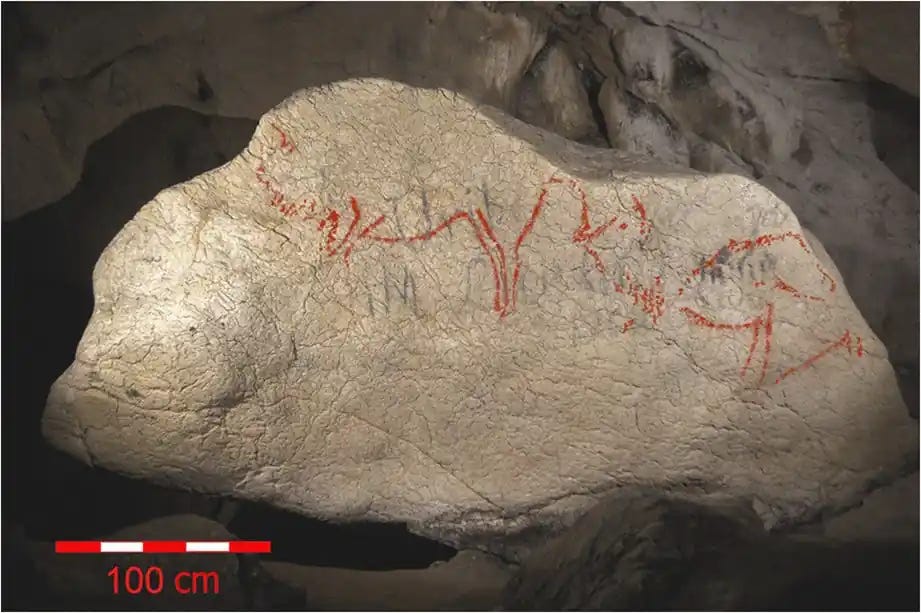
Panel Lum.D.II in Lumentxa Cave, showing two left-facing bison and a right-facing horse head. Credit: Garate et al. 2013 / I. Intxaurbe 2026.
The bison, horse, and ibex triad
The most stable pattern in the study is the recurring importance of three large herbivores: bison, horse, and ibex.
These animals form the dominant thematic backbone of the analyzed cave art. Their exact ranking can shift depending on the model, but their combined importance remains stable.
When indeterminate figures are excluded from the analysis, ibex can become more prominent. When the Atxurra assemblage is also removed, horse can become the dominant node. But these changes do not erase the larger structure. Bison, horse, and ibex remain the central organizing themes across sensitivity tests.
This is important because it shows that the result is not dependent on one cave, one ambiguous category, or one statistical choice. The system remains organized around the same core group of large herbivores.
The study therefore supports the idea that Magdalenian artists in this region shared at least some graphic conventions for how major animal themes were combined.
Indeterminate figures and the problem of ambiguity
One of the more difficult categories in the study is the group of indeterminate or “unknown” figures.
These are motifs that cannot be securely identified because of preservation, schematic execution, ambiguity, or incomplete form. The category is useful, but it also creates a methodological problem. It may group together figures that were not actually related in Paleolithic thought.
For this reason, the study repeated analyses with indeterminate figures excluded. It also tested alternative classifications for disputed motifs, including certain animal identifications.
The overall structure remained broadly stable. The same major organizing themes continued to dominate.
At the same time, the study does not simply dismiss ambiguous figures as noise. Some indeterminate forms may reflect deliberate simplification, hybridity, or images that do not fit modern taxonomic categories. Their ambiguity may have been meaningful in the original visual system.
This is why the study treats inclusion and exclusion as two different analytical choices, each with its own costs.
Panel-theme networks
To complement the theme-to-theme networks, the study also created panel-theme bipartite networks.
A bipartite network connects two different kinds of nodes. In this case, panels and motifs. This allows researchers to examine how themes are distributed across compositional units and identify panels that act as convergence points.
Two models were used: a binary model based on presence or absence, and a count-weighted model that included motif repetition within panels.
These models confirmed that some themes are widely distributed and structurally important, while others are rare or marginal.
One example concerns vulva motifs. In the binary network, sexual motifs occupy a very marginal position. They are rare, weakly connected, and do not structure the wider distribution of panel-theme associations. In the analyzed corpus, vulva motifs occur in a single panel at Aitzbitarte IV, a panel devoted exclusively to that theme.
This does not make them unimportant culturally. It means that, in this specific network, they do not function as major connectors in the broader system.
Orientation and direction
The study also examined formal variables, especially the direction in which figures face.
This is important because a visual system can be structured not only by which figures appear together, but also by how they are drawn.
At the level of individual themes, bison and ibex tend to be oriented leftwards, while horses tend to be oriented rightwards. These tendencies appear in the raw results, although the author treats them cautiously because some do not remain statistically strong after correction for multiple comparisons.
At the corpus level, however, the relationship between theme and orientation is statistically meaningful. The study reports that theme and orientation are not independent, suggesting that direction was partly structured by the type of figure being represented.
This means orientation was not just a casual artistic choice. It formed part of the wider graphic organization of the panels.
Horses and alignment
The study also tested whether horses tend to face other motifs in confrontational arrangements within the same panel.
The result is interesting because horses do not appear primarily as confrontational figures. Instead, they tend to align more often in the same general direction as associated motifs.
This finding matters because it challenges a simple reading of animal panels as scenes of direct opposition. The arrangement of figures may reflect conventions of association, sequencing, or visual grammar rather than literal narrative encounters.
The study therefore adds nuance to how panels should be read. A horse next to another animal does not automatically represent a direct interaction. Its placement and direction may belong to a deeper compositional rule.
Inclination and spatial positioning
Figure inclination also shows patterned structure.
Horses are strongly associated with horizontal positions. Anthropomorphic figures and stylized female figures are more strongly associated with vertical orientation. Bison show a more varied pattern, including inclined and vertical positions.
This suggests that the visual system worked at more than one level. Theme choice mattered. Co-occurrence mattered. Orientation mattered. Inclination also mattered.
Together, these features point to a structured graphic system in which certain animals were not only chosen repeatedly but also placed and drawn according to recurring conventions.
The study therefore argues that laterality and inclination should be treated as part of the syntax of Paleolithic art.
What “grammar” means here
The word “grammar” can easily be misunderstood.
The study does not claim that Paleolithic cave art was writing. It does not argue that bison, horse, and ibex functioned like words in a sentence. It also does not decode the meanings of individual images.
Instead, grammar refers to patterned organization: repeated rules or conventions governing how themes are combined and distributed.
A grammar can exist in a visual system without being a spoken language or written script. In this case, the grammar appears in recurrent associations between motifs, hierarchical relationships between central and peripheral themes, and formal choices such as direction and inclination.
The study is therefore careful. It identifies structure, but it avoids overinterpretation.
The central role of bison in ecosystems and human history
Bison emerges as the strongest organizing node in the minimum spanning tree and appears as a major pole in the broader network.
This matches older structural interpretations of Cantabrian and Franco-Cantabrian cave art, where bison often occupies an important symbolic and compositional position. The new study strengthens that idea by showing that the pattern can be demonstrated statistically in a large and systematically documented dataset.
The importance of bison does not mean that the animal had one fixed meaning across all caves. It may have carried different associations depending on panel, cave, group, or period.
What the study shows is more precise: bison repeatedly appears in structurally important positions within the analyzed Magdalenian graphic system.
In that sense, bison was not only an animal image. It was a central element in the organization of the visual field.
The Basque region as a cultural corridor
The location of the study is important.
The Basque region lies between the central-western Cantabrian area and the Pyrenean-Aquitaine world. During the Last Glacial Period, this zone formed part of a corridor connecting the Iberian Peninsula with continental Europe.
The recurrence of similar organizational patterns in this intermediate zone supports the idea of partially shared graphic principles across connected Magdalenian networks.
This does not mean all caves followed the same rigid system. The sensitivity analyses show that local variation existed. In some models, ibex or horse becomes more prominent. Some caves preserve unusual concentrations of particular motifs. Preservation and discovery history also affect the dataset.
But beneath this variation, the same triad of bison, horse, and ibex remains structurally important.
That points to a shared visual tradition with local flexibility.
A method for studying symbolic systems
One of the most important contributions of the study is methodological.
Paleolithic cave art is difficult to interpret because the artists left no written explanation. Researchers must work from images, surfaces, spatial context, archaeological deposits, and comparison across sites.
Network analysis provides a way to study structure without claiming to know meaning in advance. It allows researchers to ask whether motifs cluster, whether some themes act as hubs, whether panels form groups, and whether the system behaves differently from a random distribution.
This method can be especially useful because it is transparent and reproducible. The study’s workflow and network files are made available through a public GitHub repository, allowing other researchers to examine, test, and adapt the method.
That transparency is important in a field where interpretation can easily become subjective.
The limits of the study
The study is careful about what it can and cannot show.
It does not reveal the exact meaning of bison, horses, ibex, signs, or anthropomorphic figures. It does not prove a single shared myth. It does not reconstruct a spoken language or a literal narrative system.
It also depends on the quality of preservation and classification. Some figures may be lost. Some are difficult to identify. Some caves are better preserved or more completely documented than others. The category of indeterminate figures remains methodologically challenging.
The author addresses these issues through taphonomic evaluation, sensitivity analyses, and careful discussion of uncertainty.
This makes the conclusion stronger. The claim is not that every detail is fixed, but that the major patterns are stable enough to be meaningful.
How this discovery reshapes our understanding and what it could mean moving forward
The study changes how Paleolithic cave art can be discussed.
Instead of treating images only as isolated animals, researchers can examine how they function within panels, caves, and regional systems. Instead of asking only what a bison meant, the question becomes: where does bison appear, what does it appear with, how is it oriented, and what role does it play in the wider network?
This approach moves the study of cave art closer to a formal analysis of visual communication.
It also supports a long-standing idea: Paleolithic artists were working within shared conventions. Their images were not placed or combined casually. They belonged to structured traditions that were learned, repeated, modified, and transmitted across communities.
Why this research is important
The Cantabrian and Bay of Biscay cave art traditions are among the most important records of early human symbolic behavior.
The new study shows that this art can be investigated with tools normally used to study complex systems: networks, modularity, hierarchy, co-occurrence, and distribution.
The result is a more rigorous picture of Magdalenian visual culture. Large herbivores, especially bison, horse, and ibex, formed the central backbone of the system. Other motifs played more contextual roles. Orientation and inclination followed patterned tendencies. These patterns remained visible across multiple analytical approaches.
The deeper significance is that Paleolithic art was organized. Its structure can be measured, compared, and tested.
More than 14,000 years after the Magdalenian artists entered these caves, their images still preserve traces of a visual order: a grammar of animals, signs, panels, and surfaces shaped by the symbolic world of Ice Age communities.
Support Independent Ancient Content :
Your support helps me create more archaeology posts, articles, and mini history videos:
Sources
Intxaurbe, I. (2026). Mapping the Symbolic Structure of Palaeolithic Rock Art Using Co-occurrence Network Analysis. Journal of Archaeological Method and Theory, 33, Article 59. DOI: 10.1007/s10816-026-09796-y
La Brújula Verde. (2026, June). Paleolithic Cave Art Was Not Random: A Study Reveals a Hidden Grammar in the Caves of the Cantabrian Region. La Brújula Verde.
UNESCO World Heritage Centre. Cave of Altamira and Paleolithic Cave Art of Northern Spain. UNESCO World Heritage List.
Intxaurbe, I., Garate, D., & Arriolabengoa, M. (2024). Drawing in the depths: spatial organization patterns related to Magdalenian cave art. Related research on the spatial organization of Magdalenian cave art.
Garate, D., Rivero, O., Rios-Garaizar, J., et al. (2020). New data from the rock art findings in Aitzbitarte caves. PLOS ONE.
Research repository. (2026). Rock-Art-Theme-Co-occurrence-Network. GitHub repository associated with the study’s reproducible network analysis workflow.