


Egypt's Supreme Council of Antiquities has announced the discovery of around twenty funerary tombstones, several sarcophagi, and a collection of amulets at Tell el-Deir, the necropolis south of New Damietta in the Nile Delta.
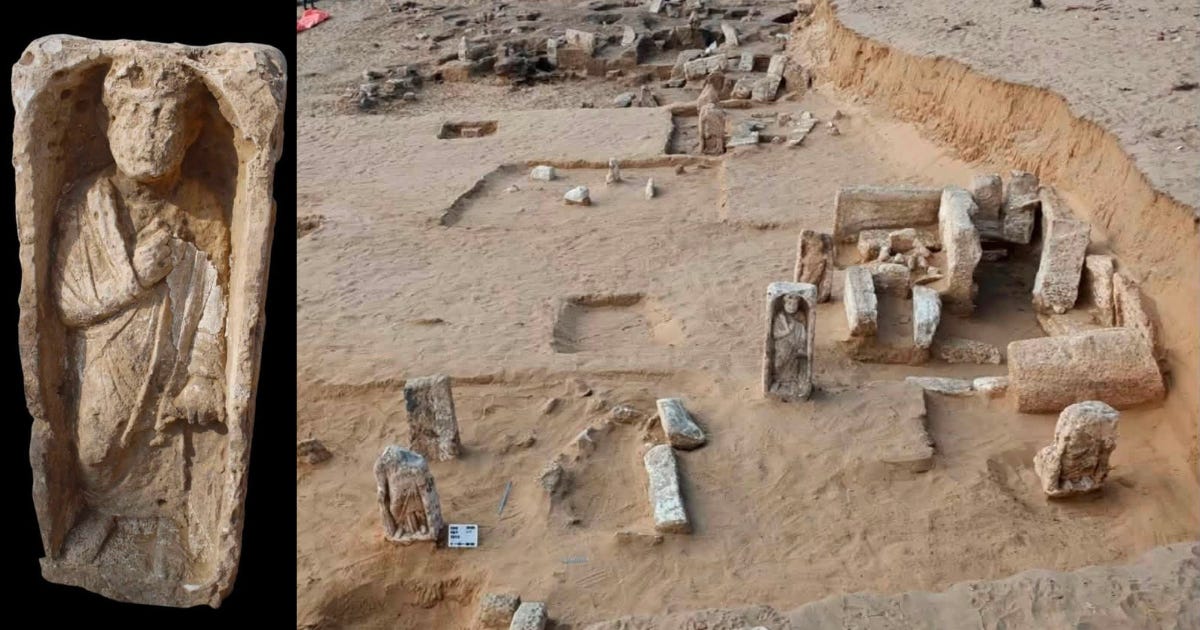
The carvings on the tombstones are what make the find interesting. On their sides and backs, Greek and Egyptian deities appear together, in combinations that could only have been produced in one place and time.
The finds come from the current excavation season at one of the eastern delta’s most productive sites, where systematic work resumed in 2007.
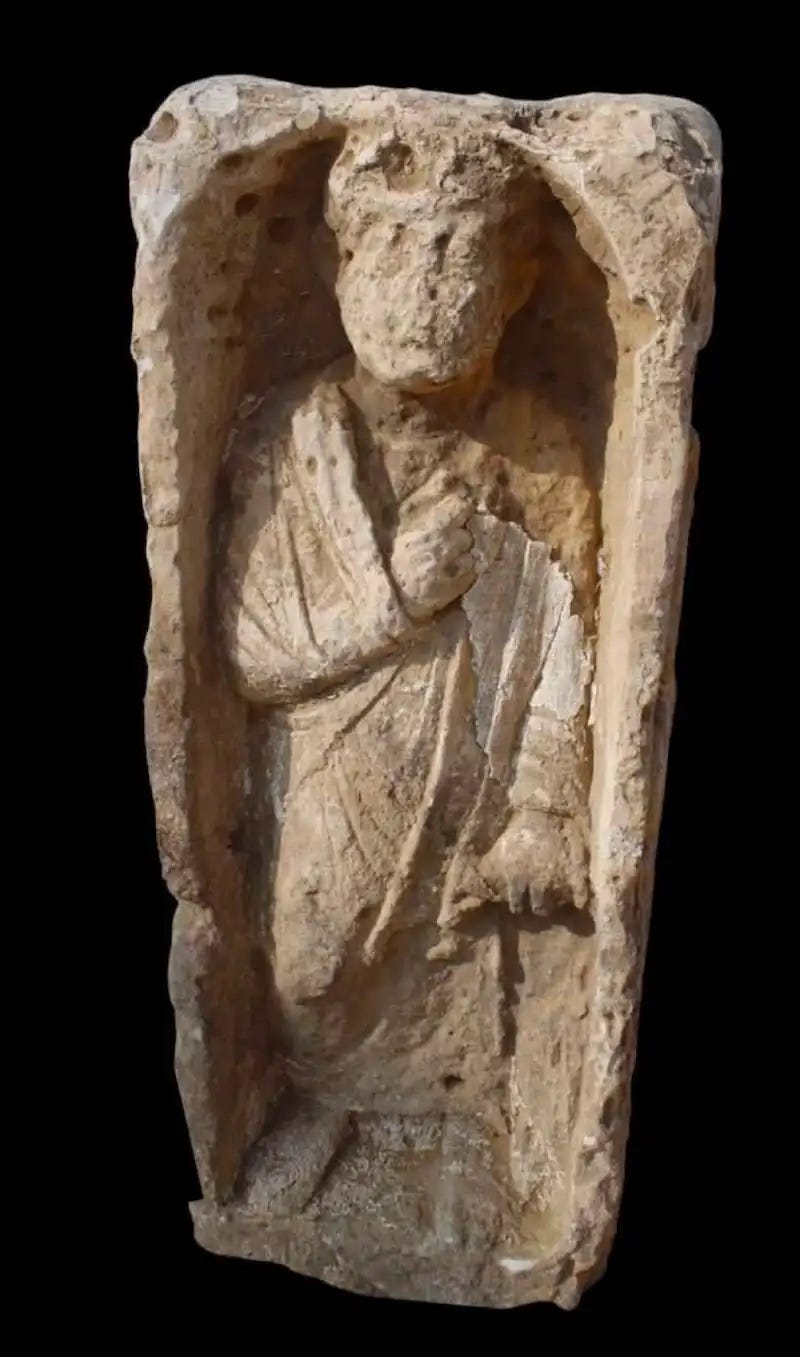
Twenty limestone stelae
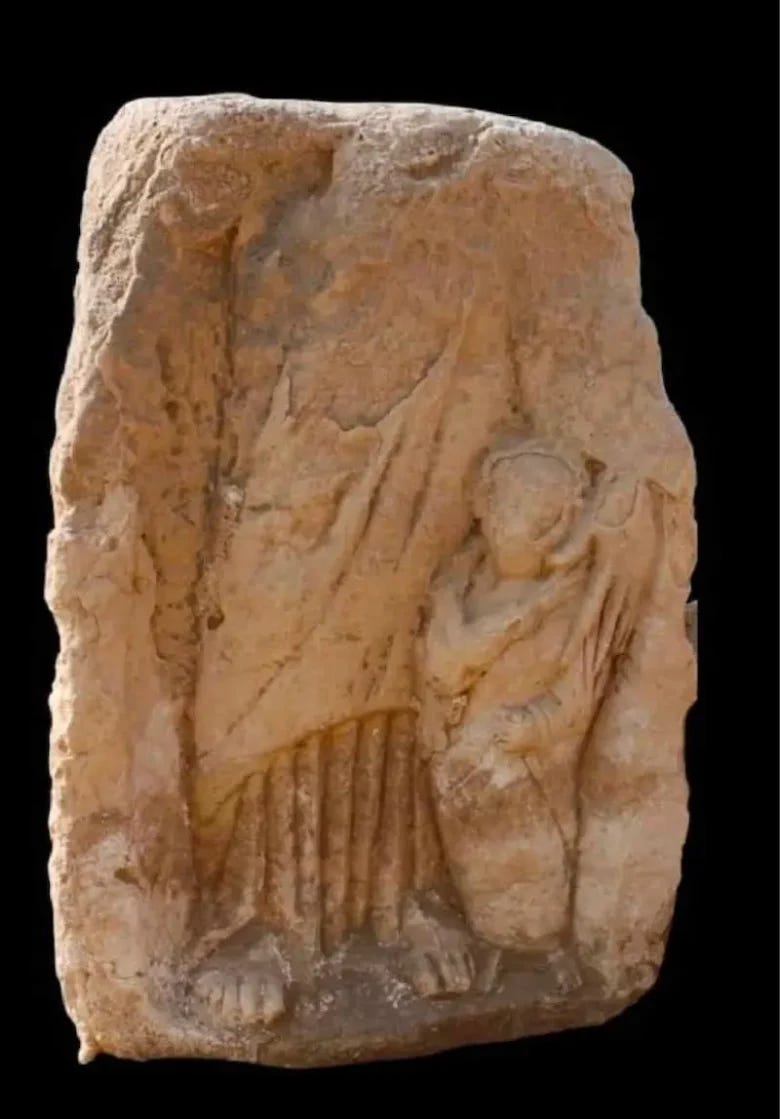
Mohamed Abdel-Badie, head of the Egyptian Antiquities Sector, described the tombstones as about twenty pieces, all carved in limestone and unique in their workmanship. Their fronts carry human figures rendered in a refined style. Their lateral sides and reverses are engraved with religious symbols and deities, among them the griffin, Agathodaimon, and Isis-Thermouthis.
For Abdel-Badie, that iconographic repertoire reflects a cultural crossroads between Egyptian religious tradition and Greco-Roman influence, and also indicates the high social standing of those buried beneath the stones.
Two serpents from two traditions
The specific combination repays a closer look, because it is not decorative eclecticism. It is theological.
Agathodaimon is the beneficent serpent of Greek tradition, associated with good fortune and, in Egypt, with the god Serapis. Isis-Thermouthis is a fusion in its own right, joining Isis with Renenutet, the Egyptian harvest deity represented as a cobra, whose Greek name was Thermouthis. The Hellenistic world eventually assimilated her to Agathodaimon precisely because both took serpent form. The griffin, a hybrid creature of Mesopotamian origin later absorbed into Greek art, completes the set.
These pairings are documented elsewhere in Greco-Roman Egypt on objects held in major collections, where Agathodaimon and Thermouthis appear as matched agrarian and fertility deities flanking Serapis and Isis. What the Tell el-Deir stelae show is that repertoire applied to the funerary monuments of a delta community, a combination that could only have emerged after centuries of contact between Egyptian and Greek populations had reshaped burial ritual in the region.
Incense, lamps, and barrel-shaped coffins
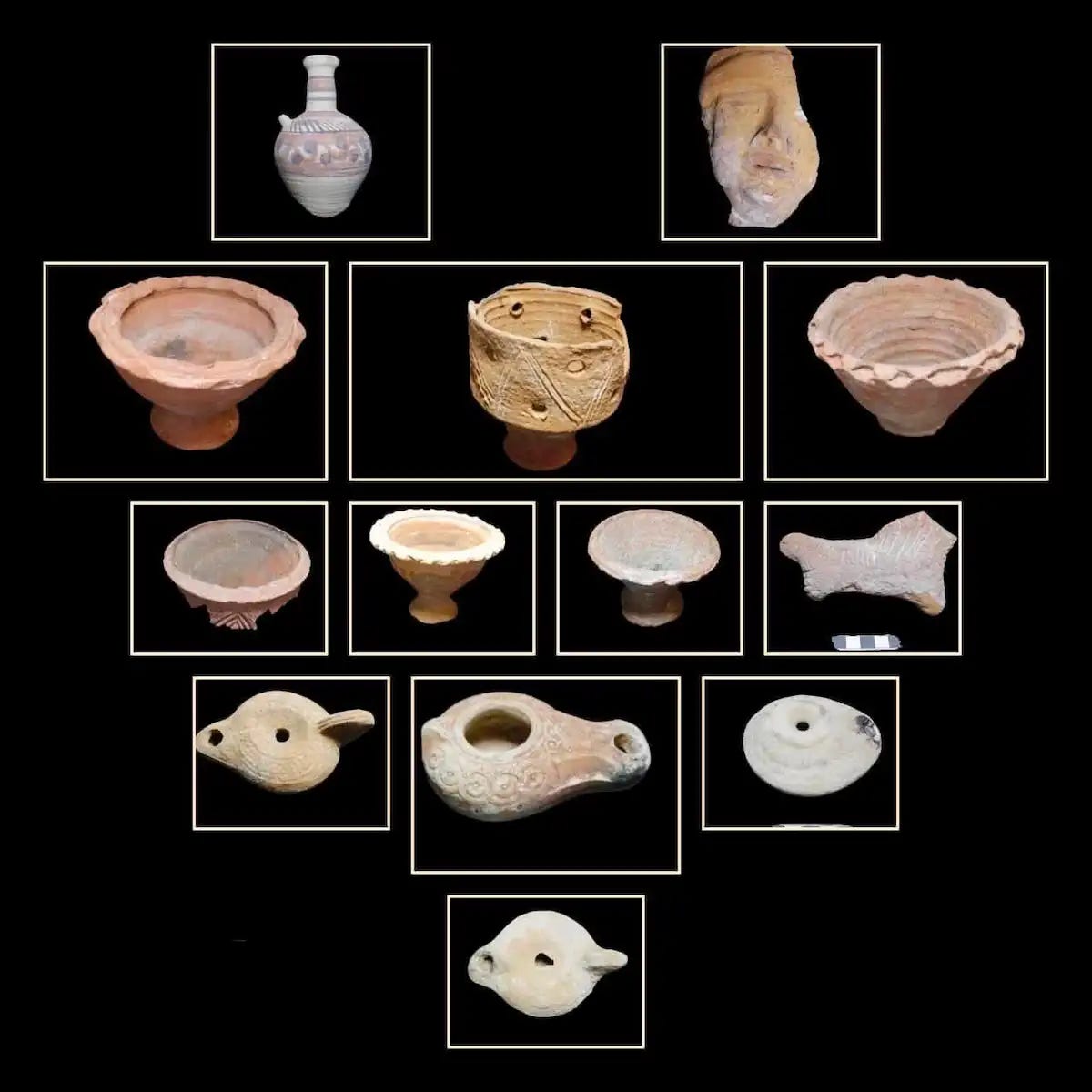
Alongside the stelae, the mission recovered a wide and varied collection of ceramic incense burners and decorated oil lamps in many different forms, together with anthropoid sarcophagi of barrel-shaped ceramic and a number of funerary amulets.
Barrel-shaped pottery coffins of this kind are characteristic of later delta burial practice, and their presence alongside the syncretic stelae reinforces the picture of a cemetery in active use well into the Greco-Roman period.
A funerary centre, not just a cemetery
Hisham El-Leithy, secretary general of the Supreme Council of Antiquities, said the discovery opens new avenues for understanding how the delta’s necropolises developed, and confirms that Tell el-Deir was not simply a burial ground but a complete funerary centre with its own defined social, cultural, and religious identity.
He added that the find strengthens the site’s standing as one of the most significant in the eastern delta, with the potential to revise the settlement map and the record of ancient cemeteries across the region, and to add to what is known about the history of Damietta governorate in antiquity. El-Leithy noted that the Council is providing full support to the mission this season, following instructions from Minister of Tourism and Antiquities Sherif Fathy to facilitate the work of expeditions across Egyptian sites.
A site with a long record
Tell el-Deir has been yielding material for years, and the accumulated sequence is part of what makes this season’s finds legible. The necropolis spans Egypt’s Late Period through the end of the Roman era.
Earlier seasons produced burials of the Twenty-sixth Dynasty, the Saite period, the last native ruling family before the Persian conquest of 525 BC, including bodies covered with thin gold foils shaped as Isis, Bastet, and Horus, alongside scarabs and miniature pottery canopic jars. A 2024 campaign uncovered mudbrick chambers still holding their grave goods after some 2,500 years, among them a pottery vessel containing 38 bronze coins of the Ptolemaic period. In 2019 the mission found Byzantine gold coins depicting the emperors Phocas and Heraclius, along with limestone coffins carved with human faces.
Sources: Egyptian Ministry of Tourism and Antiquities and Supreme Council of Antiquities, July 30, 2026, via Xinhua. Background on Tell el-Deir from prior excavation seasons reported 2019 to 2024. Comparative material on Agathodaimon and Isis-Thermouthis in the collection of the Metropolitan Museum of Art.