


In 1988 Iraqi archaeologists working in the Northwest Palace at Nimrud noticed that parts of a baked-brick floor in the palace’s southern, domestic section sat at odd angles. The team of Muzahim Mahmoud Hussein lifted the paving and found a vaulted tomb beneath it, sealed with brickwork inscribed with the name of Ashurnasirpal II. More tombs followed in 1989. Amy Gansell’s 2018 study in the American Journal of Archaeology calls these burials the only evidence for royal Neo-Assyrian women’s dress found in its original setting. The finds sit beside a much larger body of royal imagery carved in stone, and the two sources do not line up neatly.
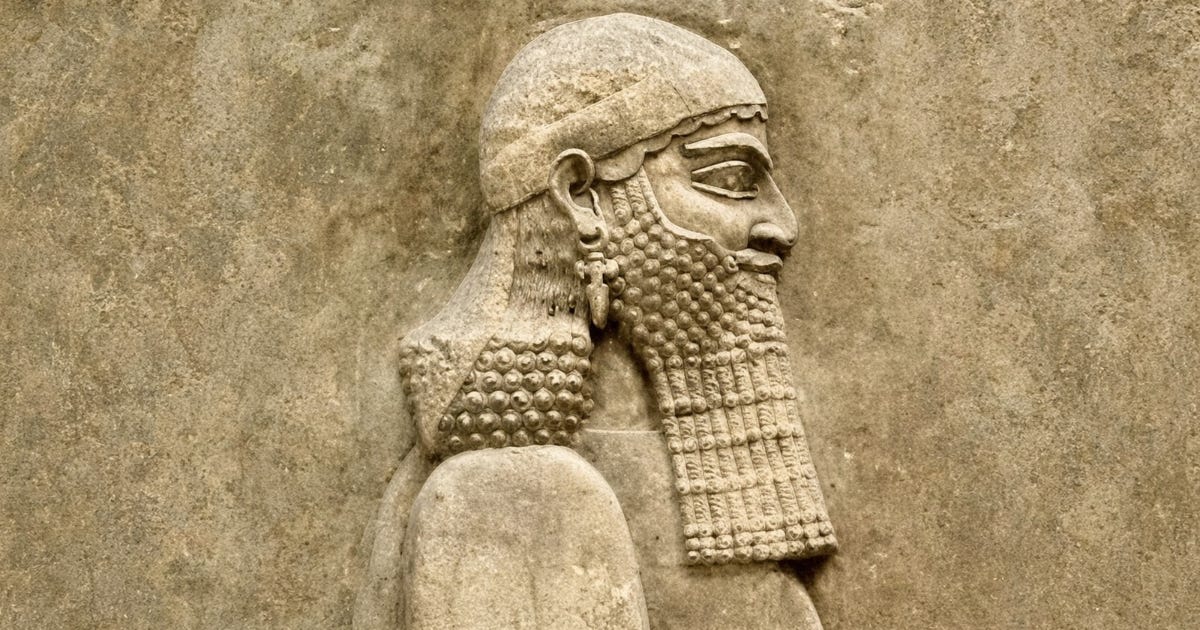
A figure on the relief of Sargon II from the palace at Khorsabad, perhaps Crown Prince Sennacherib, wears an ornate headband and richly sculpted dress. About 710 BCE, Louvre, Paris. Credit: Marco Prins / Livius.org, CC0 1.0. Upscaled and resized.
Each queen was buried with a standard set of jewellery and garment ornaments
Gansell proposes a standard but flexible ensemble for a queen. It consists of a headdress, earrings, collars, beads, bracelets, up to ten matching rings, anklets, fibulae, seals and an ornamented garment. Each queen wore a diadem with a streamer at the back. Tombs II and III together held more than 300 earrings.
Tomb II was the most intact. A calcite sarcophagus shaped like a bathtub held two women in their early thirties, laid one on top of the other and buried about a generation apart. Objects inside name Atalia, a queen of Sargon II, and a queen of Tiglath-pileser III called Yabâ, and one of Shalmaneser V called Banitu. The two names may belong to one woman. The tomb held about 26 kg of gold, including two crowns. Many gold pieces carry a scorpion symbol used for royal women instead of a name.
Gansell observes that each tomb holds more jewellery than a single person could wear at once, which points to personal selection. Some pieces may have arrived with dowries or come from outside Assyria. Jewellery was also gendered. Men and eunuchs wore different earrings and arm cuffs from women.
A crown from a bronze coffin belongs to a young queen named Hama
Tomb III was built for Mullissu-mukannišat-Ninua, a queen of Ashurnasirpal II. The lid inscription also names Shalmaneser, and scholars debate why. Her alabaster sarcophagus was nearly empty, with a bead and a fragment of bone. Bronze coffins in the antechamber held other burials. Coffin 2 contained a young woman wearing a gold and lapis lazuli crown. It stands 16 cm high and 24 cm across, with leaves, flowers, grapes and winged female genies. Wikipedia’s summary of the research notes it has no known parallel, and scholars have suggested western Syria, eastern Cilicia or Assyria itself as its origin.
A gold stamp-seal pendant from the coffin names Hama, queen of Shalmaneser IV and daughter-in-law of Adad-nirari. In 2017 Tracy Spurrier argued in the Journal of Near Eastern Studies that the pendant, the royal treasure, the coffin’s position in another queen’s tomb and the bones of a woman aged about 18 to 20 identify the occupant as Hama. Green copper staining on the bones suggests the body stayed in the coffin throughout decomposition. Yasmina Wicks had argued in 2015 that a personal pendant need not belong to the person buried with it, and later scholars have found Spurrier’s case the stronger one.
