


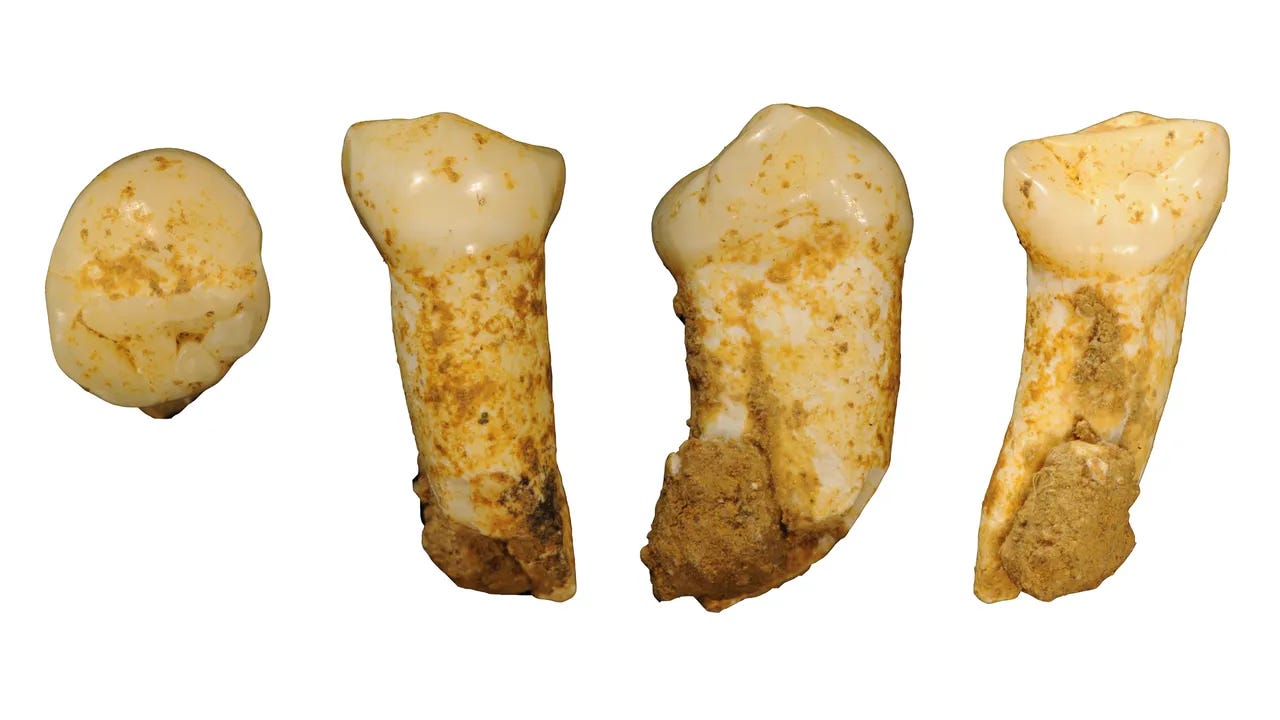
Four teeth from two caves in Guangxi, southern China, have been assigned to two different groups of archaic humans. Two belong to a Denisovan-affinity lineage. The other two come from a lineage the authors call unresolved archaic Homo. The study, by researchers at the Institute of Vertebrate Paleontology and Paleoanthropology (IVPP) of the Chinese Academy of Sciences and the Guangxi Institute of Cultural Relics Protection and Archaeology, appeared in Nature on 25 November 2026. Chinese outlets date it 26 November because of the time difference. Song Xing, Huiyun Rao and Guangmao Xie are named among the authors, and Qiaomei Fu designed and supervised the project.
Two caves, four teeth and no tools
The teeth were recovered in 2021 during a survey of a migration corridor across Guangxi that began in 2015. Chuanshandong, in Long’an County near Nanning, produced a pair of lower premolars, possibly from one individual. Longchuandong, in Luzhai County near Liuzhou, produced an upper second molar and a lower premolar. No stone tools or other cultural remains were found with the teeth. Most fossils at Longchuandong are isolated teeth, so the authors think water carried them into the cave.
Enamel proteins stand in for DNA
DNA survives poorly in the warm, humid conditions of southern China. The team therefore extracted proteins from tooth enamel, the approach previously used on Homo antecessor and the Dmanisi Homo erectus material. The public proteomics dataset lists three teeth analysed, and the team also compared tooth shape with other fossils.
The Longchuandong teeth line up with Denisovans
The Longchuandong molar most closely resembled Denisova 4 across the dental features studied. Both Longchuandong teeth carry the enamel protein variant AMBN 273V, and in the protein tree they group with Denisova 3 with full statistical support. Uranium-series ages range from about 104,500 to 42,600 years. The authors write that the samples are likely to represent a Denisovan-affinity lineage.
This is the first Denisovan fossil evidence from the subtropical Lingnan region, which covers much of today’s Guangdong and Guangxi. The paper lists Denisovan evidence in Siberia, northern China, the Tibetan Plateau, the Taiwan Strait, subtropical southern China and tropical Laos.
The Chuanshandong teeth fit no known group
The Chuanshandong premolars carry AMBN 253G, previously reported only in late Homo erectus from Zhoukoudian, Hexian and Sunjiadong. They also carry an ancestral form of amelogenin (AMELY 179M) shared with Homo antecessor and great apes, and they lack the 273V variant. In the protein tree they fall as a sister group to the common ancestor of Neanderthals, Denisovans and modern humans.
The authors call this placement preliminary. The AMBN 253G call rests on nine peptides and could shift with more data. They suggest mixing among archaic groups or gene flow from Homo erectus as possible explanations. They do not propose a new species.
Dating is firm for one tooth and loose for the rest
Uranium-series dating of one Chuanshandong premolar gave about 100,800 years, treated as a minimum age. Luminescence dates for the Chuanshandong sediments are far younger, about 49,500 to 34,200 years, and the authors suggest burial may lag well behind the true age of the teeth. Animal fossils indicate both sites are younger than about 300,000 years. Four teeth cannot show population size, how long either group lasted, or whether they overlapped in time.
A year of Denisovan and archaic finds in China
The paper follows a run of 2026 results. In September, Nature published Denisovan remains from Bianfu Cave in Yunnan, which include an arm bone, two skull fragments and four teeth. An October Nature study by Xing and colleagues argued that Xujiayao in northern China belongs to the Denisovan lineage. In November, two papers placed Homo erectus teeth from Baxian and Naxian caves, also in Guangxi, at roughly 324,000 to 184,000 years old.
The IVPP team suggests the unknown lineage either evolved in response to Lingnan’s environment or ranged widely across East Asia and later retreated there. They describe southern China as both a geographic refuge and an evolutionary melting pot for archaic humans.
See: Longchuandong Cave on the Ancient Content Historical Atlas
Subscribe for a few dollars a month and get every long read, the short documentaries and the full archive. Cancel anytime.
Sources:
Xing, S., Rao, H., Xie, G. et al. (with Fu, Q.). “Middle–Late Pleistocene Denisovans and unresolved Homo in southern China.” Nature, published 25 November 2026. DOI 10.1038/s41586-026-11341-6. https://www.nature.com/articles/s41586-026-11341-6
Proteomics dataset PXD071210, PRIDE repository (submitter Xiao Wang, lab head Qiaomei Fu). https://www.omicsdi.org/dataset/pride/PXD071210
Chinese Academy of Sciences, “Fossils Extend Denisovan Range into Subtropical South China, Reveal Unknown Human Lineage”, 26 November 2026. https://english.cas.cn/newsroom/cas-in-media/202611/t20261126_1220924.shtml
Xinhua, same title, 26 November 2026. https://english.news.cn/20261126/ac0f91e773474b9f856962af34405b81/c.html
Context on Bianfu Cave, Nature Asia-Pacific press release, 11 September 2026. https://www.natureasia.com/en/info/press-releases/detail/9437
Context on Baxian and Naxian caves, EurekaAlert, November 2026. https://www.eurekalert.org/news-releases/1152246
How extraordinary that four teeth can tell us so much, yet leave us with so many unanswered questions. I rather appreciate the researchers' restraint in not rushing to declare a new species.