


In 1978, on the eastern shore of Lake Turkana in northern Kenya, a geologist noticed a deep rounded dent in the rock while her colleagues dug a trench to examine the sediment layers. It was a hippopotamus track. When the crew cleared that surface, two hominin footprints emerged beside it.
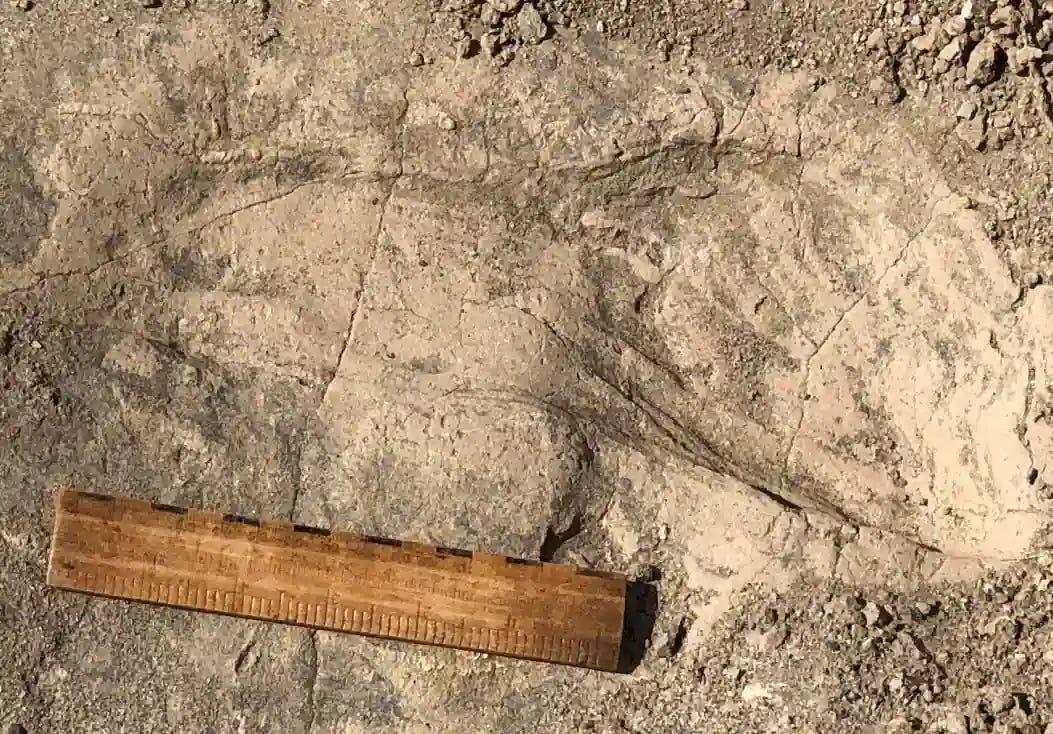
Nearly fifty years later, that surface has produced a result that overturns what paleoanthropologists thought they knew about the body size of Paranthropus boisei, an extinct human relative long assumed to have been considerably smaller than its contemporaries. The footprints indicate individuals standing up to 1.8 meters tall and weighing around 75 kilograms, comparable to a large modern human.
The study, published in the Proceedings of the National Academy of Sciences on July 27, 2026, was led by Kevin Hatala of Chatham University in Pittsburgh, who is also an associated researcher in the Department of Human Origins at the Max Planck Institute for Evolutionary Anthropology in Leipzig.
A site that took five decades to read
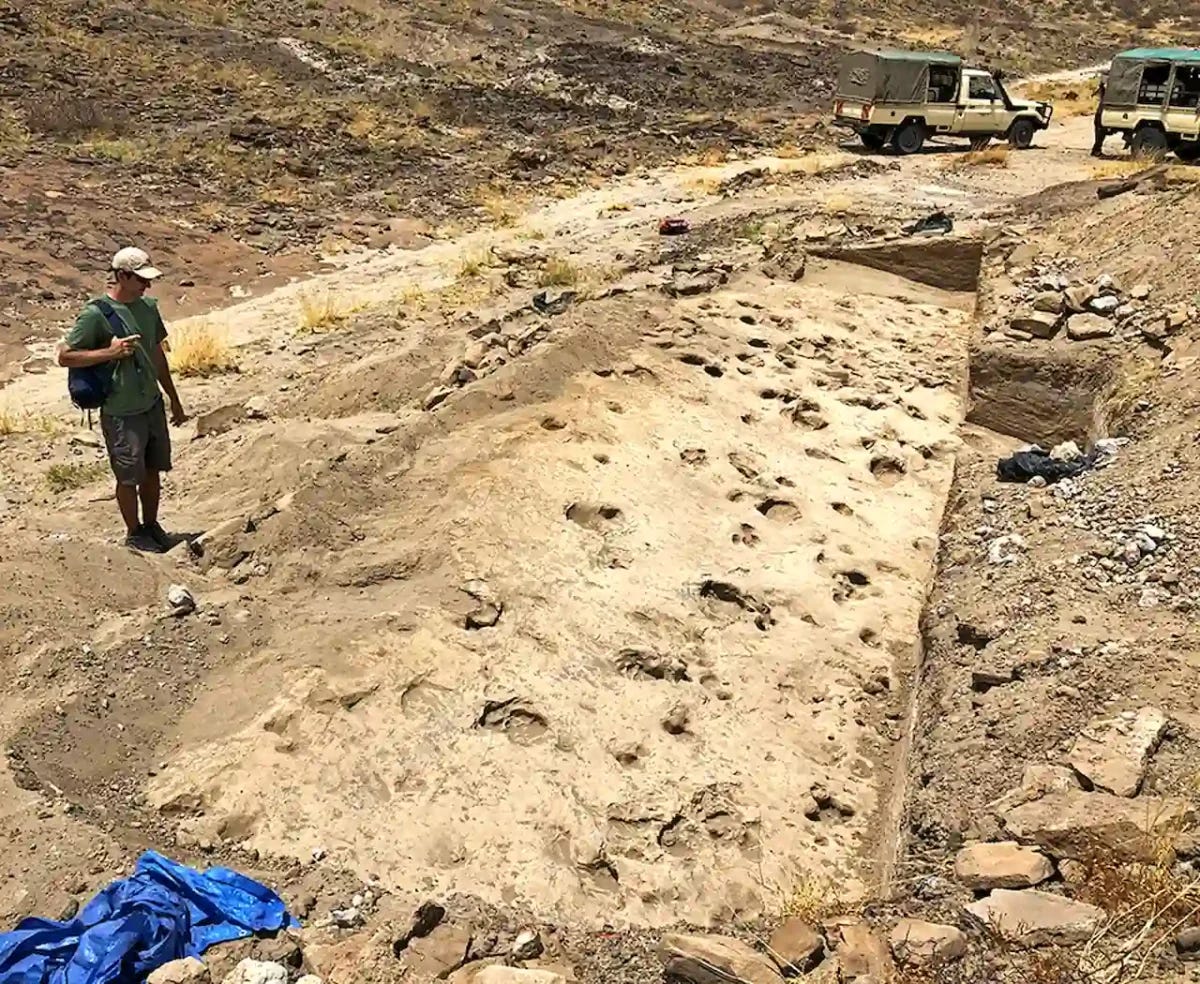
The geologist was Kay Behrensmeyer of the Smithsonian’s National Museum of Natural History, who has worked in this region since 1969. After she and her team documented the first prints in 1978, the site, designated GaJi10, was reburied in sand to protect it. The team returned in 2016 and again in 2023, uncovering far more of the same layer each time.
The surface now preserves 21 hominin footprints made by eight individuals, alongside tracks left by hippopotamus, antelope, and other animals. Volcanic ash in the surrounding rock dates the layer to roughly 1.43 million years ago, in the Early Pleistocene.
Behrensmeyer has been direct about why footprints matter in a discipline built largely on bones. What makes them scientifically valuable, she notes, is that they preserve an instant in time, and they let people connect with these fossils far more readily than an isolated fragment of bone or jaw can. On the length of the project, she has said she never imagined in 1978 that the find would grow into an assemblage this large or yield insights this broad into hominin ecology.
Why the size is a problem
Almost everything known about Paranthropus boisei comes from the head. The species is represented overwhelmingly by skulls with massive jaws and heavy grinding teeth, and its anatomy below the neck has remained poorly documented. Earlier estimates, built from a small number of postcranial fossils, suggested it was substantially smaller than Homo erectus, the contemporary species generally considered a possible direct ancestor of modern humans.
The GaJi10 tracks contradict that. The team identified them as Paranthropus using analytical methods they developed in 2024, based on foot anatomy and patterns of movement preserved in the prints. The sizes then came as a surprise, since they fall in the same range as tracks attributed to Homo erectus.
That matters beyond a single measurement. If Paranthropus was as large as Homo erectus, then two similarly sized hominins were sharing the same landscape at the same time, which changes how researchers should think about competition, resource use, and coexistence along this lakeshore.
The two species were certainly both present. In 2024, members of the same team described a slightly older trackway nearby preserving prints from both Paranthropus and Homo erectus, evidence that they occupied the same habitats across hundreds of thousands of years. What is not known is how they behaved toward one another. Behrensmeyer puts the limit plainly, that we cannot say how the two hominins interacted on the mudflats, only that both were there at the time.
Eight adults, no children
The footprints also record something bones cannot, which is a group in motion.
All eight individuals appear to have been adults, and mostly adult males. There are no juveniles and no clear evidence of females in the group. Neil Roach of Harvard University, a co-author, takes that composition as a hint at social complexity, suggesting these hominins may have lived in large groups where males competed for mates but also tolerated one another at times, gaining safety in numbers in a dangerous environment.
The landscape justified the caution. The same shoreline at that period supported crocodiles, elephants, hippopotamus, and the other large animals whose tracks cross the same surface.
Why the lake keeps appearing
GaJi10 belongs to a larger pattern. Researchers have now documented hundreds of hominin footprints across more than half a dozen sites along the eastern shore of Lake Turkana, deposited over a span exceeding 100,000 years.
Behrensmeyer finds the geological repetition striking, noting that the same kind of lake margin deposits occur in two areas of East Turkana some 40 kilometers apart and of roughly the same age. Her working question is what conditions allowed these tracks to be preserved at all, on the reasoning that understanding the preservation should help explain why hominins kept returning to this environment across so long a period.
Purity Kiura of the National Museums of Kenya, a co-author, framed the find in terms of what it means for the region and for stewardship of it. The footprints along the margins of Lake Turkana, she said, reinforce the area’s global importance for understanding human evolution and preserve remarkable evidence of how these relatives lived 1.4 million years ago, strengthening Kenya’s standing as one of the world’s leading paleoanthropological landscapes and underlining the responsibility to protect that heritage.
The team returns to Kenya later this year. Hatala describes the accumulating sites as a photo album under construction, each one a snapshot offering a different window onto hominin anatomy, locomotion, behavior, and environment in the Early Pleistocene.
Sources: Max Planck Institute for Evolutionary Anthropology and Smithsonian Institution, press releases, July 27, 2026. Hatala, K.G., Roach, N.T., et al. (2026). “Insights Into Hominin Body Size, Locomotion, and Behavior From Early Pleistocene Trackways in Northern Kenya.” Proceedings of the National Academy of Sciences 123(31), e2530996123. doi.org/10.1073/pnas.2530996123
I’m still as fascinated by these “digs” as I was when first reading those original Nat Geo articles decades ago.
Besides traveling in a group for safety, do they have any sense of what else this group might have been doing? Hunting? Migrating?