


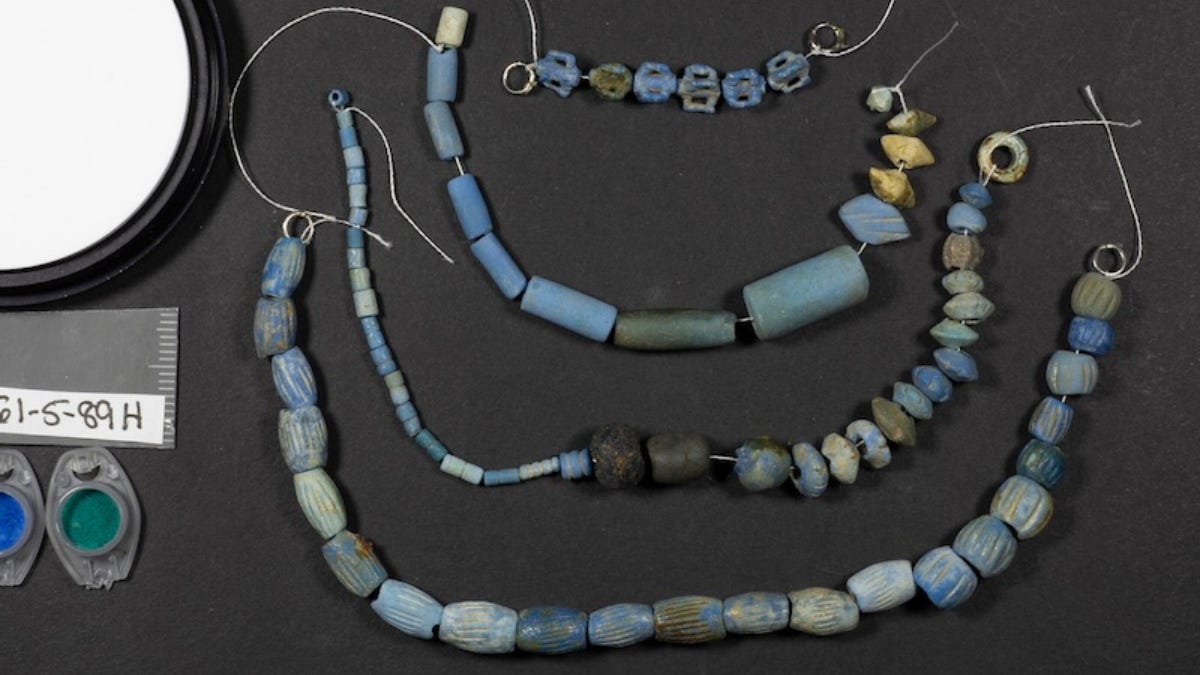
Around five hundred objects made of moulded Egyptian blue paste have been identified in the Penn Museum's collections from Hasanlu and Dinkha Tepe, two Iron Age II sites in northwestern Iran. They were excavated by the Hasanlu Project between the 1950s and the 1970s and have sat in storage since.
Penn Today spoke to Vanessa Workman, an archaeometallurgist in the School of Arts and Sciences who also works at the museum’s Center for the Analysis of Archaeological Materials, and Alexis North, a museum conservator, about the material and what they are doing with it.
What Egyptian blue is and why making it was difficult
The pigment gets its colour from crystals, and its chemistry is identical to a naturally occurring mineral called cuprorivaite. Workman points out that cuprorivaite is very rare indeed in the earth’s geology, so where you find it, it is almost always synthetic.
Making it means combining a copper-bearing material, silica in the form of quartz sand, an alkali such as plant ash or natron, and calcium carbonate such as limestone, then grinding the lot to a fine powder and firing it in a closed vessel at a controlled temperature.
Workman describes it as the earliest known synthetic pigment, and draws a distinction that matters. People had been throwing yellow ochre into fires to turn it red for hundreds of thousands of years. This is different. This is the first case of craftspeople using pyrotechnology to fundamentally alter the composition of a mixture in order to produce a colour.
The same process yields a green, known as Egyptian green, chemically very similar but with a slightly different crystal structure. North’s point is that the craftspeople had worked out how to adjust the recipe for the shade they wanted.
Nothing comparable appears again for a very long time. Han blue, made by a broadly similar process, comes more than two thousand years later, and Maya blue, made by bonding a clay to indigo, more than a thousand years after that.
Blue is uncommon in the mineral world, and producing it took more work than the other colours in use. As Workman puts it, this was a deliberate piece of thinking, an instance of we want this, how do we make it.
The scale in Iran is the surprise
Egyptian blue was used in Egypt as a paint from about five thousand years ago, and later as a material for small objects like beads and vessels. Most of the blue paint in Egyptian art is Egyptian blue.
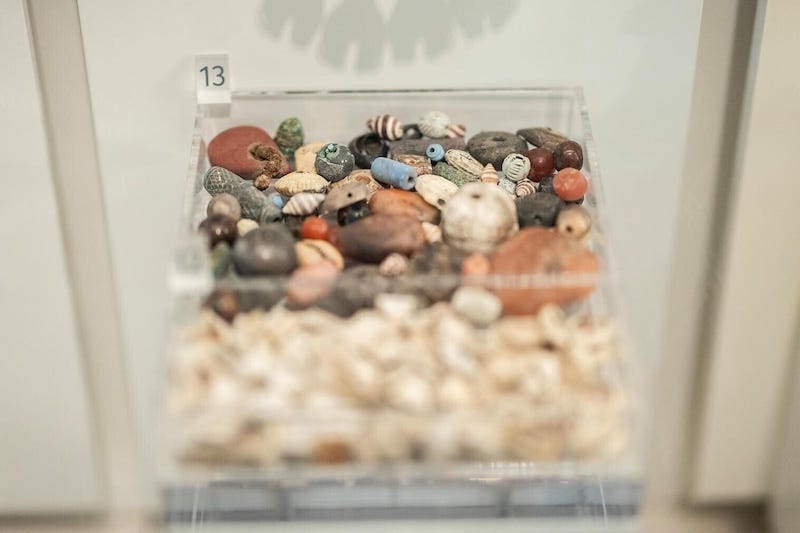
What turns up at Hasanlu and Dinkha Tepe is something else. A student project first drew the team’s attention to the quantity of it, and Workman says they realised how much material there was and how unusual that was. In Egypt and the wider Near East people were painting objects with the pigment and making small beads and scarabs. Here there are large furniture legs, vessels, decorative wall tiles, bracelets and anklets.
North notes that identifying the pigment is straightforward, because it luminesces in a way that infrared photography picks up. Photographing anything suspected of carrying traces of it has become standard practice in the museum’s conservation work, and it is easy and non-destructive.
What they are testing for now
With the objects catalogued, the team has moved on to the pigment itself. They are testing for chemical differences, using microscopy to work out production techniques, and looking at what the destruction of Hasanlu did to the material.
That destruction is worth explaining. Around 800 BC the settlement was attacked and burned, its inhabitants killed where they fell, and the site left with an extensive burned layer holding hundreds of skeletons. It is where the Hasanlu Gold Bowl came from, and where the two skeletons known as the Hasanlu Lovers were found. The fire is why so much survives, and it is also something the team now has to account for when reading the pigment’s condition.
They are also looking at isotopic signatures in the raw materials, which could narrow down where those came from and where the objects were made.
The claim that would matter most
If the pigment was made in northwestern Iran, Workman says, it would be the earliest known instance of Egyptian blue being produced outside Egypt.
That is the finding to watch, and it is conditional. How these craftspeople obtained the materials, and where they learned the technique, are both still open.
Workman’s broader argument is that chemical and isotopic analysis gives you tools for studying human mobility and connection, and the history and routes of a technology. People in the past, she says, keep turning out to have moved across much larger distances than anyone assumed.
Thanks for reading. Support Independent Ancient Content. Your support helps me create more archaeology posts, articles, and mini history videos:

Sources: Penn Today, University of Pennsylvania, 11 August 2026, interviews with Vanessa Workman and Alexis North, via Arkeofili. Background on Hasanlu from the Penn Museum’s Hasanlu Project archive and the Metropolitan Museum of Art.
Interesting that blue should be found from that period in Iranian history, as the colour is so well-associated with porcelain ware from a later period in the country's cultural repertoire.
So interesting, thank you.
Blue is always a complicated colour, in plants too, not so many blue flowers around.