


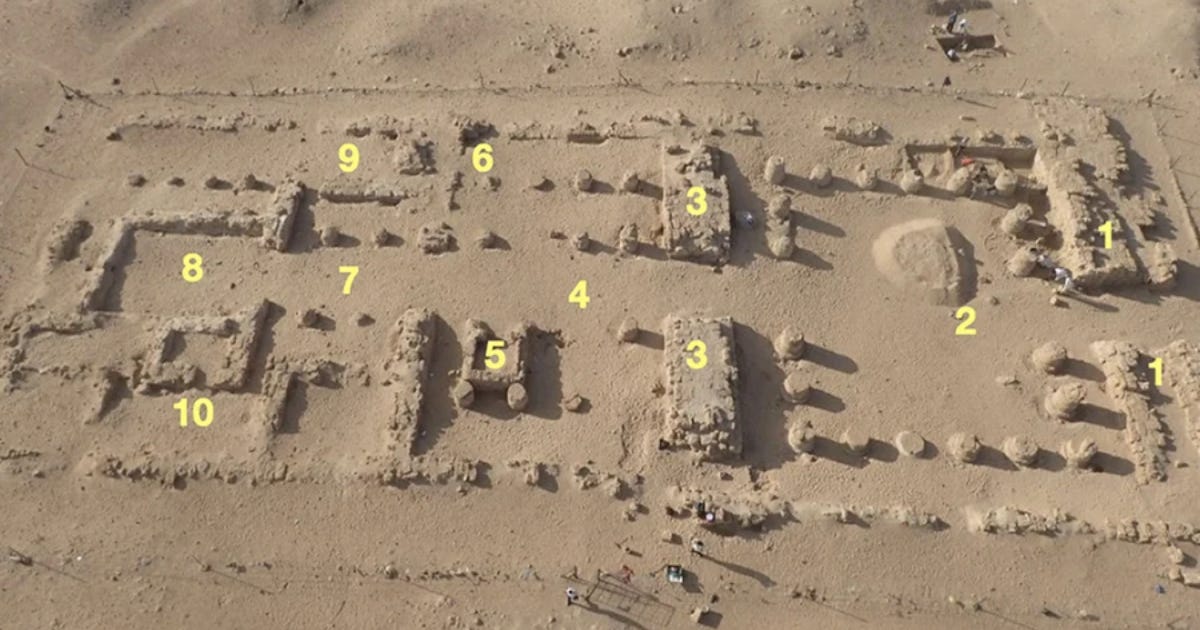
Excavated mudbrick remains at the Sanam Temple, Napata, Sudan. Photo: from Lemos et al. 2026, Antiquity, CC BY 4.0.
Archaeologists have uncovered a workshop that made faience, the glassy blue and green ceramic of the ancient Nile valley, directly behind the Sanam Temple at Napata, the capital of the Kushite kingdom in what is now Sudan. Dated to about the middle of the seventh century BCE, it appears to have supplied funerary figurines for the royal cemetery at Nuri, and its makers used crushed Red Sea shells in place of limestone.
Ancient Content, October 19, 2026
Three firing pits and two basins stood just outside the temple wall
The Sanam Temple lies in Napata, near the Fourth Cataract of the Nile in northern Sudan. King Taharqo, a Kushite ruler of the 25th Dynasty who also held Egypt, built it in the seventh century BCE and dedicated it to Amun-Bull-of-Nubia of Sanam. The British Egyptologist Francis Llewellyn Griffith dug there for a single season in 1912. A team led by Rennan Lemos of Durham University and Kathryn Howley of New York University’s Institute of Fine Arts returned from 2018 to 2020, the first excavations at the site in more than a century.
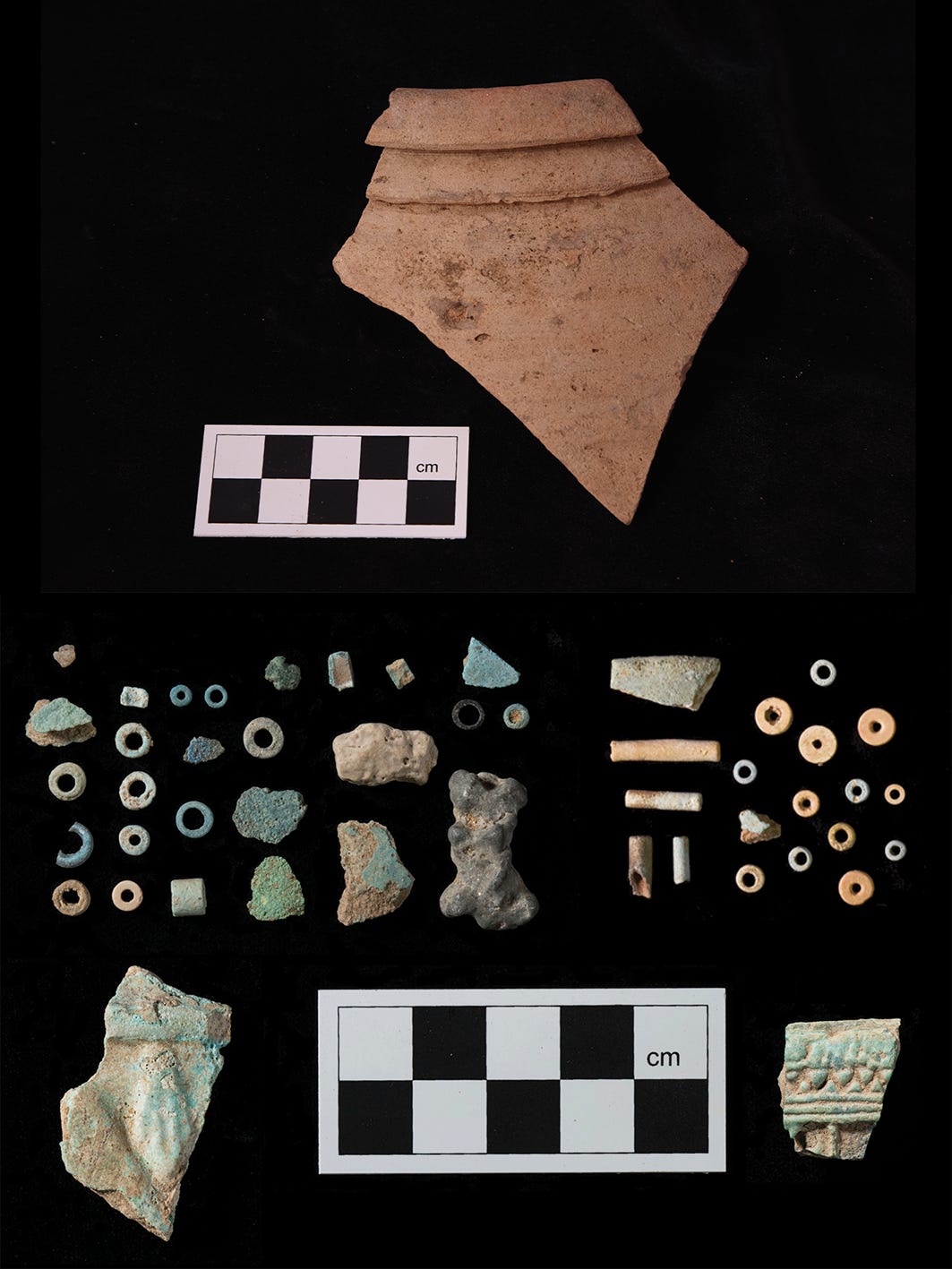
Above, an Egyptian marl storage jar rim from the compacted layer beneath the faience workshop at the Sanam Temple, Napata, Sudan. Below, multicoloured faience disk beads, vessel fragments and wasters from the workshop. Photo from Lemos et al. 2026, Antiquity, CC BY 4.0.
Behind the rear of the sandstone temple they found the workshop. It consisted of three firing pits and two mudbrick basins, set in compacted, ashy layers that also held hundreds of blue, green and white disk beads, fragments of faience vessels, small shells and wasters, the failed pieces that potters discard. The builders had laid a thin, hard surface of broken storage jars beneath it, apparently to give the fires a stable floor.
Faience needs a firing temperature of roughly 900 degrees Celsius. The authors note that simple kitchen-style ovens can reach it, and the evidence does not show whether the Napatan workers used purpose-built kilns or removable covers.
A clay mould inside the temple matches a faience shabti from the workshop
Shabtis are small funerary figurines placed in tombs to work on behalf of the dead. In 1912 Griffith recovered clay moulds for shabtis and amulets at Sanam and published them in 1922, but without a clear archaeological context. The American archaeologist George Reisner had meanwhile excavated faience shabtis at Nuri, the royal cemetery of the Napatan kings. Griffith’s moulds match those figurines closely.
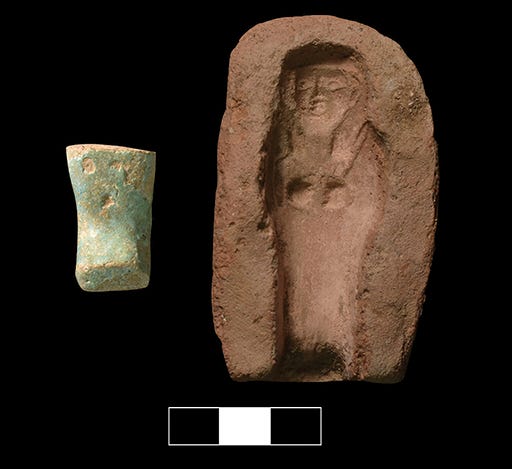
The new excavations tie the two together. A clay mould found inside the temple matches a fragmentary green faience shabti, without an inscription, that came out of the workshop. The authors conclude that the faience funerary goods in the royal tombs at Nuri were probably made in temple workshops of this kind.
The date rests on pottery. No radiocarbon dates are reported. Rims of Egyptian marl storage jars point to the eighth and seventh centuries BCE, while local jars of Nile silt suggest a slightly later date. The abstract places the workshop in the mid-seventh century BCE.
Workers crushed Red Sea shells because Nubia has no limestone
Faience is made from silica mixed with an alkali and lime, fired until the surface turns glassy. Sudanese Nubia has no local limestone, and the Sanam workers found another source of lime. The team recovered thousands of small gastropod and bivalve shells, and the shells were crushed in the mudbrick basins before going into the faience paste.
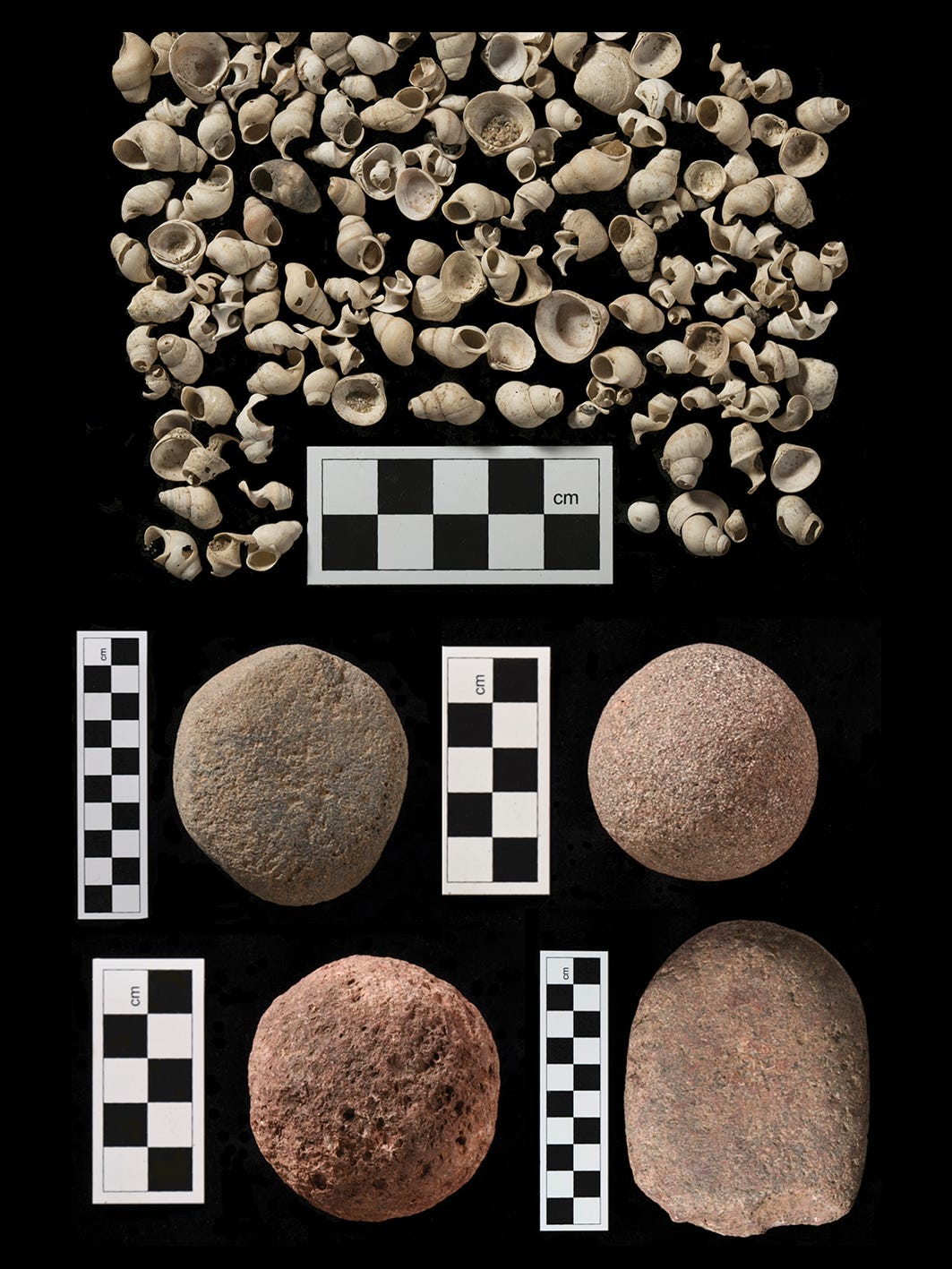
The bivalves are most likely Transkeia globosa, a species from the Red Sea. The gastropods could not be identified with confidence, and the authors say the war in Sudan has prevented further analysis. Lemos describes the recipe as “technical innovation and not simple imitation”, according to Archaeology News Online Magazine. The authors argue that a shell supply brought from a distant coast points to control over raw materials.
Smoke beside a temple suggests the crown valued the link
In Egypt, temples controlled workshops, and temple-linked faience production is known from New Kingdom sites such as Amarna and Piramesse. Egyptian workshops were often placed at the edge of settlements so that fumes would blow away. At Sanam the furnaces stood beside a temple, which the authors read as a sign that tying faience to royal authority mattered more than the inconvenience.
They argue that the workshop shows state control over raw materials, production and elite use of shabtis, a degree of centralisation that resembles Dynastic Egypt. Kushite political models are often described as polycentric, so the claim has limits. The paper itself suggests that non-state household workshops likely supplied other groups, and it points to a house-associated pottery workshop at Napatan Kerma. That is presented as a hypothesis and not as a finding.
The faience has not yet been analysed chemically
The paper reports no compositional analysis of the faience, and it states that Nubian faience has yet to be fully investigated with scientific methods. Griffith generally stopped a few centimetres above the temple floors in 1912, and Howley has reported that the 2018 to 2020 seasons showed undisturbed deposits remain. The Sanam Temple Project describes the faience production areas as the only known ones of the Napatan period.
A must read
The discovery of the faience workshop at Sanam Temple suggests that the Kushite economy derived significant authority from the state-controlled production of prestige goods, rather than relying primarily on land and agriculture as seen in neighboring Egypt. By placing a noxious, smoky manufacturing process directly within a sacred religious precinct, the Kushite state demonstrated a tight integration of royal, religious, and economic power. Furthermore, the innovative use of crushed seashells instead of scarce limestone highlights how ancient trade and resource limitations drove local technological adaptation rather than simple reliance on imported materials.