


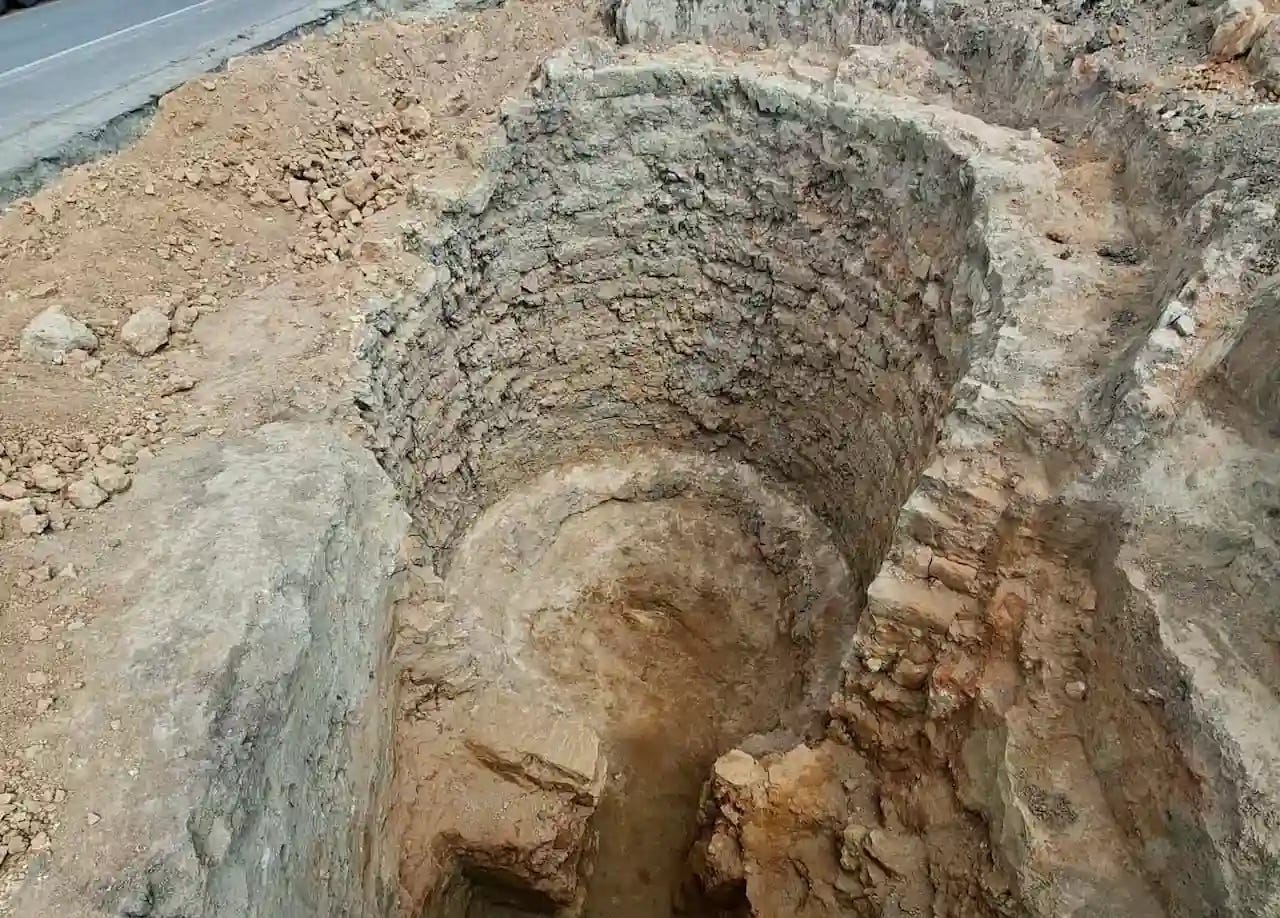
Detail of the Roman lime kiln discovered in Hungary. Credit: Szent István Király Museum.
The kiln was built into the natural slope of a hill, using the landscape itself as part of the structure. Its unusually good preservation makes it one of the most important Roman industrial finds of its type in Hungary in more than a century.
The excavation was carried out by the National Archaeological Institute of the Hungarian National Museum in cooperation with the Szent István Király Museum. The fieldwork was led by archaeologist Alexandra Kiss, with specialists and volunteers participating in the rescue excavation.
Archaeology ahead of motorway expansion
The discovery came to light during spring excavations linked to the widening of the M1 motorway. Large infrastructure projects often reveal archaeological remains hidden beneath modern transport corridors, and this work near Bicske exposed traces of human activity from several periods.
The area had already produced important finds in previous investigations. Earlier work identified part of an early Roman settlement, remains of an Árpád-period settlement, and three Roman-period child burials. The latest excavation added more features from the early Roman and late Árpád periods, along with storage pits and sunken structures from the late medieval and Ottoman periods.
This long sequence shows that the landscape near Bicske was used repeatedly across many centuries. People returned to the same area in Roman, medieval, and Ottoman times, making use of its terrain, resources, and position.
Within this multi-period archaeological landscape, the Roman lime kiln stands out as the most significant scientific discovery.
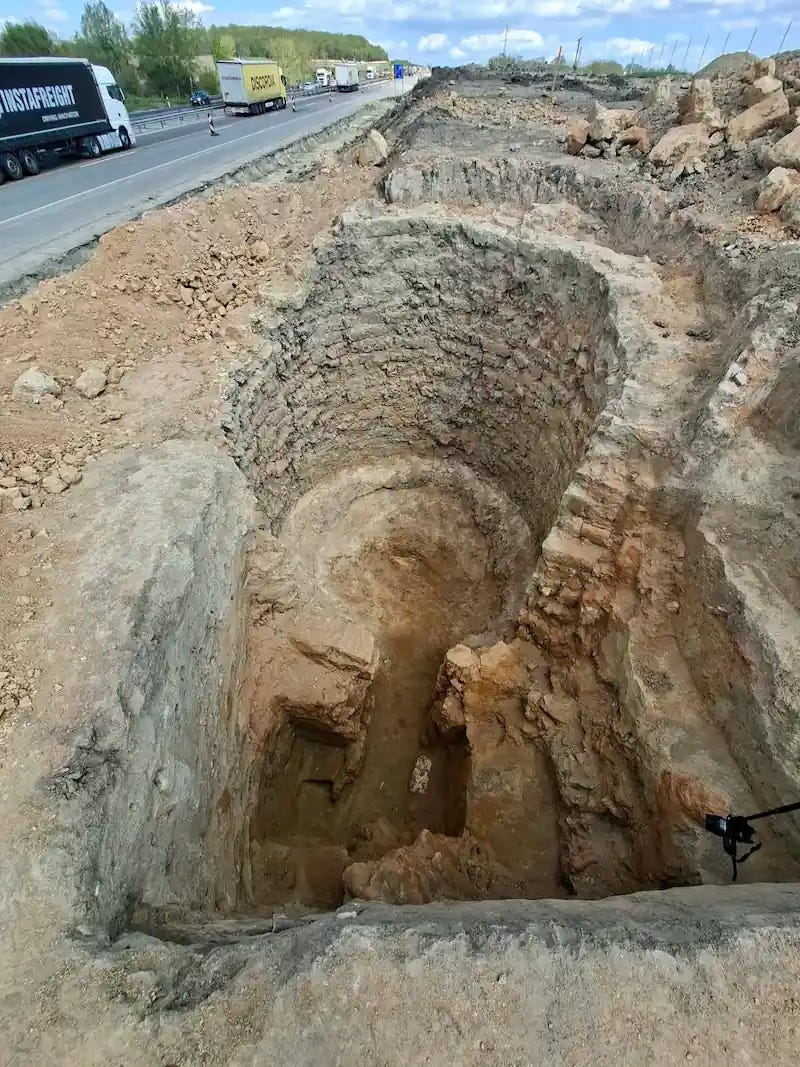
View of the Roman lime kiln uncovered in Hungary. Credit: Szent István Király Museum.
A Roman kiln built into a hillside
The kiln was constructed by taking advantage of the natural slope of a hill. This was a practical and efficient choice. By setting the structure into the hillside, the builders could use the ground itself for support, insulation, and access.
The circular kiln measured about 230 centimeters in diameter and reached a depth of approximately three meters. It was built from mudbrick, and its walls were reinforced with clay plaster. This type of construction would have helped the kiln withstand repeated heating during the lime-burning process.
Archaeologists also identified a firing opening facing west. This opening would have allowed fuel to be added and airflow to be controlled. Around the lower part of the interior wall, a ledge ran in a circular line. This ledge probably supported the limestone that was placed inside for firing.
The structure’s lower section survived in unusually good condition. A thin layer of lime still remained on the floor and side walls, directly confirming the kiln’s original function.
How Roman lime production worked
Lime was one of the essential materials of Roman construction. To make it, limestone was heated at very high temperatures in a kiln. This process produced quicklime, which could then be mixed with water and other materials to create mortar, plaster, and concrete.
Without lime, Roman construction would have looked very different. It was used in walls, floors, baths, aqueducts, villas, military buildings, urban infrastructure, and decorative plasterwork. In provinces such as Pannonia, lime production supported both large-scale public building and local settlement construction.
The Bicske kiln therefore represents more than a single industrial installation. It belongs to the practical infrastructure that made Roman building possible. Behind every stone building, bathhouse, road station, villa, or military installation, there had to be systems for producing and transporting construction materials.
Finds that helped date the kiln
The lower fill of the kiln contained fragments that helped archaeologists date the structure. Among them were pieces of Roman tegula roof tiles and fragments of a grey ceramic bowl with a distinctive S-shaped profile.
Tegulae were flat Roman roof tiles used widely across the empire. Their presence in the kiln fill helps connect the structure to Roman-period activity at the site. The ceramic fragments also provide chronological evidence, helping specialists place the kiln within the early Roman occupation of the area.
These finds are especially valuable because industrial structures are sometimes difficult to date precisely. When datable pottery, tiles, or associated settlement remains are found in or around a kiln, they give archaeologists a clearer chronological framework.
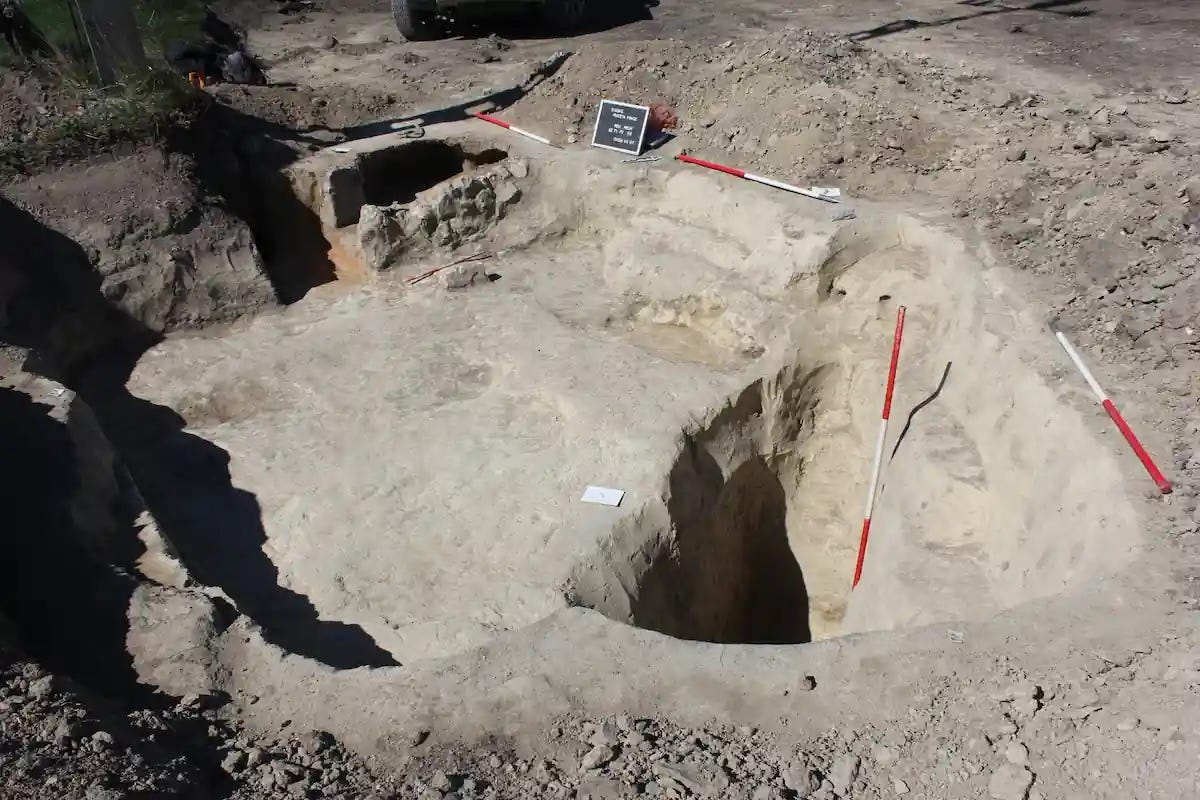
Another view of the excavation area. Credit: Szent István Király Museum.
An exceptional state of preservation
The kiln is considered nationally significant because of its condition. According to the museum’s announcement, a Roman lime kiln preserved to a comparable degree had last been found in Hungary in the early 20th century, during Bálint Kuzsinszky’s excavations at Aquincum.
That comparison is important. Aquincum, in present-day Budapest, was one of the major Roman centers of Pannonia. It included a military camp, a civilian town, public baths, houses, workshops, and urban infrastructure. A lime kiln comparable to the Bicske example was therefore associated with one of the province’s best-known Roman sites.
The Bicske discovery shows that high-quality evidence for Roman industry can also survive outside major urban centers. Rural and roadside landscapes supported the Roman building economy in ways that are often less visible than monumental architecture.
Roman Pannonia and local industry
Bicske lies in Transdanubia, within the territory that once formed part of Roman Pannonia. This region was important to the empire because of its position near the Danube frontier and its network of roads, settlements, military sites, villas, farms, and production zones.
Roman power in Pannonia depended not only on forts and cities, but also on the everyday systems that supplied them. Kilns, quarries, workshops, farms, and storage facilities formed the economic background of provincial life.
The lime kiln near Bicske fits this broader picture. It shows that Roman construction material was being produced locally, probably to support nearby buildings or settlement activity. The kiln may have served a local community, a rural estate, road-related construction, or a wider building project in the region.
The natural hillside setting also suggests practical knowledge. Roman builders and craftspeople adapted their industrial installations to the landscape, choosing locations that made production easier and more efficient.
A landscape used from Rome to the Ottoman period
Although the lime kiln is the most important find, the wider excavation revealed a dense archaeological landscape with remains from several eras.
The early Roman features show activity during the period when Pannonia was integrated into the Roman Empire. The Árpád-period settlement remains point to medieval occupation after the foundation of the Hungarian kingdom. Later storage pits and sunken features from the late medieval and Ottoman periods show that the area continued to be used long after the Roman kiln had gone out of operation.
This continuity matters because it shows how certain landscapes remained attractive across very different historical periods. People settled, stored food, worked, built, and buried their dead in the same general area for centuries.
The Bicske site therefore offers more than a single Roman discovery. It preserves a layered history of occupation, production, and land use.
The significance of the kiln
The Bicske lime kiln is important because Roman industrial archaeology often receives less attention than temples, villas, forts, mosaics, or inscriptions. Yet industrial features are essential for understanding how the Roman world functioned.
A kiln like this shows the technical side of empire. It reveals how raw materials were transformed into building materials. It shows how rural production supported architecture and infrastructure. It also helps archaeologists reconstruct the labor, planning, and resource management behind Roman construction.
The preserved lime layer, firing opening, internal ledge, mudbrick walls, and clay plaster all provide direct evidence for how the kiln was built and used. These details make the structure a rare and valuable case study for Roman lime production in Hungary.
Rescue archaeology and modern development
The discovery also highlights the importance of rescue archaeology. Modern road construction can damage archaeological remains, but when properly monitored, it can also bring unknown sites to light.
In this case, work connected with the M1 motorway revealed a complex archaeological zone with Roman, medieval, and Ottoman-period remains. The lime kiln is the clearest and most unusual feature, but it is part of a much wider historical landscape.
The excavation near Bicske demonstrates how modern infrastructure and heritage protection can intersect. Beneath a present-day transport corridor, archaeologists uncovered traces of an older world of roads, settlements, production, and building technology.
A rare window into Roman construction
The Roman lime kiln near Bicske gives researchers a rare opportunity to study an industrial structure preserved in remarkable condition. Its hillside construction, circular plan, three-meter depth, firing opening, internal ledge, and surviving lime traces all help reconstruct the process of Roman lime burning.
The find adds an important new piece to the archaeology of Pannonia. It shows that the building materials behind Roman architecture were produced through carefully planned local systems, not simply imported or improvised.
For Roman Hungary, the discovery is especially valuable because comparable lime kilns in this condition are extremely rare. More than a century after the Aquincum example, the Bicske kiln now provides another major reference point for studying Roman industrial technology in the region.
What was uncovered beside a modern motorway is therefore much more than a kiln. It is evidence of the technical knowledge, labor, and material infrastructure that supported life in a Roman province.
Support Independent Ancient Content :
Your support helps me create more archaeology posts, articles, and mini history videos:
Sources:
Szent István Király Museum / Archaeological Heritage Protection and Scientific Department published the primary announcement on Facebook, describing the Roman lime kiln near Bicske, its hillside construction, circular form, 230 cm diameter, roughly 3 m depth, mudbrick walls, clay plaster, west-facing firing opening, internal ledge, preserved lime layer, and associated Roman finds.