


Far out in Egypt's Western Desert, some 350 kilometers from the Nile, archaeologists have uncovered an entire residential city of the Byzantine era, preserved in mudbrick beneath the sands of the Dakhla Oasis.
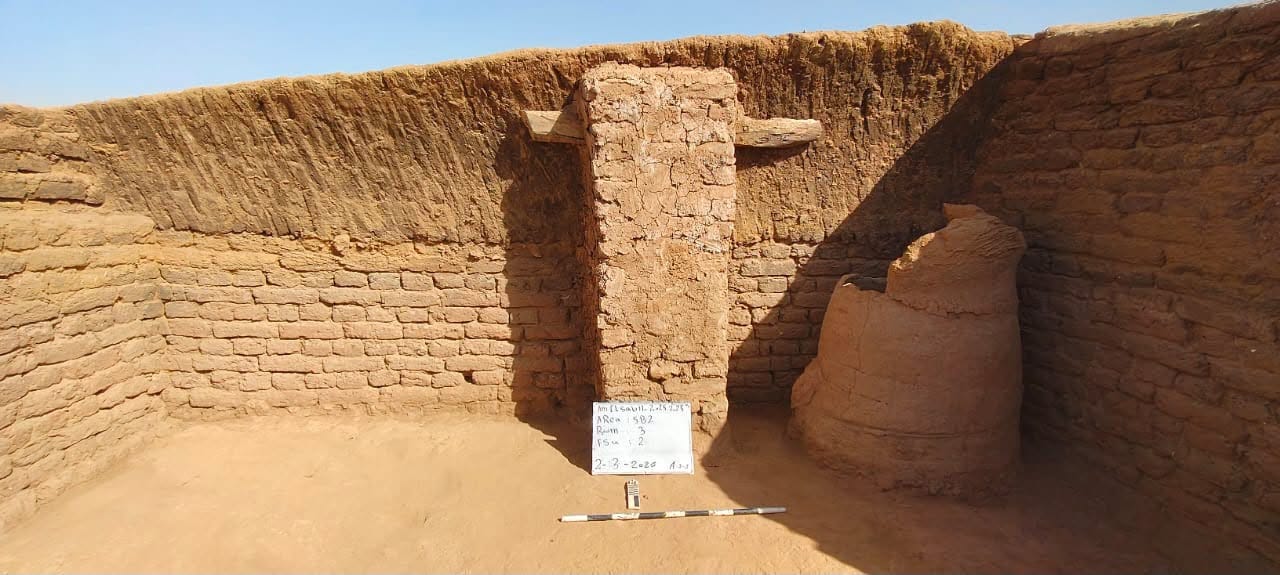
Detail of the newly discovered Byzantine city. Credit: Ministry of Tourism and Antiquities
The settlement at the site of Ain al-Sabil, in New Valley Governorate, comes with streets, squares, houses, a church, watchtowers, a fortress, coins, and roughly 200 written documents, making it one of the most complete urban sites of its period ever found in the Egyptian desert.
The discovery was announced on July 3, 2026, by Egypt’s Ministry of Tourism and Antiquities, following excavations by an Egyptian mission of the Supreme Council of Antiquities. Minister of Tourism and Antiquities Sherif Fathy called the find an important addition to Egypt’s archaeological record, one that highlights the cultural diversity that flourished in the country’s oases across different historical periods and promises to boost cultural tourism in the region.
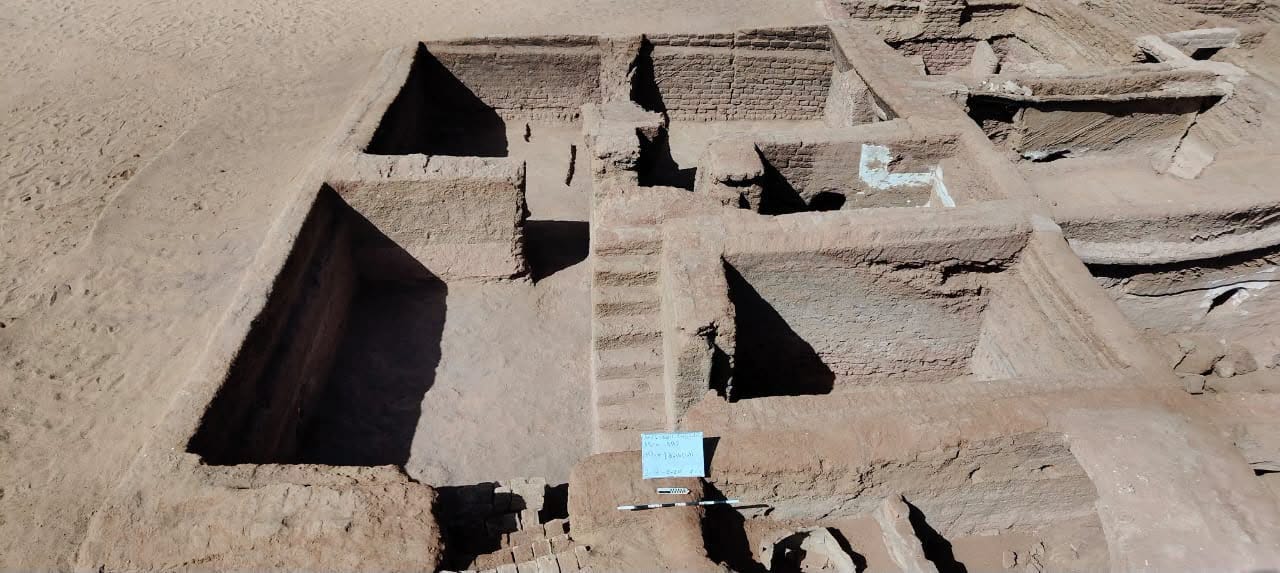
View of the excavation site. Credit: Ministry of Tourism and Antiquities
A city built to a plan
What sets Ain al-Sabil apart is not a single spectacular object but the coherence of the whole. According to Diaa Zahran, head of the Islamic, Coptic and Jewish Antiquities Sector at the Supreme Council, the city followed a carefully organized layout. Broad main streets ran from north to south, intersected by smaller cross streets running east to west, and their crossings opened into squares and courtyards distributed through the settlement. Every building uncovered so far was raised in mudbrick, the material that has allowed desert sites in the oases to survive in a state of preservation almost unthinkable in the Nile Valley.
This was no loose scatter of farmhouses. The plan knits together domestic, religious, and defensive spaces into a functioning urban whole, which is precisely what makes the site so valuable for understanding how such desert communities actually worked.
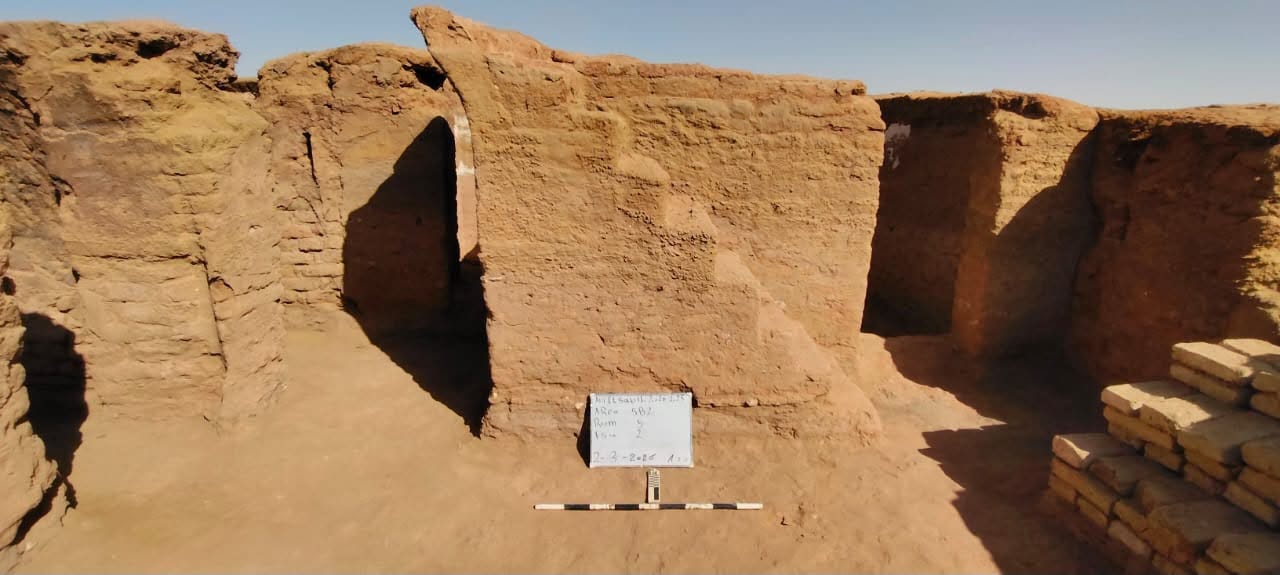
Detail of the excavated structures. Credit: Ministry of Tourism and Antiquities
Church, fortress, and the house of a deacon
At the heart of the city, overlooking one of its main streets, stood a basilica-style church that the mission dates to the middle of the fourth century AD, an early moment in the Christianization of Egypt’s countryside. Mahmoud Masoud, director general of Dakhla Antiquities and head of the archaeological mission, said the settlement contained all the key elements of a thriving, self-sufficient community. Along its perimeter the team found the remains of two watchtowers, together with a heavily fortified structure girded by thick defensive walls, a reminder that life on the desert margin required protection as well as prosperity.
The residential quarters tell the domestic side of the story. Houses featured spacious halls and vaulted ceilings, and around them the excavators documented bread ovens, kitchens, and stone tools used to grind grain, the humble machinery of everyday survival. Among the best-preserved buildings is a house dated to the second half of the fourth century AD that belonged to a man named Tisus, a deacon of the church, a rare case in which archaeology can attach a name and an office to a specific desert home.
Two hundred voices on broken pottery
Perhaps the most valuable haul is textual. Zahran Mahdi, director of the Excavations Department at the Islamic and Coptic Antiquities Sector, highlighted a collection of about 200 ostraca, fragments of pottery bearing writing in both Coptic and Greek. The texts record commercial transactions, personal correspondence, and other threads of daily life, offering researchers a direct line into the administration, economy, and social relationships of the community, written by its own inhabitants.
Alongside the documents came the material fabric of daily life. The excavation produced household pottery, bottles for storing oils and perfumes, oil lamps, and grinding equipment, together with numerous well-preserved bronze coins bearing the portraits of Byzantine emperors, Latin inscriptions, and Christian symbols, which will help anchor the site’s chronology.
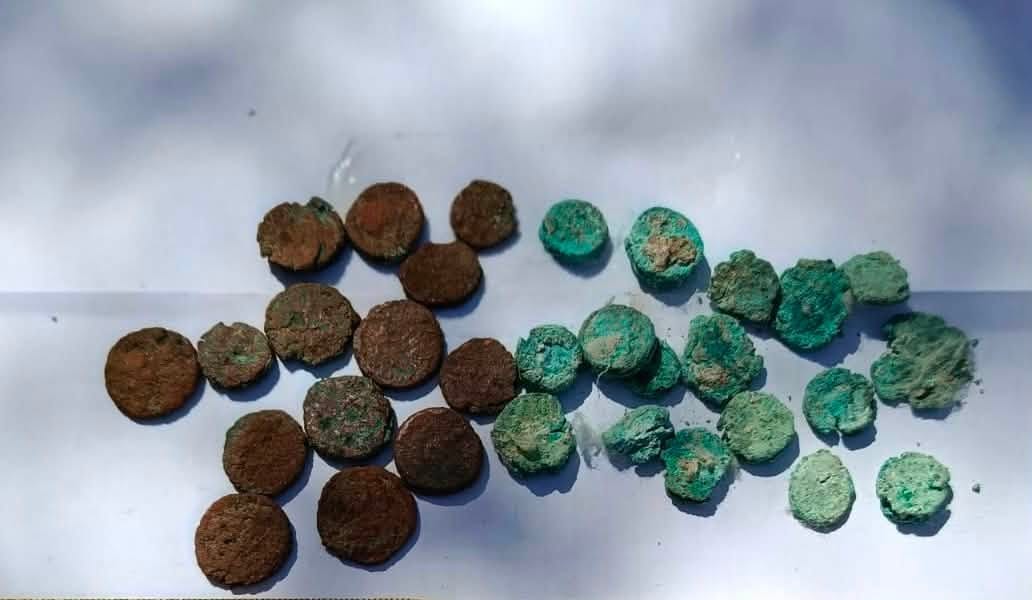
Coins uncovered during the excavation. Credit: Ministry of Tourism and Antiquities
The oasis that was never a backwater
Hisham El-Leithy, secretary general of the Supreme Council of Antiquities, said the excavation delivers valuable new information about life in the Dakhla Oasis during the Byzantine period, sharpening our picture of the settlement’s urban design, social organization, and economic activity. That picture fits a broader scholarly reassessment of Egypt’s western oases. Far from being isolated outposts, Dakhla and its neighbor Kharga formed a connected world of settlements, wells, fields, roads, and administration, and they preserve some of the clearest evidence anywhere for daily life in Late Antique Egypt beyond the Nile. Long-running excavations at Dakhla sites such as ancient Kellis and Amheida have already yielded houses, temples, churches, and archives, and Ain al-Sabil now adds a full planned town to that record.
One point of precision is worth keeping in view. The mid-fourth century falls at the transition between the Late Roman and early Byzantine worlds, so the ministry’s description of a “complete Byzantine residential city” is best read as a well-preserved Late Roman and early Byzantine settlement whose life extended into the Byzantine centuries. However the label is drawn, the substance is the same. In the sands of Dakhla, an entire town has come back into view, streets, squares, ovens, church, and the letters of its people included.
Sources. Egyptian Ministry of Tourism and Antiquities (July 3, 2026); Supreme Council of Antiquities.
I know! It might seem nerdy to most, but this stuff gets me excited!
Outstanding discovery. Thanks for sharing