


For more than two thousand years, one of history's most famous marches has resisted a final answer. In 218 BC, the Carthaginian general Hannibal Barca led an army of some 40,000 soldiers, 7,000 horses, and 37 war elephants over the Alps to strike at Rome from the north, a feat so audacious it has never stopped fascinating classicists, archaeologists, and military historians.
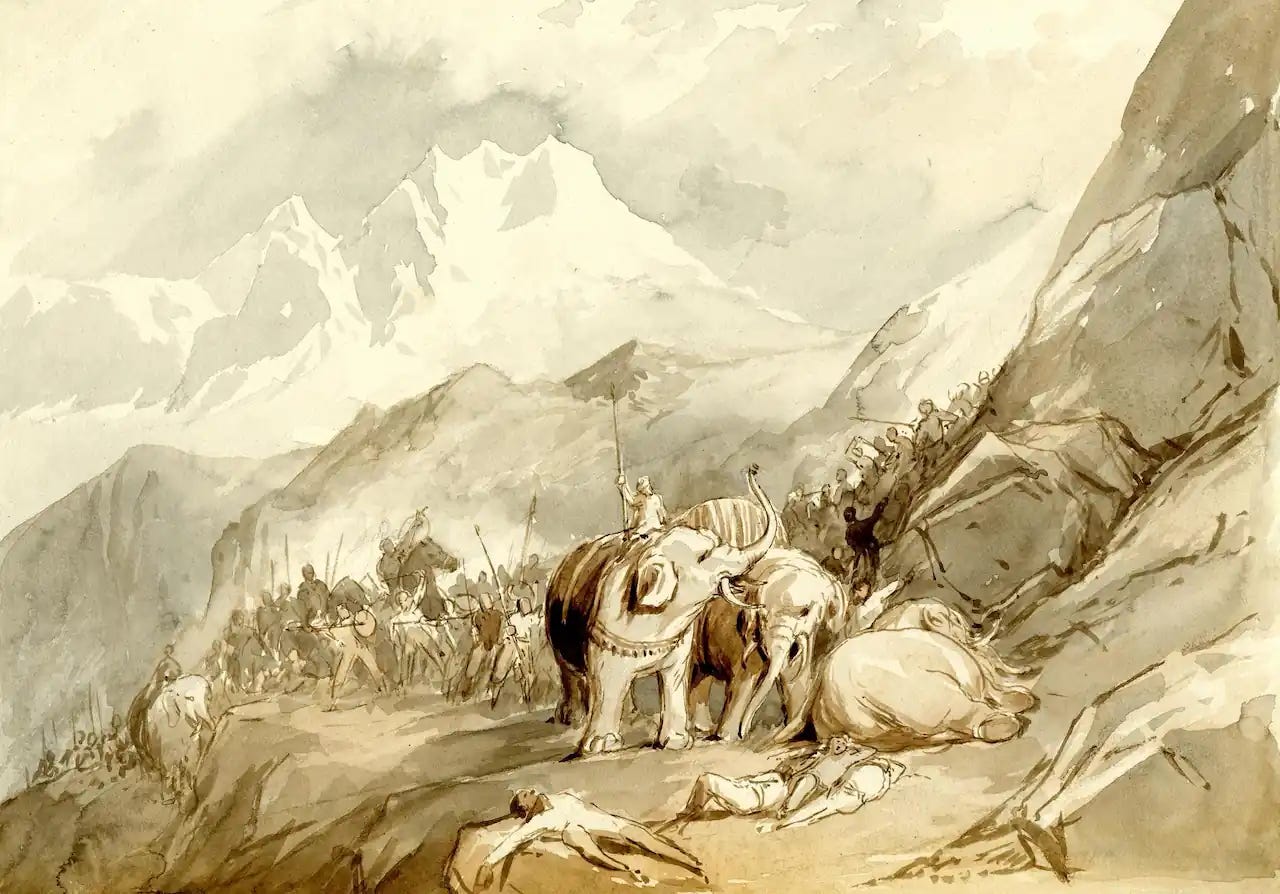
Hannibal Crossing the Alps, drawing by Clarkson Stanfield. Courtesy of the Trustees of the British Museum.
Which mountain pass he actually used has been argued over for centuries. A new study takes an unusual angle on the question, treating the crossing not as a philological puzzle but as an energy budget, and its numbers point squarely to one route, the Col de la Traversette.
The research, by Emilio Berti of the German Centre for Integrative Biodiversity Research, known as iDiv, and Friedrich Schiller University Jena, together with Fritz Vollrath of the University of Oxford and Save the Elephants in Kenya, was published in the Proceedings of the National Academy of Sciences.
Turning elephants into data
The team’s method borrows directly from movement ecology, the study of how animals allocate energy as they travel across real terrain. Vollrath, who has spent years studying the bioenergetics of African elephants in Kenya, noted that applying what has been learned from living elephant populations brings an entirely new dimension to the old debate over Hannibal’s route. The researchers built models estimating energy expenditure as a function of body mass and terrain slope, a critical variable in mountainous country where every additional meter of elevation carries an outsized metabolic cost, then calibrated those models against empirical data gathered from elephants in Kenya’s Samburu reserve.
Applying that framework to four historically proposed Alpine passes, the team calculated the total energy the entire Carthaginian force, men, horses, and elephants together, would have needed to cross each one. The Col de la Traversette came out lowest, requiring an estimated 5.42 terajoules for the whole army. The route over the Col de Montgenèvre and down into the Po Valley via Susa came second, at 6.02 terajoules. The Col du Clapier, long the leading academic favorite, ranked third at 6.28 terajoules. The Col du Mont Cenis proved least efficient of all, at 6.45 terajoules.
A quiet reversal of the leading theory
That ranking matters because it upends the conventional wisdom. As the study’s authors note, the Col du Clapier had been considered the most likely candidate among historians for years, while more recent philological and geomorphological analyses had already begun to point toward the Traversette instead. Emilio Berti was careful about how far the new analysis can go, stressing that it does not dispel all uncertainty about the exact path taken. What it does, he said, is significantly strengthen the case for the Traversette route, by showing it would have better accommodated the demands of moving a large army, elephants included, through extremely difficult terrain.
The Col de la Traversette sits at an altitude of 2,914 meters on the modern border between France and Italy, a formidable barrier by any measure, and the researchers’ models suggest it nonetheless offered the most efficient path available to a force burdened with thousands of men, horses, and multi-ton animals unaccustomed to alpine cold.
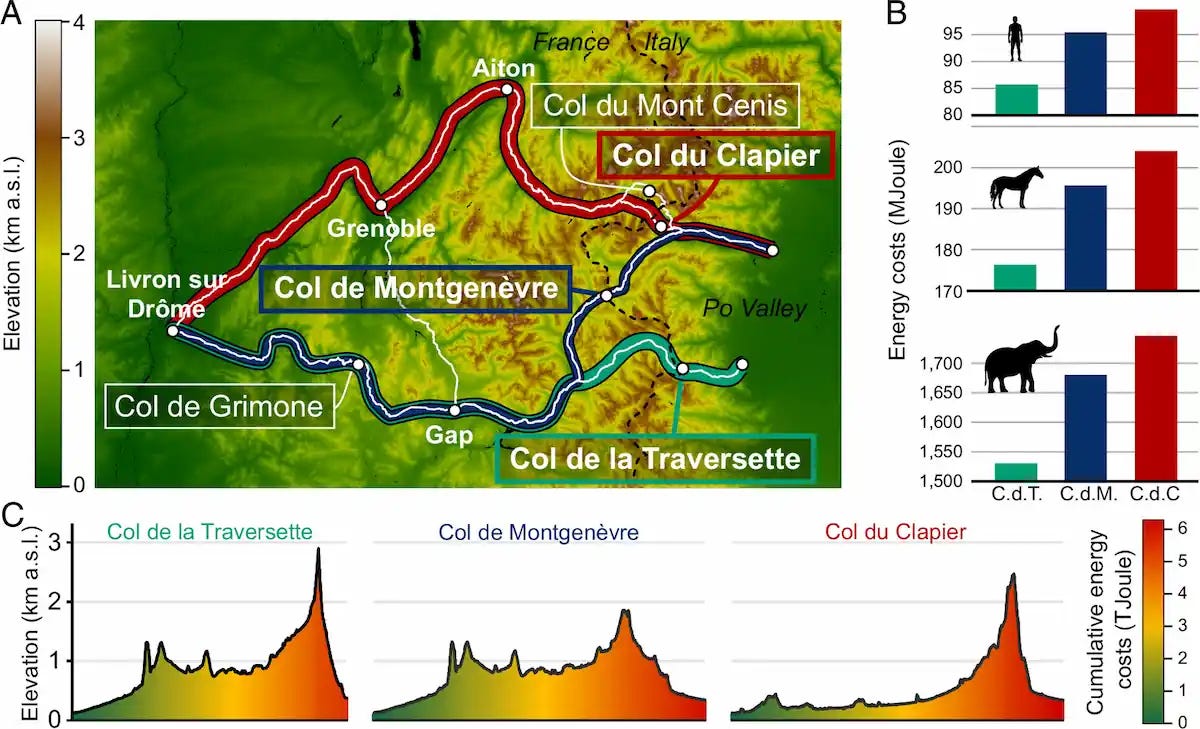
Figure X. (A) Proposed routes for Hannibal’s crossing of the Alps. Background colors indicate elevation, and white lines show all candidate routes. Colored lines highlight the three highest-ranked routes. Elevation data courtesy of NASA. (B) Cumulative direct energy costs for the three highest-ranked routes, calculated for a single soldier, horse, and elephant. Route colors correspond to those shown in panel A. Values include only direct locomotion costs and exclude additional expenditures, such as transporting supplies or supporting noncombatant personnel. (C) Elevation profiles of the three highest-ranked routes. Colors indicate the cumulative energy cost incurred by Hannibal’s army along each route. Credit: E. Berti and F. Vollrath (2026).
The elephants fared better than the men
Perhaps the study’s most striking result concerns not the route itself but what the crossing did to the different parts of Hannibal’s army. Modeling the metabolic toll of the Traversette crossing, the researchers found that human soldiers would have lost roughly 19 percent of their body fat reserves over the journey, a figure the authors consider consistent with the high mortality that classical sources describe among Hannibal’s troops during the passage. Horses fared somewhat better, losing an estimated 11 percent. The war elephants, remarkably, came through comparatively unscathed, losing only about 4 percent of their reserves, a result that runs against the long-held assumption that the elephants suffered the worst of any part of the army in the mountains.
The explanation lies in basic elephant physiology. In the wild, African savannah elephants forage for roughly fourteen hours a day simply to maintain their body weight, and their sheer size, close to three tons for both the African elephants that made up most of Hannibal’s force and his own mount Surus, an Asian elephant, comes with correspondingly large energy reserves to draw on. Those reserves, the study suggests, gave the elephants a buffer that the leaner, harder-marching soldiers simply did not have, and may help explain why so many of Hannibal’s elephants are recorded as having survived the crossing at all.
An old mystery, an unusual toolkit
The deeper puzzle behind Hannibal’s decision to bring elephants at all remains open. Historians still debate why he insisted on hauling war elephants over some of Europe’s most punishing terrain rather than relying solely on infantry and cavalry. One possibility is that he wanted the tactical shock value of unfamiliar giants in his first engagements with Roman forces. Another is that the animals were meant to awe and help win over the Celtic tribes of northern Italy whose support Hannibal needed against Rome. The new study cannot settle that question, but by reconstructing the actual physical toll the mountains took on each part of his army, it offers historians a genuinely new kind of evidence, drawn not from ancient texts but from the metabolism of the animals Hannibal brought with him.
Source. Berti, E., and Vollrath, F. (2026). “Energy costs of Hannibal’s alpine crossing.” Proceedings of the National Academy of Sciences 123(28), e2612764123. doi.org/10.1073/pnas.2612764123
On hindsight one may wonder what the hell was he thinking