


In the 29th year of Ramesses III, about 1157 BC, the craftsmen who cut and decorated the royal tombs of western Thebes walked out of their village at Deir el-Medina after their grain rations failed to arrive. A hieratic papyrus in the Museo Egizio in Turin, catalogued as Cat. 1880, records how they sat behind temples shouting “We are hungry!” and walked out several times over about three months. The museum describes the document as a record of the earliest recorded strikes in world history.
Ancient Content, October 28, 2026
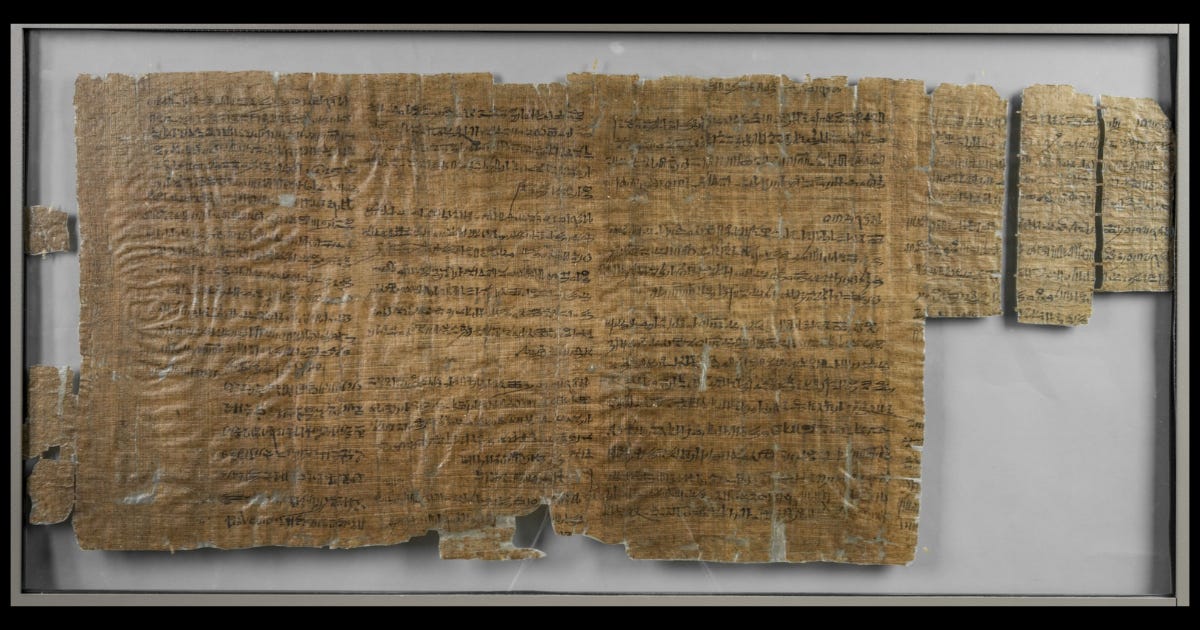
The Strike Papyrus (Cat. 1880) in the Museo Egizio, Turin, records the walkout of the royal tomb builders at Deir el-Medina in Year 29 of Ramesses III. Credit: Museo Egizio, Turin, Cat. 1880 (CC0 1.0)
A scribe of the tomb wrote the report on a papyrus now in Turin
The Strike Papyrus is a Late Egyptian text in hieratic script. The Museo Egizio credits its writing to Amunnakht, a scribe of the tomb, and lists it as Cat. 1880, a sheet measuring 950 by 450 millimetres. Eight entries on the front, spread over three columns, deal with the protests. The text runs from the second month of the winter season, called Peret, to the first month of the summer season, called Shemu, and the sheet is damaged in places. Much of the entry about the Ramesseum is lost, and only the workmen’s own statements survive.
The papyrus entered the Turin collection in 1824 with the purchase of antiquities from Bernardino Drovetti, the French consul in Egypt. The catalogue gives its origin as Thebes, probably Deir el-Medina.
The crew lived in a walled village and drew its pay in grain
Deir el-Medina housed the families of the men who built the tombs of the Valley of the Kings. The workmen formed a gang split into a right side and a left side, each with its own foreman and scribe. A Leiden University dissertation by I. Morfini puts the usual size of the gang at 30 to 60 men, with a peak of 120 under Ramesses IV.
The state paid the crew in kind. The Museo Egizio describes the regular food rations as their pay for work in the Valley of the Kings. Jesús Trello Espada, writing in the Spanish Egyptological bulletin BAEDE, describes the wages as mostly grain, with wheat for bread and barley for beer, plus oil, clothing and fish. The vizier answered for the village’s supplies.
The crew walked out on the tenth day of the second winter month
The papyrus dates the first protest to Year 29, second month of Peret, day 10. Jean-Christophe Antoine places that date in early November. The men passed the guard posts of the necropolis and sat down behind the mortuary temple of Thutmose III. In the translation by Paul Frandsen they say, “We are hungry, for 18 days have already elapsed in this month.” The rations for the month were 18 days overdue.
The Strike Papyrus has only just begun. Below are a police chief’s offer, a vizier’s half ration and a king who did not outlive the crisis by long. Paid subscribers, keep reading. Free readers, upgrade to unlock the rest.
