


The craftsmen who built the royal tombs of the Valley of the Kings took days off for illness, and the Egyptian state subsidised that leave, according to Anne Austin’s 2014 UCLA dissertation on the village of Deir el-Medina. Austin reports that nearly one third of recorded absences occurred when a workman was too sick to work, and that the crew’s physician, called the swnw, had an assistant and received extra rations from the state.
Ancient Content, November 3, 2026.
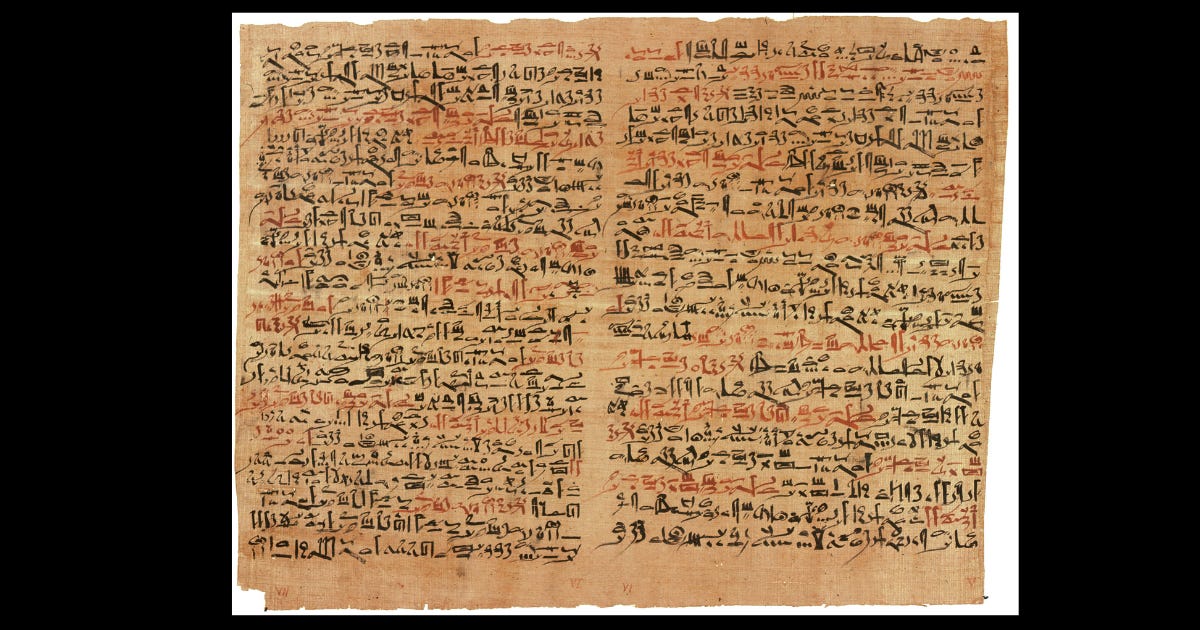
The Edwin Smith Papyrus documents ancient Egyptian medicine, including the diagnosis and treatment of injuries. Public Domain
The state subsidised sick leave for the village
Deir el-Medina housed the craftsmen who cut and decorated the royal tombs of the Valley of the Kings, and Wikipedia dates its occupation to the 18th through 20th Dynasties, about 1550 to 1080 BCE. Austin’s dissertation, “Contending with Illness in Ancient Egypt, A Textual and Osteological Study of Health Care at Deir el-Medina”, combines village texts with skeletal evidence. Its abstract states that “The ancient Egyptian government provided rations for medical professionals and subsidized sick leave for the workmen.” The abstract adds that villagers also relied on reciprocal care from colleagues and family.
The state paid the workmen in grain. Writing in 2015, when she was a postdoctoral fellow at Stanford University, Austin reports monthly wages in grain, housing and servants for laundry, grinding grain and carrying water, with provisions reaching wives and children too. She adds that monthly ration records suggest workmen kept their pay when off sick for several days. The strike of year 29 of Ramesses III, reported earlier on Ancient Content, concerned the same community’s grain, which Wikipedia describes as delayed wheat rations.
Nearly a third of recorded absences involved illness
The register is only the beginning. Below are the reasons workmen gave for missing work, the physician and assistant who received days off to prepare medicine and Merysekhmet, who climbed to the royal tomb while too ill to work. Paid subscribers, keep reading. Free readers, upgrade to unlock the rest.
