


Five small clay dogs lay buried under a doorway in the North Palace at Nineveh, around 645 BC. None is much longer than a finger. Each was painted a different colour, and each carries a name pressed into its left side in cuneiform. The names tell the dogs what to do.
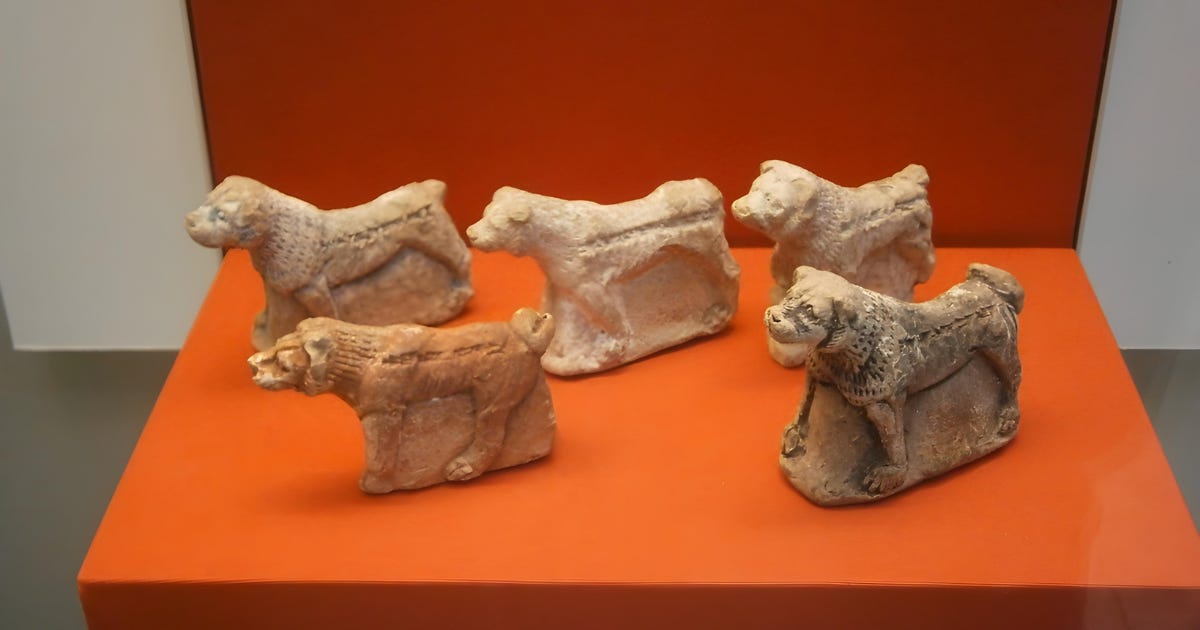
Five painted clay dogs buried under a doorway in Ashurbanipal’s North Palace at Nineveh, about 645 BC, each inscribed with its name. British Museum, London.“colour adjusted” after the licence. Photo by Zunkir, CC BY-SA 4.0, via Wikimedia Commons
Five dogs, five names
The British Museum numbers them 30001 to 30005. William Kennett Loftus excavated them in Room S, at door d, of the palace built for Ashurbanipal. The dogs stand about five centimeters high.
From left to right as they are usually shown, they are “Don’t think, bite!”, “Catcher of the enemy”, “Biter of his foe!”, “Expeller of evil” and “Loud is his bark!”. In Akkadian the last is dan rigiššu.
The colors match the jobs. “Don’t think, bite!” was covered in white. “Catcher of the enemy” was red, and much of its pigment survives. “Biter of his foe!” was turquoise blue, a colour that rarely survives on objects like this. “Expeller of evil” was white with red spots. “Loud is his bark!” was black. All five are on display in Room 55 of the British Museum.
A recipe for guarding a door
The dogs were not a whim. A tablet from Assur, written in Ashurbanipal’s reign, tells the exorcist to bury two sets of five model dogs under a doorway, to stop evil crossing the threshold. Figurines of this kind went under doorways, into thresholds and into corners, the places where evil spirits and disease were thought to lurk.
A Note to Free Subscribers:
Support independent ancient history research and unlock every long-form article, short documentary, and the full Ancient Content archive for just a few dollars a month. Cancel anytime.

