


When the upper floor of a house on Pompeii's Via di Nola gave way in the eruption of AD 79, the painted vault of its banquet room came down with it and shattered. Nearly two thousand years later, conservators have reassembled more than a quarter of that ceiling, revealing a large mythological composition built around the sacred marriage of Dionysus and Ariadne.
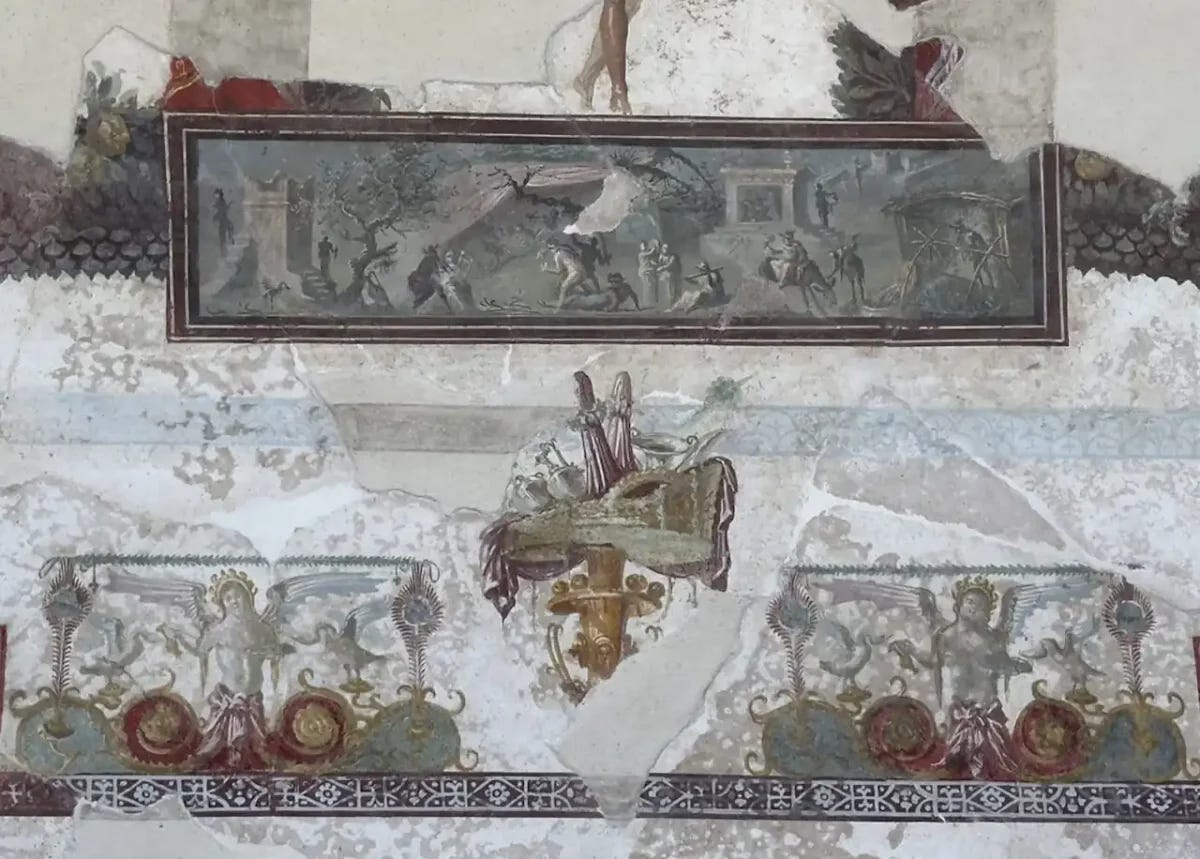
The restored vault was presented on July 24, 2026, in the Palestra Grande at Pompeii, following an international workshop at the site’s auditorium where Italian and foreign institutions working within the park compared notes on current excavation campaigns.
A house with a bakery, and worse
The ceiling comes from the Casa con Panificio, the House with Bakery, in Insula 10 of Regio IX. The name is prosaic, but the building has produced some of the most striking Pompeian archaeology of recent years.
Excavation of the insula began in 2023, prompted by the need to stabilize excavation fronts and improve drainage across the plateau, and it quickly became the largest dig at Pompeii in a generation. The block sits between two insulae opened in the eighteenth and nineteenth centuries, and it held the only stretch of street frontage on Via di Nola in Regio IX still buried. Two connected atrium houses emerged, both originally Samnite and both converted in the first century AD to accommodate commercial work, a laundry in one and a bakery with its oven, millstones, and food-processing rooms in the other. The house with the bakery has been associated with a man named Aulus Rustius Verus.
The same building yielded the so-called prison bakery, a room with barred high windows and a single exit into the atrium, its floor marked by the circular grooves of millstones worked by a donkey and by enslaved labor. It also produced the black room, a dining space with dark walls and a white mosaic floor carrying Third Style paintings of scenes from the Trojan War. Three victims of the eruption were found in the bakery rooms, two adults and a child of roughly three or four, killed by collapsing ceilings while the house was in the middle of renovation work.
Fragments that stayed where they fell
The newly restored decoration belonged to the vaulted ceiling of a cenacolo, a dining room on the upper floor. Its survival owes something to how it was destroyed. Because the fragments were recovered at the spot where the ceiling collapsed, archaeologists could attribute them to that room with certainty and begin matching pieces together during the excavation itself, identifying numerous joins before conservation work formally started.
The restoration built on that preliminary sorting, combining conservation treatment, archaeological study, and the design of the eventual display. Crucially, the team limited its work to fragments whose original position was sufficiently documented, which is why only part of the composition has been reassembled. That restraint follows the modern conservation principles of recognizability and reversibility, meaning the reconstruction should never be mistaken for the original and can be undone.
What the ceiling showed
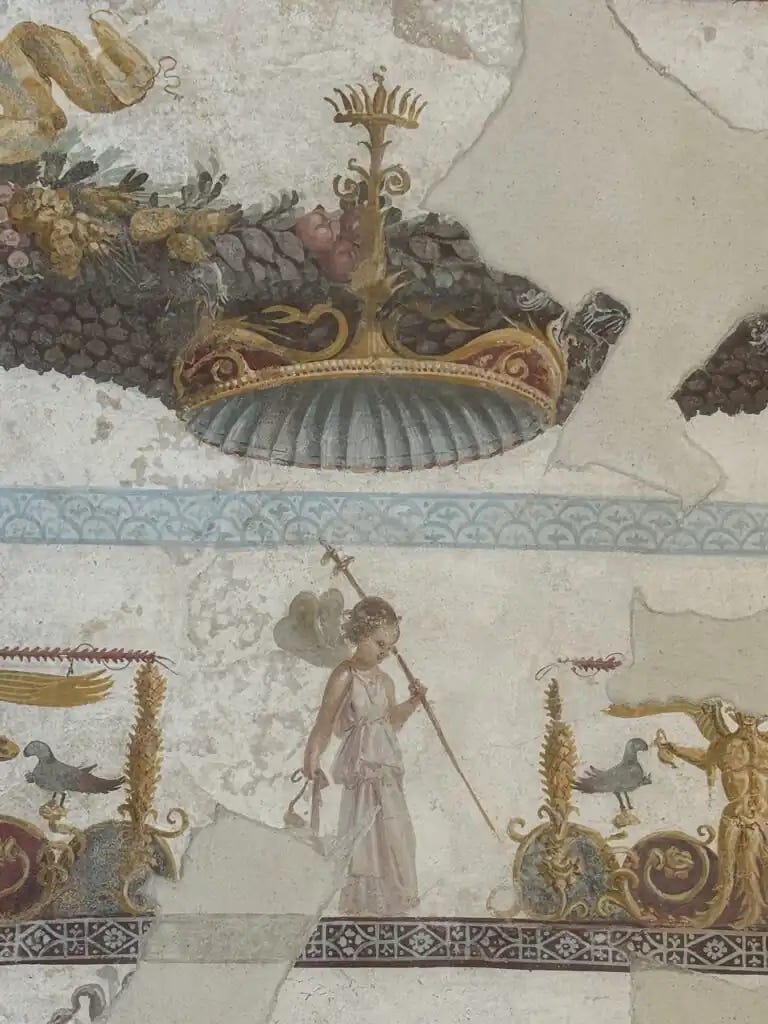
The reconstructed portion reveals an elaborate scheme organized around a large central panel, framed by painted aediculae, decorative borders, vegetal festoons, allegorical figures of the seasons, winged genii, and a dense array of ornament, all in rich polychromy.
The central subject is a hierogamy, the sacred union of Dionysus and Ariadne. That scene survives only in fragments, and its reconstruction depended on comparison with other ancient depictions of the same theme. At the center, Dionysus reclines on a chariot facing Ariadne, who plays a harp accompanied by a lyre-playing eros, while two musician centaurs draw the chariot forward.
The identification is supported by the rest of the decoration, which is saturated with Dionysiac reference. Among the festoons heavy with fruit and flowers appear ritual symbols of the god’s cult, theatrical masks, and vessels used in libations, the whole scheme converging on the divine couple at its center.
A support built to be added to
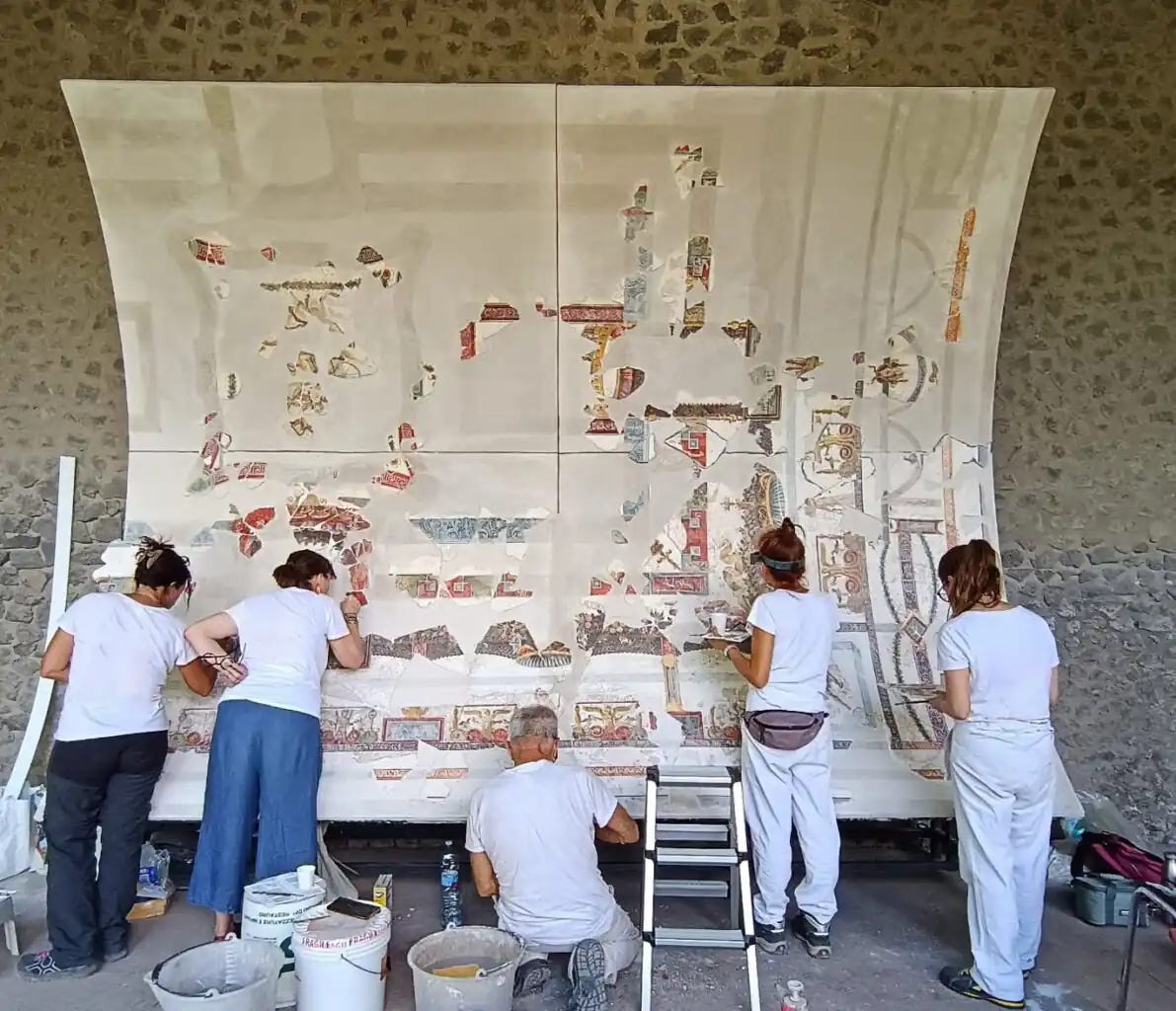
The park describes the project’s most innovative element not as the painting but as the mount built to hold it. A traditional flat panel would have been useless here, since the fragments came from a curved vault, and only the gradual reassembly of the pieces revealed what that curvature had originally been. The support was therefore designed in parallel with the restoration itself, developing as the shape of the ceiling emerged.
The result restores something of the room’s original spatial feel while protecting the fragments, and it is modular. New pieces can be added without disturbing what has already been assembled, which matters because the reconstruction is explicitly unfinished. Numerous fragments belonging to this ceiling are stored separately, and more may yet come out of the house as excavation continues. In effect, the restoration has been designed as an open process that can be updated as the archaeology advances.
Gabriel Zuchtriegel, the park’s director, framed the work as an example of Italian leadership in archaeological restoration, and noted that sharing the results of conservation projects is also a way of sharing research.
A Dionysiac year at Pompeii
The ceiling arrives in a year the park has organized around Dionysus. That focus was sharpened by the discovery, between 2024 and 2025, of a megalography in the Casa del Tiaso in the same Regio IX, depicting a procession in honor of the god and counted among the most important paintings of its kind found at the site.
The theme extends beyond scholarship. The second edition of the park’s Esopop storytelling festival, titled Ecstatic Pompeii, will bring live theatrical performances to cultural sites across the Vesuvian area every Friday and Saturday from August 28 to September 26, 2026, during the park’s evening openings, an attempt to put new archaeological findings into conversation with contemporary performance.
Sources: Parco Archeologico di Pompei, press release, July 24, 2026. Additional context from Pompeii Sites e-journal and excavation reports on Regio IX, Insula 10.
Awe inspiring story of the disaster and the find.
Imagine the excitement of those who got to work on the restoration! Thank you for sharing!