


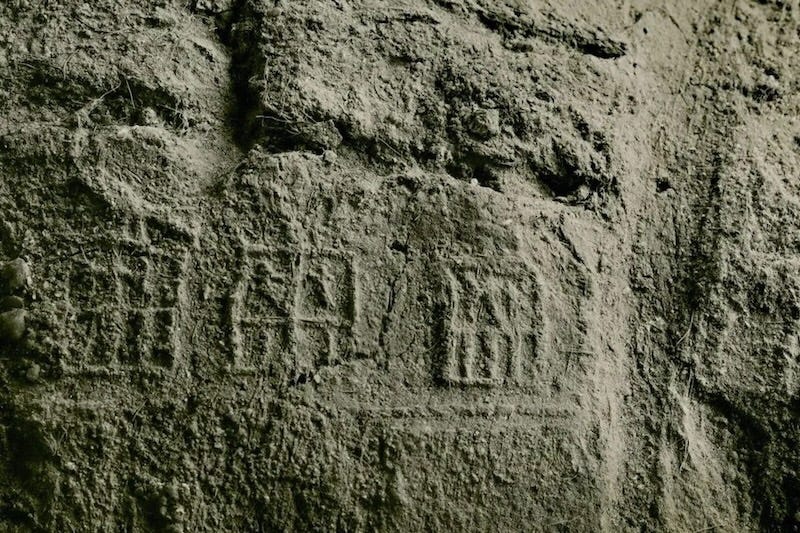
In a tomb at Saqqara, the British archaeologist Walter B. Emery found thirteen mud jar stoppers stamped with a row of four serekhs, the framed royal names of early Egyptian rulers. Two of the serekhs belonged to King Djer. Emery came to believe the other two named a woman, Meretneith. The stoppers are now lost, and so is the glass plate of his photograph. A new study argues that a scan of his surviving print is enough to settle the reading.
The paper, by Sue Kelly of the Czech Institute of Egyptology at Charles University and Crystal Miller of the University of Bucharest, appears in Prague Egyptological Studies volume 36. It concludes that Meretneith, also written Merneith, held the serekh reserved for rulers and began her political life as Djer’s co-regent.
Petrie first took her for a king
The story begins at Abydos. Flinders Petrie thought he had found a new king, Merneit, when he excavated tomb Y in the royal cemetery, even though the name on the royal stela lacked a serekh. Further inscriptions of the name with a feminine ending led scholars to identify Meretneith as a queen consort.
Her tomb is one of the reasons the debate never closed. Tomb Y measured 16.5 by 14.0 metres and 2.7 metres deep, with eight narrow chambers around the burial chamber, and Petrie remarked that it was the most carefully built in the cemetery. The surviving limestone stela, now in the Egyptian Museum in Cairo, gives her name with Neith’s crossed arrows and shield, the hoe and the mouth sign, but no serekh and no title.
Emery’s stoppers carried four serekhs
At Saqqara tomb S3503, the stoppers lay on a shelf and around the mouth of the tomb shaft. Each impression showed four serekhs in a line, three together and a fourth after a noticeable gap. Emery recognised the first and fourth as Djer’s and noted that the other two carried a different name and lacked the Horus falcon. Stone vessels inscribed with Meretneith’s name lay beside the sarcophagus and in the burial chamber.
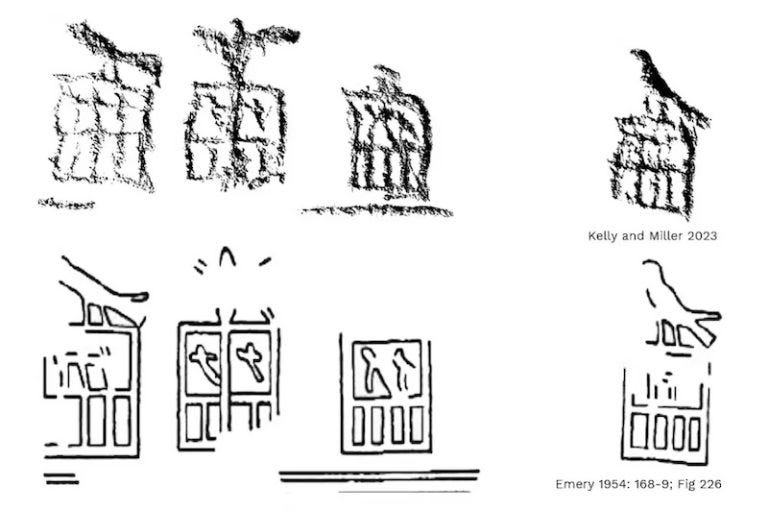
Emery did not interpret the middle serekhs in his 1954 report. In 1961 he described them as Meretneith’s serekhs topped by Neith’s crossed arrows and suggested she might have been Djer’s successor. Several scholars accepted the reading. Peter Kaplony argued in 1963 that the published sealing was unconvincing, and his objection prompted the new study.
The evidence has since shrunk. The stopper and Emery’s original glass plate are both missing, leaving only the black-and-white print in the Egypt Exploration Society archive and Emery’s line drawing.
A scanned photograph stands in for the missing artefact
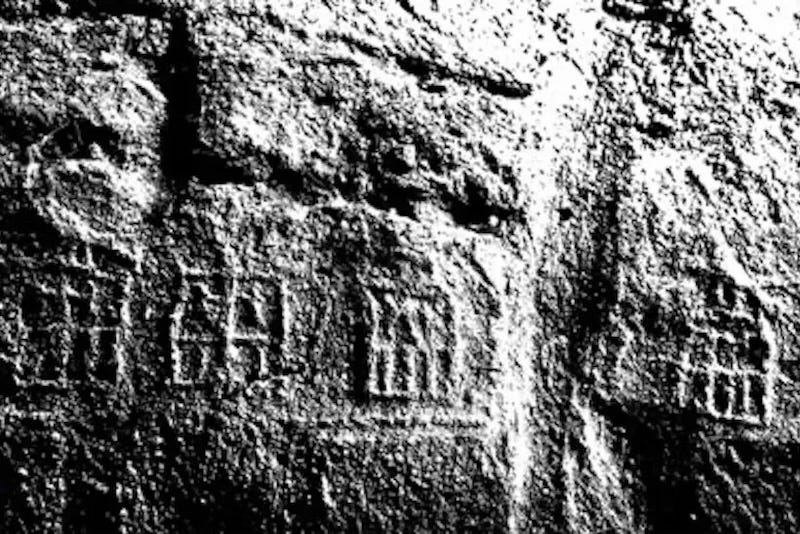
In September 2022, staff of the Egypt Exploration Society made high-resolution scans of the print on an Epson Perfection V700 flatbed scanner. The authors corrected the contrast in Adobe Lightroom and exported the result as a TIFF file.
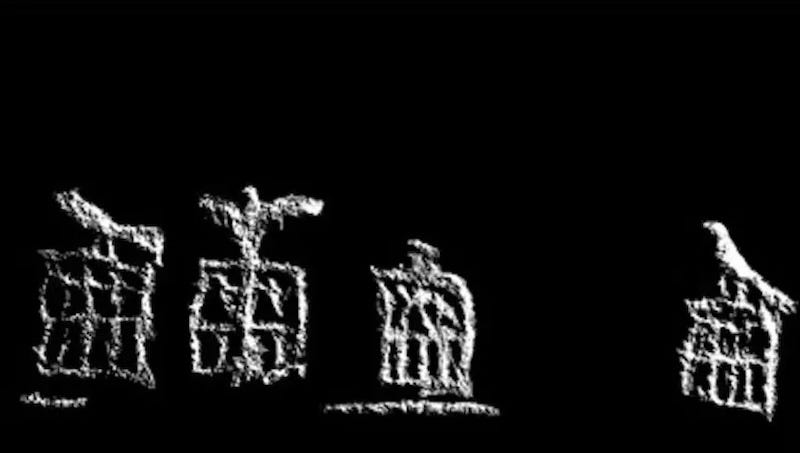
They first tried DStretch, a decorrelation tool widely used on rock art. Because it works on colour differences, its usefulness on a black-and-white print was limited, so the team kept its results as a baseline for comparison. The main method used Photoshop. A high-contrast threshold mask separated the raised impression from the clay surface, the background was removed and the colours inverted, and the result was converted into a vector drawing. The authors liken the output to a charcoal rubbing and consider it far more accurate than a hand drawing.
The enhanced serekhs show a doubled hoe sign
In the first serekh beside Djer’s, the name compartment shows the hoe sign, read mr, written twice. Its form closely matches other inscriptions of Meretneith’s name, though it sits at a slight angle. The emblem above this serekh matches the Neith traces Emery recorded, and the authors reject Silke Roth’s earlier suggestion that it was part of a falcon.
The third serekh is less clear. It again appears to have a doubled hoe, but the figure on top does not look like the Neith symbol. Roth had said in 1997 that the legs and belly of the royal falcon could be made out on Emery’s photograph, and the new illustration appears to confirm her. The authors call the idea of a first known female Horus serekh tempting but remain cautious.
The authors argue spelling varied for every early ruler
The main objection to Emery’s reading was that the doubled hoe differs from how Meretneith’s name is written elsewhere. Kelly and Miller survey her inscriptions and find no standard form. Some add a mouth sign, some a feminine ending, and her name runs vertically or horizontally in either direction. The one constant across all her inscriptions is the hoe sign, the sign doubled in the serekhs.
Kings’ names were just as unstable in this period. Jochem Kahl identified 15 different writings of Narmer’s name. Djer’s flax-bundle sign varies even within a single seal, and Anedjib’s heart sign appears with four blood vessels in one serekh and seven in the next. On this basis, the authors conclude that little argument remains against attributing the serekh to Meretneith and read the Neith emblem as the female counterpart of the Horus falcon.
The authors read the seal as a co-regency with Djer
No other known seal impression places two rulers’ serekhs side by side. The authors compare it with two ivory labels that Günter Dreyer read in 2021 as naming Narmer and Aha together, and with a contested year label from Qaa’s tomb showing the serekhs of Semerkhet and Qaa. They conclude, in their own words, that the first stage of Meretneith’s career was as a co-regent, following earlier proposals by Peter Schulze and Jean-Pierre Pätznick.
Her family ties remain uncertain. Scholars generally consider her Djer’s daughter, the successor of Djet and possibly his wife.
Seals from Den’s tomb at Abydos name her king’s mother
A later stage appears on necropolis seal impressions from the tomb of her son Den at Abydos. In both main reconstructions, by Werner Kaiser and by Günter Dreyer, the seal lists early rulers and ends with Meretneith bearing the title mwt nswt, king’s mother. She is the only person named without the funerary god Khentiamentiu before her. Kaiser explained this by her status as queen regent. Vivienne Callender and Pätznick instead suggest she was the living author of the seal, acting while Den was a minor.
Her memory lasted. A necropolis seal from the reign of Semerkhet, found by the German Archaeological Institute, still lists her. Qaa’s seal leaves her out.
Inscriptions link her name to the treasury
Several stone vessel fragments pair Meretneith’s name with royal institutions. Three from her tomb point to authority over the treasury, including a British Museum fragment, a bowl in Chicago’s Oriental Institute Museum and a piece recovered by Christiana Köhler’s team, which has been re-excavating her tomb since 2020. The authors read these as evidence of her active power, while noting that they give her no title.
Köhler’s team found hundreds of large wine jars in the tomb, some still sealed with their original stoppers. The University of Vienna described the complex as including the tombs of 41 courtiers and servants. Kelly and Miller, citing Petrie, count 49 subsidiary graves and chambers.
Other Egyptologists dispute the serekh reading
The serekh interpretation remains contested. Eva-Maria Engel of Humboldt University in Berlin, who was not involved, examined the enhanced images and told Smithsonian she does not think Meretneith appears among the names, while agreeing she was powerful. Kelly and Miller’s paper had listed Engel’s 2021 study among the works that accept the reading.
Other evidence also cuts both ways. Some scholars take the missing serekh on her stela as proof that she was a regent, not a ruler. Kelly and Miller answer that Djet and Den had both reigned since her time with Djer, which may explain the change. A funerary enclosure in Abydos’s North Cemetery, 66.5 by 25.5 metres, is attributed to her by David O’Connor and Laurel Bestock, while Kaiser and Toby Wilkinson assign it to Den.
Kelly and Miller propose a career in stages
The paper’s broader hypothesis divides her career by evidence type. The serekh marks a co-regency with Djer, the Abydos seals a later role as regent king’s mother for Den, and the treasury inscriptions her direct authority over officials. Citing radiocarbon modelling by Michael Dee and colleagues, the authors estimate she held power for at least 30 years. They suggest she could step on and off the platform of rulership as circumstances required. The final report from Köhler’s excavation at tomb Y has yet to be published.
Sources:
Kelly, S. and Miller, C. (2026). “New technology illuminating ancient evidence. Re-evaluating Meretneith’s serekhs and political position.” Prague Egyptological Studies 36, 28 to 49. Licence CC BY-NC-ND 2.0. http://hdl.handle.net/20.500.11956/212321
Emery, W. B. (1954). Excavations at Sakkara. Great Tombs of the First Dynasty II. London, Egypt Exploration Society.
Emery, W. B. (1961). Archaic Egypt. Baltimore, Penguin Books.
Petrie, W. M. F. (1900, 1901). The Royal Tombs of the First Dynasty I and II. London, Egypt Exploration Fund.
Kaplony, P. (1963). Die Inschriften der ägyptischen Frühzeit. Wiesbaden, Harrassowitz.
Roth, S. (1997). “Königin, Regentin oder weiblicher König?” In Gundlach, R. and Raedler, C. (eds), Selbstverständnis und Realität. Wiesbaden, Harrassowitz, 99 to 123.
Dreyer, G. (1987). “Ein Siegel der frühzeitlichen Königsnekropole von Abydos.” MDAIK 43, 33 to 43.
Kaiser, W. (1987). “Zum Siegel mit frühen Königsnamen von Umm el-Qaab.” MDAIK 43, 115 to 119.
Köhler, E. C. et al. (2023). “A Preliminary Report of New Archaeological Fieldwork at the Tomb of Queen Meret-Neith of the 1st Dynasty at Abydos, Umm el-Qaab.” Ägypten und Levante 33, 75 to 144.
Dee, M. et al. (2013). “An absolute chronology for early Egypt using radiocarbon dating and Bayesian statistical modelling.” Proceedings of the Royal Society A 469 (2159). DOI 10.1098/rspa.2013.0395
University of Vienna (9 October 2023). “5,000-year-old wine for Egyptian queen.” Press release. https://medienportal.univie.ac.at/en/media/recent-press-releases/detailansicht-en/artikel/5000-year-old-wine-for-egyptian-queen
Smithsonian Magazine (1 October 2026). Coverage of Kelly and Miller, with comment from Eva-Maria Engel. Via Arkeofili, “Kraliçe Merneith Mısır’ı Tek Başına Yönetmiş Olabilir,” 2 October 2026. https://arkeofili.com/kralice-merneith-misiri-tek-basina-yonetmis-olabilir/