


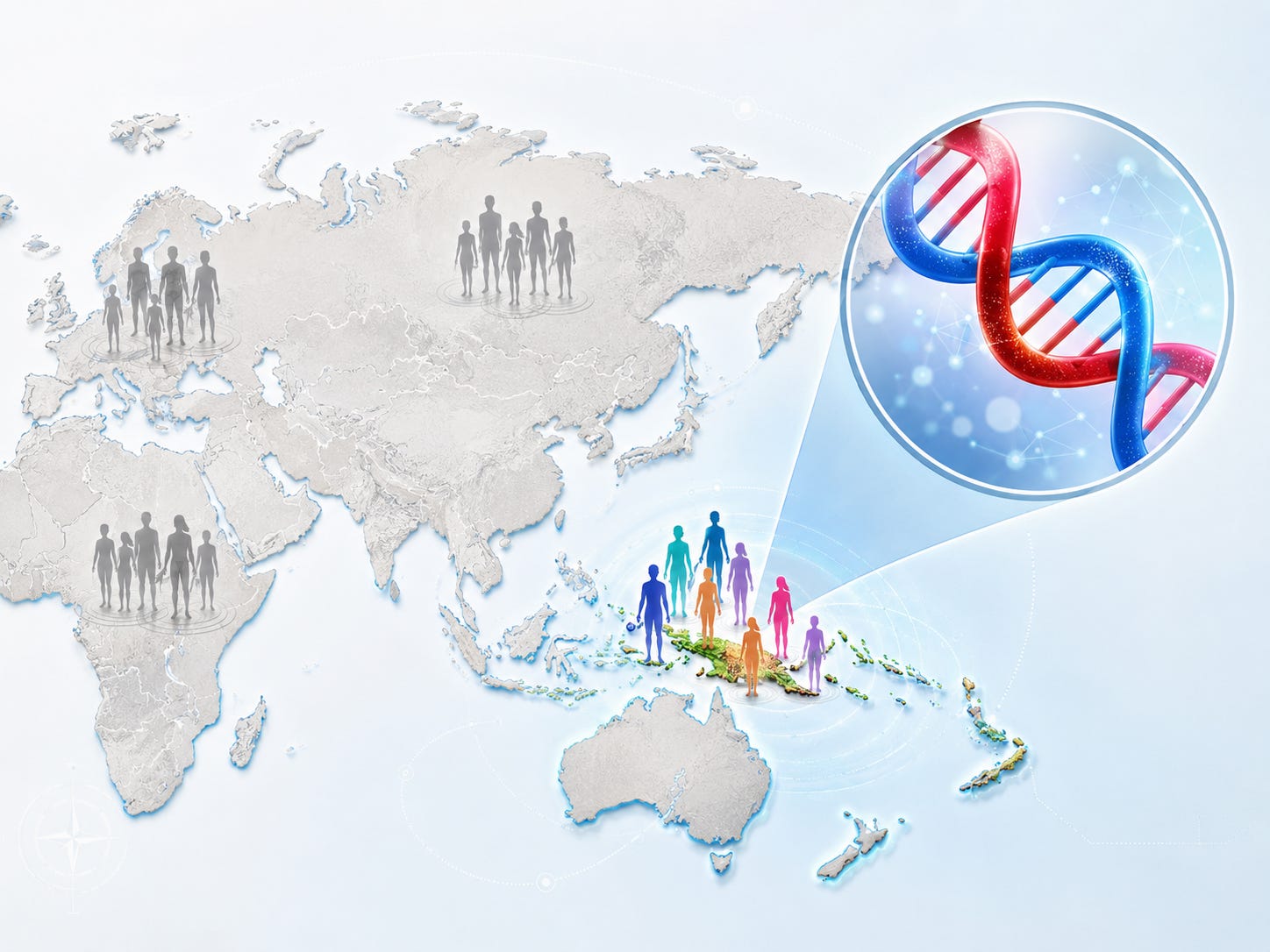
Illustration showing the genetic focus on Near Oceania, where Denisovan-inherited DNA still influences immune-related variation in some modern populations.
The research, published in Science, focuses on Near Oceania, a region that includes Papua New Guinea, the Bismarck Archipelago, and the Solomon Islands. These populations have long been known to carry some of the highest levels of Denisovan ancestry in the world, but the new study goes further. It shows that some of this inherited archaic DNA is still functionally active, especially in genes linked to immune response.
The study was led by Patrick F. Reilly, Serena Tucci, and colleagues, and provides one of the most detailed maps so far of Denisovan genetic inheritance in modern humans.
Denisovans and modern humans
Denisovans were a group of extinct humans first identified through ancient DNA from fossil remains discovered in Denisova Cave in Siberia. Although their physical remains are rare, their genetic legacy survives in several modern human populations.
People outside Africa often carry small amounts of DNA inherited from archaic humans, especially Neanderthals. Denisovan DNA is much less evenly distributed. It appears in higher proportions in parts of Oceania, especially among people with Papuan-related ancestry.
Some people in Papua New Guinea can carry up to around 5 percent Denisovan ancestry, one of the highest known proportions in living populations. By comparison, many East Asian populations carry much smaller Denisovan ancestry, often around 0.1 percent.
This difference reflects ancient encounters. When modern humans migrated through Asia and into the Pacific, they met and interbred with Denisovan-related groups. The new study suggests that these encounters left more than a passive genetic trace. Some Denisovan variants may have helped early populations adapt to new environments, including new disease landscapes.
The importance of Oceania in human genetics
Oceania is one of the most important regions for understanding human evolution, but it remains underrepresented in global genomic studies. Many large-scale genetics projects have historically focused on people of European ancestry, leaving major gaps in knowledge about Pacific populations.
This matters scientifically and medically. If some populations are underrepresented in genomic databases, researchers may miss important patterns of human variation. That can limit understanding of evolution and contribute to health inequalities as genomic medicine becomes more important.
To address this gap, the research team sequenced high-quality genomes from 177 individuals belonging to 12 Near Oceanian populations. They then compared these genomes with 1,284 previously published genomes from populations around the world.
The team also compared the results with known Denisovan and Neanderthal genomes. This allowed them to identify archaic DNA segments and study how those ancient sequences behave in modern human genomes.
A larger map of Denisovan ancestry
The study produced a major expansion of known Denisovan-inherited DNA. Researchers reconstructed 1.897 billion base pairs of archaic genetic sequence, including 831.9 million base pairs of Denisovan sequence.
This catalog contains about three times more Denisovan-inherited genetic material than had previously been identified. More than 70 percent of these Denisovan sequences were unique to Oceanians.
That finding is important because it shows how much of Denisovan genetic diversity has remained hidden because of limited sampling. Studying Near Oceanian genomes allows researchers to recover parts of Denisovan history that are barely visible elsewhere.
The study also found evidence that the ancestors of Near Oceanian populations inherited DNA from at least three distinct Denisovan-like groups. This suggests that Denisovan-related populations were genetically diverse and that modern humans encountered more than one branch of them during their movement through Asia and into the Pacific.
Ancient DNA that still affects gene activity
The most important part of the study concerns function. The researchers did not only identify Denisovan DNA. They tested whether some of those inherited variants actually influence gene behavior today.
To do this, they used a technique called a massively parallel reporter assay. This method allows scientists to test thousands of genetic variants at once and see whether they affect gene expression — in other words, whether they help turn genes up, down, on, or off.
The experiment identified 3,127 high-frequency Denisovan-inherited variants that can modify gene expression. Many of these variants are active in biological pathways connected with immunity.
This is a major finding. It means that Denisovan DNA in modern Oceanians is not simply an ancient remnant. In some cases, it still affects how human cells regulate important genes.
A strong signal in immune pathways
The study found that many functional Denisovan variants influence genes connected with the immune system, especially the interferon-gamma signaling pathway.
Interferon-gamma is a key part of immune defense. It helps coordinate responses to viruses, bacteria, and other pathogens. Genes linked to this pathway include JAK1, GBP2, and OAS1, which are involved in immune regulation and antiviral defense.
This suggests that Denisovan DNA may have helped early humans respond to infectious diseases they encountered after arriving in Near Oceania. When modern humans entered new environments, they faced unfamiliar pathogens. Genetic variants inherited from local archaic humans may have provided useful immune tools.
The researchers describe this as evidence for local adaptation. In different parts of Near Oceania, natural selection appears to have acted on different Denisovan-derived variants, especially those linked to immune function.
What the findings show — and what they do not
The study does not mean that Denisovan DNA gives a simple or universal immune advantage today. Genetics rarely works that directly.
Many immune-related genes also affect other parts of the body. Some variants that may have helped in one ancient environment could have different effects in modern settings. Researchers also do not yet know exactly which pathogens shaped these genetic changes.
The study shows that Denisovan-inherited variants can influence immune gene regulation. It also shows that natural selection increased the frequency of some of these variants in Near Oceanian populations. But it does not prove that every Denisovan variant is beneficial, or that people with more Denisovan ancestry have stronger immune systems overall.
The finding is more precise: some inherited Denisovan genetic variants appear to have functional effects, especially in immune pathways, and some of those variants likely helped ancient populations adapt to local disease environments.
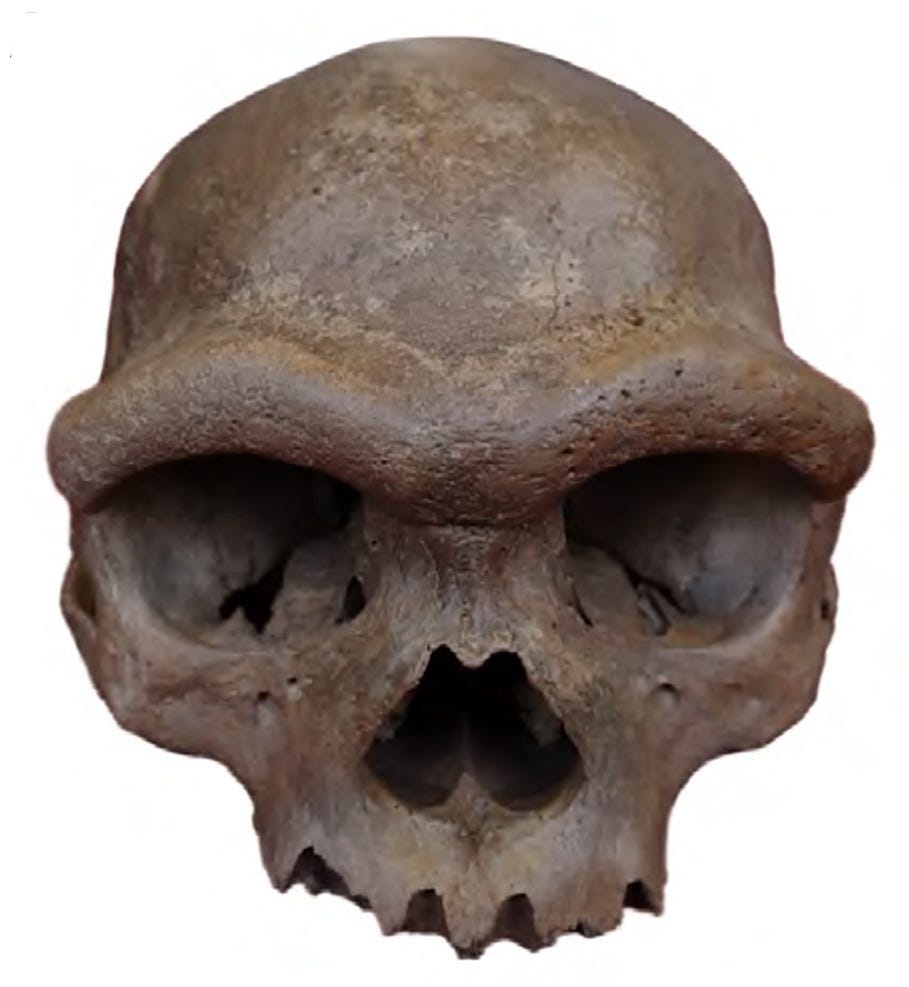
The Harbin cranium, the holotype of the species Homo longi, a Denisovan cranium. Credit: By Fu et al. (2025) - https://doi.org/10.1016/j.cell.2025.05.040, CC BY 4.0, https://commons.wikimedia.org/w/index.php?curid=167969953
Denisovan DNA and skeletal development
Immunity was not the only signal found in the study. Researchers also identified adaptive Denisovan introgression in TRPS1, a gene involved in skeletal development.
This gene is especially interesting because it has also been under strong selection in other human populations, including central African rainforest hunter-gatherers and highland populations in Ecuador. That suggests different human groups may have experienced repeated local adaptation involving the same gene or related biological pathways.
The TRPS1 result shows that Denisovan DNA may have affected more than immunity. It may also have contributed to physical traits shaped by environment, movement, diet, or other selective pressures.
Long-term isolation and bottlenecks
The study also reveals important population history within Near Oceania. The genomes show major differences among islands and populations, including signals of long-term isolation and strong population bottlenecks.
A bottleneck happens when a population passes through a period in which only a small number of ancestors contribute to later generations. This can strongly shape genetic variation.
In island regions, geographic separation can intensify these effects. Populations may remain isolated for long periods, preserving unique genetic patterns and increasing differences between neighboring groups.
This makes Near Oceania especially important for studying human diversity. The region contains deep population histories, high levels of archaic ancestry, and genetic variation shaped by both isolation and adaptation.
A history beginning tens of thousands of years ago
Modern humans reached Near Oceania very early. Archaeological and genetic evidence indicates that people were in the region by at least 45,000 years ago, with some reports using a minimum estimate of around 42,000 years.
These early migrants entered environments very different from those their ancestors had known. Tropical islands, coastal ecosystems, highlands, forests, and new pathogen landscapes all created new pressures.
Denisovan-related populations had already lived outside Africa for hundreds of thousands of years before disappearing. They may have carried genetic adaptations to local Asian and Pacific environments. When modern humans interbred with them, some of those adaptations entered the modern human gene pool.
This process is known as adaptive introgression: useful genetic variants from another population or species become incorporated into a new population and increase in frequency because they help survival or reproduction.
Implications for Understanding Human Evolution and Functional Introgression
Earlier research had already shown that Denisovan DNA survives in living people and that some archaic variants were useful. The best-known example is the Denisovan-related EPAS1 variant in Tibetans, which helps with adaptation to high altitude.
The new Oceania study expands this picture. It shows that Denisovan DNA influenced multiple biological systems and that its effects varied between populations.
It also demonstrates that archaic DNA can be studied not only as ancestry, but as active biological variation. The question is no longer only “how much Denisovan DNA is present?” The deeper question is “what does that Denisovan DNA do?”
The answer, at least in Near Oceania, appears to involve immune regulation, antiviral pathways, skeletal development, metabolism, fertility, and other traits shaped by local environments.
A more complex story of human evolution
The findings support a more complex view of human evolution. Modern humans did not simply replace archaic human groups. In many places, they met them, mixed with them, and inherited DNA that sometimes became useful.
This means that human evolution was not a clean separation of isolated species. It was a braided history of migration, contact, survival, and adaptation.
Denisovans disappeared as a distinct population, but some of their genetic legacy continued in modern humans. In Near Oceania, that legacy is unusually strong and biologically important.
The study also shows why underrepresented populations must be included in genetic research. Without Near Oceanian genomes, much of this Denisovan variation would remain unknown.
A legacy still written in the immune system
The new research shows that ancient encounters between modern humans and Denisovans still matter today. Some inherited Denisovan variants remain active in gene regulation, especially in pathways linked to immunity.
For the first people who entered Near Oceania tens of thousands of years ago, these variants may have helped them face new pathogens, environments, and survival challenges. Over time, natural selection preserved and amplified some of them.
The result is a deep biological inheritance. Denisovan DNA is not only a trace of prehistoric interbreeding. In some Oceanians, it still helps shape how genes function.
This study turns ancient DNA into a living story: the genetic consequences of encounters that happened tens of thousands of years ago are still visible in human biology today.
Support Independent Ancient Content :
Your support helps me create more archaeology posts, articles, and mini history videos:
Sources
The Yale University press release explains the study design, including 177 genomes from 12 Near Oceanian populations, comparison with 1,284 global genomes, evidence for at least three Denisovan-like groups, and functional effects on immune pathways
The Dryad dataset abstract for the study reports the reconstruction of 1.897 Gbp of archaic sequence, including 831.9 Mbp of Denisovan sequence, and identifies functional effects on IFNγ signaling genes including JAK1, GBP2, and OAS1.
Paper: Patrick F. Reilly et al. “Long-term isolation and archaic introgression shape functional genetic variation in Near Oceania.” Science 392, 2026. DOI: 10.1126/science.adr6749.