


Hundreds of ornately patterned hand stencils on a remote Colombian rock face are giving researchers, and the Indigenous communities who still live near them, a rare window into the spiritual world of the people who painted them thousands of years ago.
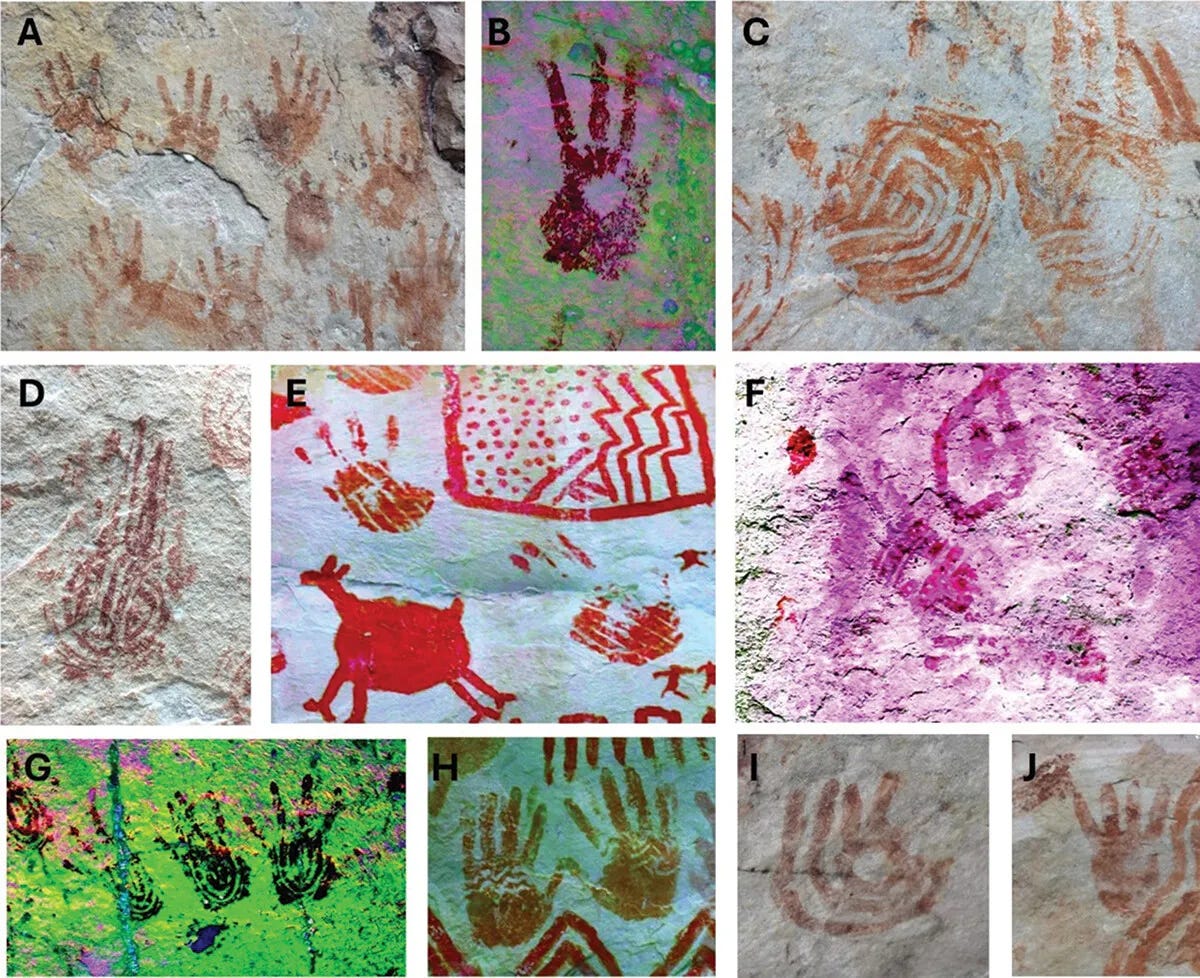
A collection of decorated hand motifs from the site. Credit: Barbara Oosterwijk, LASTJOURNEY Project
Hand stencils are among the oldest and most universal forms of rock art on Earth. They appear on cave and cliff walls from Europe to Australia, and the world’s oldest known rock art, a cluster of hand stencils in Indonesia, belongs to this tradition. While many such images are thought to have been made simply by pressing or blowing pigment around a hand, often by children, archaeologists have long suspected that certain elaborately decorated handprints served a very different, far more deliberate purpose: as ritual markings made by community leaders.
A new study published in the journal World Archaeology now offers compelling evidence for that idea, focusing on one of the richest rock art landscapes in the world: the Serranía de la Lindosa in the Colombian Amazon.
A Monumental Canvas of Red Ochre
Located in Colombia’s Guaviare department, La Lindosa is home to thousands of red-ochre paintings dated to roughly 11,000 years ago, making it one of the most extensive and visually stunning bodies of prehistoric art ever documented. Earlier research into the site’s imagery, much of it conducted by the same international team behind this latest paper, has already linked many of its painted figures to shamanic ritual, particularly scenes showing human figures transforming into powerful animals such as jaguars and snakes.
For the new study, researchers Barbara Oosterwijk, Linda Hurcombe, Jamie Hampson, and José Iriarte turned their attention specifically to the site’s handprints, examining two major painted rock faces known as Cerro Azul and Paredones del Potrero.
Hundreds of Hands, Hundreds of Stories
Across the two panels, the team catalogued 496 individual hand images. Strikingly, 348 of them, about 70 percent, were not plain stencils but carried distinctive decorative patterns across the palm and fingers. Of these, 256 featured spiral designs, while 84 displayed linear motifs such as zigzags and ellipses.
Just as telling as the decoration was the placement. Most of the painted hands were found between two and three meters above the ground, too high to have been made without assistance from a ladder or scaffold. For the researchers, that detail alone signals that these were not casual or incidental markings, but images whose creators went to considerable effort, underscoring their importance within the artistic tradition of the site.
What the Elders Say
To interpret the patterns, the researchers once again turned to the Indigenous communities whose ancestors are believed to have created, and whose oral traditions still echo, this art. Their testimony adds a layer of meaning that the painted rock alone cannot provide.
According to the study’s authors, Ulderico Matapí, a ritual specialist from the Matapí community, explained that each hand motif represents a form of shamanic knowledge tied to managing the land, from cultivating crops to gathering medicinal plants. Desana elder Victor Caycedo offered a complementary reading, suggesting that the stylistic variation between different types of hands reflects the presence of distinct social or spiritual groups, each expressing its own identity through the designs.
Taken together, these accounts point to the handprints functioning as a kind of encoded record, one that communicated cosmological principles and ritual authority within a belief system in which the rock face itself was understood as a threshold, a meeting point between the human, ancestral, and spiritual worlds.
Caution Over Certainty
Importantly, the research team stops short of assigning fixed, literal meanings to individual motifs. Rock art interpretation is notoriously difficult to pin down with certainty, and the authors are careful to present the elders’ testimony as an interpretive lens rather than a definitive translation of a “code.”
What the study does argue, more confidently, is methodological: that collaborating directly with descendant Indigenous communities is essential to understanding prehistoric rock art, rather than relying solely on external archaeological analysis. This approach builds on the team’s earlier work at La Lindosa, which similarly drew on testimony from Tukano, Desana, Matapí, Nukak, and Jiw elders to interpret the site’s broader iconography of human-animal transformation.
A Living Connection to a Prehistoric Past
The findings add another layer to what is already considered one of the most significant rock art complexes on the planet, sometimes likened to an Amazonian “Sistine Chapel” for its scale and density of imagery. For the descendant communities involved in the research, the work is more than academic: it represents a continuing thread connecting their ancestors’ artistic and spiritual practices to living cultural knowledge today.
As excavation and analysis of La Lindosa continues, researchers say further papers examining the site’s geometric, plant, and figurative motifs are expected, each promising to add new pieces to the picture of how the rock art’s ancient creators understood, and recorded, their place in the world.
Source: Oosterwijk, B., Hurcombe, L., Hampson, J., & Iriarte, J. (2026). “Joining hands: cross-cultural analysis of decorated handprints.” World Archaeology, 1–24. DOI: 10.1080/00438243.2026.2680483. Reported by IFLScience, June 25, 2026.