


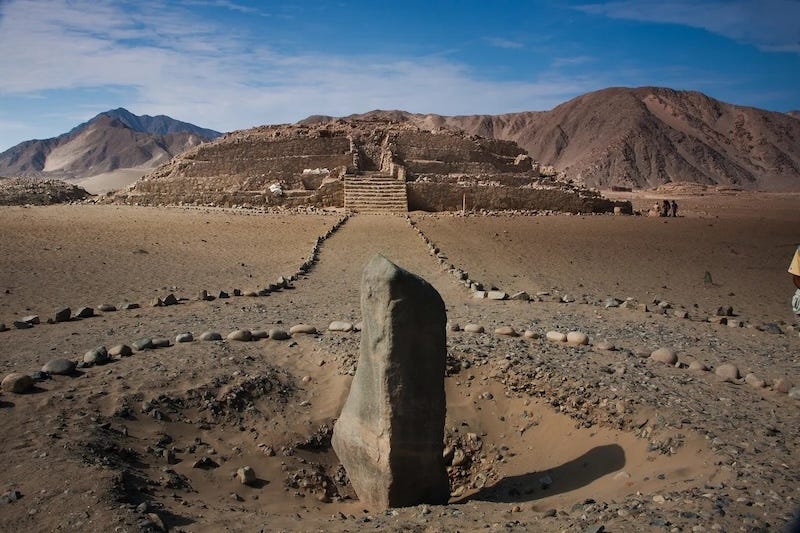
Caral is marked by impressive pyramids and sunken ceremonial platforms.
Long before the Inca, Maya, and Aztec became the best-known civilizations of the Americas, a much older society was already building monumental architecture on the arid coast of central Peru. This civilization was centered at Caral, a 5,000-year-old urban settlement in the Supe Valley.
Caral is often described as the oldest known center of civilization in the Americas. It emerged around 3000 BC, developed large public buildings, organized ceremonial spaces, and maintained regional exchange networks. What makes the site especially striking is the character of its archaeological record: researchers have found monumental architecture, music, ritual spaces, elite residences, and evidence of trade, while weapons and fortifications are absent from the known remains.
For this reason, Caral has become one of the most important case studies for a different model of early civilization. Its rise may have depended less on warfare and coercion, and more on religion, trade, social organization, ceremony, and shared cultural authority.
A 5,000-year-old city in the Supe Valley
Caral lies in Peru’s Supe Valley, north of Lima, on a dry desert terrace overlooking the green river valley. The site belongs to the Late Archaic Period of the Central Andes and is part of the wider Caral-Supe or Norte Chico civilization.
The Sacred City of Caral-Supe covers a large protected area and became a UNESCO World Heritage Site in 2009. UNESCO describes it as a 5,000-year-old archaeological landscape and the oldest center of civilization in the Americas. Its architecture includes monumental stone and earthen platform mounds, sunken circular plazas, elite residential sectors, and planned urban spaces.
The city was not an isolated settlement. It formed part of a broader network of urban centers in the Supe Valley and neighboring valleys. These settlements shared architectural forms, economic connections, ceremonial practices, and a regional social system that developed between roughly 3000 and 1800 BC.
A civilization as old as Egypt’s pyramid age
The importance of Caral became clear through radiocarbon dating. Earlier researchers had underestimated the antiquity of the site, but scientific dating showed that monumental construction and urban life were already present there around the third millennium BC.
That placed Caral in the same broad era as the pyramid-building age of ancient Egypt and the early urban civilizations of Mesopotamia. In the Americas, it pushed the known emergence of complex urban society more than a thousand years earlier than many older models had assumed.
The 2001 study published in Science by Ruth Shady Solís, Jonathan Haas, and Winifred Creamer was a turning point. It showed that Caral was a preceramic urban center with monumental architecture, organized settlement patterns, irrigation agriculture, and complex public construction. Later research in the broader Norte Chico region showed that Caral was part of a larger cultural system extending across multiple valleys.
Monumental buildings and ceremonial power
Caral’s architecture reveals a society with strong organizational capacity. The site contains dozens of monumental buildings, including major pyramidal structures and sunken circular courts. The most famous of these is the Pirámide Mayor, a large platform pyramid rising above the settlement.
These buildings required planning, labor mobilization, architectural knowledge, and a governing structure capable of coordinating large public works. The construction of platform mounds, plazas, stairways, ceremonial rooms, and elite residences suggests a complex society with social hierarchy and specialized roles.
Caral also had public spaces designed for gatherings. Ritual and political meetings likely took place in these areas, reinforcing social order through ceremony rather than visible military power. The city’s plan points to a leadership system closely tied to religious ideology and communal participation.
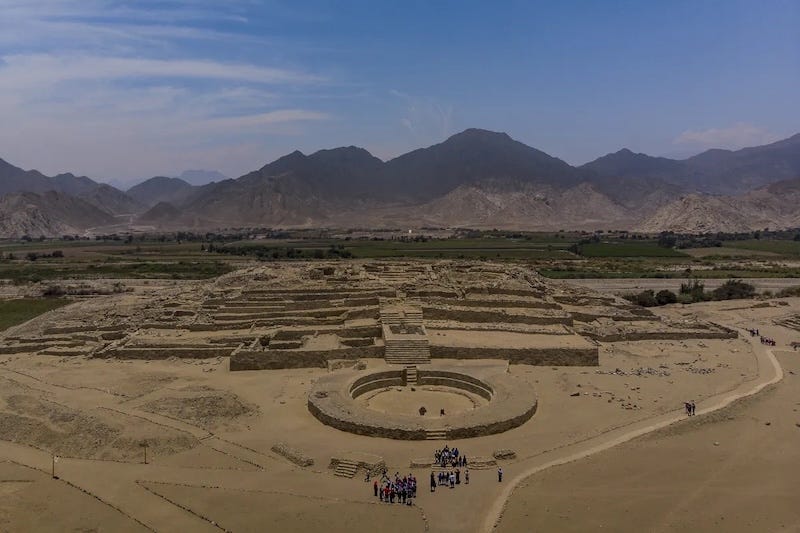
A view of the ruins of Caral, a UNESCO World Heritage Site
A society with little evidence of warfare
One of the most discussed features of Caral is the absence of defensive architecture and military equipment in the known archaeological record. Researchers have reported no clear evidence of fortifications, battle weapons, or mass destruction connected with war at the site.
This has led to the idea that Caral may have developed for more than a millennium with very limited organized violence. The claim should be handled carefully, because archaeology can rarely prove that a society was completely peaceful in every aspect of life. Still, the material pattern is unusual when compared with many later states in the Americas, where warfare, fortified settlements, and weapons are much more visible.
Caral may therefore represent a model of early complexity in which authority was maintained through ideology, ritual, economic control, and exchange networks. Power may have been organized around religious leadership, control of resources, and the ability to connect coastal, inland, and highland communities.
Trade instead of military expansion
Caral’s location helped connect different ecological zones. The people of Caral had access to agricultural land in the valley, marine resources from the Pacific coast, and goods from the Andes and the Amazonian sphere.
Excavations have revealed evidence of trade and exchange, including marine foods from the coast and nonlocal materials from distant regions. This suggests that Caral’s influence was built partly through interregional networks.
These exchange systems may have strengthened the city’s stability. Instead of relying on conquest, Caral appears to have linked communities through food production, ritual obligations, prestige goods, and shared ceremonial practices. The Supe Valley became a center of interaction between the coast, highlands, and forested regions.
Music at the center of ceremonial life
Caral’s cultural life also included music. One of the most remarkable discoveries came from the area of the amphitheater, where archaeologists found musical instruments made from animal bones.
Researchers have reported 32 flutes made from pelican and condor bones, along with dozens of cornets made from deer, llama, or related camelid bones. These instruments show that music had a major ceremonial and social role at Caral.
Their materials also point to broad connections. Pelicans and marine birds link the site to the coast, while camelids and deer connect it with inland and highland environments. The instruments were not only musical objects; they also reflected the regional world that Caral brought together.
The presence of an amphitheater and musical instruments suggests that public performance helped bind the community. Music, ritual, and collective gatherings may have been central tools of social cohesion.
A city of farmers, fish, builders, and ritual specialists
Caral’s economy combined agriculture with access to marine resources. The people cultivated crops such as squash, beans, sweet potatoes, and cotton, using irrigation systems in the Supe Valley. Marine resources, including anchovies and sardines, also reached the inland city from the Pacific coast.
Cotton may have been especially important because it could be used to produce nets and textiles. Coastal fishing communities needed nets, while inland agricultural communities needed marine protein. This created a strong basis for exchange between the coast and the valley.
The settlement also shows social differentiation. Some buildings and residential areas were more elaborate than others, suggesting divisions between elite groups, specialists, craft workers, and laborers. The elites may have coordinated ritual, planning, redistribution, and construction.
A major climate crisis around 4,200 years ago
Caral’s long development eventually faced a severe environmental crisis. Around 4,200 years ago, a major drought affected the region. Some researchers connect this event with the wider 4.2-kiloyear climate event, a period of environmental stress that also impacted parts of Mesopotamia, Egypt, the Indus world, and other regions.
For Caral, the drought appears to have disrupted agriculture and made life in the Supe Valley much harder. Crop failures and food shortages likely forced many people to leave the original city and resettle in places with better access to water or marine resources.
This crisis brought a major change, but the civilization’s traditions continued. Archaeological evidence from later sites suggests that the people connected with Caral carried their architectural styles, symbolic systems, and social practices into new settlements.
Vichama and Peñico: survival after Caral
Two sites are especially important for understanding what happened after Caral’s decline: Vichama and Peñico.
Vichama lies near the Pacific coast, where communities could combine fishing with farming in the Huaura Valley. Archaeologists have found dramatic reliefs and murals at the site that appear to refer to famine, death, renewal, and the return of water. These images include emaciated human figures, pregnant women, ritual scenes, fish, and symbolic creatures connected with rain.
Peñico, located inland east of Caral, also appears to have continued important traditions from the older civilization. It flourished between about 1800 and 1500 BC and included monumental buildings, public spaces, and ceremonial architecture. Its location near water sources and trade routes made it a strategic settlement linking the coast, highlands, and Amazonian zones.
These later sites suggest that the Caral civilization did not simply vanish in a single moment. It transformed, relocated, and adapted to changing environmental conditions.
Peñico and the final phase of the tradition
Peñico has become one of the most important recent discoveries connected with Caral. After years of research led by Ruth Shady and her team, the site was opened to the public in 2025.
The settlement contains multiple monumental structures, including public buildings and residential spaces. Archaeologists have described it as a continuation of Caral’s social and architectural tradition after the climate crisis. Its ceremonial halls, sunken plazas, and layout echo earlier patterns from Caral-Supe.
Peñico may have served as a hub of trade and political-religious activity during the later phase of the civilization. Its economy was connected with agriculture, exchange, and possibly the movement of prestige goods such as hematite, a mineral used for red pigment and symbolic purposes in the Andes.
By around 1500 BC, Peñico was also abandoned. With that, the long Caral-Supe tradition came to an end as a major civilizational system. Later Andean cultures developed in different forms, eventually leading to civilizations with stronger evidence of warfare, state expansion, and military organization.
Caral’s place in the history of civilization
Caral is important because it challenges the assumption that early civilization always emerged through war, conquest, or centralized force. Its archaeological record points to another path: monumental architecture, religious authority, music, trade, irrigation, planned urbanism, and regional cooperation.
It also changes the timeline of the Americas. Caral shows that complex urban society developed in Peru thousands of years before the Inca and long before many better-known civilizations of the Americas.
The site’s story is also relevant today because of how its people responded to environmental stress. Faced with drought, they moved, adapted, and rebuilt traditions in new places. The evidence from Vichama and Peñico suggests continuity through crisis rather than immediate cultural collapse.
Caral remains one of the most important archaeological sites in the world because it shows that the first civilization in the Americas may have been built around ceremony, exchange, and social coordination rather than war. Its pyramids, plazas, instruments, and murals preserve the memory of a society that found a distinctive path to complexity on Peru’s desert coast.
Sources
IFLScience, Benjamin Taub, “The Oldest Civilization In The Americas May Have Been Entirely Peaceful: For 1,000 Years, Caral Made Music, Not War,” published June 2026.
UNESCO World Heritage Centre, “Sacred City of Caral-Supe,” official World Heritage description and criteria.
Zona Arqueológica Caral, official heritage page on Caral-Supe, UNESCO inscription, territorial protection zones, and Caral’s civilizational importance.
Smithsonian Magazine, “First City in the New World?” background on Ruth Shady’s work, the radiocarbon dating, the Pirámide Mayor, musical instruments, trade, food, and irrigation.
We spent three weeks in the Andes last year, following the Inca trail all the way to Santiago. For our next trip, we plan going North from Lima to explore Caral. This is a great article and I am confident that people will soon connect the dots between Caral, Wari, and Tiwanaku cultures and realize there had been advanced cultures in Mesoamerica and the Andes thousands of years before Inca and that they were much more advanced that we allow ourselves to admit today. Thanks a lot.
Are you familiar with Timothy Alberino’s and LA Marzulli’s work there on the megolithic structures? There are over 100. This is just 1 of them. He is also the author of “ “Birthright, The Coming Posthuman Apocalypse and the Usurpation of Adam's Dominion on Planet Earth”
https://youtu.be/CcEZuz8l8O8?is=EzwTsQiWMHzT7OmY
https://a.co/d/0htaai7r