


Archaeologists excavating the prehistoric lakeside settlement of Mrdaja near Star Dojran in southeastern North Macedonia have uncovered a 3,500-year-old Mycenaean-type bronze sword, several bronze battle axes and the remains of a metalworker’s workshop.
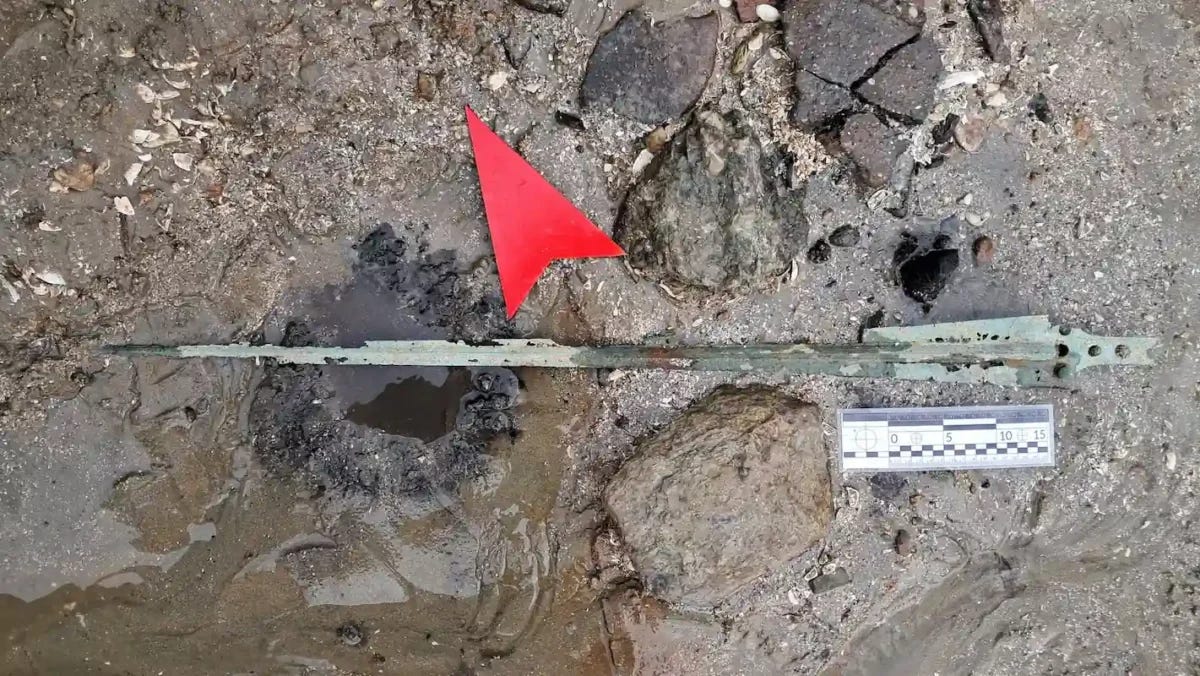
The 3,500-year-old Mycenaean-type bronze sword uncovered in situ at Mrdaja on Lake Dojran, North Macedonia, photographed beside a 15-centimetre scale bar. Photograph by Zoran Rujak, NI Institute for Protection of Monuments of Culture and Museum, Strumica
The 2026 campaign was directed by Zoran Rujak, advisor curator at the National Institution Institute for Protection of Monuments of Culture and Museum in Strumica, with funding from North Macedonia’s Ministry of Culture and Tourism. Over less than two months, a small team of five to six specialists excavated roughly 350 square metres along the southern shore of Lake Dojran, close to the Greek border. According to the Macedonian Archaeological Association (MAD), the new stratigraphy shows that people inhabited Mrdaja from the Middle Bronze Age in the first half of the second millennium BC through the Late Bronze Age and into the transitional period before the Iron Age.
Excavators uncover three timber platforms and a bronze workshop at Mrdaja
Mrdaja was a pile-dwelling settlement where residents built timber houses atop wooden platforms driven into the shallow lakebed. During the 2026 season, Rujak’s team documented the structural remains of three Bronze Age houses.
Inside one of these buildings, excavators recovered casting moulds and metallurgical debris showing that a smith worked bronze directly within the settlement. The structure also contained architectural and symbolic features that set it apart from ordinary domestic dwellings, leading Rujak to interpret it as both an active production facility and a high-status building within the community.
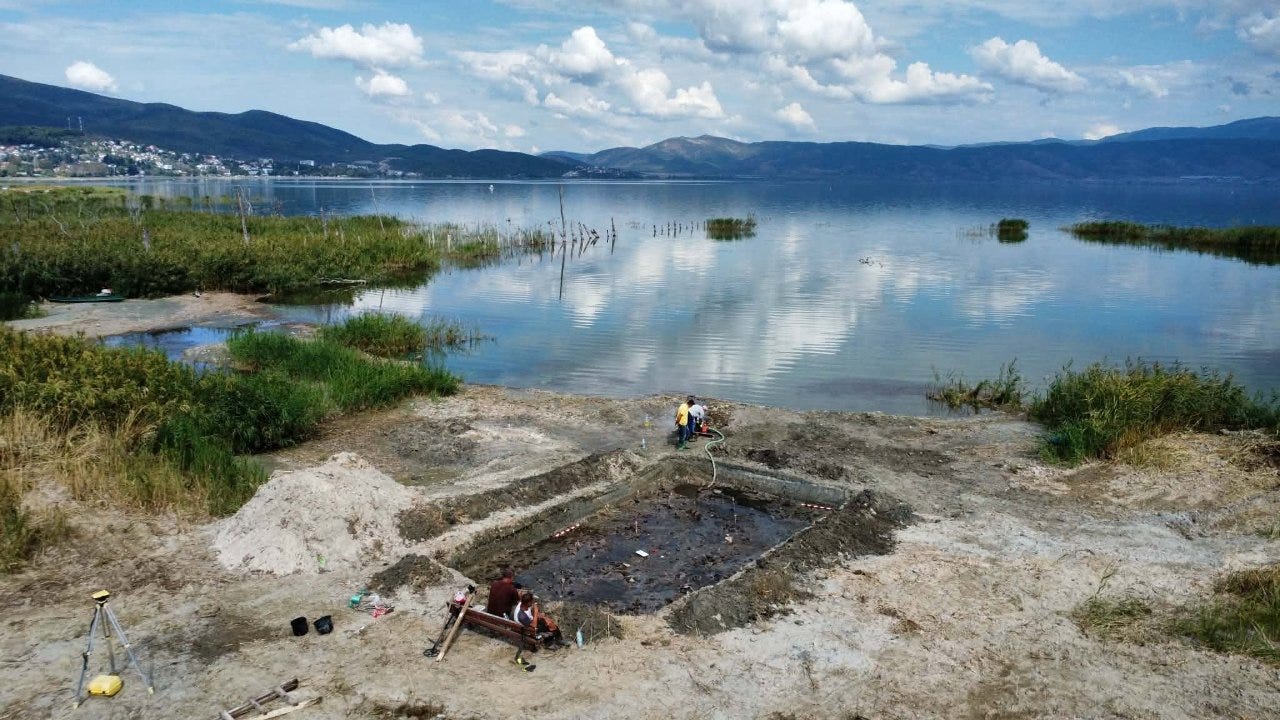
Elevated view of the 2026 excavation trench at Mrdaja on Lake Dojran, showing waterlogged Bronze Age timber piles along the shoreline. Photograph by NI Institute for the Protection of Monuments of Culture and Museum, Strumica.
A Mycenaean-type rapier and scattered axes point to Aegean trade and local conflict
The most prominent find from the 2026 trench is a bronze rapier-style sword of Mycenaean type, dated typologically to roughly 3,500 years ago. In interviews with Macedonian media, Rujak identified the weapon as the oldest bronze sword recorded in North Macedonia to date.
Alongside the sword, the team recovered bronze battle axes and other weapons scattered around the exterior of the metalworker’s house. While the distribution of weapons outside the workshop raises the possibility of a sudden violent attack during the upheavals of the Late Bronze Age, the excavation team has stressed that armed conflict remains a working hypothesis rather than a confirmed conclusion.
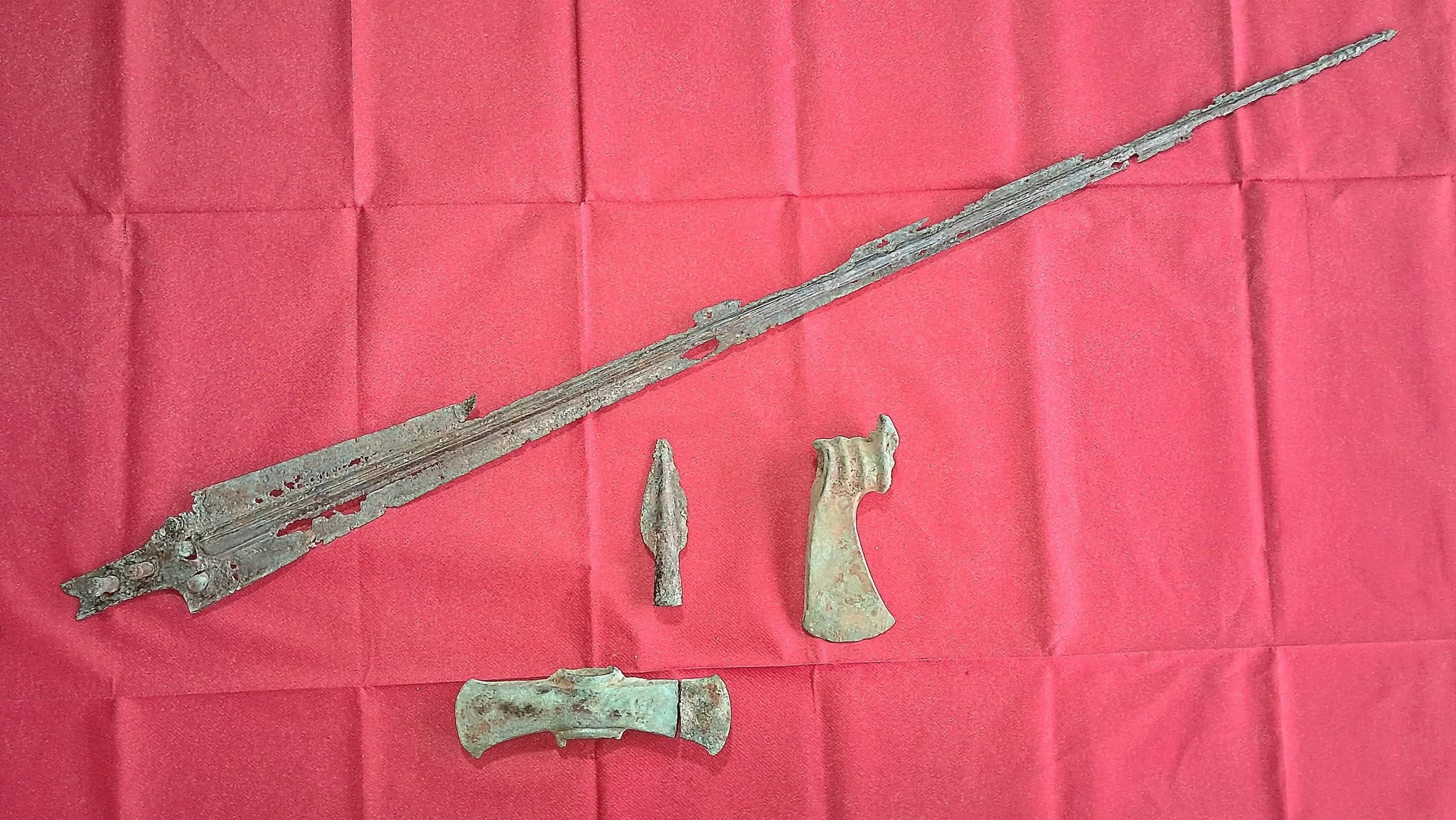
The Mycenaean-type bronze rapier sword, spearhead and two battle axes recovered at Mrdaja on Lake Dojran in North Macedonia. Photograph by NI Institute for the Protection of Monuments of Culture and Museum, Strumica.
Whether carried north through trade or forged by smiths familiar with southern prototypes, the rapier demonstrates direct links between the Dojran basin and the Aegean world. Lake Dojran sits along natural river and valley corridors connecting the Vardar (Axios) valley to the northern Aegean coast, placing Mrdaja along an active Bronze Age exchange route.
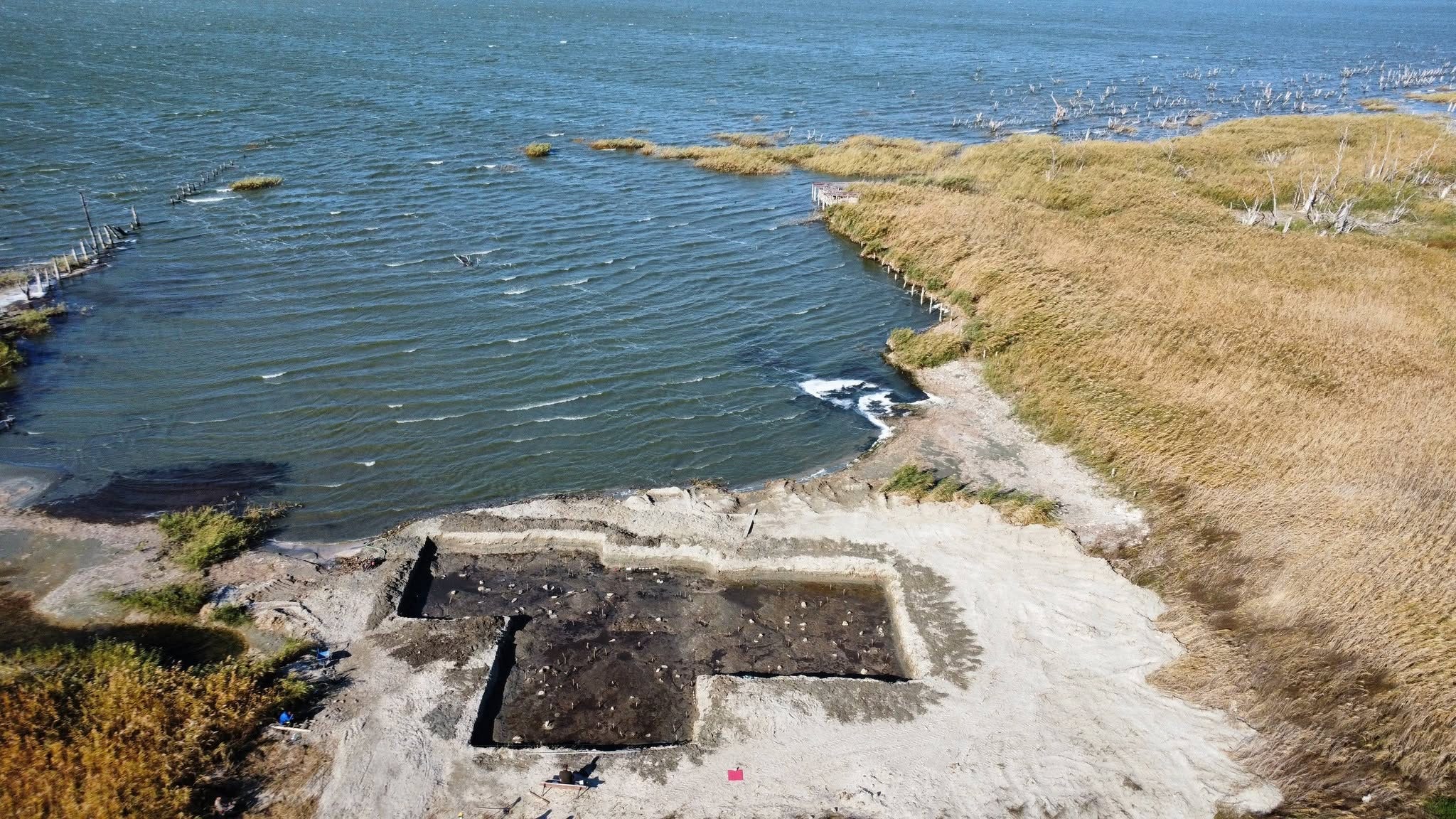
Aerial view of the waterlogged 2026 excavation trench and shoreline reed beds at the Bronze Age pile-dwelling site of Mrdaja on Lake Dojran, North Macedonia. Photograph by Zoran Rujak, NI Institute for Protection of Monuments of Culture and Museum, Strumica
Solar pottery and bull-horn emblems push the settlement back to the Middle Bronze Age
Beyond weaponry, the 2026 excavations yielded two-handled ceramic vessels, pottery fragments incised with circular and geometric solar motifs, and clay objects shaped like bull horns. Rujak interprets the bull-horn pieces as cultic objects used in structured community rituals, echoing symbolic traditions attested across the Bronze Age Aegean.
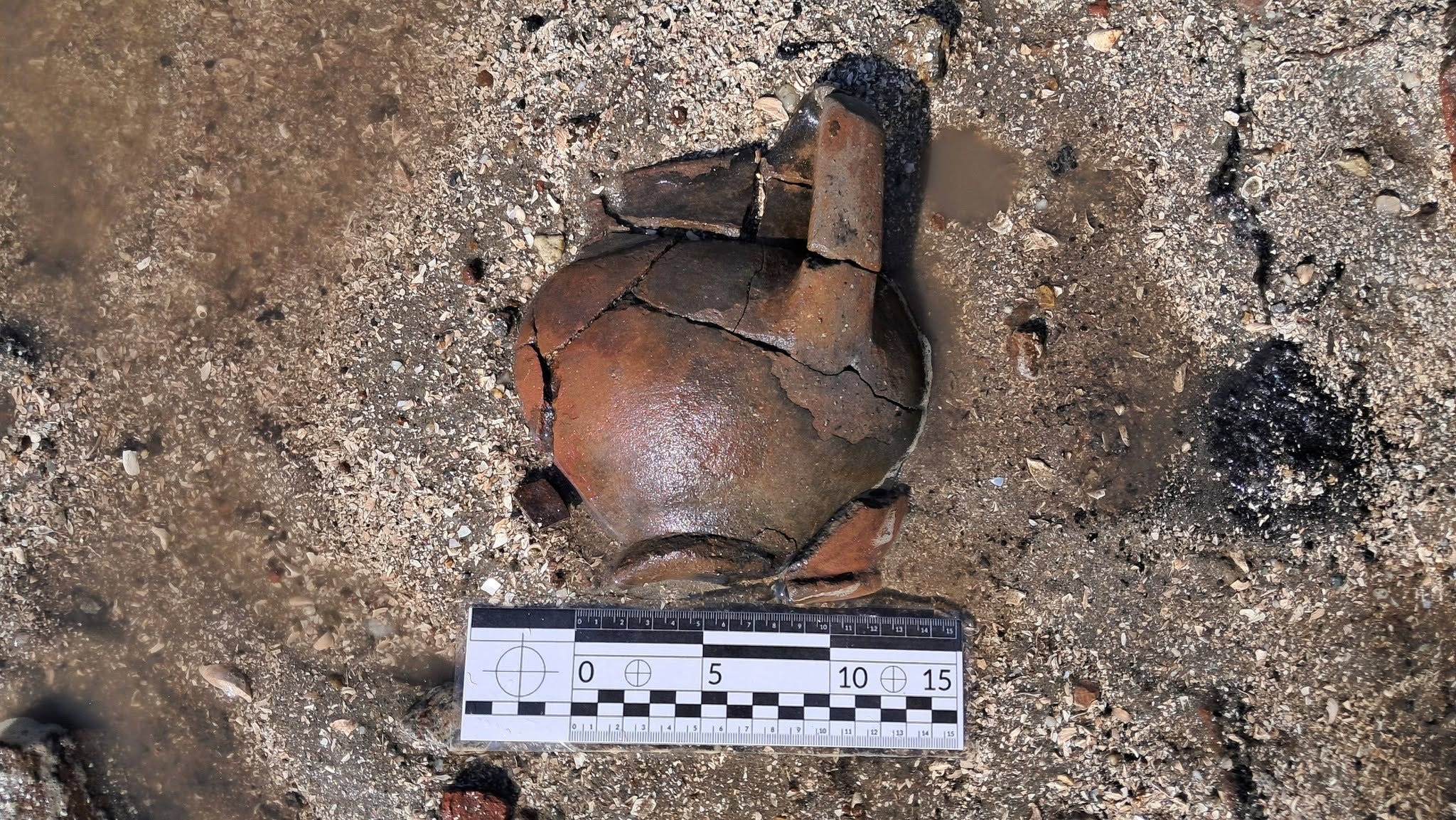
A fractured Bronze Age handled ceramic vessel photographed in situ in wet sediment beside a 15-centimetre scale bar during the 2026 excavation at Mrdaja on Lake Dojran, North Macedonia. Photograph by Zoran Rujak, NI Institute for Protection of Monuments of Culture and Museum, Strumica
Together, the metallurgical moulds, imported or Aegean-inspired weaponry and decorated ceramics show that Mrdaja operated as a connected craft and trading settlement rather than an isolated fishing village. Plans are now underway between local heritage institutions to establish an open-air museum over the water at Star Dojran to display the reconstructed pile-dwelling architecture and recovered artefacts.
Subscribe for a few dollars a month and get every long read, the short documentaries and the full archive. Cancel anytime.
📍 Explore Mrdaja on the Ancient Content Atlas: