


Archaeologists at the Tartessian site of Casas del Turuñuelo in Guareña, Badajoz, have uncovered an exceptional bronze ritual cart dating back around 2,500 years. The object is unique in the Iberian Peninsula and has no close parallel currently known in the western Mediterranean.
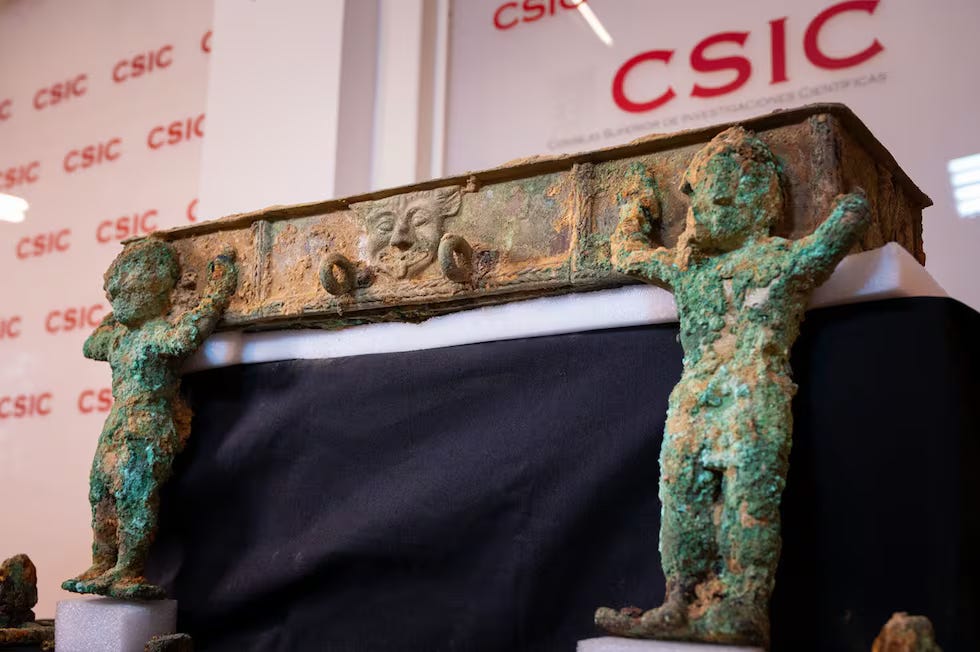
Restored bronze ritual cart from Casas del Turuñuelo. Credit: César Hernández, CSIC.
The discovery was made during the eighth excavation campaign at the site, led by the Instituto de Arqueología de Mérida, a joint research center of the Spanish National Research Council, CSIC, and the Junta de Extremadura. The find was presented in Madrid together with other objects recovered from the latest campaign.
The cart preserves two wheels and part of its main box. Although incomplete, it retains a rich figurative decoration with mythological beings, including griffins, human support figures, and a frontal image identified with Achelous, a river deity known in Greek and Etruscan iconography.
The object adds a major new piece to the study of Tartessos. It suggests that the people who occupied Casas del Turuñuelo were connected to luxury exchange networks reaching across the Mediterranean, including Etruria, Greece, Egypt, and eastern Mediterranean regions.
Casas del Turuñuelo and the world of Tartessos
Casas del Turuñuelo is one of the most important archaeological sites for the study of Tartessos, the early civilization of the southwestern Iberian Peninsula. The site lies in Guareña, in the province of Badajoz, within the Middle Guadiana Valley.
Tartessos flourished during the first millennium BC, especially in the southwest of the Iberian Peninsula, in areas connected with modern Andalusia and Extremadura. Ancient authors associated the region with wealth, metals, trade, and distant Mediterranean contacts.
For a long time, Tartessos was surrounded by myth and uncertainty. Archaeology has gradually changed that picture. Sites such as Cancho Roano, La Mata, El Carambolo, Huelva, and Casas del Turuñuelo have helped define Tartessos as a complex society with monumental architecture, religious practices, elite display, writing, imported goods, and strong Mediterranean connections.
Casas del Turuñuelo has become especially important because of its extraordinary preservation. The main building was intentionally sealed beneath a large mound after a final ritual episode around the end of the 5th century BC. This act protected parts of the structure and its contents for more than two millennia.
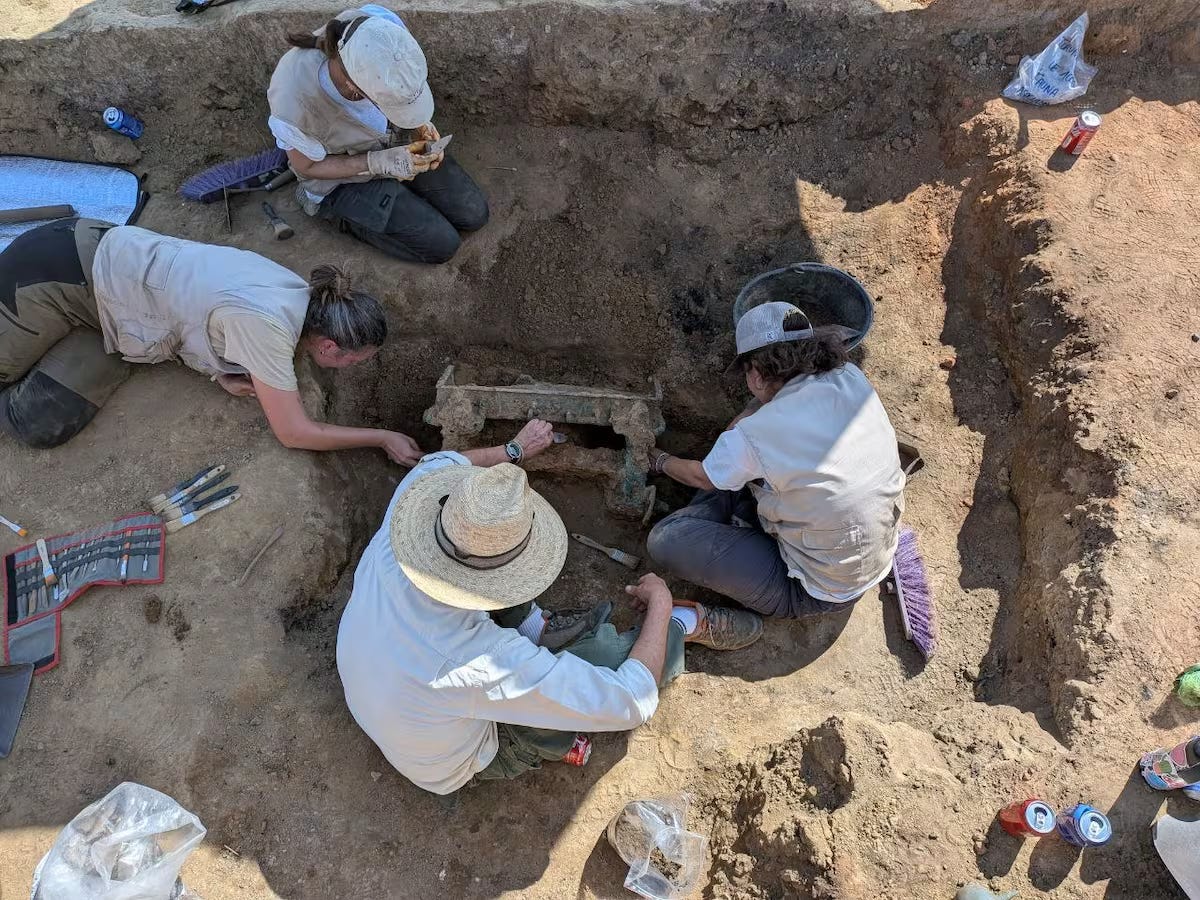
Archaeologists uncover a bronze ritual cart at the Tartessian site of Turuñuelo de Guareña in Badajoz. Credit: IAM-CSIC.
A monumental building sealed beneath a tumulus
The main building at Casas del Turuñuelo is one of the most remarkable Tartessian structures ever excavated. It was built with adobe and other materials and is known for its size, preservation, and unusual ritual deposits.
The mound covering the complex measures about 90 meters in diameter and around 6 meters high. The latest excavation campaign focused on the northern and southern sectors of this tumulus, around room H-100, a space of about 70 square meters and currently the largest room excavated in the building.
Archaeologists have documented new rooms and circulation areas that expand the known plan of the complex. This is important because Casas del Turuñuelo was not a simple rural building. It was a monumental structure with complex architecture, ritual spaces, elite objects, and evidence for carefully organized ceremonies.
The site has repeatedly produced finds that reshape understanding of Tartessian society. Earlier campaigns revealed a large animal sacrifice, the first known human representations from Tartessos, a slate tablet with warrior imagery and a southern Paleohispanic alphabet, and the oldest Greek marble altar so far known in the western Mediterranean.
The bronze cart now joins this sequence of exceptional discoveries.
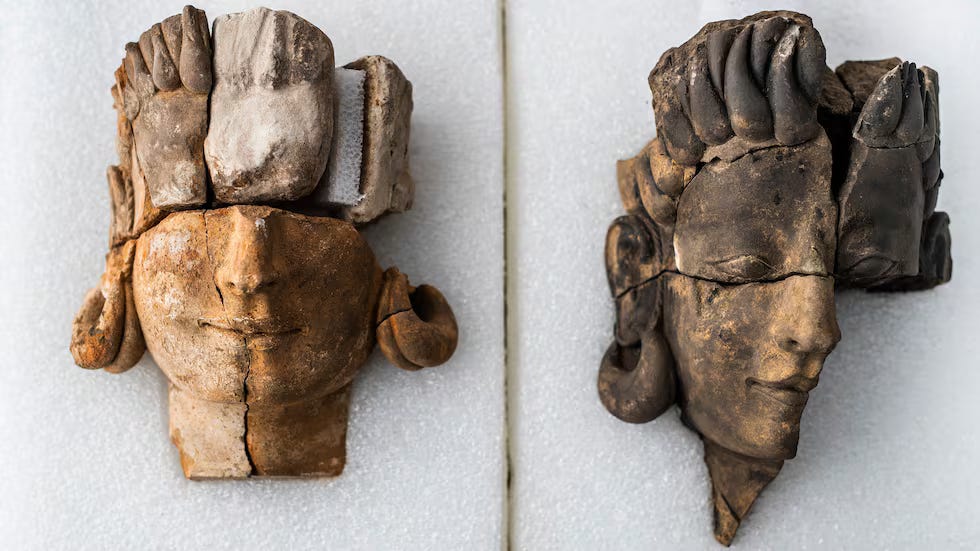
Tartessian sculptures uncovered at the Turuñuelo archaeological site in Guareña, Badajoz. Credit: Samuel Sánchez.
The bronze cart from corridor S3
The ritual cart was found in the southern sector of the main building, in corridor S3. This area already had a strong ritual character because archaeologists had documented a distinctive altar shaped like a bull hide nearby.
The cart appears to preserve half of the original object, including two wheels and part of the box. It is small, around 62 centimeters according to reports from the excavation presentation, but its technical and symbolic complexity is extraordinary.
The object was made from bronze elements assembled with iron components. This construction indicates skilled metalworking and careful planning. The cart was not a practical vehicle for transport in the ordinary sense. Its size, material, iconography, and location point toward a ceremonial function.
The researchers describe it as a votive or ritual cart. Its exact use remains under study, but its discovery beside a ritual area suggests that it belonged to ceremonial activity inside the building.
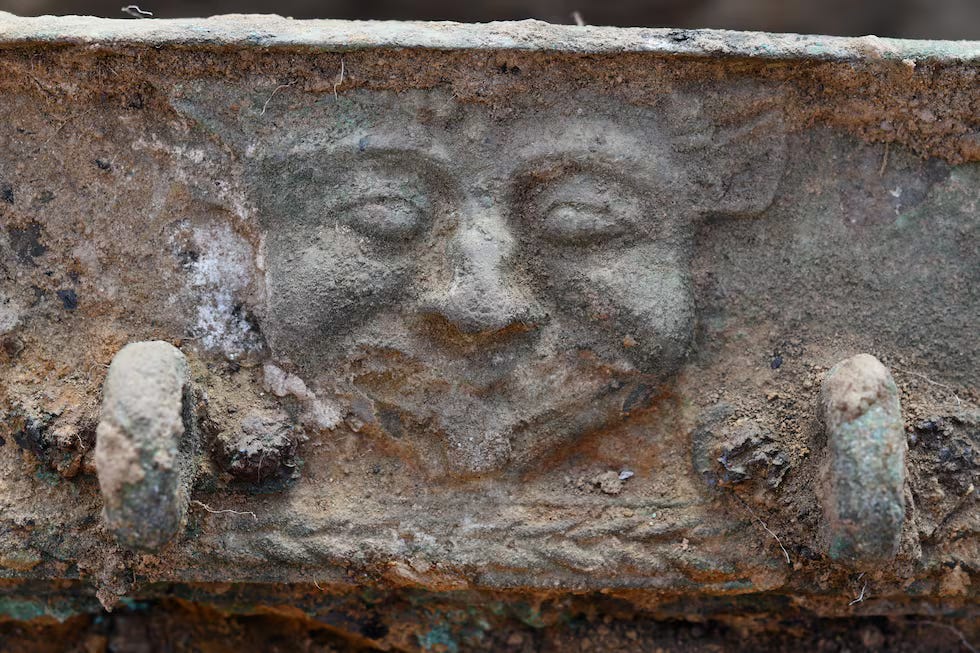
Detail of the Achelous figure on the bronze ritual cart from the Tartessian site of Turuñuelo de Guareña in Badajoz. Credit: IAM-CSIC.
Achelous on the front
One of the most striking elements is the figure represented on the front of the cart.
Researchers identify it as Achelous, a river deity from Greek mythology. Achelous often appears in Mediterranean art as a powerful water-related being, sometimes with hybrid features. In the Turuñuelo cart, the figure may also carry associations with the underworld because of its gesture and iconographic treatment.
Some reports describe the figure as a hybrid image connected with Achelous and gorgon-like features. This combination is especially significant because it suggests the adaptation of Mediterranean mythological imagery into a Tartessian ritual context.
The image does not simply show artistic imitation. It points to a visual language shared across cultures, then reworked locally. A Greek or Etruscan figure could become meaningful inside a Tartessian building in the interior of the Iberian Peninsula.
This is one of the strongest signs that Casas del Turuñuelo was part of a connected Mediterranean world.
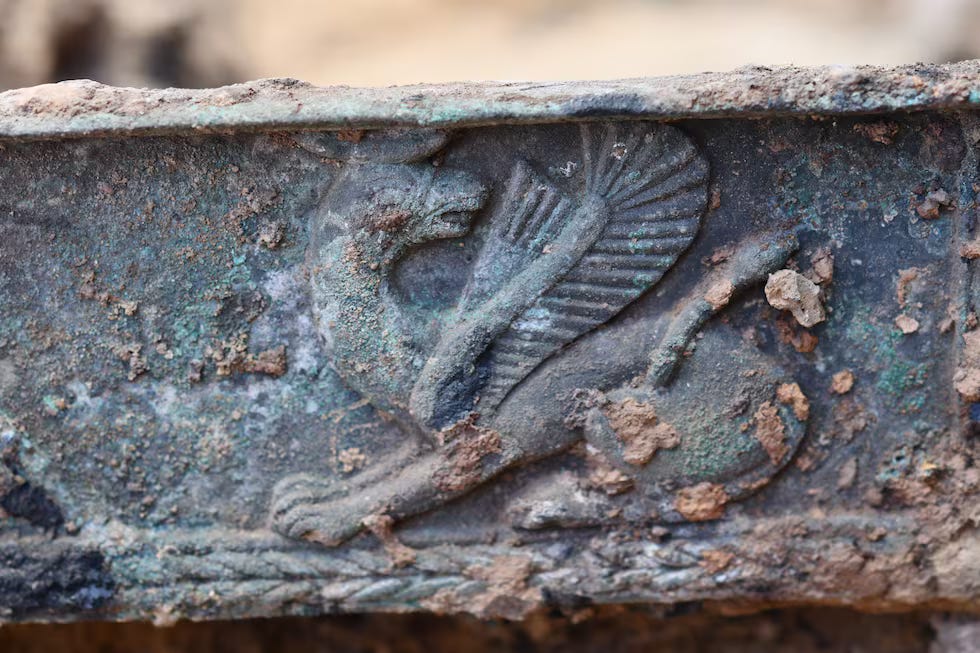
Detail of a griffin on the bronze ritual cart from Turuñuelo de Guareña. Credit: IAM-CSIC.
Griffins, atlantes, and decorated wheels
The cart’s decoration also includes two griffins on the sides. Griffins are mythological beings with the head and wings of an eagle and the body of a lion. In ancient Mediterranean art, they often appear as guardians, protective creatures, or symbols linked with power, death, and the divine.
At the ends of the cart, two human figures with raised arms support the structure. These are described as atlantes, figures that appear to hold or carry an architectural or symbolic weight.
The wheels are also decorated, which shows that the cart was designed as a complete ceremonial object. Its surface was not left plain. Every visible part seems to have contributed to the visual and symbolic effect.
The combination of Achelous, griffins, human support figures, and decorated wheels gives the cart a dense mythological language. It connects water, protection, power, and possibly the underworld.
Etruscan parallels
The closest known comparisons come from ancient Etruria, in central Italy.
This does not prove with certainty that the cart was made in Etruria, but the parallel is important. The researchers consider an Etruscan origin possible, based on the structure and decoration of similar objects known from that region.
If the cart was imported, it would represent a luxury object that traveled from the central Mediterranean into the interior of the Iberian Peninsula. If it was made locally by craftspeople familiar with Etruscan models, it would still show intense cultural contact and the circulation of technical and symbolic knowledge.
In either case, the cart shows that Tartessian elites were engaging with high-status Mediterranean objects and images.
This is especially important because Casas del Turuñuelo lies inland, far from the main coastal ports usually associated with Mediterranean exchange. The object shows that luxury goods and ideas could move deep into the Guadiana Valley.
A ceremony of banquets, perfumes, and closure
The function of the cart is still being studied, but researchers have proposed a ritual use connected with banquets and ceremonial activity.
Sebastián Celestino, one of the excavation directors, has suggested that the cart may have been linked with activities around banquets. The object was found near the so-called banquet room, connected with the final communal meal or ceremonial gathering before the building was closed.
Another possibility is that the cart carried perfumes, incense, or aromatic resins. Some reports describe it as a possible mobile incense burner or perfume burner. If so, it may have held embers or aromatic substances during ritual ceremonies.
This interpretation fits the character of Casas del Turuñuelo. The building appears to have been deliberately closed through a complex ritual sequence that included banqueting, animal sacrifice, and intentional burning. The cart may have formed part of that final ceremonial world.
Imported goods from Greece, Egypt, and the East
The bronze cart was not the only important find from the latest campaign.
Archaeologists also recovered Greek pottery from the region of Attica, an Egyptian alabaster vessel, and carved ivory objects of eastern origin. Some of the ivories are decorated with warriors, animals, and plant motifs.
These objects are crucial because they show the long-distance networks connected to Casas del Turuñuelo. The site was receiving or using materials and luxury objects linked with multiple Mediterranean regions.
Greek ceramics point to Aegean trade connections. Egyptian alabaster points to the prestige circulation of exotic vessels. Oriental ivories point to eastern Mediterranean craft traditions and elite display.
Together with the bronze cart, these finds show that Tartessian elites were not isolated local rulers. They participated in a wide exchange system where objects, symbols, materials, and ritual forms moved across seas and inland routes.
Bronze objects from the northern sector
The northern sector of the excavation also produced important metal objects.
Archaeologists recovered two bronze braziers and a bronze cauldron. These finds reinforce the impression of wealth, ritual consumption, and ceremonial practice at the site.
Bronze vessels and braziers were not ordinary household items in this context. They belonged to a world of feasting, heating, offering, scent, display, and ritual preparation.
When considered together with the cart, imported ceramics, alabaster, and ivories, the metal finds show a high level of elite material culture.
They also point to repeated patterns at Casas del Turuñuelo: formal spaces, imported goods, metalwork, ritual equipment, and controlled closure of the building.
The final closing of the building
One of the most remarkable aspects of Casas del Turuñuelo is the way the building was closed.
The evidence suggests that the structure was intentionally burned and sealed after a major ritual episode. This was not ordinary abandonment. The people who used the building appear to have carried out a deliberate act of closure.
Previous discoveries at the site include a large animal sacrifice, especially involving equids, described as one of the largest such deposits in the western Mediterranean. This event appears to belong to the final phase of the building.
The new cart may have participated in this same ritual atmosphere. Found near the banquet area and close to ritual installations, it likely belonged to ceremonies that marked the final use of the building.
The closure of Casas del Turuñuelo therefore seems to have been a carefully staged event involving food, animals, fire, precious objects, and symbolic imagery.
A site of political and ritual power
The richness of the finds suggests that Casas del Turuñuelo was a place of significant authority.
Its architecture required organized labor. Its imported objects required access to trade routes and exchange partners. Its ritual deposits required social coordination. Its precious materials reveal access to wealth.
Esther Rodríguez and Sebastián Celestino have emphasized that objects of this kind reflect the power of the people who controlled the site. The cart, in particular, suggests an elite capable of attracting rare objects from distant regions or commissioning work inspired by Mediterranean models.
This power was not only economic. It was also ritual and political.
The building seems to have been a center where authority was performed through ceremonies, banquets, sacrifice, and display. The bronze cart was part of that performance.
Tartessos beyond the coast
The discovery also strengthens a broader shift in how Tartessos is understood.
Older interpretations often focused heavily on the coastal southwest, especially Huelva, Cádiz, and the Guadalquivir region. These areas remain central to the history of Tartessos because of metals, ports, Phoenician contacts, and early urban development.
But Casas del Turuñuelo shows that the interior also played a major role.
The Middle Guadiana Valley was not peripheral. It contained elite centers with monumental architecture, specialized ritual activity, and access to Mediterranean goods. The bronze cart makes this point especially clear because it places an object with possible Etruscan connections inside an inland Tartessian ceremonial complex.
This changes the map of Tartessos. The culture was not limited to coastal exchange zones. Its networks extended inland, where local elites transformed imported objects and ideas into their own forms of power.
A Mediterranean language of myth
The cart’s iconography shows how mythological imagery traveled across the ancient Mediterranean.
Achelous belongs to Greek myth. Griffins appear widely across Near Eastern, Greek, Etruscan, and other Mediterranean visual traditions. Atlante figures also belong to a shared artistic vocabulary of support, strength, and cosmic or architectural symbolism.
At Casas del Turuñuelo, these images appear together on a bronze ritual object in a Tartessian context.
This does not mean Tartessos simply copied foreign art. The more interesting possibility is cultural selection and transformation. Foreign symbols were adopted because they had meaning, prestige, or ritual power. Once placed inside a local building, they became part of Tartessian ceremonial life.
The cart therefore offers a rare view of symbolic exchange. It shows not only the movement of an object, but the movement of visual ideas.
Conservation after excavation
The bronze cart required immediate conservation.
Bronze can begin to deteriorate when exposed after long burial, especially once it meets light, oxygen, and changing humidity. Because of this risk, the piece was transferred for specialized treatment.
The conservation work is being carried out at the Servicio de Conservación, Restauración y Estudios Científicos del Patrimonio Arqueológico, SECYR, at the Universidad Autónoma de Madrid.
This phase is essential. Cleaning, stabilization, documentation, drawing, imaging, and material analysis will help researchers understand the object’s construction, technology, function, and history.
The excavation has revealed the object, but the laboratory will reveal many of its details.
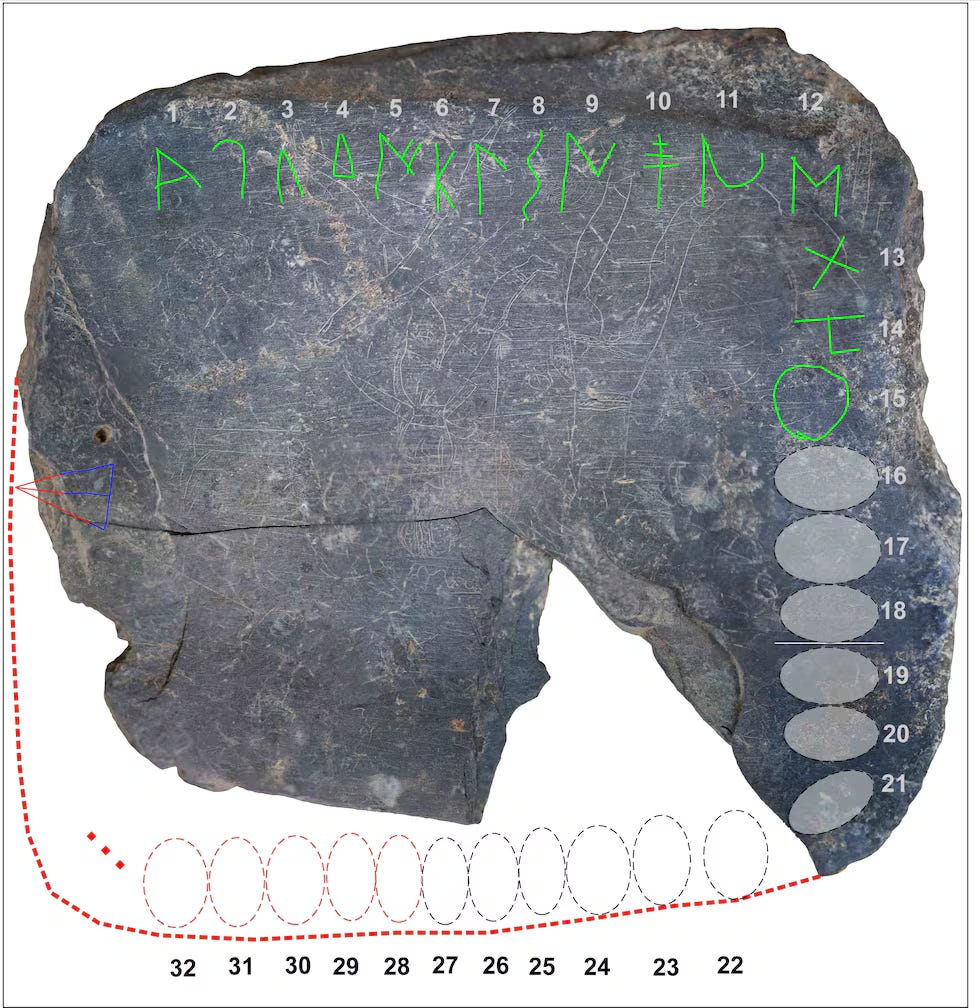
Infographic showing the alphabet engraved on a 2,500-year-old slate tablet from the Tartessian site of Turuñuelo de Guareña in Badajoz
A decade of discoveries
The bronze cart is part of a longer sequence of discoveries at Casas del Turuñuelo.
In 2017, archaeologists documented a major animal sacrifice. In 2023, they revealed the first human representations known from Tartessos. In 2024, they presented a slate tablet with warrior scenes and a southern Paleohispanic alphabet. In 2025, they reported a Greek marble altar described as the oldest known in the western Mediterranean.
Each discovery has added a new layer.
The site has shown that Tartessian society had monumental buildings, complex rituals, figural art, writing, imported goods, and highly developed forms of elite display.
The 2026 bronze cart fits directly into this pattern. It is not an isolated curiosity. It belongs to a site that has repeatedly produced evidence for a sophisticated, connected, and powerful community.
A rare object from a connected world
The bronze cart from Casas del Turuñuelo is exceptional because it combines technical skill, mythological imagery, ritual function, and Mediterranean connectivity.
Its possible Etruscan parallels link it to central Italy. Its imagery draws from a wider Mediterranean symbolic world. Its discovery beside ritual spaces connects it to banquets, offerings, scents, fire, and the closure of the building. Its presence in Badajoz shows that luxury exchange reached deep into the Iberian interior.
The object gives researchers a new way to study Tartessos. It shows a society that was local and cosmopolitan at the same time.
At Casas del Turuñuelo, Mediterranean gods, imported ceramics, Egyptian alabaster, eastern ivories, bronze ritual equipment, and Tartessian architecture all came together inside one monumental building.
The cart is small in size, but its historical meaning is large. It carries the image of a connected Iron Age world, where objects moved across seas, symbols crossed cultures, and the elites of Tartessos used foreign forms to express their own authority.
Sources
El País. (2026, June 24). Un carro ritual de bronce único de hace 2.500 años arroja luz sobre los lazos entre Tarteso y otras civilizaciones mediterráneas. El País.
Agencia SINC. (2026, June 24). Encuentran un carro de bronce único en la Península que evidencia un comercio de lujo entre Tarteso y el Mediterráneo. SINC.
Junta de Extremadura. (2026, June 24). El hallazgo en el Yacimiento Casas del Turuñuelo de un carro de bronce único en la Península evidencia un comercio de lujo entre Tarteso y el Mediterráneo. Junta de Extremadura.
Ayuntamiento de Guareña. (2026, June 24). Hallado en el Turuñuelo de Guareña un excepcional carro votivo de bronce, único en la península ibérica. Ayuntamiento de Guareña.
La Vanguardia. (2026, June 24). Un excepcional carro de bronce hallado en Casas del Turuñuelo revela el comercio de lujo entre Tartessos y el Mediterráneo hace 2.500 años. La Vanguardia.
Cadena SER. (2026, June 24). El carro votivo de Casas del Turuñuelo, una pieza única en el mundo. Cadena SER.
Cadena SER. (2026, June 25). Este carro refleja el enorme poder de quienes habitaron Casas del Turuñuelo. Cadena SER.
Heritage Daily. (2026, June 25). Archaeologists discover ceremonial Tartessian bronze chariot. Heritage Daily.