


Ismailia Governorate, Egypt. Archaeologists working in the Wadi Tumilat, the long natural corridor that links the eastern Nile Delta to Egypt's eastern frontier, have uncovered an entire community frozen in one of the most obscure chapters of ancient Egyptian history. At the site of Tell el-Kua, an Egyptian mission has revealed houses, storerooms, ovens, grain silos, and burial grounds that together date to the Second Intermediate Period, the turbulent age when rulers known as the Hyksos governed the north of the country. The Ministry of Tourism and Antiquities announced the discovery on 29 June 2026.
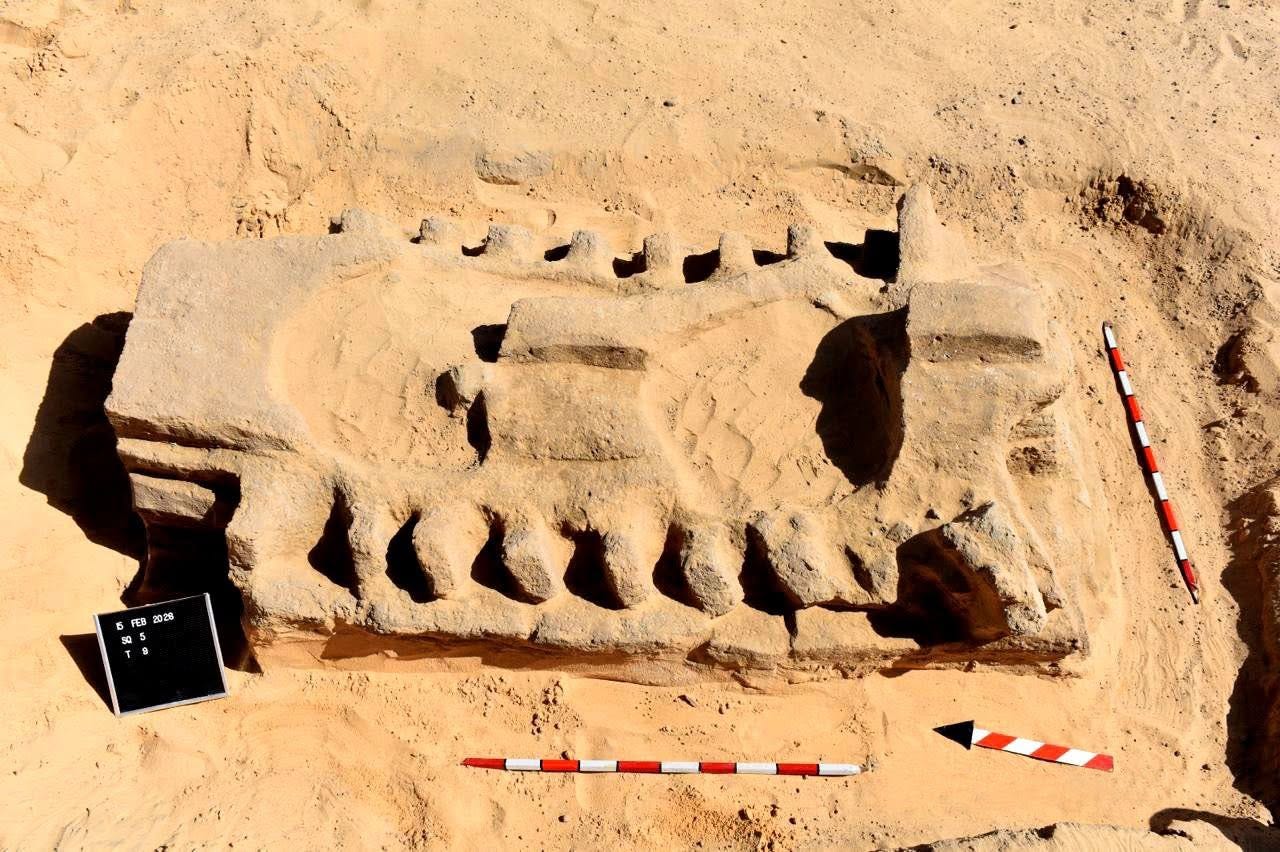
Excavations at the newly discovered site. Credit: Ministry of Tourism and Antiquities
What makes the find unusual is its completeness. Rather than a single building or a lone cemetery, the excavators have exposed the interlocking parts of a working settlement, residential, economic, and funerary, offering a rare and rounded picture of daily life in the eastern Delta nearly three and a half thousand years ago.
A community caught in full
Sherif Fathy, Egypt’s Minister of Tourism and Antiquities, described the discovery as an important addition to understanding how people settled the eastern Delta during this era, noting that it reveals an economically and socially integrated community combining living quarters, stores, production facilities, and areas for the dead. The Ministry framed Tell el-Kua as a self-sufficient settlement, a place where the everyday rhythms of housing, food storage, manufacture, and burial can all be read from the ground.
Dr Hisham El-Leithy, Secretary-General of the Supreme Council of Antiquities, stressed the strategic position of the site on the Wadi Tumilat axis, one of the most important routes connecting the eastern Delta with Egypt’s eastern borders. That location, he said, points to the settlement’s part in trade and cultural exchange, and helps illuminate the passage from the Second Intermediate Period to the beginnings of the New Kingdom.
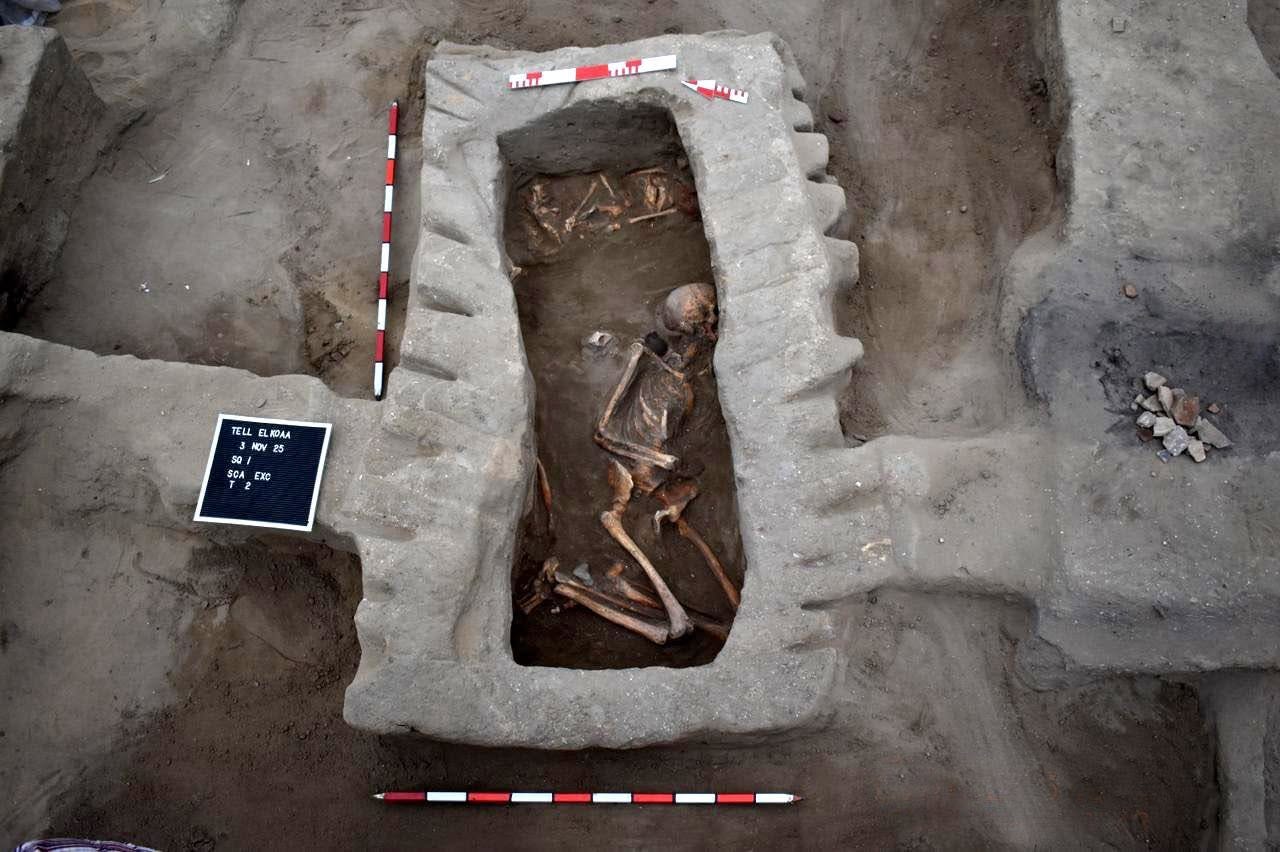
One of the newly discovered tombs. Credit: Ministry of Tourism and Antiquities
Houses, ovens, and grain stores
According to Mohamed Abdel Badie, head of the Egyptian Antiquities Sector, the mission uncovered ten tombs built of mudbrick, some rectangular in plan and others fronted by distinctive architectural facades, all assigned to the Fifteenth Dynasty associated with Hyksos rule. Alongside the cemetery lay an organized residential quarter measuring about 30 by 60 meters, containing rooms and several halls together with ovens and silos for storing grain. The combination signals clear economic activity on the spot, a settlement that produced, stored, and consumed rather than merely buried its dead.
The site covers roughly 55 feddans, or about 23 hectares, and the evidence suggests it remained in use until the middle of the Eighteenth Dynasty. That long life span reflects an unbroken continuity of settlement across the very moment when Egypt passed from Hyksos control into the New Kingdom, a transition usually told through battles and royal inscriptions rather than through the houses and storerooms of ordinary people.
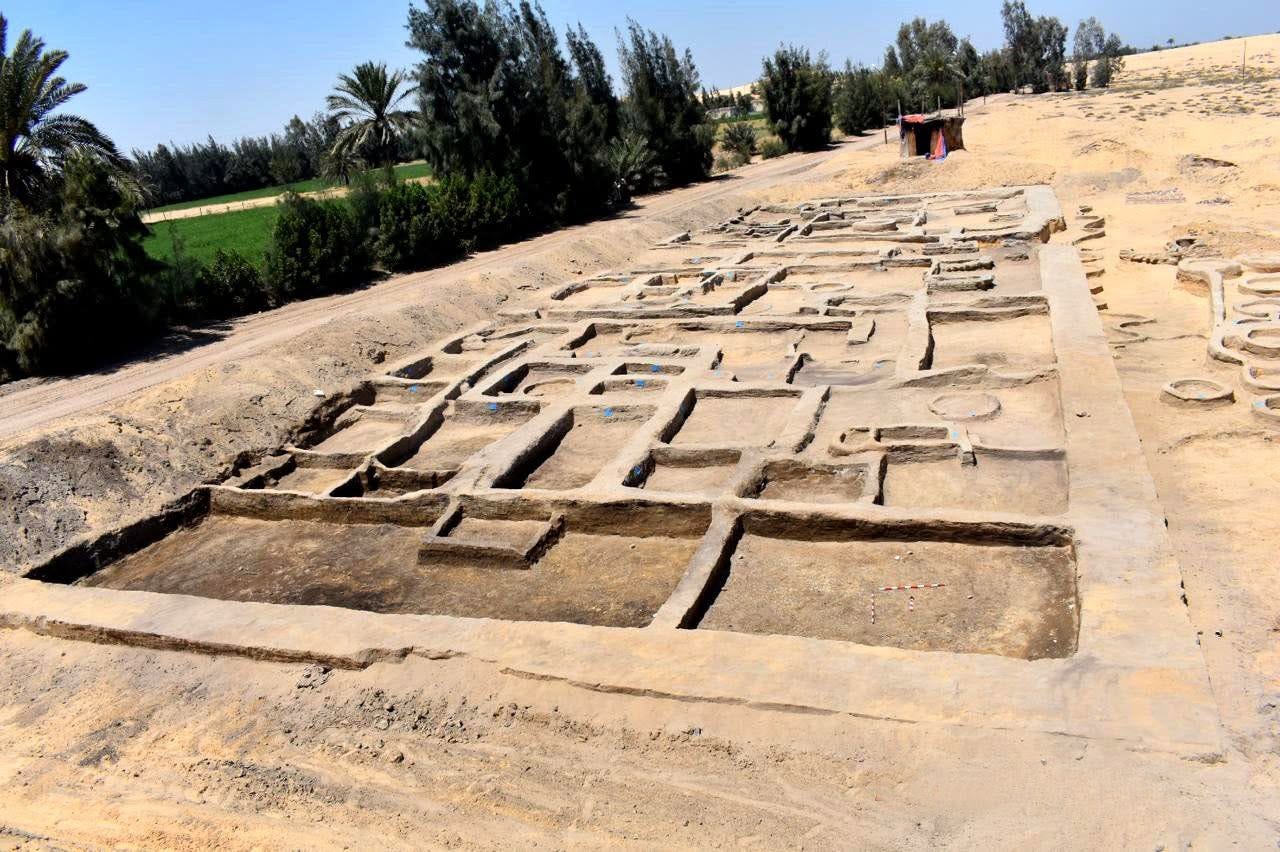
Aerial view of the site. Credit: Ministry of Tourism and Antiquities
Scarabs, bronze, and the mark of the Levant
The excavation produced a rich assemblage of small finds. Among them were scarabs, bronze tools, a range of pottery vessels, kohl pots carved from alabaster, and juglets in the so-called Tell el-Yahudiya style. That last category is telling. Tell el-Yahudiya ware, a dark, polished juglet decorated with patterns filled with white paste, is a hallmark of the Middle Bronze Age and circulated widely between Egypt and the Levant during the Hyksos period, a ceramic signature of the connections that bound the eastern Delta to the lands beyond Sinai.
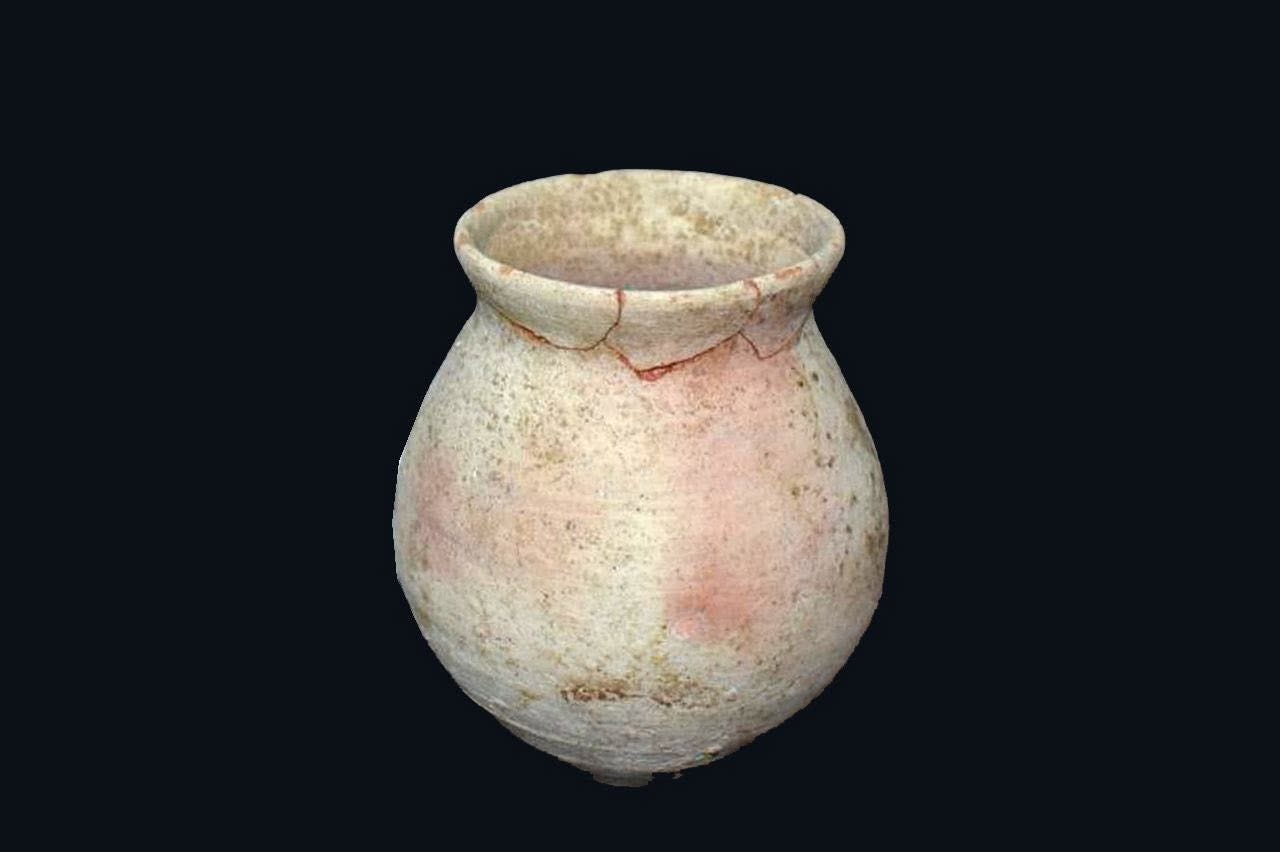
A finely preserved ceramic vessel uncovered during the excavations, offering insight into daily life at the site. Credit: Ministry of Tourism and Antiquities
Study of the human remains revealed individuals who had died between the ages of 25 and 40, while animal bones recovered from the graves shed light on diet and on the offerings placed with the dead. Some of the pottery carried seals and production marks, which the team reads as evidence of broad trading networks and a possible role for Tell el-Kua as an important center for commercial distribution in the region.
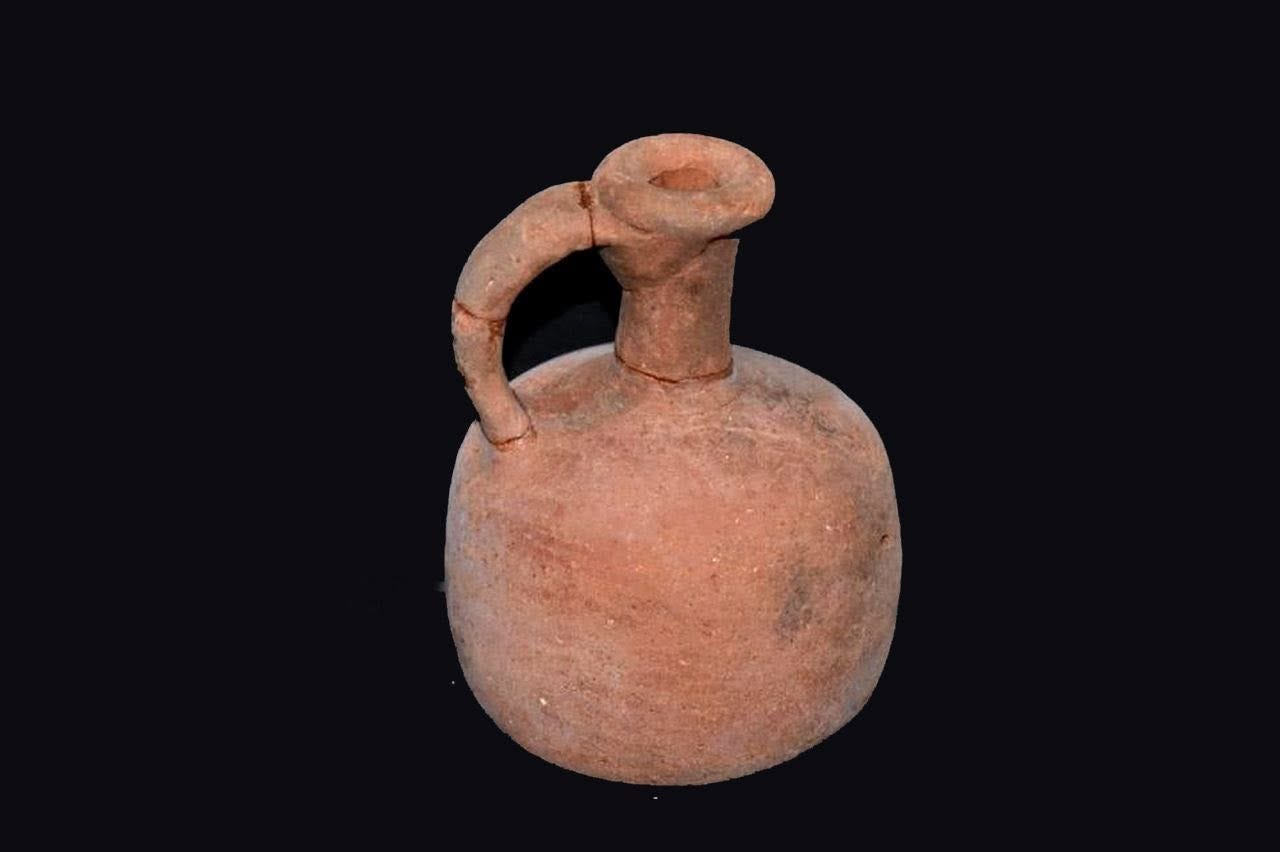
A well-preserved ceramic jug with a handle, recovered from the excavation, reflecting everyday domestic pottery traditions at the site. Credit: Ministry of Tourism and Antiquities
Burials that break the pattern
For the first time at the site, archaeologists found human burials placed outside the built mudbrick tombs, some of the bodies laid in a crouched or squatting position. Mostafa Hassan, director of the Ismailia antiquities area and head of the mission, noted that this is an unusual practice that will be the subject of further archaeological study. Such departures from the expected funerary norm are exactly the kind of detail that can reshape understanding of belief and social difference in a period for which written sources are thin.
The Second Intermediate Period in context
The Second Intermediate Period, conventionally dated to roughly 1650 to 1550 BC, was a time of political fragmentation between the Middle Kingdom and the New Kingdom. In the north, the Hyksos, rulers of Asiatic and Levantine background, established the Fifteenth Dynasty and governed from their capital at Avaris, also in the eastern Delta. They introduced or popularized new technologies and maintained close ties with the wider eastern Mediterranean world, and their eventual expulsion by the Theban kings around 1550 BC opened the imperial age of the New Kingdom.
The Wadi Tumilat, where Tell el-Kua sits, was a natural gateway between the Egyptian heartland and the deserts and routes leading toward the Levant. Settlements along it stood at the meeting point of Egyptian and foreign influence, which is part of what gives this discovery its weight. By preserving the residential, productive, and funerary life of a single community in one place, Tell el-Kua promises to add flesh to a period more often defined by its rulers than by the people who lived under them, and to reinforce the standing of the eastern Delta as a vital crossroads in ancient Egyptian history.
Excavation and study at the site are expected to continue, with further analysis of the unusual burials, the human remains, and the marked pottery likely to refine the picture in the seasons to come.
Source: Egyptian Ministry of Tourism and Antiquities announcement of 29 June 2026, as reported by Egyptian outlets including El-Watan News and Masrawy.