


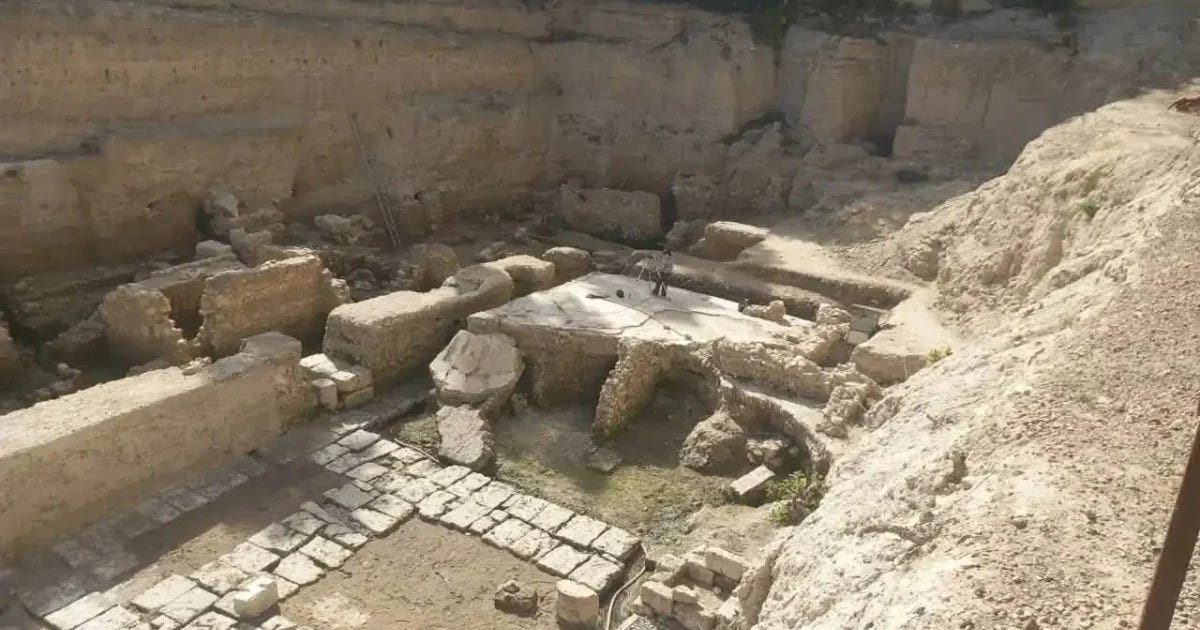
Dressed limestone foundation blocks, surrounding walls and groundwater drainage channels exposed inside the excavation trench at Shallalat Gardens in Alexandria, Egypt. Photograph by the Ministry of Tourism and Antiquities, from excavations by the Hellenic Research Institute of Alexandrian Civilization (HRIAC)
Archaeologists excavating beneath the Shallalat Gardens in central Alexandria have exposed the square limestone foundations of a large building, surrounding enclosure walls and a subterranean tunnel running northward. Egypt’s Ministry of Tourism and Antiquities announced the findings on 24 November 2026, stating that a government-appointed scientific committee has raised a preliminary hypothesis linking the structure to a Ptolemaic royal tomb.
The excavations were carried out by a Greek archaeological mission from the Hellenic Research Institute of Alexandrian Civilization (HRIAC), directed by Calliope Limneos-Papakosta. Working in the Shallalat Gardens for nearly two decades with financial backing from the Moheb Kassabgui Foundation and Reliance Egypt, the team has been probing a sector that ancient topography places inside the Royal Quarter of Ptolemaic Alexandria.
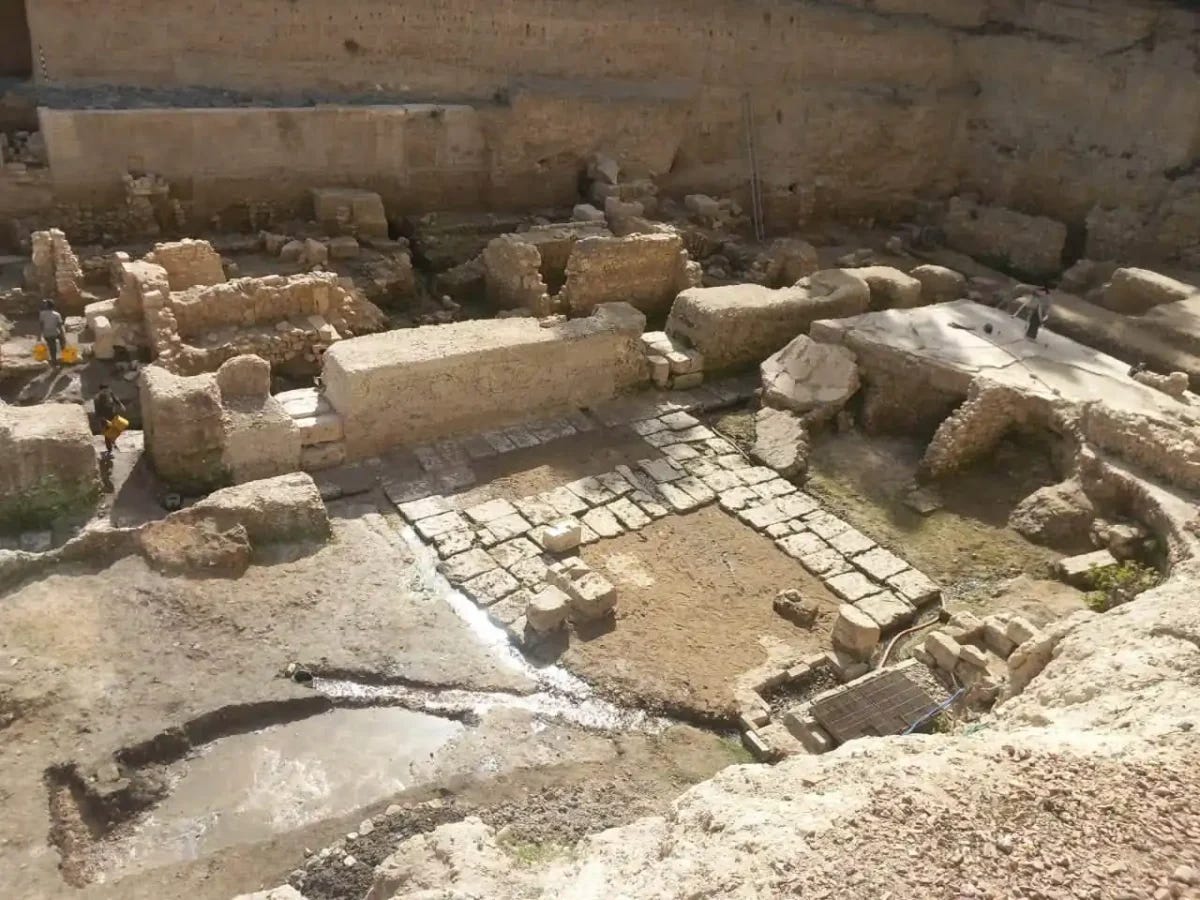
Dressed limestone foundation blocks, surrounding walls and groundwater drainage channels exposed inside the excavation trench at Shallalat Gardens in Alexandria, Egypt. Photograph by the Ministry of Tourism and Antiquities, from excavations by the Hellenic Research Institute of Alexandrian Civilization (HRIAC)
An Egyptian scientific committee assesses the limestone foundations
Following receipt of the mission’s excavation report, Minister of Tourism and Antiquities Sherif Fathy appointed a specialised archaeological committee to inspect the trench. Chaired by Ayman Ashmawy, head of the Central Administration for Lower Egypt, Sinai and the North Coast Antiquities at the Supreme Council of Antiquities, the panel included specialists and professors of Greek and Roman history and archaeology from Alexandria University and Tanta University. The committee examined the exposed masonry on site and submitted its evaluation to Hisham El-Leithy, Secretary-General of the Supreme Council of Antiquities, who presented the findings to the minister.
In its report, the committee noted that the square plan and scale of the limestone foundations indicate that a tall, monumental building once stood above them. Based on its architectural features and position inside the ancient palace district, the panel proposed as a working hypothesis that the structure served a funerary function and could correspond to the royal mausoleum founded by King Ptolemy IV Philopator, who ruled Egypt from 221 to 204 BC. Ashmawy emphasised in the ministry statement that this identification remains an initial hypothesis subject to further excavation and architectural study.
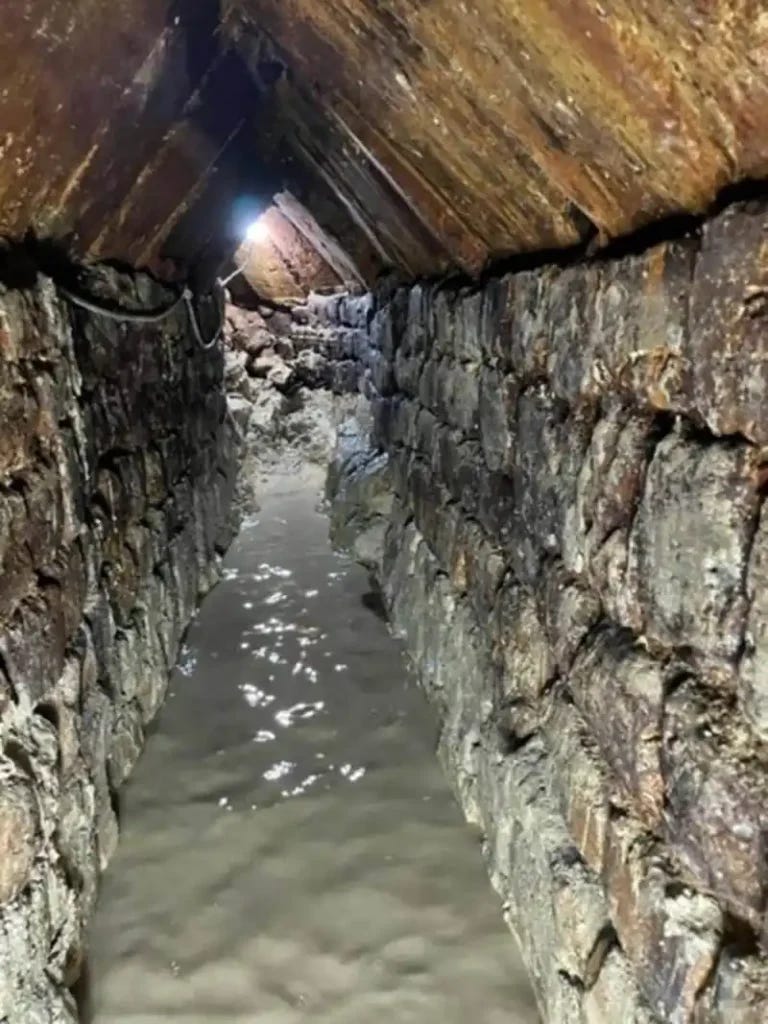
Interior of the stone-lined subterranean tunnel with a pitched slab roof and flooded floor beneath the excavation trench in Shallalat Gardens, Alexandria. Photograph by the Ministry of Tourism and Antiquities, from excavations by the Hellenic Research Institute of Alexandrian Civilization (HRIAC).
Ancient texts place the Ptolemaic royal enclosure inside the palace district
The committee’s hypothesis draws on classical accounts of Alexandria’s royal precinct. Writing around 20 BC, the Greek geographer Strabo described the royal palaces as covering a quarter to a third of the city. Within that complex, Strabo located an enclosed precinct called the Soma (Geography 17.1.8), stating that it held the tombs of the Ptolemaic kings alongside that of Alexander the Great.
A later Roman-era compiler, Zenobius (Proverbs 3.94), attributes the construction of this collective mausoleum, which he calls the Sema, directly to Ptolemy IV Philopator. According to Zenobius, Philopator erected the monument in the centre of the city and transferred the remains of his ancestors, his mother Berenice II and Alexander of Macedon into a single dynastic shrine.
Two decades of deep pumping beneath the Alexandrian water table
Excavating to Ptolemaic levels in central Alexandria requires overcoming a high water table. Located over the northern bastions of Alexandria’s medieval fortifications, the Shallalat Gardens sit above saturated ground where groundwater appears at roughly 7.5 metres below the modern surface. Limneos-Papakosta obtained her excavation permit in March 2007 and opened the first trenches two months later.
On 4 May 2009, the mission uncovered an early Hellenistic marble statue of a nude male figure at the site, which Limneos-Papakosta published in 2022 as a portrait of Alexander the Great and which is now displayed in the Alexandria National Museum. To reach deeper architectural strata below the water table, the team installed a continuous well-point pumping system in 2016. That effort exposed massive limestone foundation blocks roughly 10 metres below park level, associated with Ptolemaic-era pottery and extending at least 36 metres along an east-west axis.
Architectural evidence still separates structural scale from royal identification
While the ministry announcement highlights the square footprint, surrounding walls and northward tunnel, the released documentation contains neither inscriptions nor burial chambers, and it omits exact measurements of the newly cleared masonry. Monumental stone foundations in the Royal Quarter could also belong to a major temple, colonnaded hall or administrative complex within the Ptolemaic palace precinct.
The tunnel running beneath the structure warrants particular caution. In earlier preliminary reports covering the 2007 to 2020 field seasons, the HRIAC mission documented a rock-cut subterranean passage beneath the limestone foundations as a post-Hellenistic feature, noting in 2019 that its plastered sides suggested a water channel. Clarifying the stratigraphic relationship between the tunnel, the enclosure walls and the square foundation platform will require further excavation before the building’s exact purpose is established.
Subscribe for a few dollars a month and get every long read, the short documentaries and the full archive. Cancel anytime.
📍 Shallalat Gardens on the Ancient Content Atlas:
Sources
Egyptian Ministry of Tourism and Antiquities, official press release on the Greek archaeological mission excavations at Shallalat Gardens, Alexandria, issued 24 November 2026 (reproduced in Cairo 24, Al-Masry Al-Youm and Daily News Egypt, 24 November 2026)
Limneos-Papakosta, Calliope, “Early Hellenistic marble statue found in Alexandria, Egypt”, Technical Annals, Vol. 1, No. 1, December 2022, pp. 95–113, DOI 10.12681/ta.32105
Limneos-Papakosta, Calliope, “Archaeological Evidence of the Tsunami of 365 AD in Alexandria, Egypt”, Hellenic Research Institute of Alexandrian Civilization (HRIAC), 2024 (no DOI assigned)
Strabo, Geography, Book 17, Chapter 1, Section 8 (Loeb Classical Library edition)
Zenobius, Proverbs (Centuriae), Book 3, Section 94
That's interesting. I guess we need to keep waiting and see what comes from it .. Patience is a virtue haha 🙃