


On Egypt's northwestern Mediterranean coast, the Egyptian archaeological mission working at Marina El Alamein has announced a new discovery, eighteen ancient tombs, together with a number of surface burials, sarcophagi, and archaeological finds uncovered during excavation work at the site.
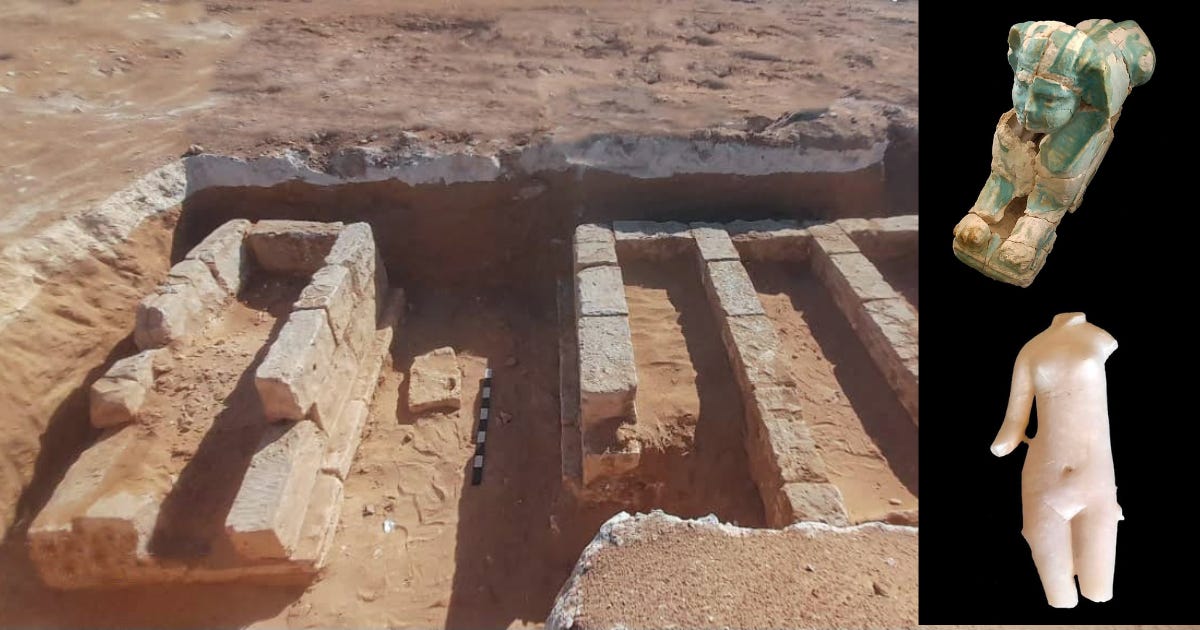
New Tombs Discovered at Egypt's Ancient Leukaspis. Credit: Egyptian Ministry of Tourism and Antiquities
The mission also revealed remains of the ancient city’s extensions and architectural components beyond the burial ground itself, pushing the total number of tombs recorded at Marina El Alamein since the site’s discovery in 1986 up to 44 and reinforcing its standing as one of the most prominent ancient coastal cities on the Mediterranean.
Minister of Tourism and Antiquities Sherif Fathy described the find as an important scientific and archaeological addition, one that contributes to understanding the cultural identity of ancient Marina El Alamein’s inhabitants and to re-evaluating the city’s historical role as a civilizational and cultural center linking Egypt with the wider Mediterranean world. He noted that the ministry is giving considerable attention to the scientific excavation work at the site in preparation for opening it to visitors, adding a new cultural tourism product alongside the beach tourism for which the North Coast is already known.
Hisham El-Leithy, secretary general of the Supreme Council of Antiquities, outlined the site’s development plan, which includes a visitor center, routes for electric vehicles and pedestrians, a museum storage facility, an administrative headquarters, and an open-air theater. Completion is expected within the first half of next year, after which Marina El Alamein is meant to stand as a fully integrated archaeological and tourism destination.
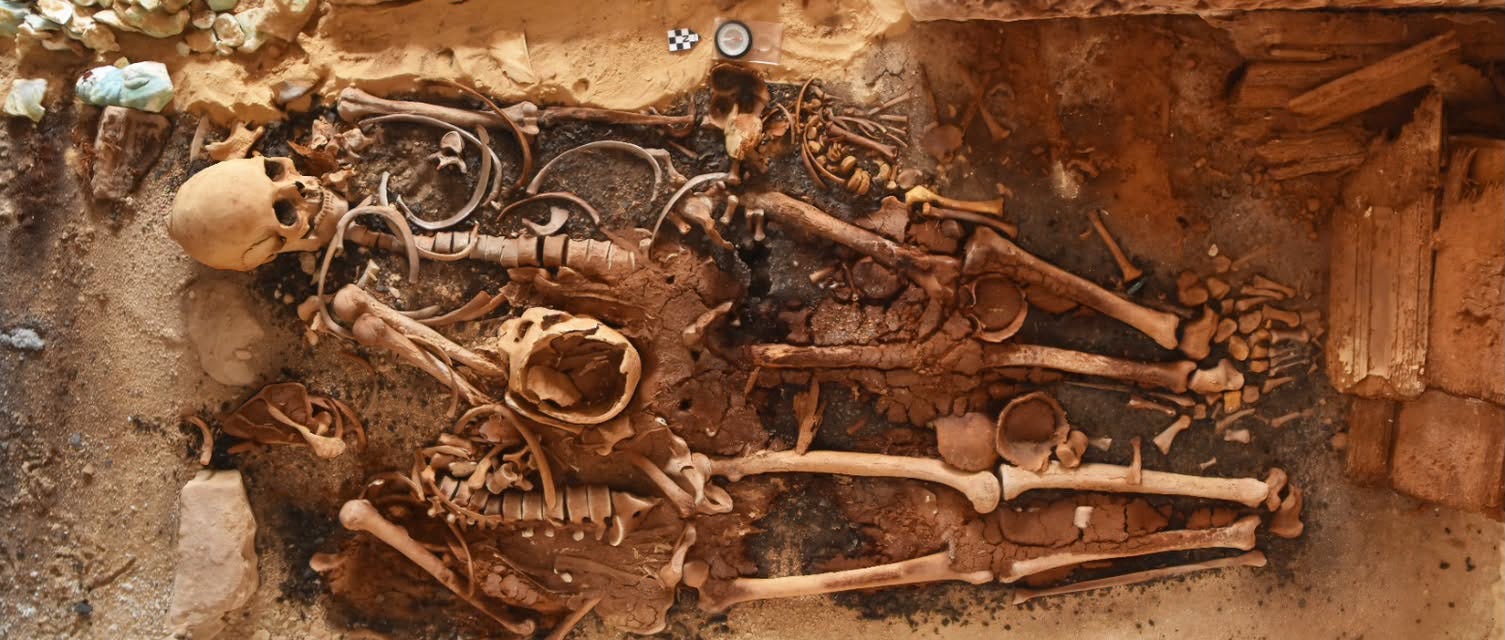
Skeletal remains uncovered during excavation at Marina El Alamein, found alongside pottery vessels and wooden elements from the burial. Photo Ministry of Tourism and Antiquities.
A city of rock-cut tombs and altars
Mohamed Abdel Badie, head of the Egyptian Antiquities Sector at the Supreme Council of Antiquities, said the newly discovered tombs include eleven cut entirely into the rock, known as hypogea, with an average depth of about eight meters, in addition to seven surface tombs built of limestone. Some of the tombs stand out for their exceptional state of preservation, with burial openings still sealed by their original stone slabs, untouched since antiquity.
The excavation also revealed numerous surface burials around the tombs, reflecting the social diversity of the city’s inhabitants, along with a water well that had later been reused for burial purposes, a clear example of how ancient Egyptian influence persisted in funerary architecture through the Ptolemaic and Roman periods. The work yielded a distinguished group of artifacts as well, including complete and near-complete pottery vessels, amphorae, oil lamps, plates, limestone altars and basins, and architectural elements associated with the tombs.
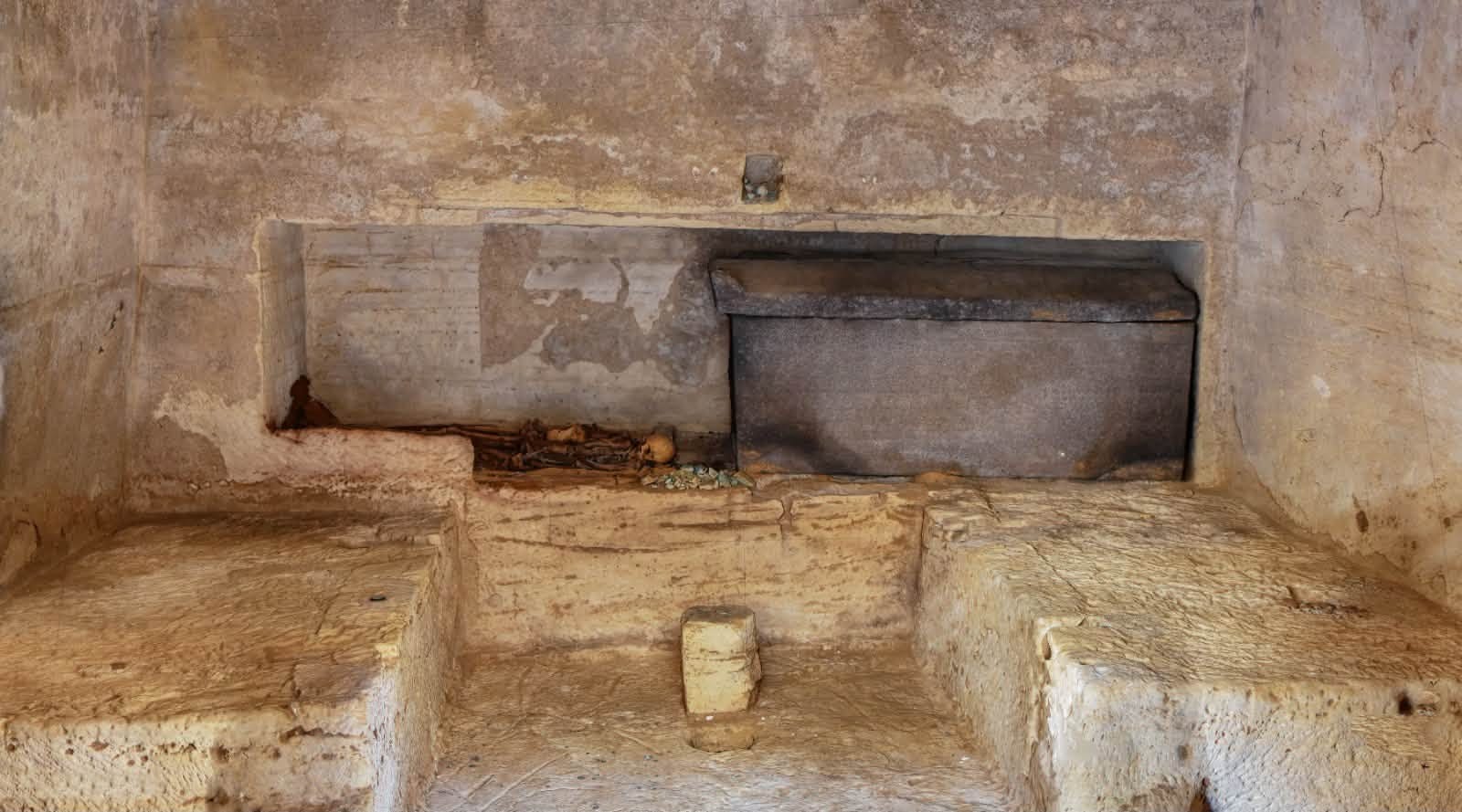
The interior of one of the rock-cut tombs uncovered at Marina El Alamein, showing a sealed sarcophagus and skeletal remains within a burial niche. Credit: Ministry of Tourism and Antiquities.
Hisham Hussein, head of the Central Administration for Lower Egypt Antiquities, pointed to a limestone altar for offerings with a distinctive architectural facade imitating the false door known from ancient Egyptian funerary belief. Also among the finds were an unfinished marble statue believed to represent the goddess Aphrodite, a limestone funerary stele depicting a seated man holding a bird, and a number of glass tear bottles.
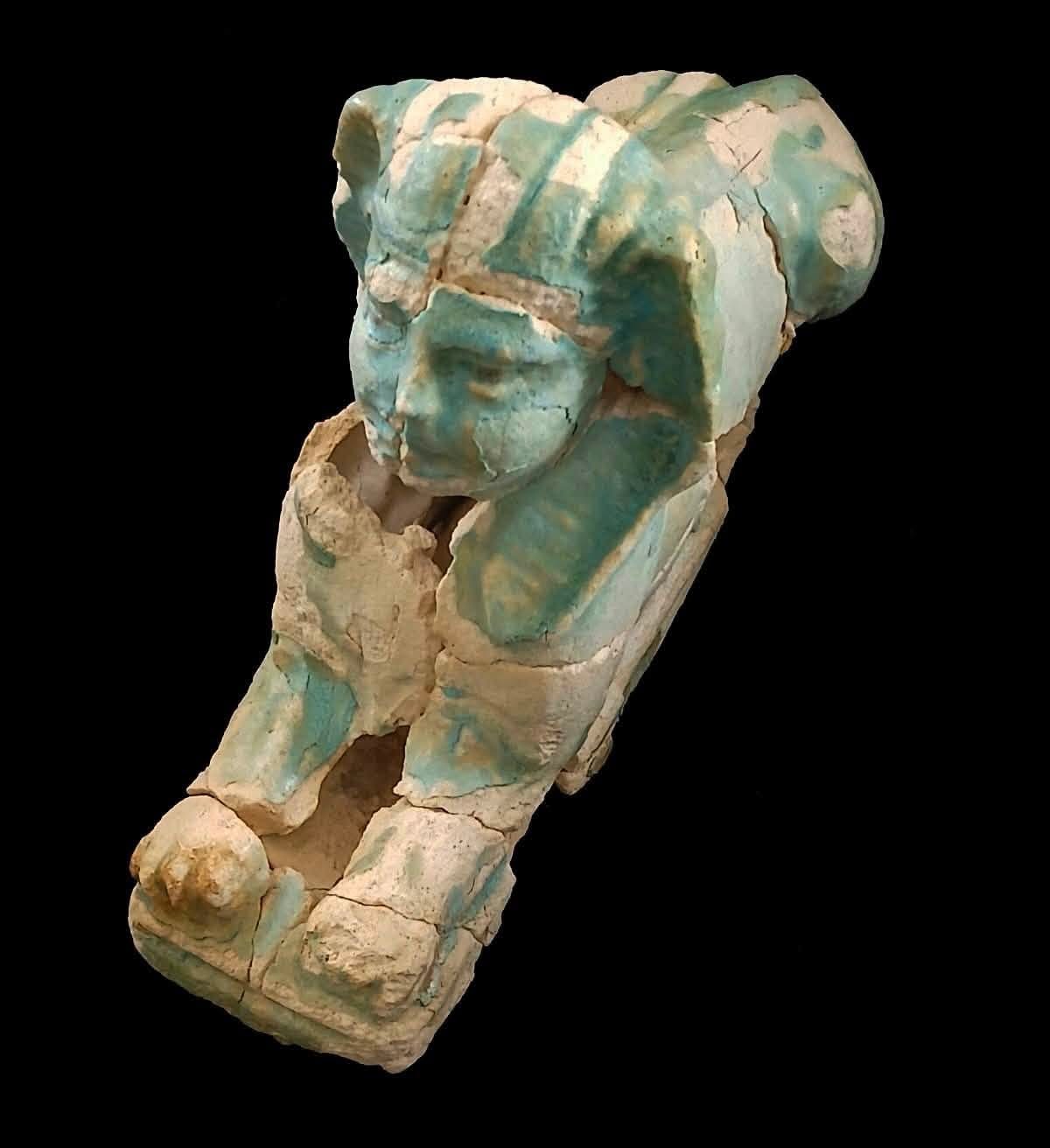
The plaster sphinx statue found at Marina El Alamein, discovered beside the sealed granite sarcophagus in one of the tombs. Credit: Ministry of Tourism and Antiquities.
A sealed sarcophagus and a sphinx in plaster
Iman Abdel Khalek, head of the mission and director of the area, reported the discovery of a granite sarcophagus 2.5 meters long, its original lid still in place, containing skeletal remains now under study. Beside it, the team found the remains of a plaster sphinx statue, further confirming the persistence of Egyptian religious and artistic influence within the city through the Hellenistic and Roman periods.
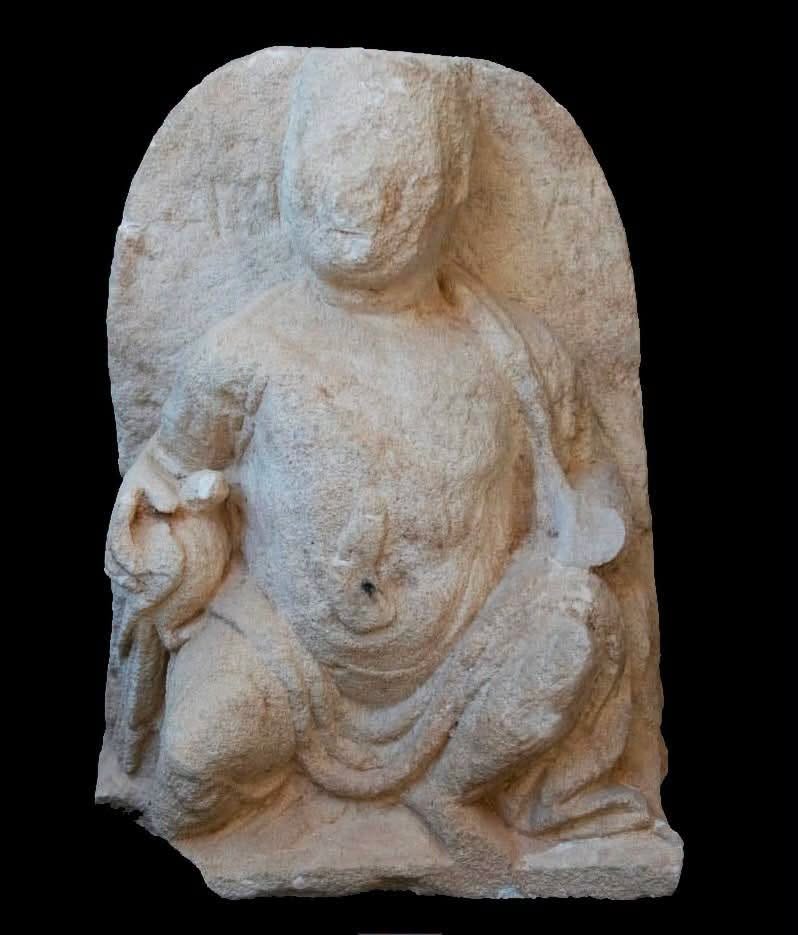
The limestone funerary stele found at Marina El Alamein, showing a seated man holding a bird. Credit: Ministry of Tourism and Antiquities.
Gold on the tongues of the dead
Among the most striking finds, Abdel Khalek noted, were 24 gold pieces placed inside the mouths of some of the deceased, representing what is known as the golden tongue, one of the elements tied to the funerary beliefs of that era. One of the pieces was shaped as the Eye of Horus, among the most important protective symbols in ancient Egyptian belief.
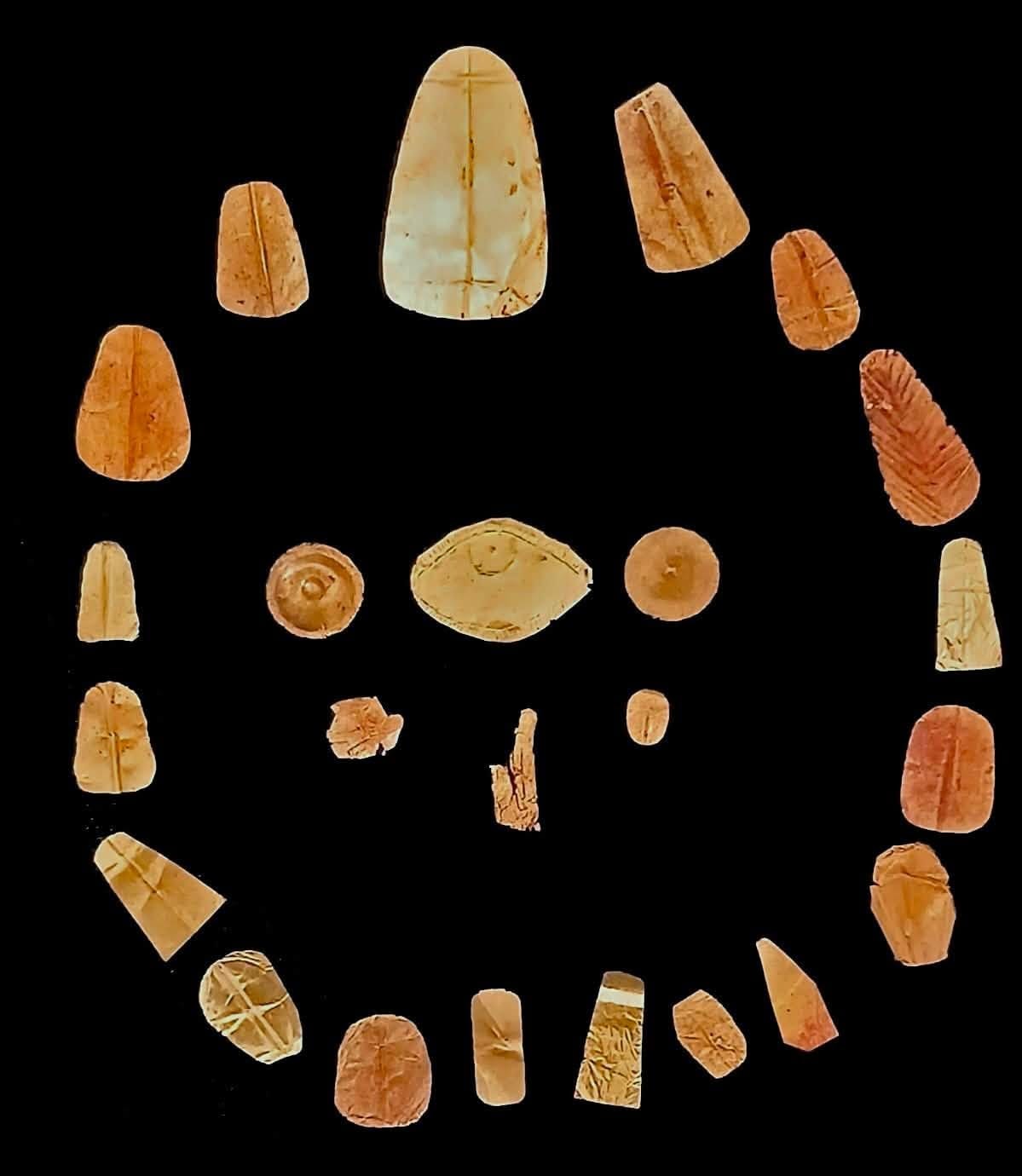
Gold tongue amulets from Marina El Alamein, laid out together after their recovery from the burials. Ministry of Tourism and Antiquities.
A city called Leukaspis
Marina El Alamein lies on Egypt’s northwestern coast, about 100 kilometers west of Alexandria, and is believed to represent the city of Leukaspis, mentioned by the Greek geographer Strabo. The city flourished from the Hellenistic era through the Byzantine era, reaching the height of its urban and economic activity during the first three centuries AD.
The site was discovered by chance in 1986 during construction work in the Marina area, and the extensive excavation and study that followed has revealed one of Egypt’s best-preserved ancient coastal cities, with a street network, houses, public facilities, a port, commercial districts, and extensive cemeteries reflecting the cultural and civilizational diversity that marked Egypt’s Mediterranean coastal cities during the Hellenistic and Roman periods.
The ministry describes this discovery as a new step toward completing our understanding of the city’s history, and toward reinforcing its position as one of the most important archaeological and cultural destinations on the North Coast, within the framework of the Ministry of Tourism and Antiquities’ efforts to preserve Egyptian heritage and make it accessible to the public.
Source. Egyptian Ministry of Tourism and Antiquities, official statement.