


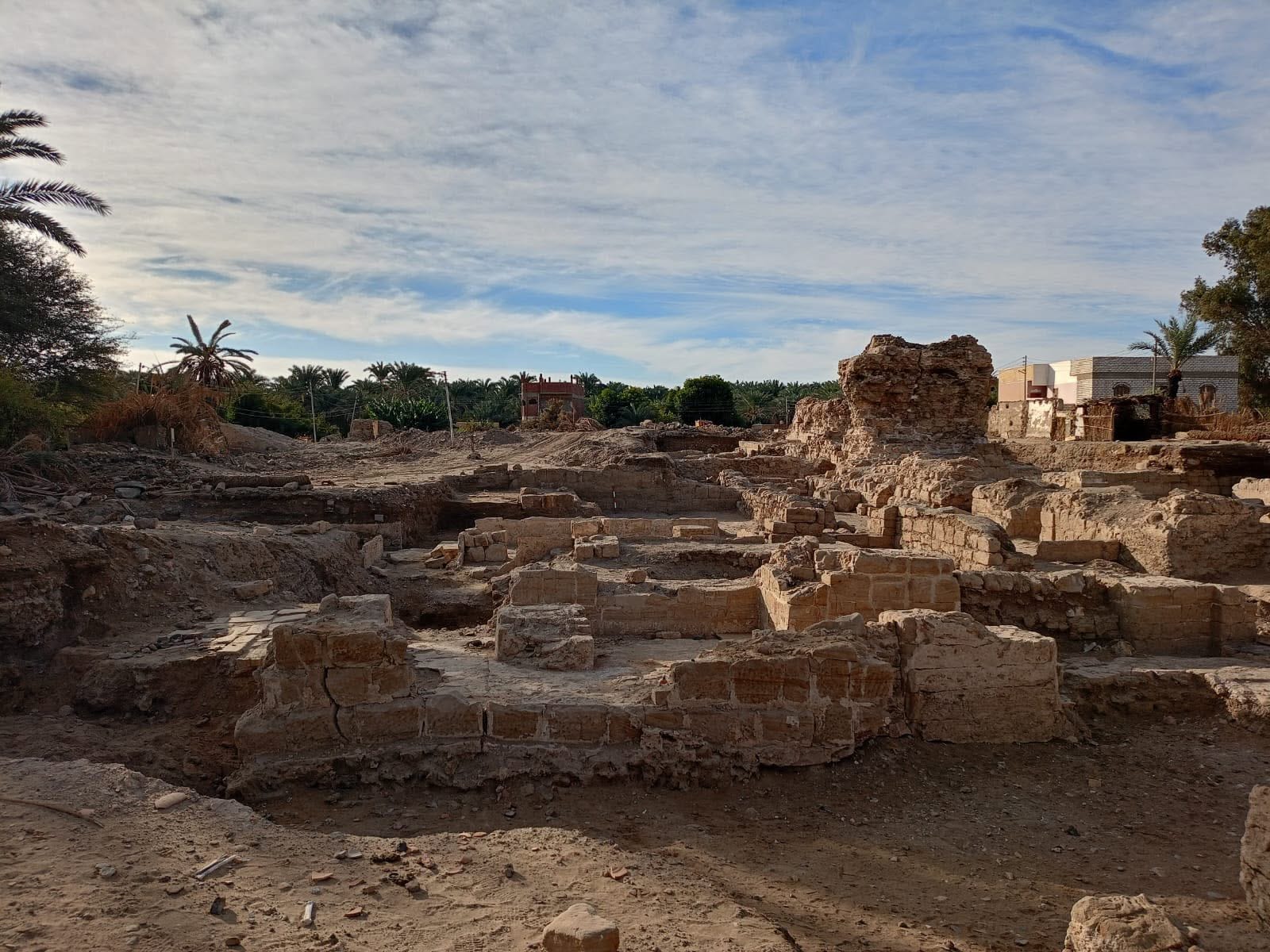
View of excavations. Credit: Egyptian Ministry of Tourism and Antiquities وزارة السياحة والآثار
The discovery was announced by Egypt’s Ministry of Tourism and Antiquities after excavations by an Egyptian archaeological mission of the Supreme Council of Antiquities. The work took place at the temple site in the village of El-Qasr, in Bahariya Oasis, about 335 kilometers west of Giza.
The temple itself dates mainly to Egypt’s 26th Dynasty, around 2,600 years ago. But new finds show that the site’s sacred and architectural history reaches much further back, into the New Kingdom, around 800 years before the Saite temple took shape.
A new phase of excavation at Qasr El-Qadim
The latest season of excavation revealed additional architectural remains belonging to the Temple of Qasr El-Qadim. Among the most important finds are the remains of a sandstone room and several inscribed stone blocks.
Some of these blocks carry the names and titles of King Psamtik I, the founder of Egypt’s 26th Dynasty. His reign marked the beginning of the Saite revival, a period when Egypt regained political strength and placed renewed emphasis on traditional religious and artistic forms.
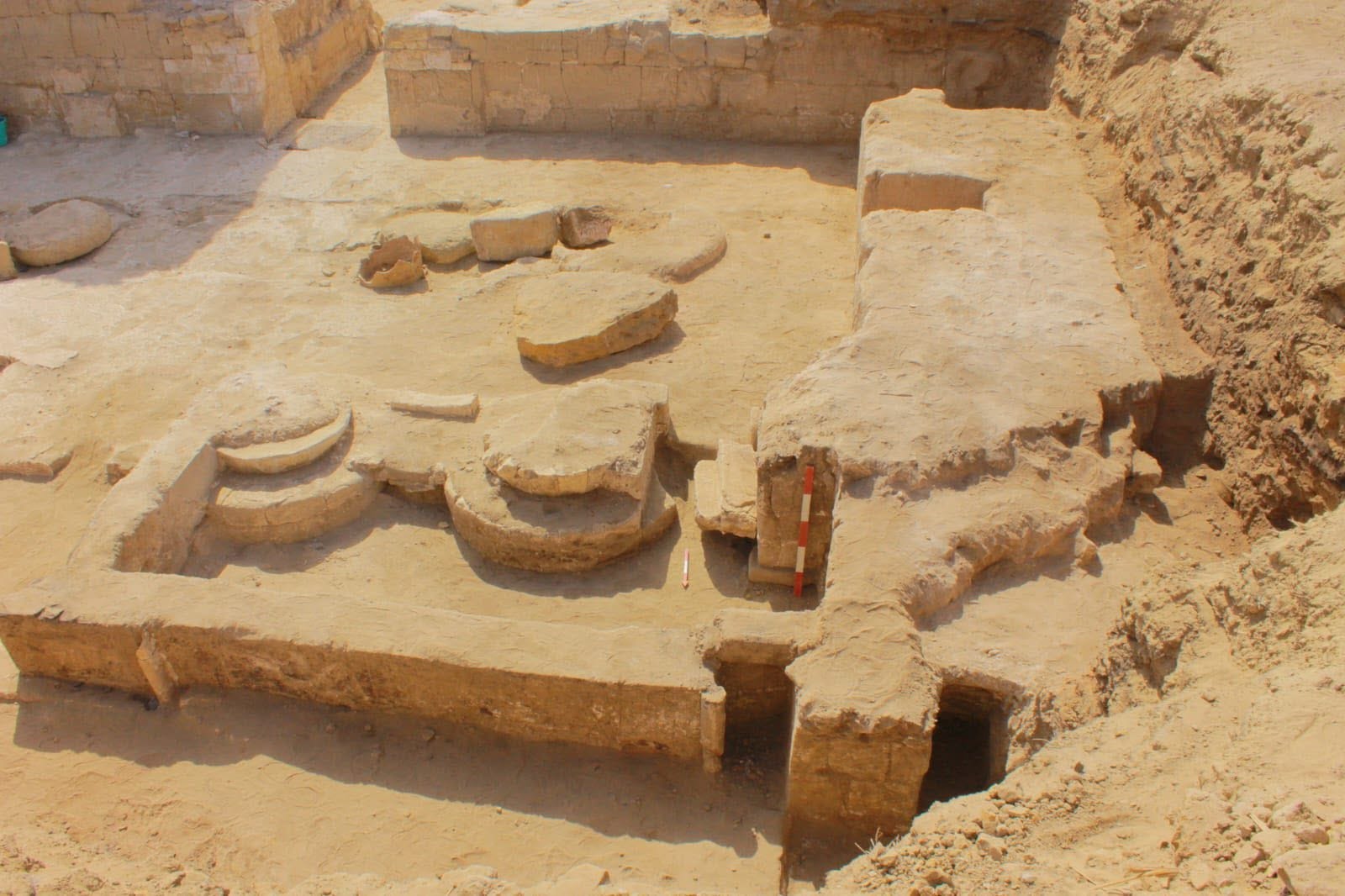
Another view of the newly uncovered structures. Credit: Egyptian Ministry of Tourism and Antiquities
These inscribed blocks are valuable because they help archaeologists reconstruct the temple’s plan, building history, and royal patronage. Rather than seeing the temple as a single-phase monument, the new finds support a longer and more layered story of construction, reuse, and development.
Dr. Hisham El-Leithy, Secretary-General of Egypt’s Supreme Council of Antiquities, described the discovery as new evidence for the historical and archaeological importance of Qasr El-Qadim. He emphasized the site’s role as a religious and administrative center across successive periods of Egyptian history.
A temple from the Saite period
The main temple at Qasr El-Qadim belongs to the 26th Dynasty, also known as the Saite period. This dynasty ruled Egypt from the 7th to the 6th century BC, a time of political renewal after earlier instability.
According to the excavation results, the temple began during the reign of Psamtik I and continued to develop under later kings, including Wahibre, known to Greek writers as Apries, and Ahmose II, known as Amasis.
This long royal sequence shows that the temple held significance beyond a single reign. It remained important enough to receive additions, decoration, and architectural attention over several generations.
Earlier work by the mission had already uncovered major parts of the temple, including its principal hypostyle hall. That hall contains 16 sandstone columns, along with connected rooms and chapels. Remains of scenes and hieroglyphic texts preserve the names of Egyptian deities, especially Amun-Ra, Amunet, and Khonsu.
These divine names place the temple within the wider religious landscape of Egyptian oasis cults, where forms of Amun worship played an important role.
The ancient capital of Bahariya
Qasr El-Qadim is one of the most important archaeological sites in Bahariya Oasis. During the Late Period, it appears to have functioned as an old capital or central settlement of the oasis.
This location was strategically important. Bahariya formed part of Egypt’s Western Desert network, linking the Nile Valley with desert routes, oasis communities, agricultural zones, and trade paths toward Libya and other western regions.
The oasis landscape was productive because underground water made agriculture possible. Date palms, olives, grapes, cereals, and other crops could be grown in a desert environment that would otherwise have been difficult to sustain.
The new finds confirm that Qasr El-Qadim was deeply connected with both religion and administration. The presence of royal inscriptions, temple architecture, industrial installations, storage zones, and written documents suggests a complex settlement with many functions.
Evidence from 800 years earlier
One of the most important aspects of the discovery is the evidence for activity before the 26th Dynasty temple.
The mission found a stone stela dating to the reign of Amenhotep II of the 18th Dynasty. Amenhotep II ruled during the New Kingdom, many centuries before Psamtik I. The team also recovered archaeological pieces connected with Ramesses II of the 19th Dynasty.
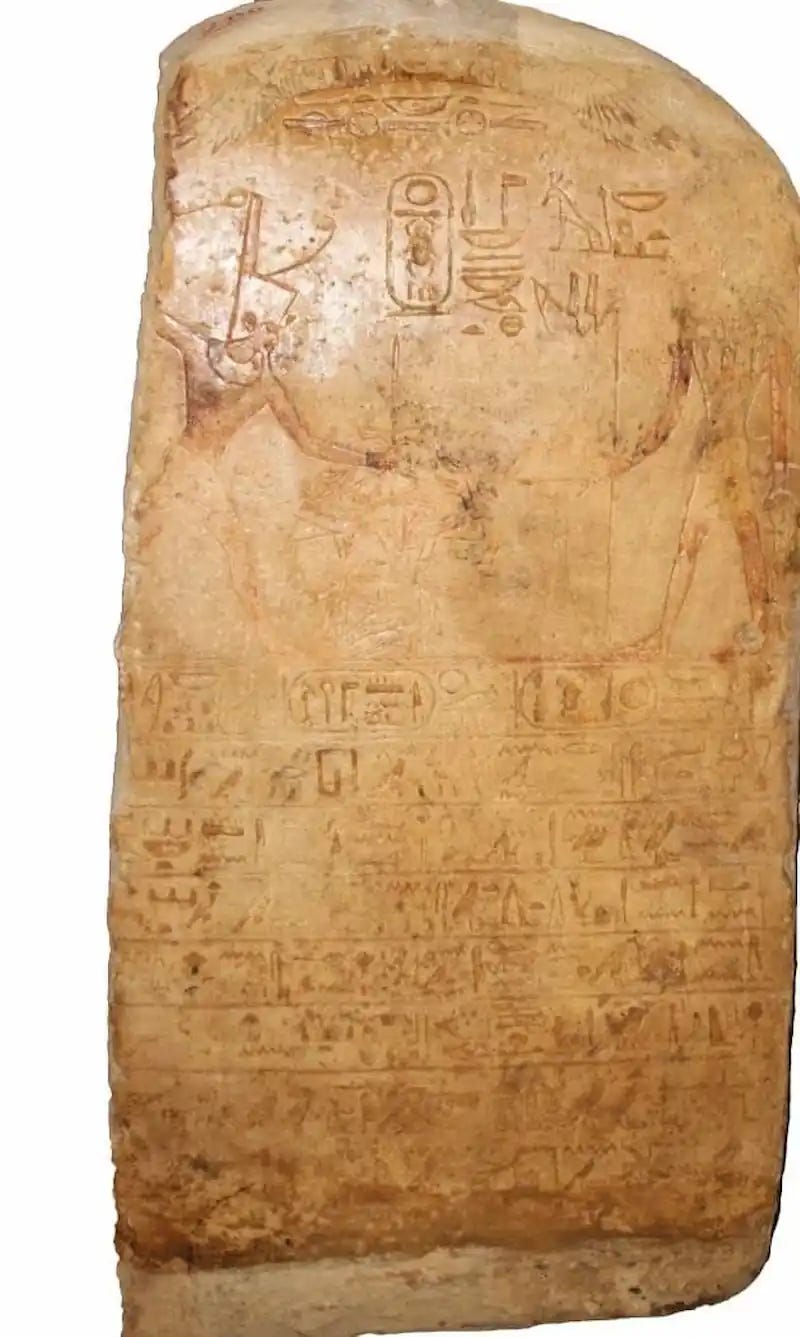
A stele uncovered during the excavations. Credit: Egyptian Ministry of Tourism and Antiquities
These finds show that the site had religious and architectural importance long before the Saite-period temple was built. The title of the discovery — that Bahariya was sacred 800 years before its temple — reflects this New Kingdom evidence.
This is significant because it changes the way the site can be understood. Qasr El-Qadim was part of a long sacred landscape. The 26th Dynasty temple may have formalized, enlarged, or monumentalized an older religious tradition already present in the oasis.
A temple developed across many reigns
The discoveries support the idea that the Temple of Qasr El-Qadim was a multi-phase project. It began in one period, expanded in another, and continued to attract use and modification over time.
The stela of Amenhotep II and the fragments from Ramesses II point to earlier New Kingdom interest. The inscribed blocks of Psamtik I show strong 26th Dynasty royal involvement. Later architectural elements and finds show continued occupation into the Greek and Roman periods.
This long sequence gives researchers a rare opportunity to study continuity in an oasis setting. Instead of a short-lived monument, the temple appears as part of a sacred center that remained meaningful across changing dynasties, political systems, and cultural phases.
Dr. Hussein Abdel-Basir, an Egyptian archaeologist, described the discovery as important for redrawing the religious and administrative map of Bahariya during the Late Period. He noted that the finds show Bahariya as an active part of the Egyptian state system, rather than an isolated desert settlement.
Later Greek and Roman activity
The site also preserves strong evidence for continued use after the Pharaonic period.
Archaeologists found ostraca, as well as Coptic and Latin texts, showing that Qasr El-Qadim remained active into the Greek and Roman periods and as late as the 4th and 5th centuries AD.
The team also identified industrial installations, including basins used for producing wine and oils, along with storage areas. These features show that the site had an economic life alongside its religious and administrative role.
During the Roman period, Egypt’s oases were important agricultural zones. Wine, olive oil, dates, and other products could be produced in desert settlements and connected to wider provincial networks. The evidence from Qasr El-Qadim fits this pattern closely.
The site therefore reveals a shift in function across time. A Pharaonic sacred center continued to be used in later periods, while parts of the complex or surrounding area became connected with production, storage, and daily economic activity.
Wine, oil, and oasis economy
The discovery of wine and oil production installations is especially important because it shows how Bahariya functioned as a productive oasis.
In desert environments, water is the foundation of settlement. Where springs and underground water were available, communities could grow crops, maintain orchards, raise animals, and support religious or administrative centers.
Wine and oil production required organized agriculture, specialized installations, storage vessels, labor, and distribution. Their presence at Qasr El-Qadim suggests that the site was connected with a wider economic system.
This also helps explain why the oasis mattered to the Egyptian state. Bahariya was valuable as a religious center, but also as an agricultural and logistical zone in the Western Desert.
Earlier discoveries at the temple
The current excavation builds on years of earlier work. The mission has been active at Qasr El-Qadim since 2014, and previous seasons have already revealed major parts of the temple.
One earlier discovery was especially important: a metal seal or stamp found inside the temple that preserved the ancient name of the sanctuary, “Ib-Set,” meaning “Seat of the Heart” or “Place of the Heart.”
The team also recovered a group of religious and artistic objects, including a statue of the god Thoth, a bronze figure of Osiris, a bronze amulet of Ra-Horakhty, the head of a statue representing a priest or prominent official, and a chapel connected with a local governor and priest named Pa-di-Iza.
These finds show that the temple was not just an architectural shell. It contained cult objects, votive material, elite religious imagery, and evidence for local officials tied to the administration of the oasis.
Bahariya as a religious landscape
The new discoveries also strengthen the idea that Bahariya was part of a wider sacred geography.
Egyptian oases were often connected with Amun worship, local forms of divine authority, and desert routes. Amun and related deities appear in several oasis contexts, linking local cults with major religious traditions of the Nile Valley.
At Qasr El-Qadim, the presence of Amun-Ra, Amunet, and Khonsu in temple inscriptions suggests a religious program connected with the Theban divine world, adapted to an oasis setting.
The discovery of earlier New Kingdom material adds depth to this picture. It suggests that official or religious interest in Bahariya began long before the Saite rulers developed the monumental temple.
A site with many lives
Qasr El-Qadim now appears as a site with many historical lives.
In the New Kingdom, it was already connected with sacred activity. In the 26th Dynasty, it became the location of a major temple linked with royal patronage. In the Greek and Roman periods, it continued to function within a changing oasis economy. By the 4th and 5th centuries AD, written material in Coptic and Latin shows the site remained part of a living cultural landscape.
The new excavations give archaeologists more than isolated objects. They reveal continuity across almost two thousand years.
Bahariya Oasis was a sacred center, a regional capital, an agricultural producer, and a desert crossroads. The new finds at Qasr El-Qadim bring those roles into sharper focus and show how much of the oasis’s history still remains beneath the sand.
Support Independent Ancient Content :
Your support helps me create more archaeology posts, articles, and mini history videos: