


Clay tablets from Babylon, written between about 350 and 50 BC and kept in the British Museum, show that Babylonian astronomers calculated Jupiter’s movement from the area of a trapezoid. The method treats speed and time as figures in an abstract space, an idea historians had credited to European scholars of the 14th century, about 1,400 years later. Mathieu Ossendrijver of Humboldt University in Berlin reported the finding in Science in January 2016.
Ancient Content, October 27, 2026
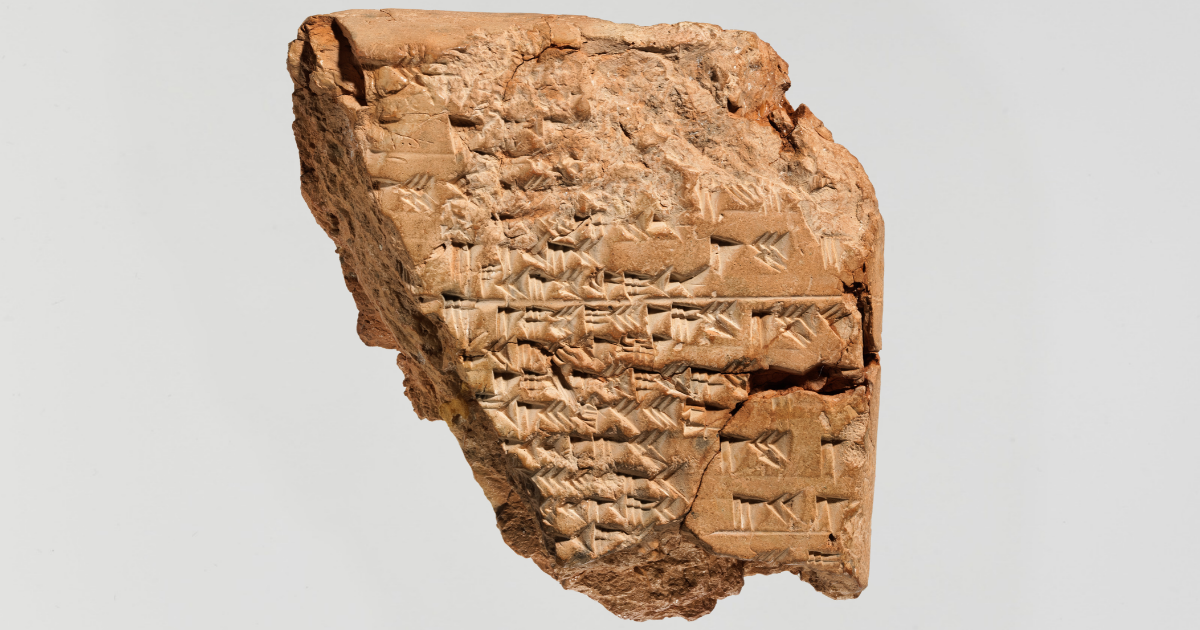
A Seleucid clay tablet with an ephemeris of eclipses, probably from Babylon, about the 4th to 2nd century BC. Babylonian astronomers of this period computed the Moon and planets with tables like this one. The Jupiter trapezoid tablets, also from Babylon, are held at the British Museum. Credit: The Metropolitan Museum of Art, Purchase, 1886 (86.11.345), Public Domain.
Four puzzling tablets waited for a fifth to explain them
For decades, a small group of Babylonian tablets in the British Museum made little sense. Four of them describe a trapezoid, a four-sided figure with two parallel sides of different lengths. They discuss its sides, its area and the way the area can be cut into parts, yet they contain no drawing and say nothing about what the shape stands for. Two of these texts had been known since 1955, but their meaning stayed unclear.
Ossendrijver, a historian of ancient science who also holds a doctorate in astrophysics, spent years on the problem. National Geographic reported that he spent 13 years on the texts and described them in his own words as “a small bunch of four weird trapezoid computations”. The key turned out to be a fifth tablet, catalogued as BM 40054, which describes the same calculation in plain arithmetic and names Jupiter as its subject. According to the Topoi research cluster in Berlin, the retired Vienna Assyriologist Hermann Hunger pointed Ossendrijver to the tablet during a visit in 2014 and supplied an old British Museum photograph of it.
The tablets come from Babylon and date to the last three centuries BC
All five tablets were most likely written in Babylon between about 350 and 50 BC. Nineteenth-century collectors dug them up without scientific methods, near the Esagila temple of the god Marduk, and the damage from those digs still limits what scholars can read. Two of the five were unpublished before Ossendrijver’s study and three had appeared in print.
They belong to a much larger body of work. The Atlas Obscura account of the discovery counts about 450 tablets that contain mathematical calculations about the sky, written in the base 60 number system that survives in the 60-minute hour. The Babylonians kept those records for centuries, and the late tablets show astronomers who computed the positions of the Moon and planets with tables and step-by-step procedures.
The new tablet records Jupiter’s speed at three points
The arithmetic tablet follows Jupiter after it first appears in the morning sky. It gives the planet’s speed along the ecliptic, in degrees per day, at three moments. At day 0 the speed is 0;12 degrees a day, which is 12 sixtieths, or 0.2 degrees. At day 60 it falls to 0;9,30, about 0.158 degrees. At day 120 it falls to 0;1,30, about 0.025 degrees.
