


A new archaeomagnetic study of Hellenistic pottery from Jerusalem shows how ordinary ceramic vessels can preserve information about two very different histories: the ancient city of Jerusalem during the age of the Maccabees, and the changing strength of Earth’s magnetic field.
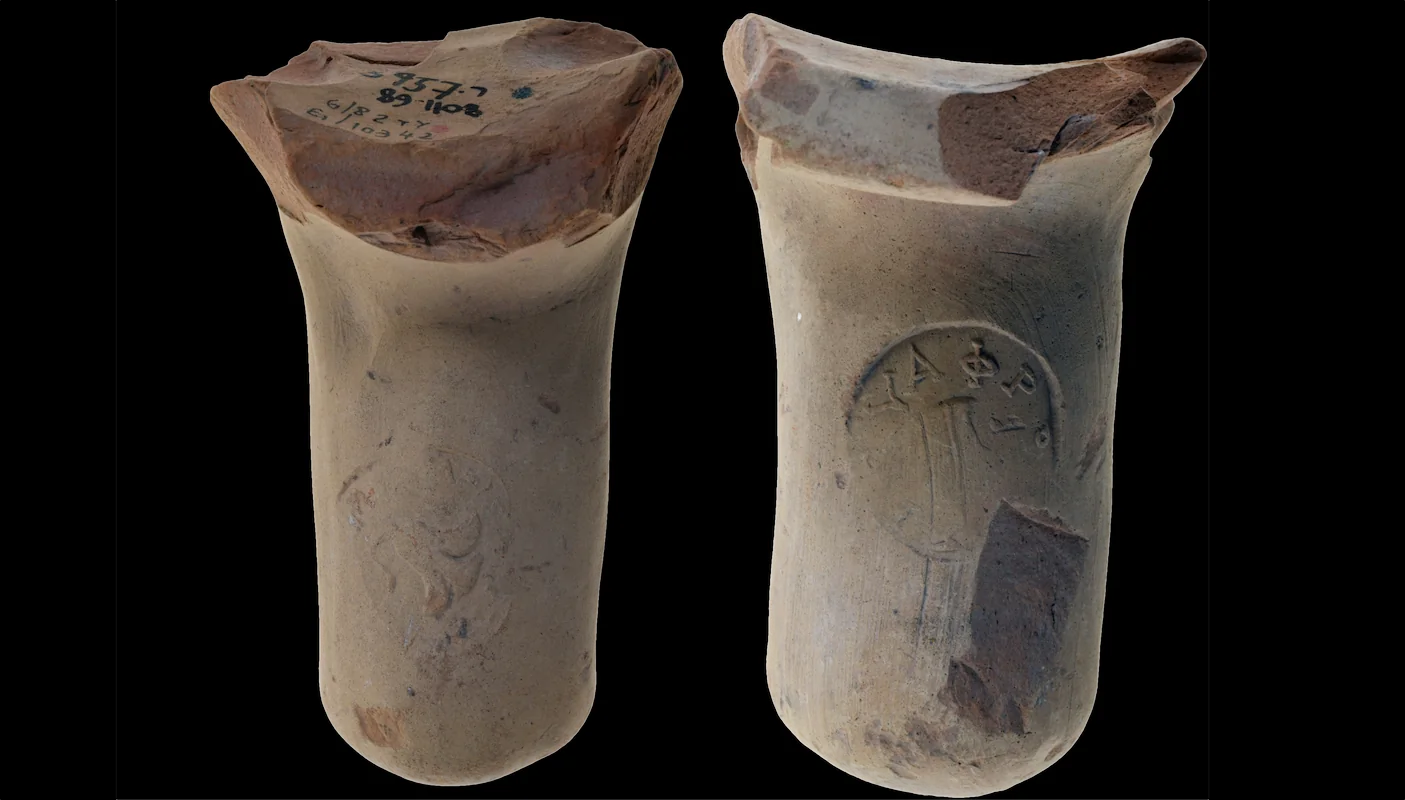
Stamped handles of Rhodian amphorae from the City of David's excavations. Credit: Israel Antiquities Authority
The research focuses on stamped Rhodian wine amphorae and local Hellenistic pottery found in Jerusalem. These jars were not only trade containers. Because they were fired in kilns, they also recorded a tiny magnetic signal at the moment they cooled. Thousands of years later, that signal can be measured in the laboratory and used to reconstruct the strength of Earth’s magnetic field in antiquity.
The study was published in Archaeometry by Yael Hochma, Lisa Tauxe, Debora Sandhaus, Oded Lipschits, and Erez Ben-Yosef under the title “Geomagnetic Intensity of Hellenistic Pottery and Stamped Rhodian Wine Amphorae From Jerusalem.” It brings together archaeology, geophysics, ceramic studies, and the history of Hellenistic Jerusalem.
Ancient jars as magnetic recorders
Pottery contains tiny magnetic minerals. When clay is fired at high temperatures, these minerals can lose their previous magnetic orientation. As the ceramic cools, they align with the surrounding magnetic field and preserve a record of its direction and strength.
This process is known as thermoremanent magnetization. It means that fired ceramics can act like time capsules for the ancient geomagnetic field.
For archaeologists, the method is valuable because it can help date pottery, destruction layers, kilns, and other heated materials. For geophysicists, it provides data about how Earth’s magnetic field behaved before modern instruments existed.
The Hellenistic vessels from Jerusalem are especially useful because some of them can be dated more precisely than ordinary pottery. This is where Rhodian amphorae become important.
Why Rhodian amphorae matter
Rhodian amphorae were transport jars produced on Rhodes and in its surrounding territory. During the Hellenistic period, Rhodes was one of the major commercial centers of the eastern Mediterranean, and its amphorae carried wine and other products across long-distance trade routes.
Many Rhodian amphorae were stamped on their handles. These stamps often include names linked to officials or producers. In particular, the eponym stamps, associated with annually changing officials, are extremely valuable for chronology.
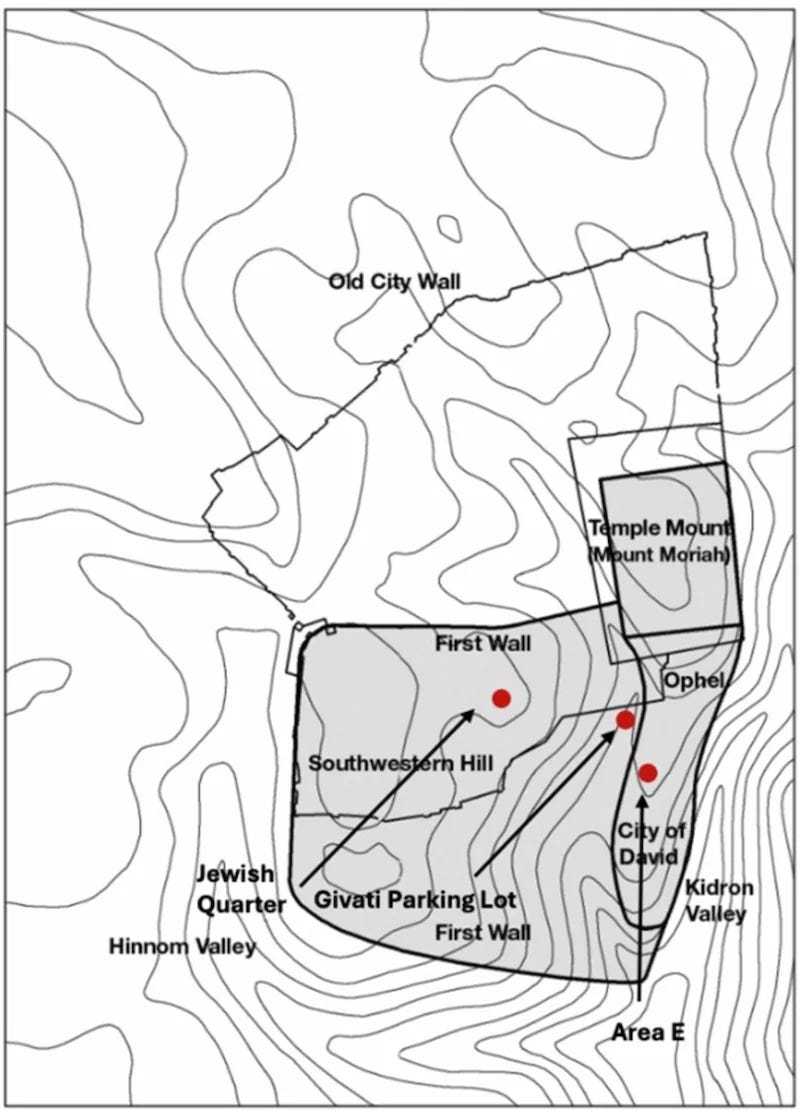
Jerusalem in the Late Hellenistic Period (mid–second to mid–first century bce) with approximate location of excavation sites; note the line of the Old City walls. Credit: Y. Hochma et al. 2026
Because scholars have reconstructed sequences of Rhodian eponyms, stamped amphora handles can often be placed within relatively narrow date ranges. This makes them unusually good archaeological anchors.
In Jerusalem, such handles show the city’s participation in Mediterranean trade during the Hellenistic period. In the new study, they also serve a second function: they help anchor measurements of the ancient magnetic field.
Jerusalem in the age of the Maccabees
The Hellenistic period was one of the most important and politically charged phases in the history of Jerusalem.
After Alexander the Great’s conquests, the southern Levant became part of a wider Hellenistic world. Jerusalem passed through Ptolemaic and Seleucid political spheres before the Maccabean Revolt and the rise of the Hasmonean dynasty in the 2nd century BC.
This was a time of urban change, military tension, religious conflict, regional trade, and new political identity. Archaeological material from the city, especially pottery, is central for reconstructing how Jerusalem developed during this period.
Stamped Rhodian amphora handles are especially important because they connect Jerusalem with wider economic systems. Their presence shows that imported goods, including wine from the Aegean world, reached the city at a time when local society was being reshaped by Hellenistic and Hasmonean forces.
The City of David and Hellenistic archaeology
Much of the discussion around Hellenistic Jerusalem has focused on the City of David, the southeastern hill of ancient Jerusalem, and surrounding excavation areas.
Finds from this part of the city have contributed to debates over the size, layout, and political character of Hellenistic Jerusalem. They also relate to discussions about the Seleucid Akra, the fortified Hellenistic presence remembered in ancient sources and connected with the conflicts of the Maccabean period.
Rhodian stamped amphora handles from Jerusalem therefore matter for more than trade history. Their dates can help clarify the chronology of urban development, imported ceramics, military architecture, and settlement growth during the 3rd and 2nd centuries BC.
The new archaeomagnetic work adds a scientific layer to these discussions. It tests whether ceramics already studied by traditional archaeological methods can also refine the magnetic record of the period.
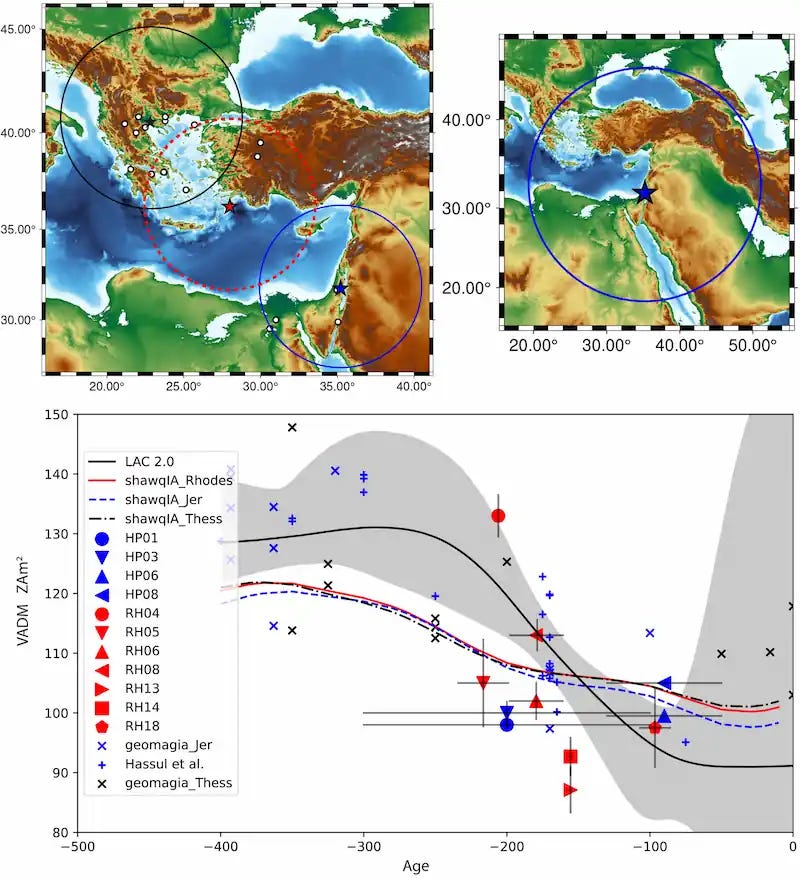
Map and archaeomagnetic data showing the pottery firing locations at Rhodes and Jerusalem, the comparison regions used in the study, and the measured archaeointensity values. Credit: Y. Hochma et al. 2026.
Measuring the ancient field
The study measured geomagnetic intensity preserved in Hellenistic pottery and stamped Rhodian amphorae from Jerusalem.
The basic question was simple but powerful: how strong was Earth’s magnetic field when these vessels were fired?
To answer that, researchers performed archaeomagnetic intensity experiments. They examined the magnetic signal locked inside ceramic material and compared it with controlled laboratory heating.
The result is an estimate of ancient field intensity. In archaeomagnetic studies, this is often expressed as virtual axial dipole moment, or VADM, a standardized way of comparing field strength across time and space.
Because Rhodian stamped amphorae can be dated through their stamps, they provide unusually useful reference points. They allow scientists to link a measured magnetic value to a relatively well-defined historical window.
Filling a gap in the magnetic record
Earth’s magnetic field is not fixed. It changes constantly in strength and direction. Over the last two centuries, the global magnetic field has weakened noticeably, and modern satellite missions continue to monitor changes such as the South Atlantic Anomaly.
But instrumental records cover only a tiny fraction of Earth’s history. To understand long-term changes, scientists need older records. Archaeological materials provide one of the best ways to extend that record into the human past.
The southern Levant is especially important for archaeomagnetism because it has produced many well-dated archaeological contexts. Earlier studies identified the Levantine Iron Age Anomaly, a period when the magnetic field in the region reached unusually high intensity during parts of the first millennium BC.
After that peak, the field weakened significantly. Hellenistic-period data are important because they help track what happened after the Iron Age anomaly and before later Roman-period evidence.
The Jerusalem pottery study contributes new measurements for this less well-documented interval.
A declining magnetic field after the Iron Age peak
Previous archaeomagnetic research in the Levant has shown that the magnetic field was extremely strong during parts of the Iron Age. It later declined during the 6th century BC and continued to change through the following centuries.
The Hellenistic vessels from Jerusalem belong to a later stage in that story. They help document the magnetic field after the period of high intensity and during the centuries when Jerusalem was under Hellenistic and Hasmonean influence.
This matters because geomagnetic change is not smooth or predictable. The field can rise, fall, spike, and fluctuate in ways that are still difficult to model. Every well-dated archaeological sample adds another fixed point to the curve.
The new measurements therefore help scientists refine the ancient geomagnetic record of the eastern Mediterranean.
How pottery became a key scientific tool
Pottery is one of the most common materials found in archaeological excavations. It was used for cooking, storage, transport, serving, and ritual activity. Because ceramic vessels were fired, they can preserve magnetic information.
This makes pottery useful in two directions.
First, archaeologists can sometimes use magnetic measurements to help date ceramic material or heated contexts when other dating methods are imprecise.
Second, geophysicists can use archaeologically dated pottery to reconstruct Earth’s ancient magnetic field.
The method depends on strong archaeological context. A magnetic measurement is most useful when the object’s date is already well constrained. This is why stamped Rhodian amphorae are so valuable: they combine ceramic material, historical trade, and independent chronological information.
The advantage of stamped handles
Most pottery can be dated only broadly, based on style, shape, fabric, and stratigraphy. Stamped Rhodian amphora handles offer something more precise.
The stamps are not decorative marks. They belong to a bureaucratic and commercial system tied to production, trade, and regulation. Since many Rhodian stamps include eponyms, and since those eponym sequences have been studied for decades, the handles can often be dated more tightly than ordinary sherds.
For archaeomagnetic work, this tight dating is crucial. A magnetic value without a good date is less useful. A good date without a measurable magnetic signal is also limited. Rhodian amphora handles bring the two together.
This makes them powerful tools for both archaeological chronology and geomagnetic reconstruction.
How the findings deepen our understanding of Jerusalem’s past
The study contributes to the chronology of Hellenistic pottery in Jerusalem. It supports the use of archaeomagnetism as an additional tool for refining ceramic dating, especially in periods where historical, numismatic, and ceramic evidence must be carefully combined.
The results are especially relevant for the 2nd century BC, a time when Jerusalem’s political and urban history is tied to the Seleucid presence, the Maccabean Revolt, and the early Hasmonean state.
Imported Rhodian amphorae show that Jerusalem was connected to Mediterranean exchange networks during this period. Their magnetic signal now adds another kind of evidence: a physical record of the geomagnetic field at the time those jars were fired.
In this way, a wine jar can speak at two scales. It can tell us about trade and consumption in Hellenistic Jerusalem, and it can also help reconstruct planetary magnetic history.
Archaeomagnetism and dating problems
Archaeologists often face dating problems, especially in periods where material culture changes gradually or where radiocarbon dating lacks precision.
In the southern Levant, some periods are particularly difficult because radiocarbon calibration curves create wide possible date ranges. Archaeomagnetic dating can help when well-dated reference curves exist.
The method compares the magnetic signal of an unknown sample with a regional curve built from well-dated samples. If the curve is detailed enough, the magnetic value can help suggest a date range.
The new Jerusalem study strengthens the reference curve for the Hellenistic period. That means future samples from the region may be easier to compare, especially if they come from kilns, destruction layers, or clearly fired ceramic assemblages.
A bridge between archaeology and geophysics
One of the strongest aspects of the study is its interdisciplinary character.
Archaeologists provide the pottery, stratigraphy, typology, historical context, and dating framework. Geophysicists provide laboratory methods for measuring ancient magnetic intensity. Ceramic specialists interpret the vessels and their place within Hellenistic trade and local production.
The result is a study that no single discipline could produce alone.
The same amphora handle can be understood as a trade object, a dated inscription, a fragment of Hellenistic Jerusalem’s economy, and a record of Earth’s magnetic field. This is what makes archaeomagnetism especially valuable: it turns ordinary archaeological objects into scientific archives.
Rhodes, wine, and Mediterranean exchange
Rhodian amphorae are among the most recognizable transport containers of the Hellenistic world. Their widespread distribution reflects Rhodes’ strong commercial role in the eastern Mediterranean.
Wine was one of the island’s important exports, and stamped amphorae helped control, identify, or organize production and trade. These jars traveled widely, reaching cities, ports, sanctuaries, military sites, and inland settlements.
Their presence in Jerusalem shows that the city was not culturally or economically isolated. Even during periods of political tension, goods from the Aegean world reached the city.
The Rhodian jars therefore provide evidence for commercial connections across the Mediterranean. Their magnetic signal now adds another layer: the jars also preserve information about the physical environment in which they were fired.
The Jerusalem of the Maccabees in a wider world
The phrase “Jerusalem of the Maccabees” often brings to mind revolt, temple politics, Seleucid rule, and the rise of Hasmonean power. The archaeological picture adds another dimension.
Jerusalem was also a city of households, markets, imported goods, storage vessels, administrative systems, and local ceramic traditions. Rhodian amphorae belong to this daily and economic side of history.
They show that Mediterranean trade reached the city during the same broad period in which political conflict reshaped Judea. The jars therefore connect local history with international exchange.
The new study helps situate Hellenistic Jerusalem inside both human and planetary histories: a city involved in Mediterranean commerce and a place whose ceramics help document the behavior of Earth’s magnetic field.
Wider scientific significance
The study matters beyond Jerusalem.
Earth’s magnetic field is generated by movement in the planet’s outer core. Its changes are complex and still not fully understood. Long-term records are essential for modeling how the field behaves over centuries and millennia.
Archaeological materials can supply those records. Fired clay, bricks, kilns, hearths, destruction layers, and metallurgical remains can all preserve magnetic signals if they were heated and cooled in the ancient field.
The more precisely dated the archaeological material, the more useful it becomes for science.
The Hellenistic pottery from Jerusalem adds new data to the eastern Mediterranean record and helps connect archaeology with global questions about geomagnetic change.
What makes this discovery significant
The study is important because it shows how small fragments of pottery can carry large amounts of information.
A stamped amphora handle may look modest, but it can preserve a name, a trade route, a date, a connection to Rhodes, evidence for Jerusalem’s economy, and a magnetic record from more than two thousand years ago.
The research also shows that the Hellenistic period deserves more attention in archaeomagnetic studies. Much previous work in the region has focused on the Iron Age, especially because of dramatic destruction layers and well-dated historical events. The Hellenistic period offers a different kind of evidence: trade vessels with stamped chronological markers.
That makes Rhodian amphorae particularly useful for refining both ceramic chronology and the geomagnetic curve.
A new way to read ancient pottery
The study of Hellenistic Rhodian amphorae from Jerusalem shows how archaeology can extract new information from familiar objects.
For generations, stamped amphora handles have helped archaeologists date trade networks and reconstruct economic life. Now they can also help scientists reconstruct Earth’s magnetic history.
The result is a wider view of the past. The same object can belong to the world of Rhodes, the Jerusalem of the Maccabees, the history of Mediterranean wine trade, and the long-term behavior of Earth’s magnetic field.
In that sense, the jars are more than containers. They are records of trade, politics, technology, and planetary change, preserved in fired clay.
Support Independent Ancient Content :
Your support helps me create more archaeology posts, articles, and mini history videos:
Sources:
The main study is Yael Hochma, Lisa Tauxe, Debora Sandhaus, Oded Lipschits, and Erez Ben-Yosef, “Geomagnetic Intensity of Hellenistic Pottery and Stamped Rhodian Wine Amphorae From Jerusalem,” published in Archaeometry in 2026. The Wiley page identifies the article and notes that the study concerns Hellenistic pottery and stamped Rhodian wine amphorae from Jerusalem.
The 2018 ASOR abstract for “Archaeomagnetism of Rhodian Stamped Jar Handles from the City of David” shows that the project examined stamped Rhodian amphora handles from City of David and Jewish Quarter excavations, using their well-studied chronology as anchors for archaeomagnetic research.
Christian Habicht’s study of Rhodian amphora stamps explains why Rhodian eponyms are important for Hellenistic chronology, while the AJA review of the Rhodian stamp lexicon summarizes the system of eponym and fabricant stamps on Rhodian transport amphorae.
NASA explains the protective role of Earth’s magnetosphere, while ESA reports that Earth’s magnetic field has lost around 9 percent of its global average strength over the last 200 years and discusses the South Atlantic Anomaly
The 2020 PLOS ONE study on Jerusalem’s 586 BC destruction explains how burnt archaeological materials can record ancient geomagnetic intensity and direction, and gives a key reference point for archaeomagnetic dating in Jerusalem.