


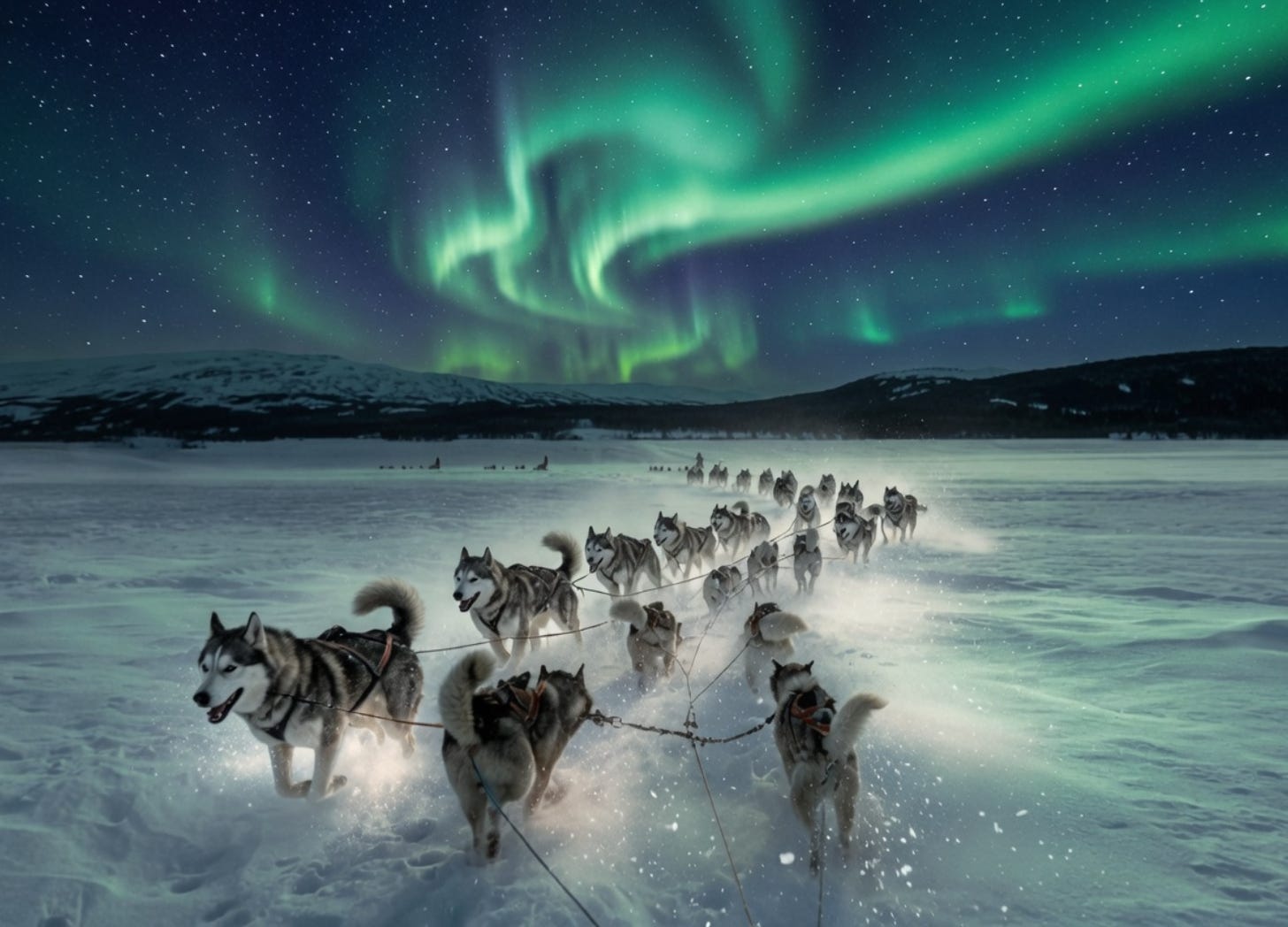
Ancient Sled Dogs Helped Arctic Hunters Stay Connected 8,000 Years Ago
A remote archaeological site in the Siberian High Arctic is changing how researchers understand early human life in the far north. At Zhokhov Island, part of the New Siberian Islands, evidence suggests that prehistoric hunter-gatherers lived in one of the world’s most extreme environments while maintaining long-distance exchange networks that stretched across vast frozen landscapes.
The key to that mobility may have been sled dogs.
Archaeological finds from Zhokhov show that people living there around 8,000 radiocarbon years ago used advanced transport technology, including wooden sledges and domesticated dogs. Obsidian tools found at the site also reveal contact with distant regions far to the east, suggesting that these Arctic communities were far more connected than once assumed.
A remote settlement in the High Arctic
Zhokhov Island lies in the De Long group of the New Siberian Islands, in the East Siberian Arctic. Today it is an isolated and severe environment, but during the Early Holocene, sea levels were lower and the geography of the region was very different.
At the time of occupation, the area around Zhokhov was linked more closely to the mainland or to a shrinking Arctic coastal plain. This made seasonal travel across tundra and snow-covered landscapes possible. The environment was still harsh, but it offered enough resources for a skilled hunter-gatherer population to survive year-round.
Systematic research at Zhokhov began in the late 20th century, and later excavations revealed an unusually rich archaeological record. Permafrost helped preserve materials that usually disappear at ancient sites, including wood, bark, woven objects, animal hair, and other organic remains.
The site produced thousands of stone artifacts, tens of thousands of animal bones, hundreds of objects made from antler, bone, and mammoth ivory, and around a thousand wooden artifacts. This makes Zhokhov one of the most important Early Holocene sites in the Arctic.
A year-round Arctic base camp
Researchers believe the main occupation of Zhokhov took place between about 8250 and 7800 radiocarbon years before present, with peak activity around 8000–7900 BP. In calendar terms, this is often discussed as roughly 9,000 years ago, while popular summaries describe the site as around 8,000 years old.
The site appears to have functioned as a year-round base camp, although activity varied by season. In spring and autumn, hunters focused on reindeer herds moving through the tundra. In winter, they hunted polar bears, especially females in dens.
This subsistence pattern shows a highly specialized adaptation to the Arctic. Zhokhov’s inhabitants understood animal behavior, seasonal movement, weather, snow conditions, and the geography of a large territory.
The hunting of polar bears in winter was especially demanding. It required knowledge of denning behavior and the ability to operate in cold, dark, and dangerous conditions. The scale of animal remains at the site shows that this was a regular part of life, not an occasional activity.
Domesticated dogs at Zhokhov
One of the most important aspects of the site is the evidence for dogs. Canid remains from Zhokhov show that fully domesticated dogs were present in this Arctic community. Studies of dog bones and skulls suggest that these animals were used for both hunting and transport.
Researchers have argued that Zhokhov dogs show signs of purposeful selection. Some dogs appear to match a size range suitable for pulling sledges, while larger animals may have been used in hunting, including potentially dangerous hunting activities such as polar bear pursuit.
This matters because it suggests an early form of specialized dog use. The people of Zhokhov were not simply keeping dogs as companions or general-purpose animals. They appear to have integrated dogs into a wider economic and transport system.
Later genetic research also connects ancient Siberian sled dogs with modern Arctic sled dog lineages. A 9,500-year-old Siberian dog related to archaeological sled technology shows genetic similarity to modern sled dogs such as Greenland sled dogs, Alaskan malamutes, and Siberian huskies. This supports the idea that Arctic sled-dog traditions have very deep roots in northeastern Siberia.
The world’s oldest evidence for wooden sledges
Zhokhov has produced some of the earliest known wooden sledge components in the world. These include runners, uprights, fragments, and possible preforms. Some pieces were well enough preserved for researchers to reconstruct how the sledges may have been built.
The sledges appear to have included more than one type. Some may have been small, light sledges that could be pulled by a hunter, a dog, or both. Others were larger cargo sledges designed for heavier transport and probably moved by dog teams.
This level of transport technology is significant. Sledges require planning, woodworking skill, suitable materials, knowledge of snow conditions, and trained animals. They also require harnessing systems, route knowledge, and the social organization needed to maintain working dogs.
At Zhokhov, sledge transport formed part of everyday survival. It helped people hunt, move tools and meat, travel between areas, and maintain links across the Arctic landscape.
Obsidian from 1,500 kilometers away
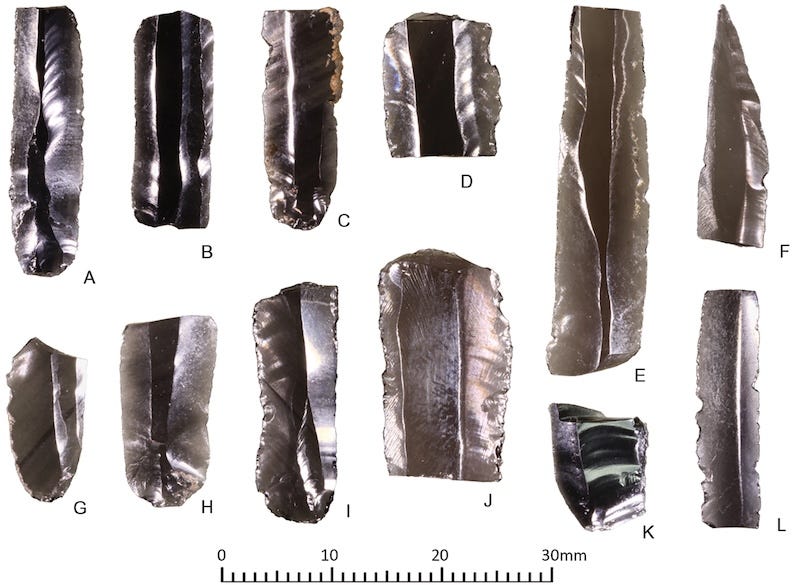
Obsidian artifacts, including microblades, found at the Zhokhov site. Credit: Pitulko, V. V., et al. 2026.
The strongest evidence for long-distance connection comes from obsidian. Archaeologists found 79 obsidian artifacts at Zhokhov, including microblades, blades, flakes, and a small piece of raw material. Obsidian made up only a tiny fraction of the stone assemblage, but its origin is highly important.
Researchers analyzed 14 obsidian artifacts using geochemical methods. Their chemical signatures matched the Cape Medvezhiy source near Lake Krasnoe in Chukotka, about 1,500 kilometers from Zhokhov in a straight line.
This is an extraordinary distance for Early Holocene material movement in the High Arctic.
The people of Zhokhov probably did not travel directly to the source and return with the obsidian. The distance was too great for ordinary direct procurement on foot. Instead, the obsidian most likely moved through exchange networks linking groups across northeastern Siberia.
This means Zhokhov was part of a wider communication system. Goods, information, knowledge, and possibly people moved across a huge region.
A network across millions of square kilometers
The authors of the obsidian study suggested that Early Holocene people in the northeastern Siberian Arctic maintained a well-developed network covering as much as four million square kilometers.
Such a network would have allowed communities to exchange raw materials, tools, news, technological knowledge, marriage partners, and social ties. In an environment where isolation could be dangerous, long-distance connections would have been essential.
The obsidian from Lake Krasnoe is therefore more than a material curiosity. It is evidence for social geography. It shows that Zhokhov’s inhabitants were connected to people living far beyond the island.
Dog-powered transport may have made this possible. Sledges pulled by dogs could move people and goods more efficiently over snow-covered terrain than travel on foot. In early spring, when snow remained firm and daylight increased, long-distance travel would have been especially practical.
Arctic transport as a major innovation
Dog sledding is often associated with recent Arctic cultures, but Zhokhov pushes the roots of this technology deep into prehistory. The evidence suggests that by the Early Holocene, people in the East Siberian Arctic had already developed a sophisticated land-transport system.
This was not a small technical detail. In the Arctic, transport shapes survival. It determines how far people can hunt, how much food can be moved, how groups communicate, and how communities stay connected across enormous territories.
The Zhokhov evidence suggests that sledges and working dogs transformed human life in the far north. They made it possible to exploit larger territories, maintain exchange networks, and live in high-latitude landscapes that would otherwise have been extremely difficult to occupy.
Some researchers argue that the complexity of the sledges found at Zhokhov implies an even earlier period of technological development. In other words, dog-sledge systems may have been emerging before the main occupation of the site.
Hunting, transport, and social organization
Zhokhov was not a simple survival camp. Its archaeological record points to a community with advanced planning and complex organization.
The inhabitants made tools from stone, bone, antler, ivory, wood, and other materials. They hunted reindeer and polar bear, used dogs for practical work, made sledge components, and acquired exotic stone from far away.
Their world was based on movement. They traveled across today’s New Siberia, Faddeyevsky, and Kotelny islands, as shown by raw materials brought from those areas. The presence of obsidian from Chukotka adds a much larger exchange dimension.
The people of Zhokhov lived in an Arctic environment, but they were not cut off from others. Their economy depended on skill, mobility, and communication.
What the discovery tells us about early Arctic life
The Zhokhov evidence changes the picture of prehistoric life in the Arctic. It shows that early northern hunter-gatherers were capable of maintaining large-scale networks, using advanced transport technology, and managing specialized working dogs.
The obsidian study gives a clear archaeological signal of connection over enormous distances. The dog and sledge evidence explains how such connection could have worked in practical terms.
Together, these finds suggest that sled dogs were already central to human life in the High Arctic thousands of years ago. They helped people move across snow-covered landscapes, carry materials, hunt, trade, and maintain contact with distant communities.
Zhokhov Island may look isolated on a modern map, but in the Early Holocene it was part of a mobile and connected Arctic world.
Sources:
IFLScience — Benjamin Taub, “In The World’s Most Remote Prehistoric Settlement, People Ate Polar Bears, Invented Dog Sledding, And Traded Obsidian Over 1,500 Kilometers,” published June 2026. It reports the same main findings for a general audience.
Pitulko, V. V., Kuzmin, Y. V., Glascock, M. D., Pavlova, E. Yu., & Grebennikov, A. V. 2019. “‘They came from the ends of the earth’: long-distance exchange of obsidian in the High Arctic during the Early Holocene.” Antiquity 93(367), 28–44. This is the main academic paper on the 79 obsidian artifacts, the 14 geochemically analyzed samples, the Lake Krasnoe/Cape Medvezhiy source, and the 1,500 km exchange distance.
Pitulko & Pavlova 2024, “Zhokhov site sledges as a part of the land transportation system of the East Siberian Arctic dwellers 9000 years ago,” discusses the wooden sledge components, possible sledge types, and the role of dog-sledge transport in long-distance exchange.