


The Scythians live in the imagination as free-riding horse nomads, fierce in battle and roaming the open grassland with no fixed center of power. A sweeping new ancient-DNA study complicates that picture.
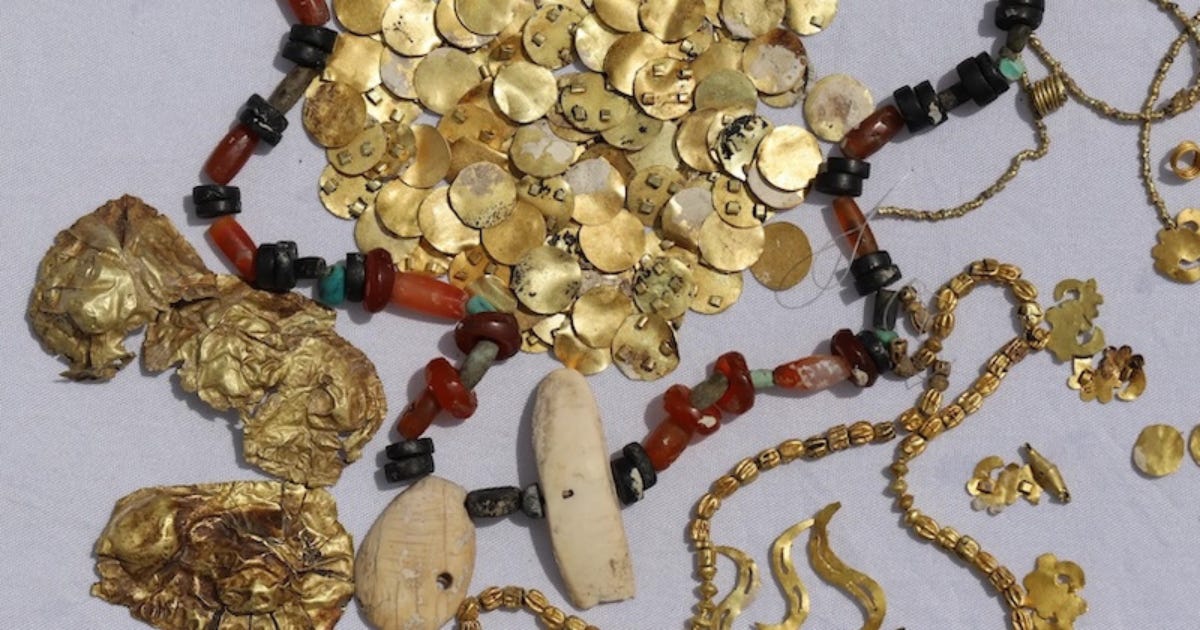
Artifacts recovered from the elite burial site of Eleke Sazy in eastern Kazakhstan. Credit: Zainolla Samashev
Sequencing the genomes of 85 Iron Age individuals from across Central Eurasia, researchers have found that these nomadic societies were organized around powerful elite dynasties, ruling families whose authority was inherited and whose blood ties stretched across burial grounds hundreds of kilometers apart. Nearly half of those elites were women.
The work, published on July 3, 2026, in the journal Science Advances, was led by archaeogeneticist Ayshin Ghalichi of the Max Planck Institute for Evolutionary Anthropology in Leipzig and the University of Texas at Austin, with an international team that included colleagues in Kazakhstan. Its central finding is that social inequality among the steppe nomads emerged during the Iron Age, around 900 BC, and hardened into something like dynastic rule.
Reading power in the genome
Almost everything known about the Scythians has come from the outside. Ancient Greek and Roman writers described these skilled equestrians, and their monumental burial mounds, called kurgans, dot the steppe from the Altai Mountains to the Black Sea. Their tattooed mummies, their exquisite animal-style goldwork, and their women warriors, who may have inspired the Greek legend of the Amazons, were famous across the ancient world. Yet the Scythians left no writing of their own, and after a run of military defeats around 200 BC they were largely absorbed into other groups.
To get at how these scattered communities were connected and how their societies were structured politically, the team sequenced DNA from 85 individuals dating between roughly 900 and 200 BC, comprising 38 people from elite kurgan burials and 47 from ordinary graves, including 45 or 46 newly sequenced genomes. What emerged was a clear genetic signature of a ruling class. Elite individuals were about eleven times more likely to be biologically related to one another than to non-elites, pointing to a powerful, extended family group presiding over the steppe nomads.
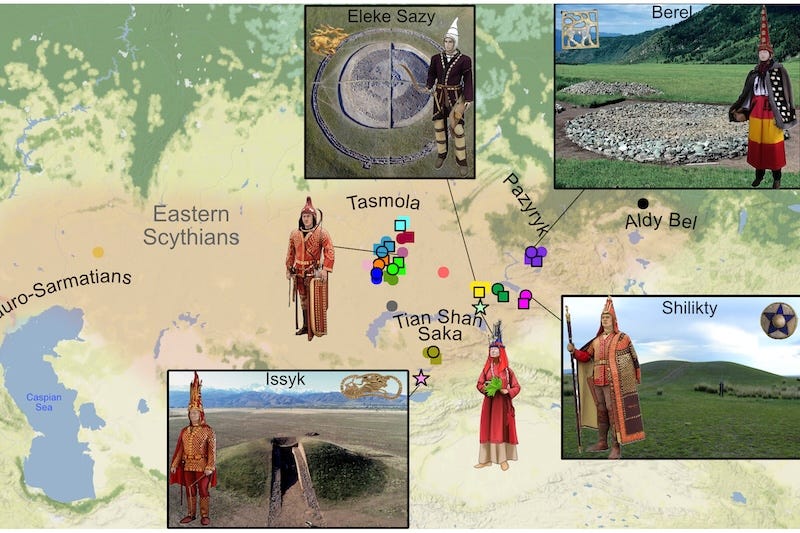
Map showing major Iron Age Eurasian steppe sites included in the study. Ancient DNA reveals evidence of elite dynastic rule among Iron Age Eurasian steppe nomads. Credit: Study authors.
Kin scattered across the grasslands
Within that elite the researchers identified close family bonds, including two pairs of full brothers, a brother and sister, and a parent and child. In one striking case, two brothers had been buried in different regions far apart from each other. In another, an elite grandfather and his grandchild were laid to rest in entirely separate cemeteries. That last pattern, elite kin linked across distant burial grounds, is the strongest evidence for dynastic rule, since it shows that a single ruling lineage held sway over a wide territory rather than a single local community.
At the same time, elite burials tended to cluster closer together than ordinary ones. As co-author and genetic anthropologist Ainash Childebayeva notes, this hints at a degree of geographic centralization, and she points to the famous “Valley of the Kings” in Siberia, an area dense with large elite kurgans likely from a period similar to the one in the study, as a possible expression of the same tendency.
Women at the top
One of the most consequential results concerns gender. Ancient authors such as Herodotus had claimed that Scythian women could hold positions of high status, and the genetics now supports them. Nearly half of the elite individuals in the dataset were women, which Ghalichi describes as a noticeable presence indicating that women held high social standing in Iron Age Scythian society. Rather than authority passing strictly through male or female lines, the team found that power seems to have run through extended elite family networks in which women were full participants, buried in the same richly furnished graves, with the same gold and honors, as elite men.
The mystery of the Golden Man
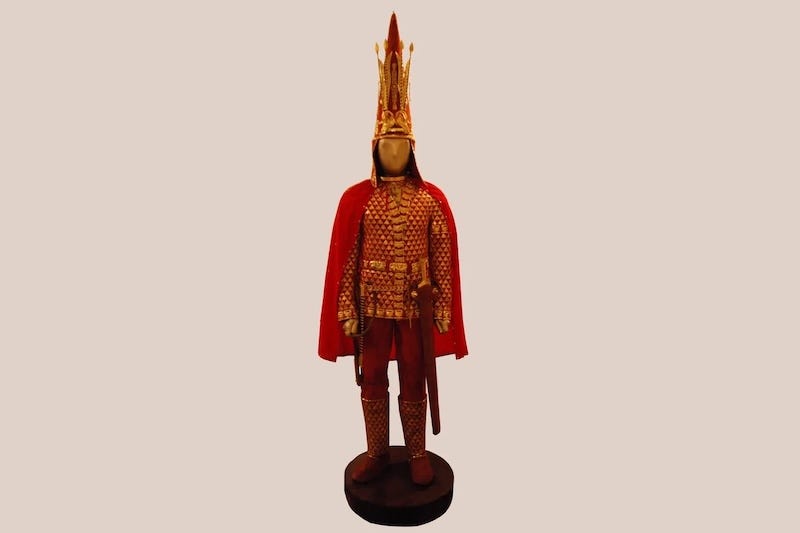
Reconstruction of the “Golden Man,” whose DNA was sequenced as part of the study. Credit: Gulmira Mukhtarova
The DNA also settled a decades-old question about one of the steppe’s most celebrated finds. The Golden Man, a young skeleton discovered in 1969 in a kurgan at Issyk in Kazakhstan, was buried with more than 4,000 gold ornaments and a silver bowl bearing an inscription that has never been deciphered. Because the bones alone could not reveal the individual’s sex, and because experts tended to assume a powerful warrior must be male, the Golden Man was long presumed to be a man, even though Scythian women clearly wielded comparable power. This study produced the first genome-wide data for the Golden Man, and although the coverage was low, the result indicates the individual was more likely male than female. The team could not establish any kinship links for this person.
More telling, according to Childebayeva, is that the Golden Man died young, around age 17 by the evidence of the bones, yet was given elite burial, a combination that argues for inherited rather than earned status. She calls an even more dramatic example the match between an elite grandfather and his one-year-old grandchild, both interred in elite kurgans. Graves of elite children like these reinforce the conclusion that among the Iron Age steppe nomads, social status was passed down by birth.
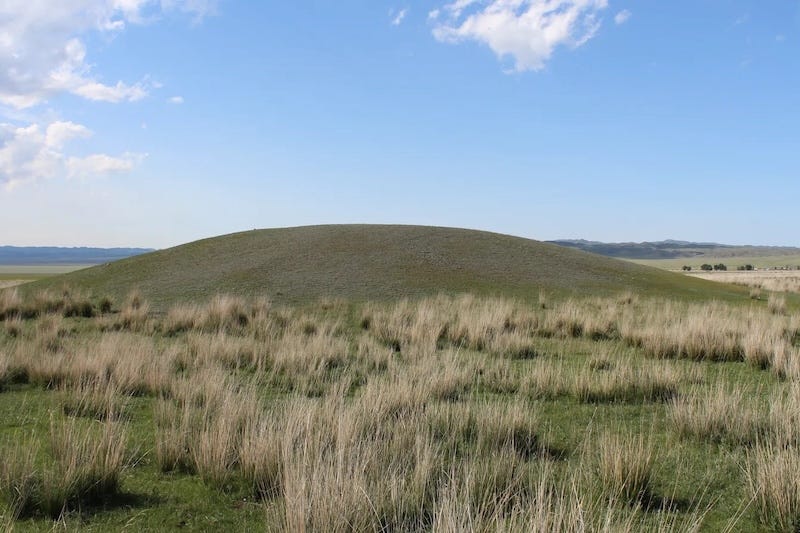
One of the kurgan burial mounds before excavation. Credit: Rinat Zhumatayev.
A new view of the steppe
The picture that emerges is of a nomadic world far more hierarchical and politically structured than the romantic image of free riders suggests. By weaving together archaeology, anthropology, and genetics, the study reconstructs patterns of marriage, kinship, and political organization that were invisible in the archaeological record alone, revealing dynasties whose reach crossed the grasslands and whose power descended through the generations. As the authors put it, the findings advance our understanding of how social inequality and differentiation arose among the ancient nomadic groups of Eurasia, and shed light on the earliest of them in the first millennium BC.
Sources. Live Science; Max Planck Institute for Evolutionary Anthropology. Article, Ayshin Ghalichi et al. (2026), “Ancient DNA reveals elite dynastic rule among Iron Age Eurasian Steppe nomads,” Science Advances, doi.org/10.1126/sciadv.aef0108.
Fascinating story, and intriguing to hear about females sharing the power structure, a rarity and all the more mysterious for it.
Elite families …? or Ancient Oligarchs…? It’s all the same to me…?❔❓🙏🏼