


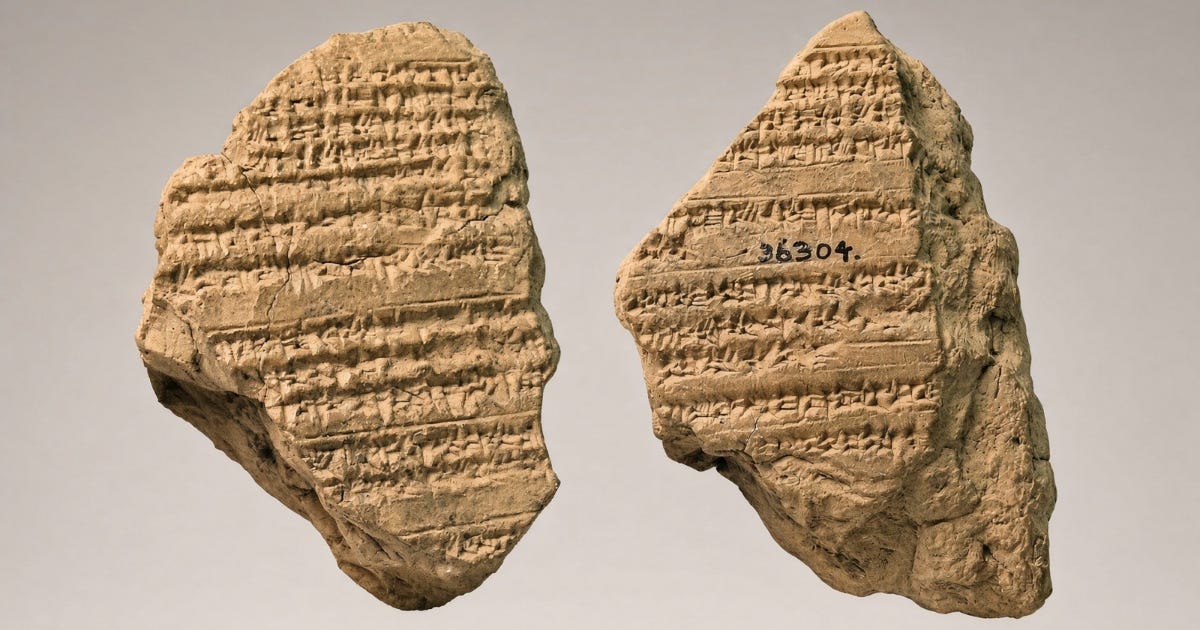
The Alexander Chronicle (BCHP 1), obverse and reverse. This Babylonian clay tablet, held in the British Museum as BM 36304, records the fall of Darius III and Alexander’s pursuit of Bessus. Photos via Livius.org, CC0 1.0 Universal. Tablet in the British Museum, London.
The Babylonian Astronomical Diaries, cuneiform tablets kept from about 652 to 61 BCE, hold a contemporary Babylonian account of Alexander the Great’s war with Darius III. One tablet dates the battle of Gaugamela to October 1, 331 BCE and records a total lunar eclipse eleven days earlier, and another entry reads “The king died” for June 11, 323 BCE. Scholars use the Diaries to test later Greek and Roman narratives and still debate how some lines should be read.
Ancient Content, November 19, 2026
The Diaries kept a six-century record from Babylon
The Astronomical Diaries are Akkadian cuneiform texts that record astronomical observations alongside weather, river levels, commodity prices and political events. Wikipedia dates the series from about 652 to 61 BCE and says several hundred tablets survive, very few of them complete, with most dating between 400 and 60 BCE. The British Museum holds most of them. The CAENO project notes that historians have dated 180 of the surviving Diaries.
The standard edition is Abraham Sachs and Hermann Hunger’s Astronomical Diaries and Related Texts from Babylonia, published by the Austrian Academy of Sciences between 1988 and 1996. Its first volume covers 652 to 262 BCE, the second 261 to 165 BCE and the third 164 to 61 BCE. Jona Lendering of Livius.org adds that the edition counts years as Western years, while the Babylonian year began in spring, so the edition’s year “-330” corresponds to 331/330. Scholars group the Diaries with goal-year texts, almanacs and excerpts under the label GADEx.
Observers logged the sky beside prices and politics
Each Diary covers several months, divided into monthly sections. The daily entries record the position of the moon and planets, eclipses, solstices, equinoxes and the rising and setting of Sirius. Lendering notes that the writers sometimes remark that clouds filled the sky or that an observation was missed. At the end of each month the Diary lists the level of the Euphrates, market prices for barley, dates, mustard, cress, sesame and wool, and sometimes events such as warfare, disease, royal visits or cultic activity.
Wikipedia says the Diaries may have been connected to divination and were likely a source for the Babylonian Chronicles. Lendering suggests regular observation began under King Nabu-nasir (747 to 734 BCE), and the oldest surviving tablet dates to 652/651 BCE and the youngest to 61/60 BCE.
The Gaugamela tablet fixes the battle to October 1, 331 BCE
The free part is only the beginning. Below, the Gaugamela tablet and its eclipse, one line about Darius’s troops that scholars read two ways, and the entry that records Alexander’s death. Claim my free post, then upgrade to continue.
