


On the hill of Arin Berd, on the southeastern edge of Yerevan, a joint French and Armenian archaeological mission has recovered a fragment of painted wall plaster whose colors have survived some 2,600 years with remarkably little fading. The French Embassy in Armenia, which announced the find, has described it as unprecedented.
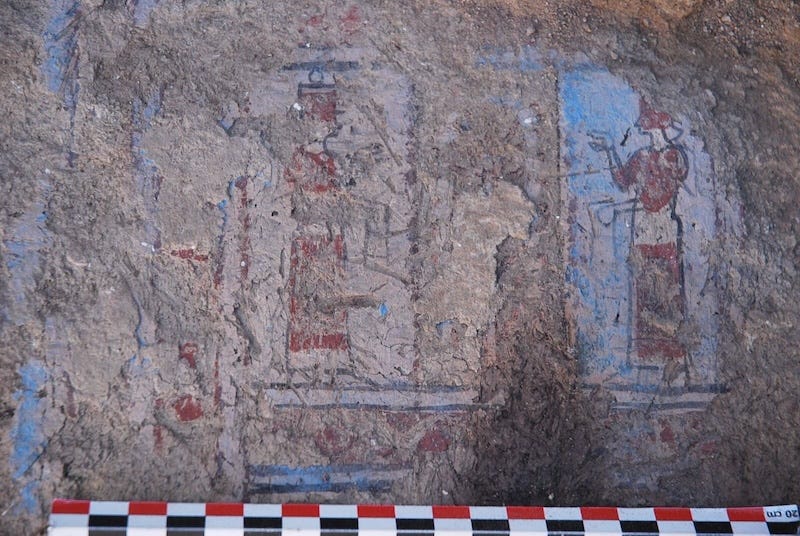
Preliminary assessment places the painting in the second half of the seventh century BC or the beginning of the sixth, the final decades of the Kingdom of Urartu. That dating is part of what makes it interesting, since it captures Urartian painting not at the height of the kingdom’s power but near its end.
A fortress older than the city around it
Erebuni was founded in 782 BC by the Urartian king Argishti I, a fact established by a cuneiform inscription found at the site, and modern Yerevan traces both its name and its origin to that fortress. The citadel was built largely of mudbrick and ringed by heavy walls, in places three rows deep. At its heart stood the temple of Khaldi, the chief god of the Urartian pantheon, whose walls carried extensive painted decoration.
Excavation there has produced palaces, temples, cuneiform inscriptions, ceramics, and metalwork, and the site has long been recognized as one of the richest sources of information on Urartian civilization anywhere. The French and Armenian teams have been working on and around the hill since 2008, and this is not the first painted material they have recovered. In June 2010, a joint expedition found remains of an Urartian wall painting along with three storage jars of a type familiar from the Van region, the Urartian heartland.
Why painted plaster so rarely survives
Erebuni was already known for its murals, both religious and secular in subject, and reconstructed chambers at the site have been repainted following the designs and colors of the authentic surviving fragments. That work gives visitors a sense of what figural and decorative painting looked like in the Armenian Highlands during the eighth and seventh centuries BC, a tradition that then breaks off for more than a thousand years before Christian fresco painting begins in Armenian churches.
The difficulty is that painted plaster is among the most fragile material archaeology deals with. Pigment fades, plaster crumbles, and the surfaces that do survive are often recovered in poor condition or with their color badly degraded. A fragment that retains its layers of color intact is genuinely uncommon, which is why the announcement stresses preservation rather than subject matter.
Recent scholarship has shown how much such fragments can yield when they are well enough preserved to analyze. A study of another Erebuni painting fragment, discovered attached beneath a second panel during conservation work, allowed researchers to reconstruct the decorative scheme it had originally belonged to. Chemical analysis of its pigments also produced a first, the identification of Egyptian blue in the territory of present-day Armenia, evidence that Urartian painters had access to a manufactured pigment produced and traded across the ancient Near East.
That same study noted a problem worth keeping in mind. Soviet-era restoration work at Erebuni heavily altered the original archaeological context of some painted material, which makes newly excavated fragments recovered under modern conditions especially valuable, since their findspots and stratigraphy can be documented properly from the start.
What comes next
Specialists expect the new fragment to yield information on Urartian painting techniques, the materials used to make the pigments, and the visual culture of the kingdom’s final phase. Beyond the object itself, the French Embassy framed the discovery as evidence of the continuing productivity of the scientific partnership between the two countries, whose joint excavations have been running at the site for close to two decades.
The find also sits within a broader pattern of recent Urartian discoveries across the region. At Garibin Tepe in the Tuşba district of Van, in Turkey, excavators have uncovered exceptionally well-preserved Urartian wall paintings in shades of blue and burgundy without known parallel, part of a site that has also produced Urartian buildings and lion sculptures. Taken together, these finds are steadily filling in a picture of a painted, colored Urartu that the surviving stone architecture alone could never convey.
Sources: Public Radio of Armenia; French Embassy in Armenia; Archaeology Magazine; Erebuni Historical and Archaeological Reserve-Museum; Dan, R., et al., "A New Painting Fragment from Erebuni and an Overview of Urartian Wall Paintings."
This blue background is stuningly vivid 🟦