


Archaeologists from the National Museum of Tajikistan have recovered a fired clay seal at Sayyod, in the Abdurahmoni Jomi district of Khatlon province. The museum describes it as a Kushan royal seal and calls the find unusually important for the study of the period.
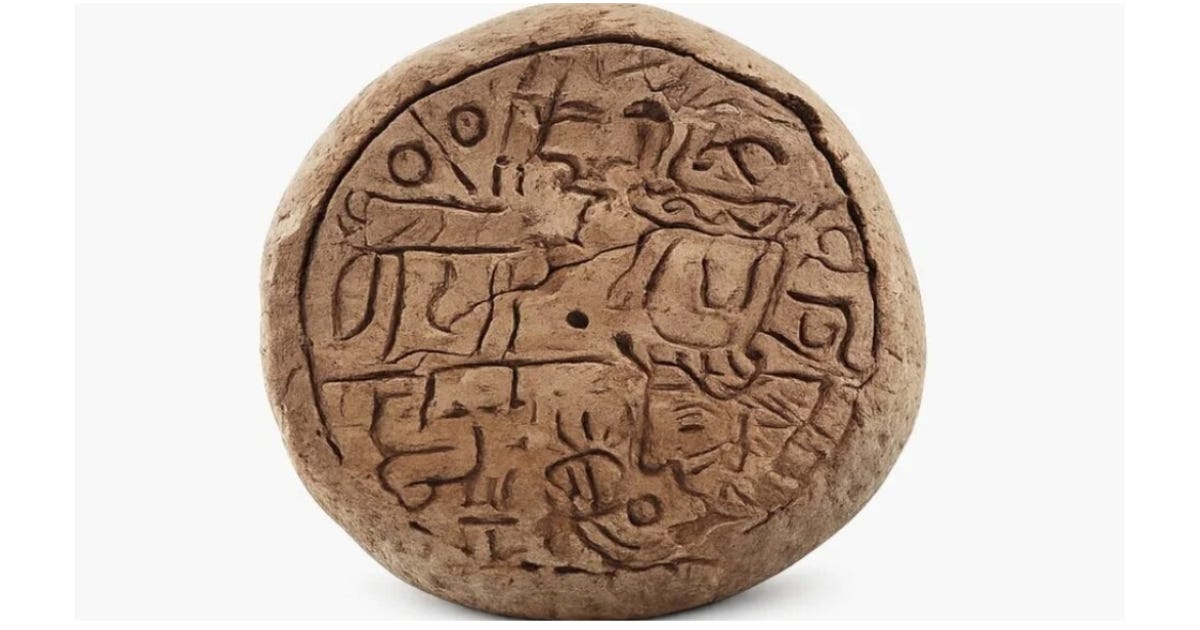
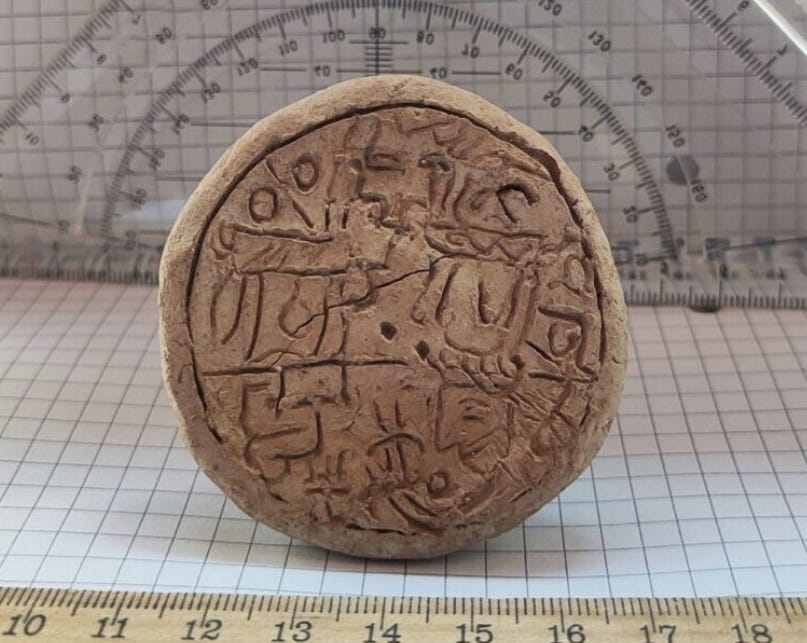
It survives in good condition. The object is beige, made of fired clay, and comes in two parts, a handle pierced with a hole, apparently for a cord, and a round working face for stamping. It stands about five centimetres high and the engraved face is roughly six centimetres across.
What is cut into the face
Everything on it is mirrored, which is what you would expect from a working seal, since the impression has to come out the right way round in clay or wax.
The archaeologists have made out a Bactrian inscription, geometric ornament, the bust of a ruler in a toothed crown, mountain goats, symbols of Kushan royal authority, and further signs that may relate to local rulers.
The inscription has not been fully read, and the museum has not settled on an interpretation of the seal as a whole. Its archaeology and numismatics department is still working on the object, so the owner, the precise date and the function are all open questions.
Why the inscription is the thing to watch
Bactrian is an Iranian language written in a modified Greek alphabet, and under the Kushans it became an important language of administration. That makes inscriptions on official objects particularly useful for reconstructing the institutions and titles of the period.
If the text can be read, it may give a name, a title or an institutional affiliation, and with it some sense of whether the seal belonged to a royal official, a local ruler, or someone else within the Kushan system.
The combination of royal symbolism with signs apparently tied to local authority is the other point of interest. It suggests the seal may document something more complicated than imperial power alone, namely the relationship between Kushan rulers and the regional nobility in what is now southern Tajikistan.
Seals, administration and trade
The Kushan Empire began in Bactria and became one of the leading political powers of Central and South Asia in the early centuries AD, eventually holding territory across parts of modern Central Asia, Afghanistan, Pakistan and northern India.
That position placed it inside the trade networks connecting China and Central Asia with India, Iran and, indirectly, the Roman world, and those connections underwrote a period of economic growth and urban expansion under Kushan rule.
The routes now grouped under the name Silk Road were never a single highway controlled by one state. They were a network of caravan tracks, market towns and regional trading chains along which goods passed from one group of merchants to the next, silk, glass, precious stones, metals, textiles, ivory and much else.
In ancient administrative systems, seals authenticated documents, identified officials or owners, sealed vessels and marked goods. If this one can be tied to a particular institution or ruler, it would say something about how authority connected to the movement and accounting of goods. There is no direct evidence yet that this seal was used in trade.
The museum says the object is undergoing archaeological, numismatic and epigraphic study, and that results will be published when that work is finished.
Source. National Museum of Tajikistan
With each archeological find-
The Ancient World always appears
more and more advanced than ever
before. People were so smart! Amazing!
Are We the Height of Man’s Civilization Today?
or-
Are We on the Downside and Falling
Quickly into Chaos and Dissolution?