


France’s National Archaeological Museum featured a small transparent scraper as its Object of the Month in September 2025.
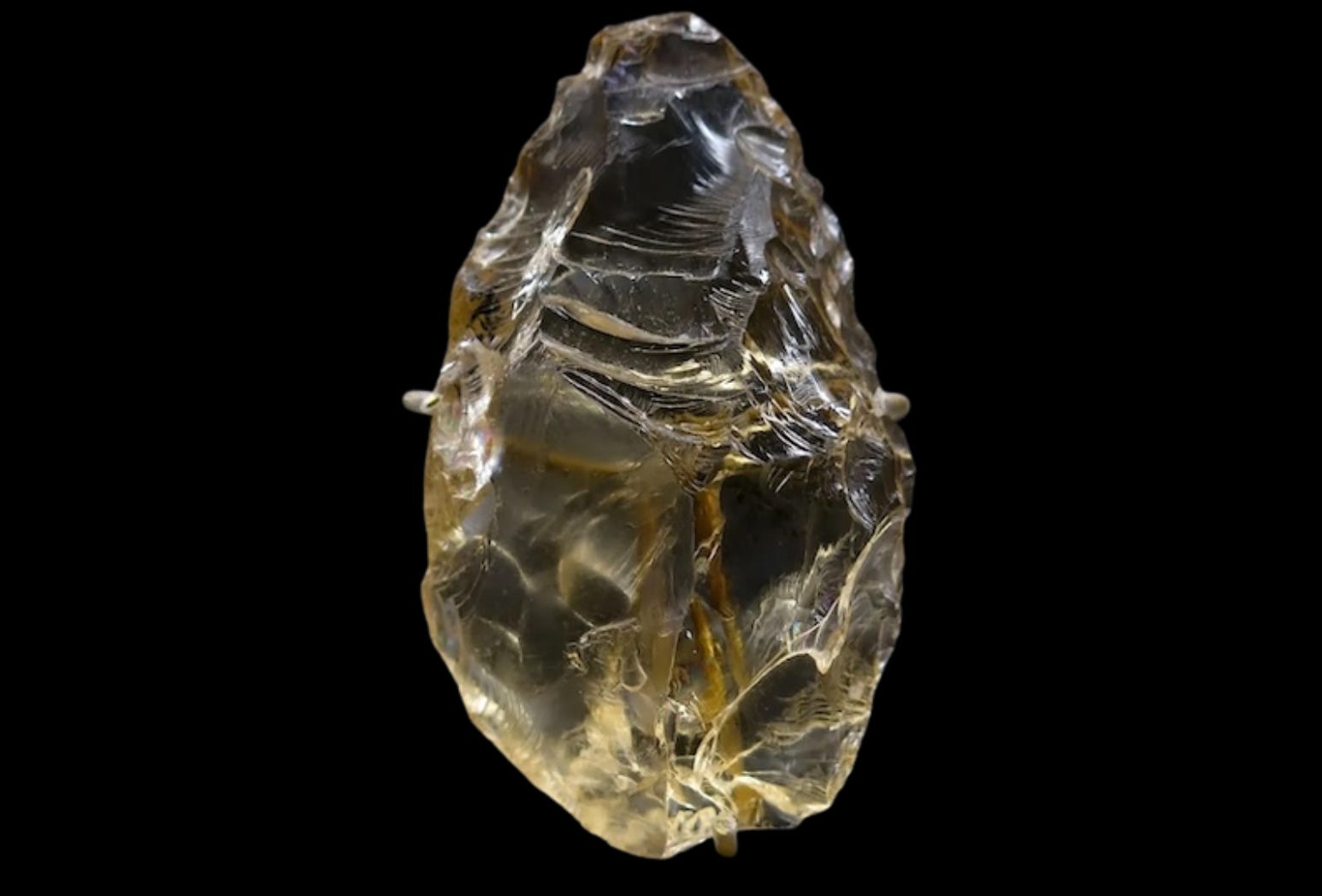
It is made of rock crystal, it was struck by a Neanderthal somewhere between 45,000 and 80,000 years ago, and it was dug up more than a century ago by an American team who did not entirely know what they had.
The tool came out of the Abri des Merveilles, a rock shelter near the commune of Sergeac in the Castel-Merle valley of the Dordogne, close to Lascaux. It was found in 1924 by the American School of Prehistoric Research, then led by George Grant MacCurdy and now a department at Harvard.
Seven pieces of crystal
Neanderthals normally worked flint or chert, which fracture predictably and give a reliable cutting edge. A small number of Neanderthal sites in Europe have produced tools of rock crystal instead, a transparent quartz that yields strikingly clear scrapers and points.
MacCurdy’s team found seven of them at Merveilles across successive seasons. In the paper he eventually published, he described the first, recovered in 1924, as transparent and tinged with just enough yellow to give it colour, and identified it as a combination scraper and point. It is that piece the museum has now displayed. Number three, found in 1928, was amethystine. Numbers five, six and seven all came out in 1929.
Alongside the tools were tiny chips of rock crystal, which indicated the pieces had been knapped on site rather than carried in finished. The raw material may have washed down from sources feeding the Vézère, the river that runs through the valley.
Why the date is a range
Abri des Merveilles has never been properly dated, and the reason is the excavation itself.
The site was first identified in 1878. The Archaeological Society of Washington secured a ten year lease in 1924, and MacCurdy and his students worked there for seven summers before moving on in 1930. The shelter holds an Aurignacian level of roughly 45,000 to 25,000 years old and Upper and Lower Mousterian levels running from about 160,000 to 45,000 years ago. A probable Neanderthal molar turned up in 1926, found by Castanet, the owner of the site.
That tooth is associated with a Lower Mousterian level, but like much of the material recovered in the 1920s it is difficult to place precisely, because the note-taking was poor and the archaeological contexts were largely lost. The 45,000 to 80,000 year bracket for the crystal tools rests on stratigraphy, tool types, and the molar rather than on any absolute date.
What it meant in 1931
The conclusion MacCurdy drew was not obvious at the time.
Most specialists then held that Neanderthals were ape-like and unintelligent, a view owing a great deal to Marcellin Boule’s 1909 analysis of the skeleton from La Chapelle-aux-Saints. Boule was working from the remains of an elderly man with osteoarthritis and produced a reconstruction of a stooping, knuckle-walking creature. That image persisted well into the twenty first century, until geneticists established that Neanderthals and modern humans had interbred.
MacCurdy read the crystal tools differently. He noted that we are accustomed to thinking of Neanderthal man as lacking aesthetic sense, which was a reasonable summary of the field in 1931, since none of the Neanderthal rock art, engravings, carved objects or pigment use recognised today had yet been found.
Writing in PNAS, in a paper called The Use of Rock Crystal by Paleolithic Man, he concluded that the Neanderthal was not an artist in the strict sense, but that an eye for beauty of form and colour was evident even from the limited use he made of rock crystal, and that he should be given credit for discerning the beauty and quality of the material he worked with.
The museum’s assessment is that MacCurdy drew highly innovative conclusions from these seven pieces, and that they helped open the way to the modern understanding of Neanderthals.
Sources: MacCurdy, G.G. (1931). "The Use of Rock Crystal by Paleolithic Man." Proceedings of the National Academy of Sciences 17(12), 633 to 637. doi.org/10.1073/pnas.17.12.633. Excavation history from the American School of Prehistoric Research, Harvard University. Musée d'Archéologie Nationale, Object of the Month, September 2025.
I find it so arrogant of modern man to think that Stone Age and Bronze Age people couldn’t make beautiful things or build monuments. The truth is that even with all their modern tools and machinery modern man cannot do better and that really pisses them off
For some mind-blowing Neanderthal art, visit the Nasher Sculpture Center's webpage and look up the exhibit "First Sculpture: Handaxe to Figure Stone" — the little bird is especially charming.
Also John Hawks discusses the "shell in the handaxe" in his blogpost "Ancient handaxes made from geodes."
And as for a Neanderthal monument, look up Bruniquel Cave in Wikipedia.
(Sorry, links aren't allowed in Notes)