


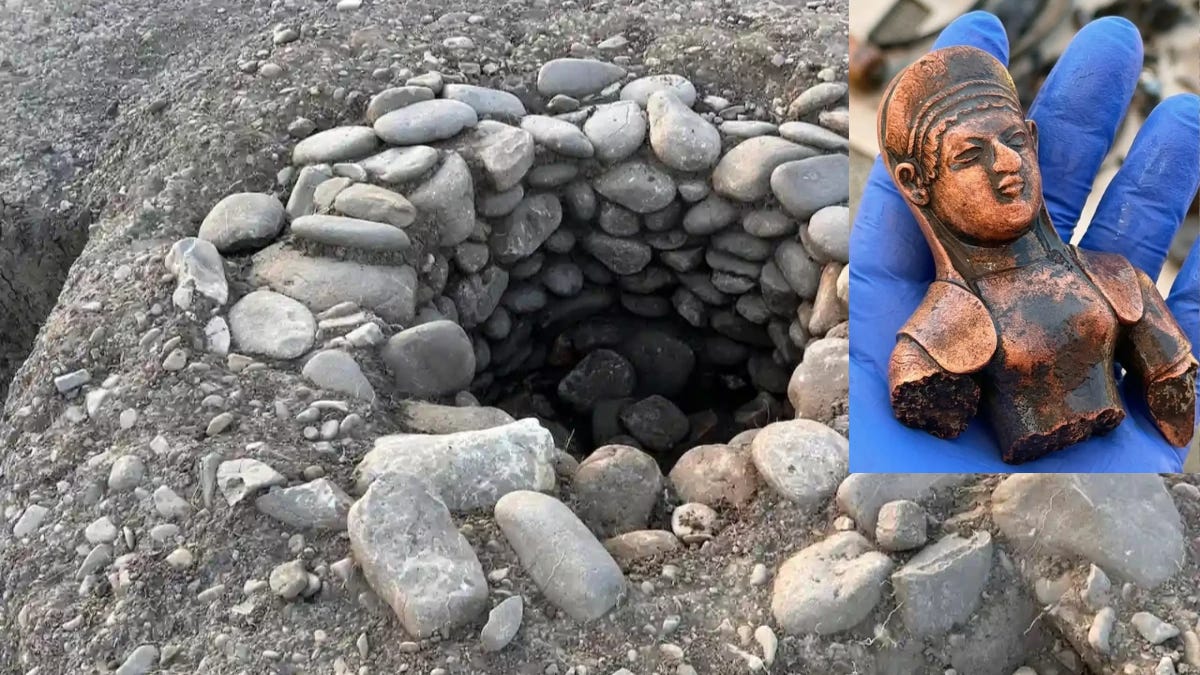
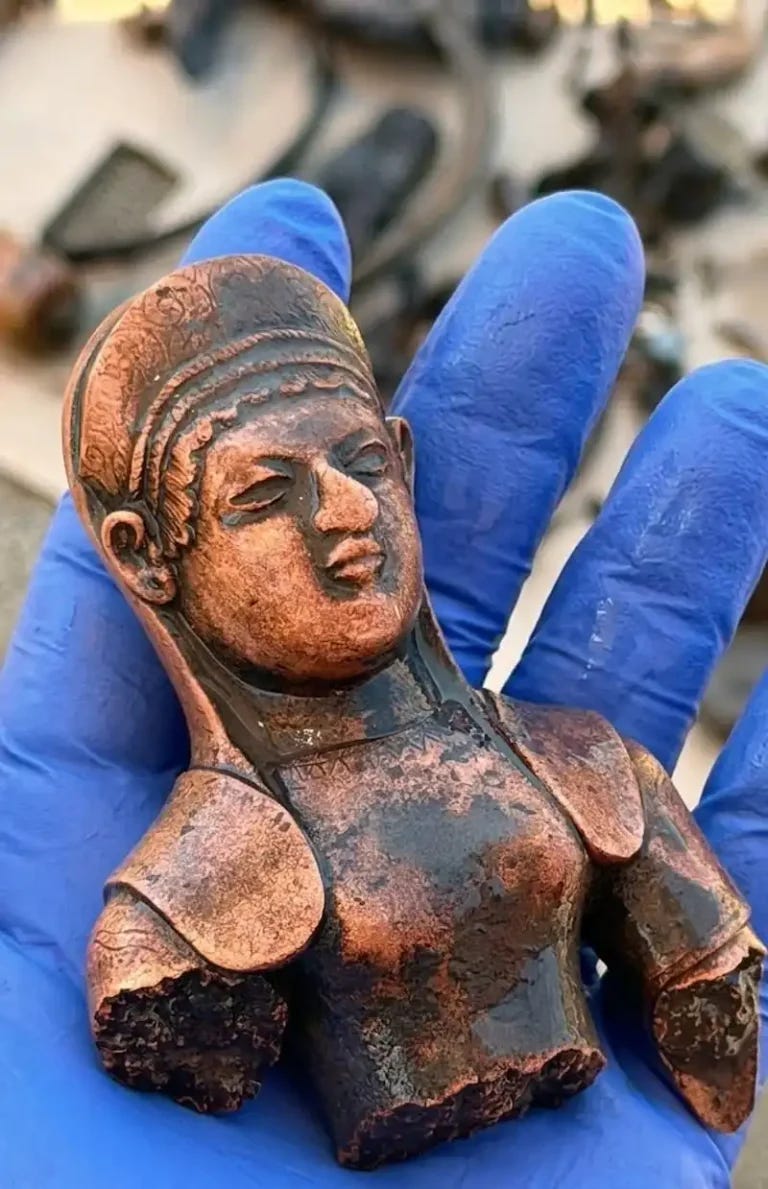
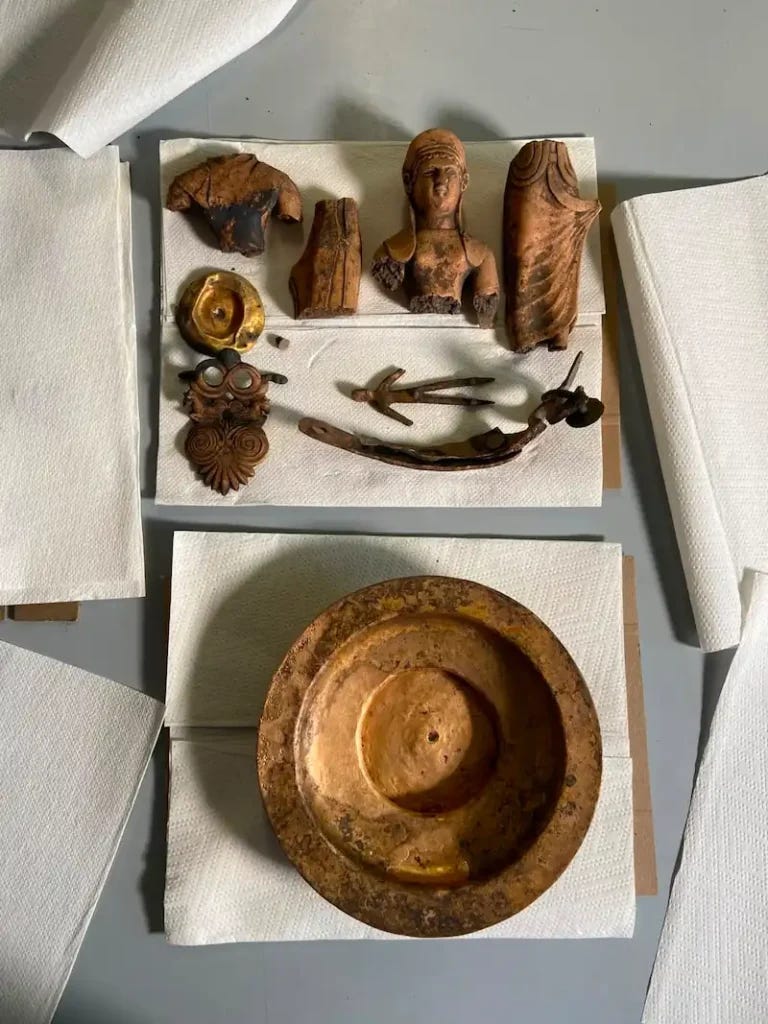
Excavators at the Etruscan city of Kainua, near Marzabotto in Emilia-Romagna, have found a well in the sacred area dedicated to the goddess Uni. Two bronze female statuettes and a bronze plate lay at the bottom, still holding the bright colour of the metal. Two adult human skeletons came out of the fill above them.
The dig is run by the University of Bologna under Elisabetta Govi, professor in the Department of History and Cultures, and this was its thirty ninth season.
The donations
Govi declared that bronzes, from the end of the VI century and start of the V century BC, when the settlement of Kainua was established, were placed purposefully in the founding ritual of the well. So this means they belong to the foundation of the site. The antique, rare bronze plate and the two other figurines are very well preserved, although Govi described the usual corrosion of bronze due to soil.
Two adult human skeletons discovered in the fill are part of the concluding ritual of the life of the well not of its start: according to the studies carried out by the professor’s university team, ‘the combination of the bronzes and skeletons suggests a sequence of actions: opening of the well with a votive rite and their closing in ritual burial, associating this context with the exclusively sacred nature tied both to the foundation of the city and the cult of the water.’
The two humans were buried in different periods, and both were adults. The well is situated in the primary sacred sector of Kainua which has the temples where two main temples are present (one identified by writings in the past as devoted to the god Tinia (Zeus/Jupiter) and his goddess consort Uni (Hera/Juno); the other one, according to those studies, at the time, devoted to Vei (Demeter/Ceres)), they are both visible now. The study helps to give information about foundation rituals and the cults of Etruscan people.
Longer excavation
The University of Bologna started excavation at the Kainua archaeological park in 1988. But thanks to the 140,000 Euros grant from the general director of museums of the Minister for Culture, and the help of DiVA fund, since 2025 this extra amount is provided yearly to the universityResearchers. This support comes from a 2023 agreement with the National Etruscan Museum of Marzabotto and the University of Bologna, which gave the researchers two additional weeks on their site to survey. It was only then that the well has been found.
Future discoveries
MNEMA exhibition has now reopened with new museographical layout, studied by its director Denise Tamborrino, on the basis that ‘the museum is primarily a working laboratory not a collection closed on its achievements ‘; now people can retrace every step of the researches in a modern exhibition. Here the new finds from Kainua will be placed when they become part of the museum. Excavation is managed by the Museums of Bologna; the Regional Directorate for Emilia Romagna (under Luigi Gallo) and MNEMA (under Denise Tamborrino) both part of it and the University of Bologna.
Sources: Università di Bologna, Unibo Magazine, 4 August 2026. Excavation directed by Elisabetta Govi, Department of History and Cultures, with the Gruppo Ravennate Archeologico.
Etruria, from what I've read, was a northern extension of the Phoenician civilization. This is fascinating, as much of the Etruscan legacy has been unearthed in the Po Valley, well inland from both the Adriatic and Tyrrhenian Seas.
It’s strange. I’ve been trying for some time now to find out more about the Etruscans, their origin, their disappearance. But all I keep coming across are theories, nothing solid. As if this people were destined to remain elusive. It may, of course, be that I’m not finding the right sources.