


An Egyptian mission has uncovered a mudbrick pyramid tomb of the Roman period at Bir el-Shaghala, in the Dakhla Oasis in New Valley governorate. It was built for a man and his wife, and it carries two things the cemetery has produced nothing quite like before.
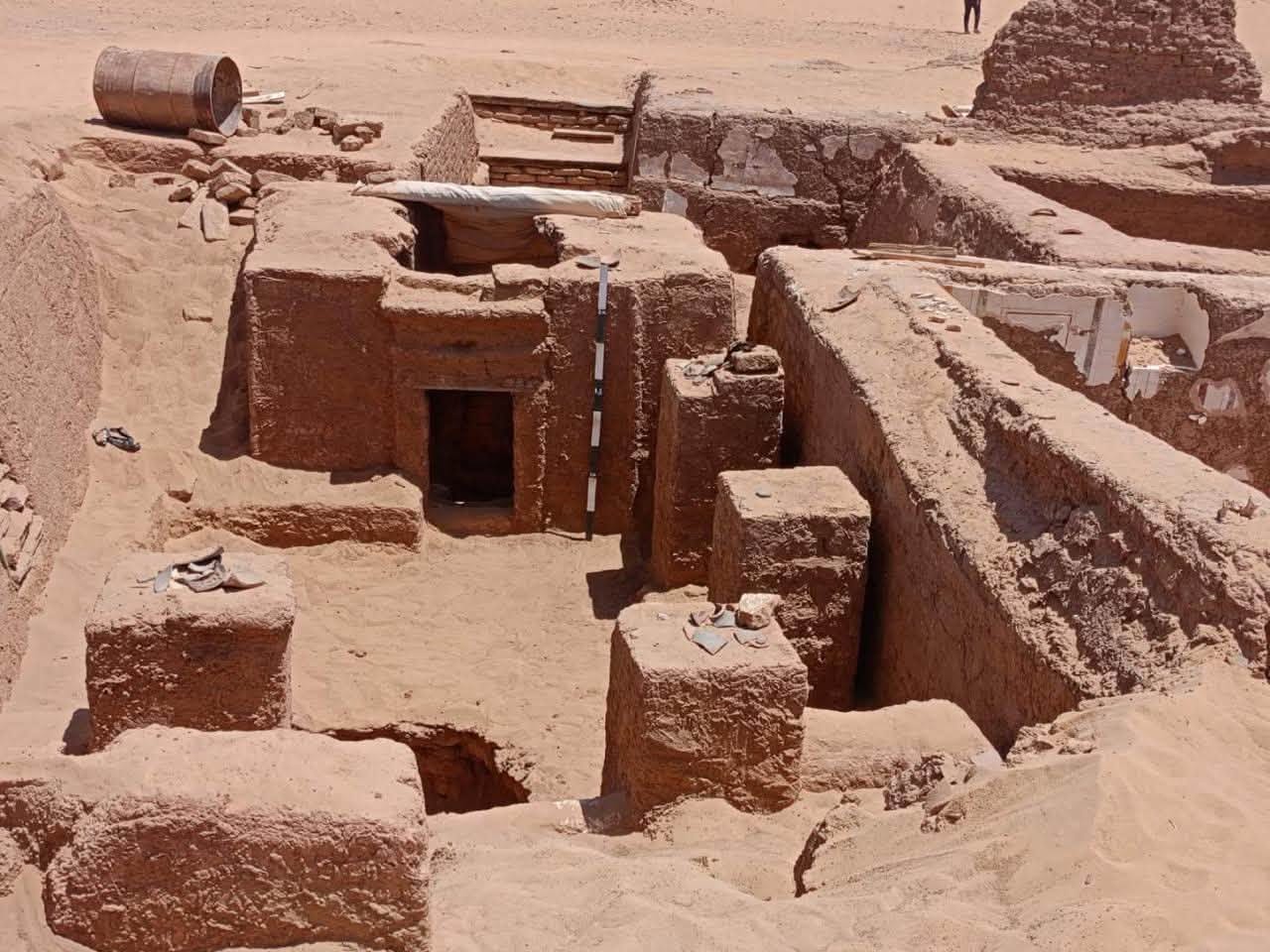
The excavated tomb at Bir el-Shaghala in the Dakhla Oasis, with its stone entrance at the centre and the mudbrick pillars of a later shrine in front. Credit: Egyptian Ministry of Tourism and Antiquities
A stone doorway in Egyptian style
Fourteen steps lead down to the entrance, which is built of sandstone and cut in sunk relief with hieroglyphic texts, spells and funerary recitations for protection.
Mohamed Abdel Badie, head of the Egyptian Antiquities Sector, calls the doorway unique at Bir el-Shaghala. An Egyptian cavetto cornice crowns it, decorated with the winged sun disc and two cobras, and below that runs an architectural element shaped as a bundle of reeds.
The lintel carries a funerary scene the cemetery has not produced before, showing the seventh hour of the Amduat, the book of the underworld that follows the sun god through the night. Inscriptions run down both sides of the doorway with texts and scenes relating to the couple. The entrance was found closed by a stone slab bearing an Osirian figure surrounded by spells.
Beyond it lies a transverse hall of mudbrick with a vaulted roof, part of which has collapsed on the western side. Two mudbrick burial chambers open to the right, plastered over, and the pyramid rises above them.
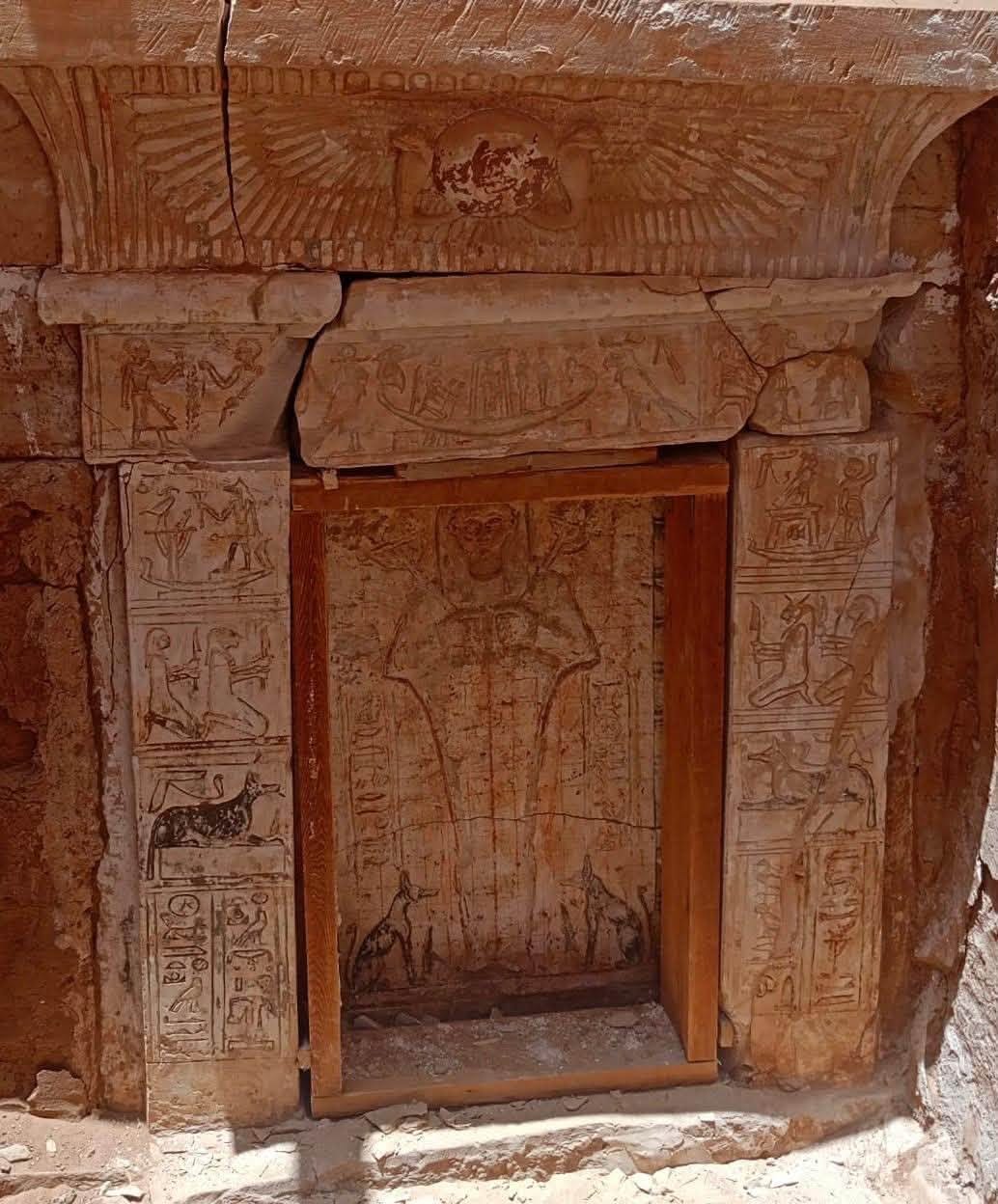
The carved sandstone entrance at Bir el-Shaghala, with the winged sun disc on the cornice and the seventh hour of the Amduat on the lintel. Credit: Egyptian Ministry of Tourism and Antiquities
Nineteen lines of Greek verse for a judge
Sami Dardiri, head of the Central Administration for Middle Egypt Antiquities, describes the second find, fixed to the southern wall of the pyramid.
It is a rectangular stone slab finishing in a gable, with a sun disc carved in raised relief at its centre. The text is written in red ink in ancient Greek, a funerary elegy of nineteen lines composed for a man named Psichtes. Preliminary study suggests he held the position of a judge.
The elegy dates to the late third and early fourth centuries AD. Dardiri presents it as evidence of a literary and cultural life running in the oases under Roman rule, in a language and a form imported from elsewhere, on a monument built in Egyptian style.
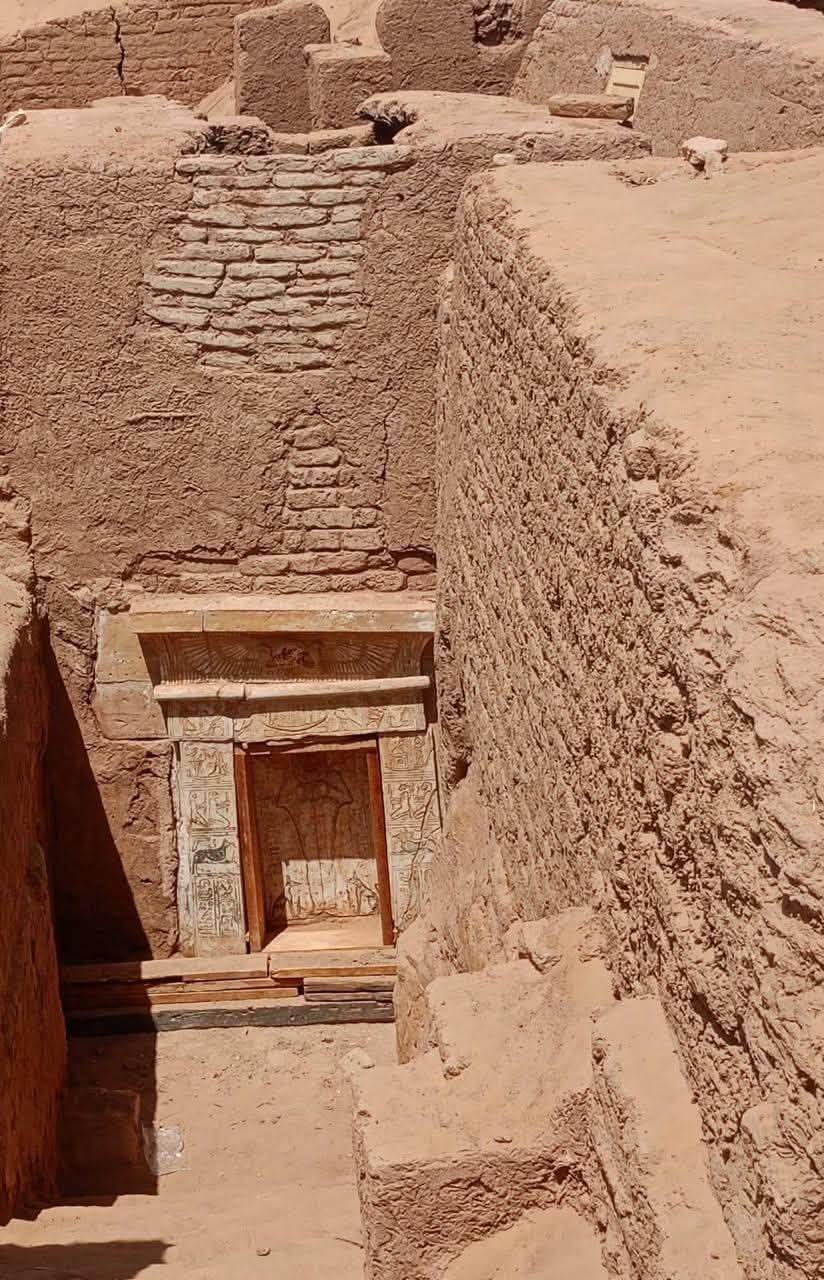
The stepped approach to the tomb at Bir el-Shaghala, leading down to the stone entrance. Credit: Egyptian Ministry of Tourism and Antiquities
What else came out of it
Mohamed Ibrahim, director general of New Valley antiquities, reports a sandstone offering table set above a purification basin of the same material, a range of pottery vessels, and a bronze coin carrying a relief portrait of the emperor Constantine.
The tomb also appears to have been reused later. A mudbrick chapel was built above the main entrance, with a funerary shrine in front of it supported by four square mudbrick pillars.
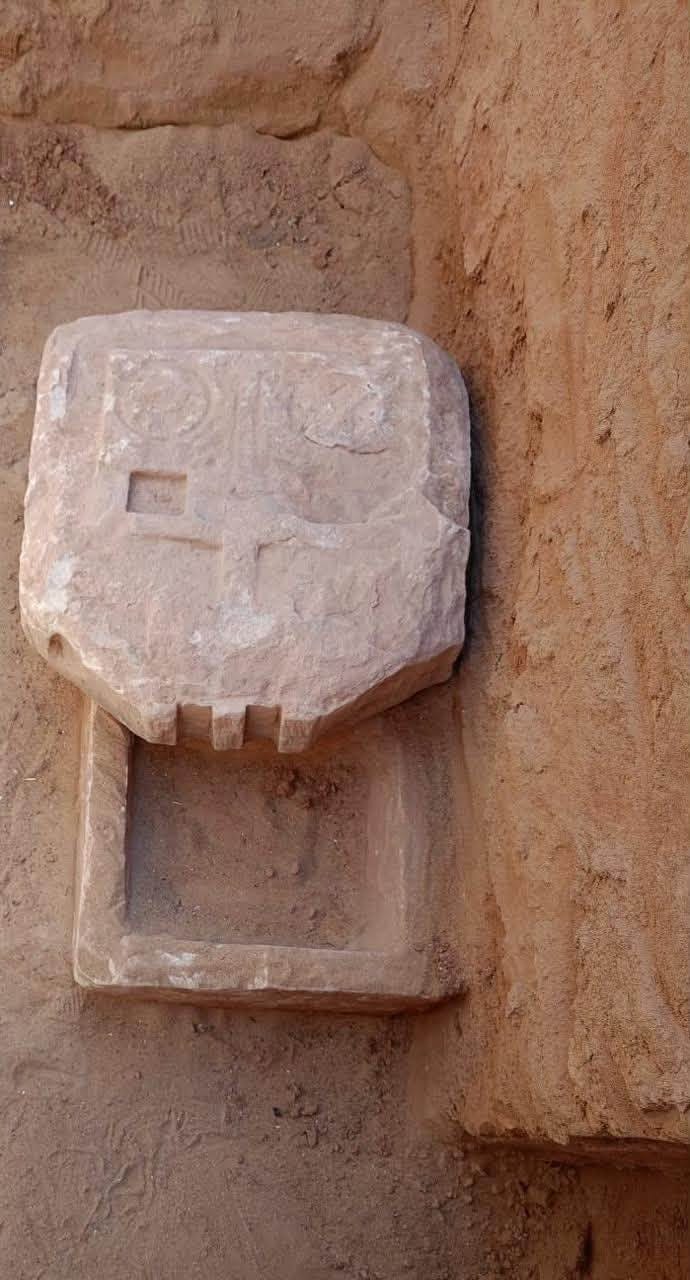
A sandstone offering table set above its purification basin, from a newly uncovered Roman-period pyramid tomb at Bir el-Shaghala, Dakhla Oasis, Egypt. Credit: Egyptian Ministry of Tourism and Antiquities
The cemetery served the capital of the oasis
Bir el-Shaghala is one of the burial grounds of Mut, the oasis capital, known in antiquity as Mothis. The modern name comes from a well on the site. Excavation by the Supreme Council of Antiquities began in 2002 and has uncovered tombs of varied plan and architectural style across successive seasons.
The pattern running through them is mixture. Egyptian forms sit alongside Ptolemaic and Roman elements. Some tombs have an open courtyard, which in others becomes a staircase flanked by altars, probably for rites performed in the open air. Several carry an upper storey with a funerary shrine beneath a pyramid.
Inside, an antechamber leads to burial rooms, some holding stone and pottery coffins, with vaulted ceilings built of sandstone or of mudbrick made from local clay. Walls and ceilings carry scenes and texts drawn from the Egyptian books of the underworld, set beside Greek and Roman elements.
Hisham El-Leithy, secretary general of the Supreme Council of Antiquities, locates the value of the find there, in what the architecture and the texts say about funerary practice and religious life in Dakhla under Rome.
Sherif Fathy, Minister of Tourism and Antiquities, described the oases as holding evidence of the succession of civilisations across Egyptian history.
Source: Egyptian Ministry of Tourism and Antiquities, announcement of September 2026.