


Sulmona, Abruzzo, Italy. On the southern edge of Sulmona, in the broad mountain basin of the Valle Peligna, archaeologists have uncovered one of the most complete records of ancient settlement ever documented in this part of central Italy.
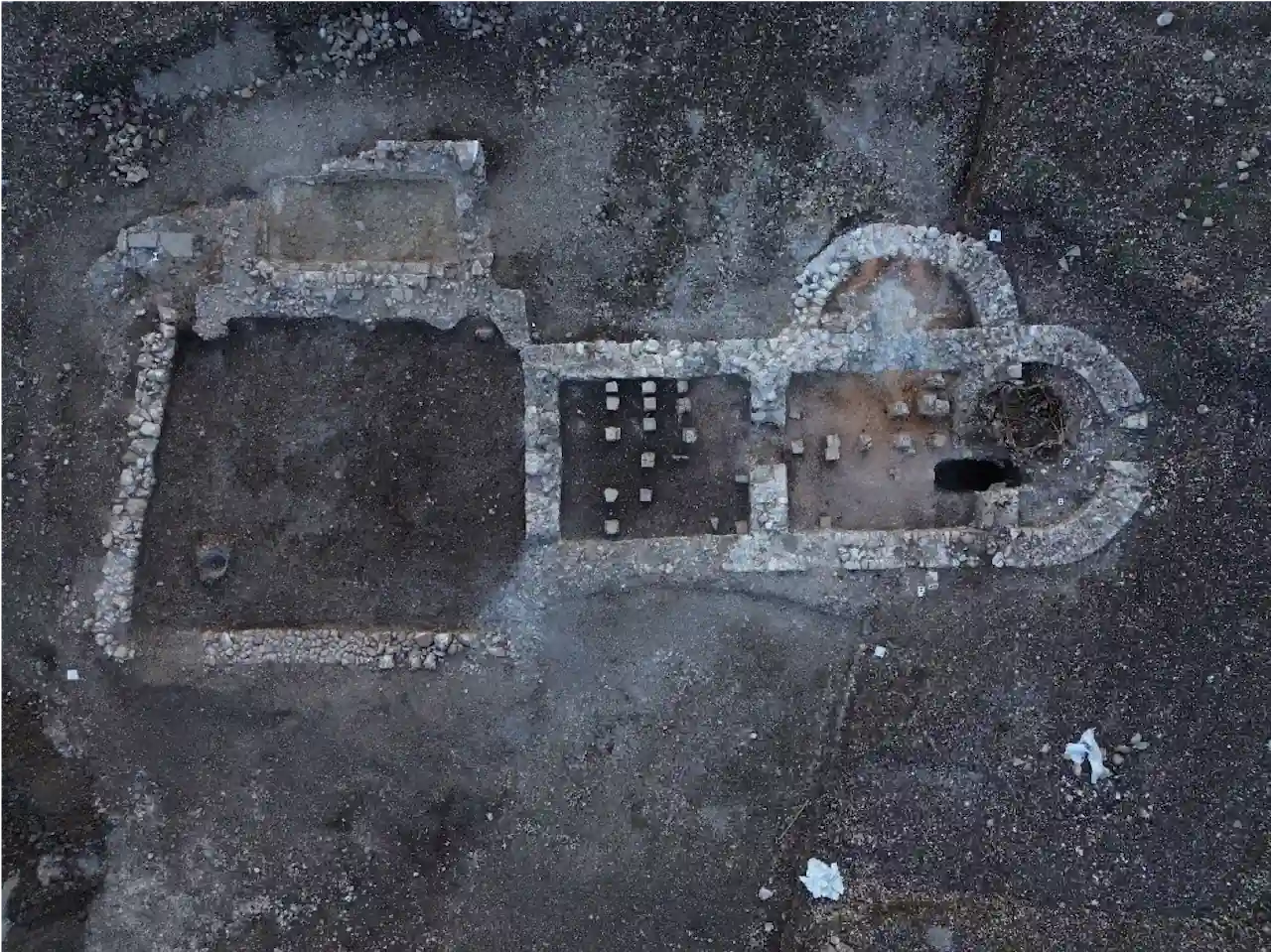
Aerial view of the Bath Complex. Credit: Soprintendenza archeologia, belle arti e paesaggio per le province di L'Aquila e Teramo
At a locality known as Case Pente, excavations have revealed the buried plan of a prehistoric village marked by the post holes of 52 huts, an associated cemetery, and, a short distance away, the remains of a Roman farm with its own private bath complex. Together the finds trace an almost unbroken human presence across several thousand years, from the close of the Copper Age to the Roman period.
The discoveries were summarized on 26 June 2026 in a statement from the Soprintendenza Archeologia, Belle Arti e Paesaggio for the provinces of L’Aquila and Teramo, the state body responsible for protecting archaeological heritage in the area. Work at the site has been under way since March 2023.
A settlement four thousand years old
The oldest and, in many respects, most striking layer at Case Pente is a village dating to the end of the Eneolithic, or Copper Age, and the beginning of the Early Bronze Age. Because the huts were built of perishable materials that decayed long ago, the settlement survives chiefly as a field of dark post holes, the footprints of timber uprights that once held up 52 dwellings. Alongside the houses, archaeologists identified a necropolis belonging to the same community.
The scale of the evidence is what makes the find exceptional. Documenting an entire village layout, rather than a few isolated structures, allows researchers to study how a community living more than four thousand years ago organized its space, how it built its homes, and how it related the world of the living to its burial ground. Excavators also recorded numerous later burials, showing that this stretch of the valley continued to be occupied and used, without long interruptions, across the millennia.
For the prehistoric sector, the Superintendence reports that the archaeological deposit has been excavated and recorded in full, in keeping with the procedures of preventive archaeology, so that the scientific information held in the soil has been recovered and preserved in the documentary record.
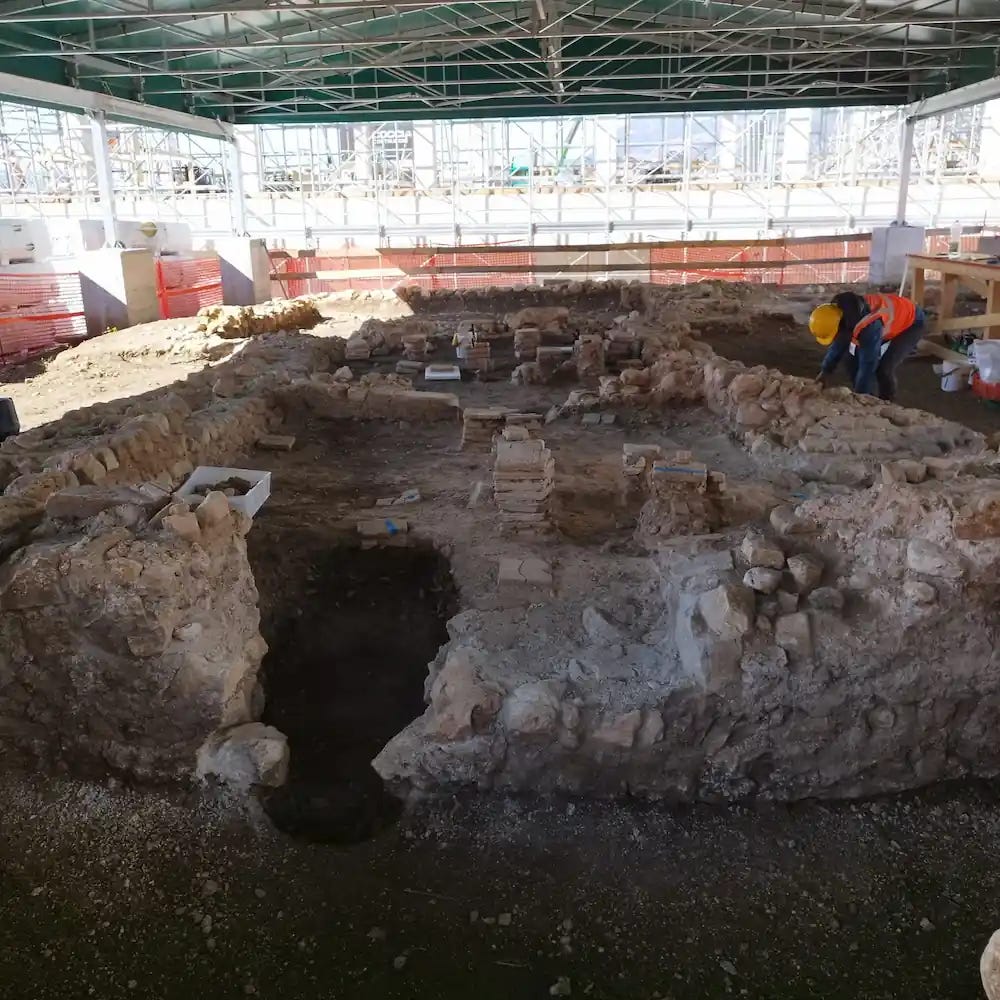
The Roman baths during archaeological excavations. Credit: Soprintendenza Archeologia, Belle Arti e Paesaggio for the Provinces of L'Aquila and Teramo.
A Roman farm and its baths
The Roman phase is represented by a rustic building, most likely part of a working agricultural estate, and by a more elaborate complex of heated rooms set along an ancient roadway that continued to shape the valley’s landscape in later centuries. In the bath rooms, the small brick pillars that once raised the floor are still visible. Hot air and smoke from a service furnace circulated through the cavity beneath, and the darkened earth still carries traces of that heating system.
Bath suites of this kind were a mark of prosperity. The wealthier Roman estates combined production buildings, storerooms, and workshops with a residence and, often, a small private bath, evidence that the owner had reached a certain level of comfort. Its presence at Case Pente suggests that the farm belonged to a substantial enterprise tied into the wider economy of a valley that, in Roman times, lay along routes linking the Adriatic and Tyrrhenian coasts.
Because of their historical value, the Roman walls will be conserved where they stand. The Superintendence has begun designing a visitor route that will make the structures accessible to the public, and restoration of the bath building has already been completed.
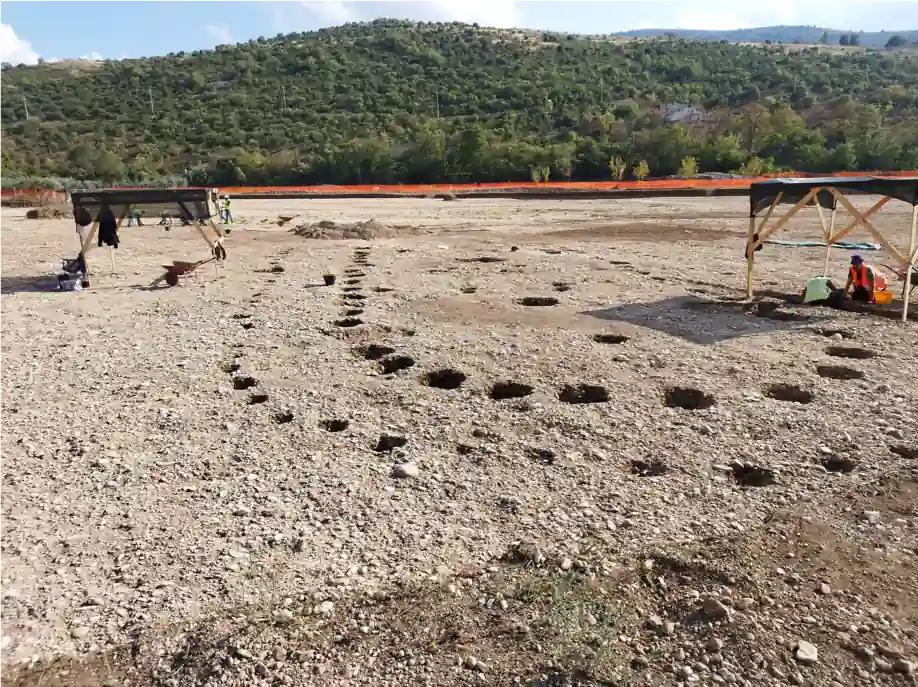
Postholes from the prehistoric settlement. Credit: Soprintendenza Archeologia, Belle Arti e Paesaggio for the Provinces of L'Aquila and Teramo.
Study, conservation, and a future exhibition
The fieldwork is one part of a broader program set out in a valorization agreement between the Superintendence and Snam, the energy infrastructure company whose project prompted the dig. The agreement provides for the restoration of all recovered finds and conserved structures, the reconstruction of a prehistoric hut beside the Roman remains, and a full scientific study of the materials. Planned analyses include anthropological and genetic study of the burials, together with archaeobotanical, archaeozoological, and archaeometric investigations and radiometric dating. The results are to be released through scientific publications and a closing exhibition intended to return the findings to the local community.
The site received its first visitors on 13 June 2026, during the European Archaeology Days, when limited numbers of residents, scholars, and enthusiasts were able to see an excavation still in progress and meet the archaeologists at work.
A long history beneath the valley
The importance of the finds is easier to grasp against the deeper history of the Valle Peligna. Before the Roman conquest the region was home to the Peligni, an Italic people who spoke an Oscan-Umbrian language and who sided with the Samnites during the Social War of the early first century BC. At nearby Corfinium, less than twenty kilometers from Case Pente, the allied Italic peoples established the capital of their confederation and pointedly renamed it Italia, one of the earliest political uses of a name that would come to identify the whole peninsula. Pelignian religion gave a central place to springs, woods, and mountains, with sanctuaries often set on high ground or beside water.
Recent work in archaeogenetics has added another layer to that picture. Studies of ancient DNA suggest that the inhabitants of Iron Age central Italy were already genetically close to the modern populations of the center and south of the country, with no sign of recent large-scale migration or population replacement. A Pelignian living in the centuries before the common era would have been broadly similar, in genetic terms, to a present-day inhabitant of Abruzzo or the neighboring regions. Their distinctiveness lay above all in culture, language, and politics rather than in ancestry.
A discovery shadowed by controversy
The Superintendence issued its statement partly in response to a public debate that had grown around the site in recent weeks. The work at Case Pente forms part of the authorization process for a Snam gas compression station, and the excavation, spread across roughly twelve hectares, is one of the largest preventive archaeology operations carried out in Abruzzo in recent years. When the project began, the area carried no archaeological protection, and what little was known came mainly from chance nineteenth-century finds.
Local activists, including a climate coalition campaigning against the plant, have argued that the construction has come at the cost of important remains, pointing in particular to a gravelled Roman road that was uncovered during the dig and then, they say, covered over as building work advanced. Critics have suggested the road may have connected Corfinium and Sulmo toward the interior of Samnium, and have linked the choices made at the site to the pressure of construction deadlines tied to substantial European recovery funding. The Superintendence, for its part, maintains that all operations were carried out lawfully and under its direct responsibility, that every find was documented, studied, and given the necessary protection, and that the most significant structures will be conserved and opened to the public.
Source: Soprintendenza Archeologia, Belle Arti e Paesaggio per le province di L’Aquila e Teramo, press release of 26 June 2026.
Interesting!!