


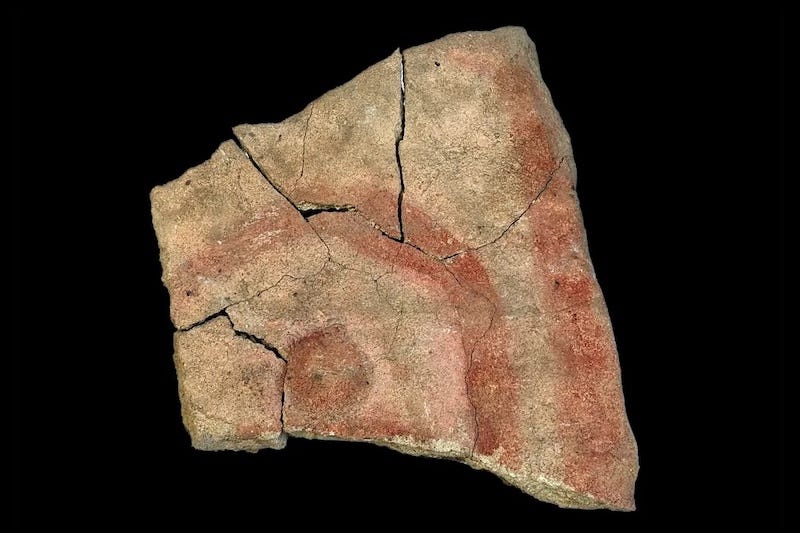
A limestone slab painted with red concentric circles and radiating lines has been excavated at the Huknaur rock shelter on Wetar Island, in eastern Indonesia. It dates to between 4,050 and 3,900 years ago, and it is the first portable example of Austronesian Painting Tradition art ever recovered archaeologically.
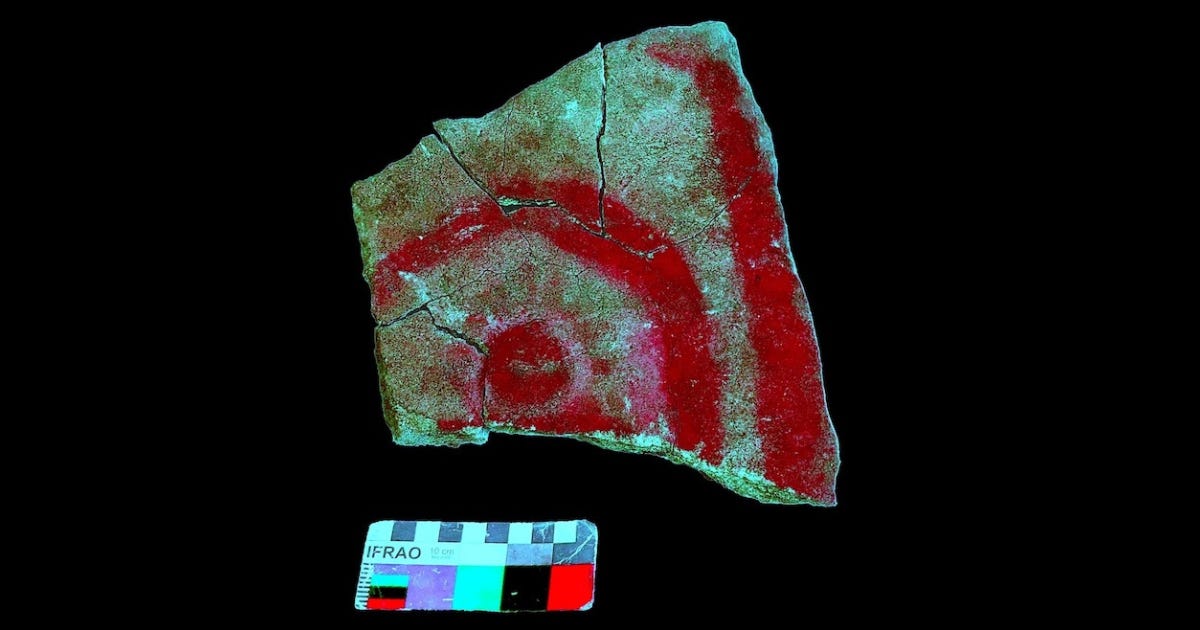
The study is by Sue O’Connor of the Australian National University, with Shimona Kealy, Hendri Kaharudin, Ceri Shipton and colleagues, published in the Proceedings of the National Academy of Sciences.
Why nobody could put a date on this art
The motif is familiar across eastern Indonesia and the western Pacific. Prominent rocks carry red concentric circles with rays, in a style resembling common representations of the sun, and the tradition is associated with Austronesian-speaking populations.
The trouble has always been chronology. The rocks these images are painted on are far older than the paint, and there is nothing datable in the pigment, so the tradition has been hard to place in time.
A painted slab buried in organic sediment is different. The sediment can be dated, which is how this piece has acquired an age when the rock panels have not.
The claim that the art came before the pottery
Here is what makes the date interesting. If it reflects when the slab arrived on Wetar rather than a later deliberate burial, then the painting tradition reached the island before pottery did.
That is a substantial claim. Pottery is one of the key technologies associated with Austronesian expansion, and it had reached Taiwan from China long before this. O’Connor’s reading is that spreading their art mattered to these voyagers more than carrying even a technology of that importance.
She raises a possible sequence. The explorers, whom she calls argonauts, may have visited islands first with their art, scouting rather than settling, and returned later with pottery once people had established themselves. Whether or not they were carrying pots, the ideas were being taken up where they found suitable islands.
The motifs are painted where they can be seen from the sea
The Austronesian language family covers more than half the world. Linguistics, genetics and archaeology together trace its origins to Taiwan, from where speakers moved into the Philippines, Indonesia, and then across the Pacific and Indian oceans, reaching Rapa Nui in one direction and Madagascar in the other.
The usual explanation for that expansion is an advance in boat technology. None of the early boats survives, so nobody knows what the advance was. Some anthropologists have argued instead that ideas drove it.
The paper sits on that side. Its authors point to the importance of founders in Austronesian culture and the respect accorded to them, which may have pushed people into long and dangerous voyages. The sun motifs are typically painted high on cliffs where they can be seen from a distance, which makes them function as an announcement that representatives of this culture had arrived.
Shipton’s point is that people travelling to new islands were not only carrying technologies and objects. They were carrying ideas, identities and ways of understanding the world.
O’Connor draws a modern comparison, noting how readily people can now be influenced on something like vaccination, and observing that cults and influencers have always had a large effect.
What happened when the ideas arrived
When Europeans reached these islands thousands of years later they brought their own ideology, usually alongside violent conquest. O’Connor says there appears to be little evidence of conflict following the Austronesian expansion, though this cannot be known with certainty. Instead people joined the culture, adopting Austronesian languages, art, technologies and burial practices.
Portable does not mean it was carried anywhere
That the slab is portable does not establish that it was carried to Wetar. O’Connor notes the limestone could be local or could have come from another island. Whether the argonauts carried objects like this on their voyages is not known.
One slab is also a thin basis for an ideology that took root across a very large number of islands. O’Connor considers the team lucky, since they excavated an area of only two meters by one.
The choice of where to dig was not random. The find came beneath an overhang with what she calls a magnificent view of the coast, which suggests a good ocean view has been valuable property for a very long time. The walls of the shelter were themselves covered in Austronesian Painting Tradition art, which O’Connor thinks may have served as a marker visible from the sea.
Source. O’Connor, S., Kealy, S., Kaharudin, H.A.F., Nutman, E., et al. (2026). “4000-Year-Old Painted Plaque From Southeast Indonesia Reveals Austronesian Painting Tradition Preceded Neolithic Pottery.” Proceedings of the National Academy of Sciences 123(34).