


Can a block of Renaissance marble carry the record of a disease that no one would name for another three hundred years? That is the question raised by a team of dermatologists and art historians writing in the Journal of Investigative Dermatology.
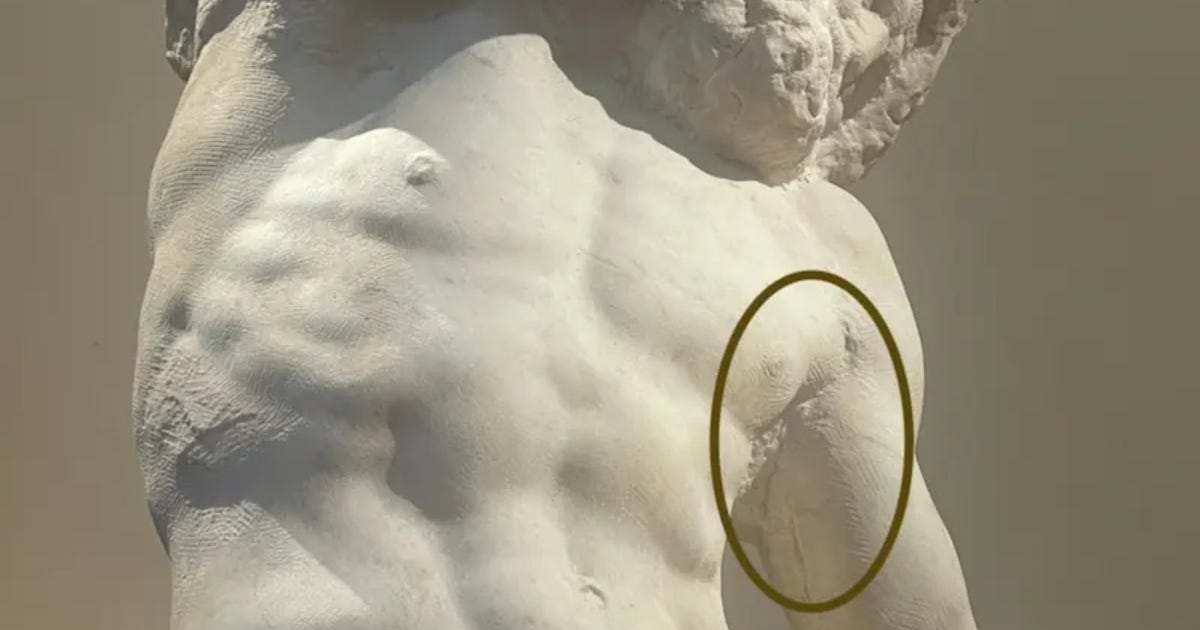
Detail of the Bearded Slave by Michelangelo. Credit: Dimitris Kamaras / Wikimedia Commons
,_Galleria_dellAccademia,_Florence_(26651357276).jpg)
Their subject is one of Michelangelo’s unfinished figures in Florence, and a small irregularity carved into its armpit that, they argue, may be the earliest known depiction of hidradenitis suppurativa.
The disease was not formally described until the nineteenth century. The sculpture dates to 1536. If the researchers are right, the carving would predate the medical description of the condition by roughly 327 years, a startling gap between what an artist may have observed and what medicine would eventually explain.
The figure in the marble
The work sits in the Galleria dell’Accademia in Florence, among the group of unfinished figures Michelangelo carved for the ill-fated tomb of Pope Julius II. Known collectively as the Prisoners, or Slaves, they appear to strain and emerge from the raw stone, and they are celebrated precisely for being incomplete, a vivid record of the sculptor’s non-finito method and of his lifelong study of the human body. The authors, Sura Alkinani, Francesca Prignano, Kira Kofoed, and Gregor B.E. Jemec, titled their paper after the “Awakening Slave,” though coverage of the study has also referred to the closely related Bearded Slave. Both belong to the same group of powerfully modeled male nudes.
Whichever figure is meant, the point of interest is narrow and specific. In the left armpit of the marble body there is a surface irregularity, a cluster of raised, uneven detail that, the researchers contend, does not match how sculptors of the period rendered the human form.

The Bearded Slave by Michelangelo. Credit: Gabriela chavarro / Wikimedia Commons

Why the armpit is the clue
The starting point is a simple visual observation. Renaissance sculptors did not, as a rule, carve axillary hair. Smooth armpits were the convention, and depictions of underarm hair in stone are rare. So when a lump of irregular relief appears in exactly that spot, the question arises of what it is meant to represent. The rarity of carved body hair, the authors suggest, tilts the balance away from the simplest explanation and toward the possibility that Michelangelo was recording something he actually saw on a living body.
The team is careful not to overreach. Marble has its own veining, fractures, and centuries of surface aging, all of which can produce shapes that fool the eye. They caution explicitly against overinterpretation, acknowledging that what looks like a lesion could be an artifact of the stone itself. Their claim is offered as a hypothesis worth taking seriously, not as a settled diagnosis.
What the disease actually is
To see why the idea has appeal, it helps to know the condition. Hidradenitis suppurativa is a chronic inflammatory skin disease that centers on hair follicles and the apocrine sweat glands, striking the areas where those structures cluster, above all the armpits, the groin, the anogenital region, and the folds beneath the breasts. It produces painful, deep-seated nodules and abscesses that can rupture, drain, connect into tunnels beneath the skin, and heal into rope-like scars. It usually appears after puberty, tends to recur for years, and affects on the order of one percent of people, though it remains widely underdiagnosed and is often mistaken for other conditions.
The armpit is one of its most typical sites. A cluster of raised, inflamed nodules in the axilla is a textbook presentation. That is what makes the carved irregularity suggestive. If Michelangelo was working from a model whose underarm bore the swellings of active disease, a faithful sculptor attentive to anatomy might well have reproduced them, even without any idea of what he was looking at.
An artist who studied bodies
The proposal gains a little weight from what is known of Michelangelo himself. He dissected cadavers, studied musculature closely, and built his reputation partly on anatomical precision. The torsos of the Prisoners, with their carefully defined muscles, are often cited as evidence of that fascination. An artist of his exactness, working from a living model, is exactly the kind of observer who might have transcribed an unusual detail of the skin without editing it into idealized smoothness.
That said, the authors do not claim Michelangelo diagnosed anything. Nothing suggests he understood the swellings as a disease. The argument is only that he may have recorded, faithfully, what was in front of him, leaving behind an image that modern clinicians can now read with knowledge he did not possess.
A question worth asking
The disease would not enter the medical literature until the nineteenth century, when French surgeons described and eventually named it, long after the marble had been carved and set aside. The researchers are honest that their reading of the sculpture cannot be proven. The enigma, as they frame it, remains open. What they offer instead is a genuine dialogue between dermatology and art history, and the reminder that works we think we know can still surprise us.
For anyone who now stands before the figure in Florence, the marble may look a little different. It remains silent and unchanging. But in one shadowed armpit there may be the trace of a human ailment, quietly waiting three centuries for a name.
Support Independent Ancient Content. Your support helps me create more archaeology posts, articles, and mini history videos:
Source: Alkinani, S., Prignano, F., Kofoed, K., & Jemec, G. B. E. (2026). "The enigma of hidradenitis suppurativa. Michelangelo's 'Awakening Slave'." Journal of Investigative Dermatology. doi.org/10.1016/j.jid.2026.03.042
Looks like a hairy armpit. That’s not a disease in Italy :)
I’m not buying it. It’s just an unfinished area.