


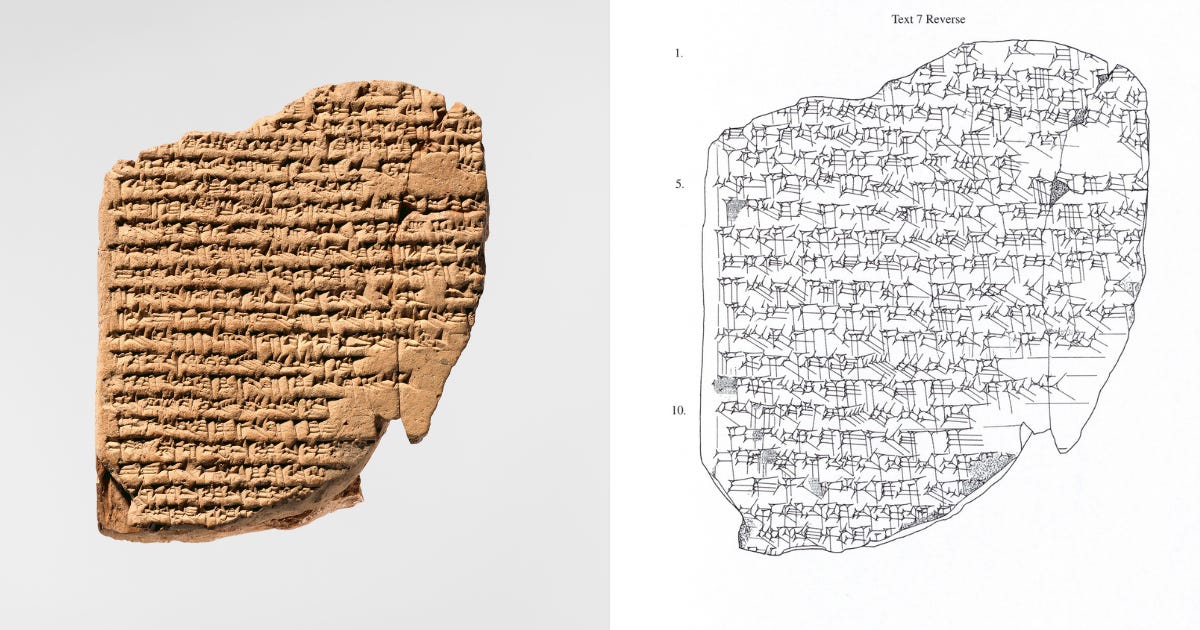
The tablet is clay, about ten centimeters by eight and two and a half thick. It was written somewhere around the second or first century BC, probably at Babylon, and the Metropolitan Museum bought it in 1886. It holds part of a balag, a liturgical lament, and the voice in it belongs to Inanna, who has lost her cities and her shrines and measures what she is now against what she used to be.
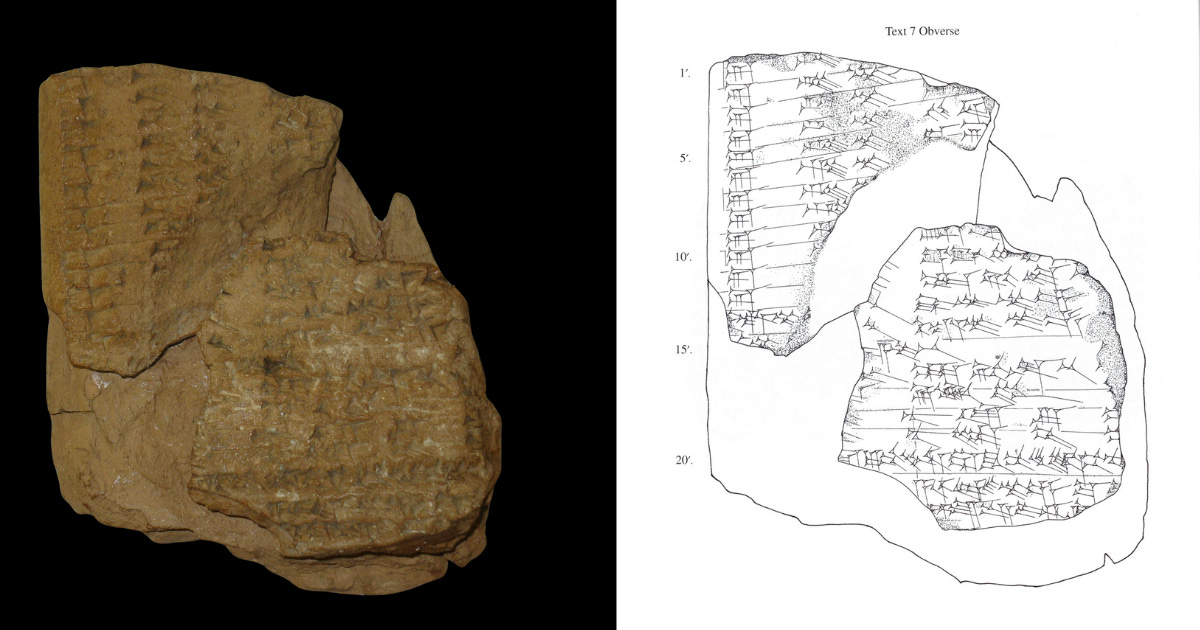
The Met catalogues it as 86.11.286a under the name a-še-er gi-ta. That is not a title in our sense. Mesopotamian compositions were identified by their opening words, the way papal encyclicals still are.
The word means the instrument first
A balag is a musical instrument, most likely a large bow harp, though the evidence is mixed enough that some scholars have argued for a drum, and the instrument may well have changed over the two thousand years the word was in use. The genre takes its name from the thing that accompanied it.
Individual instruments had proper names and were sometimes treated as minor deities in their own right, receiving offerings. This was not a prop.
The singer was a gala, and he sang in a woman’s dialect
The performer was a gala, kalû in Akkadian, a specialist in lamentation attached to the temple. They appear in records from the middle of the third millennium BC and were numerous enough to form a significant part of temple and palace personnel.
They sang in Emesal, a dialect of Sumerian which the texts associate with female speech. Goddesses speak Emesal in Sumerian literature. So do the gala. This is one of the more discussed features of the office, and it connects to a wider set of ritual performers around Inanna whose gender presentation the sources treat as deliberately ambiguous.
Emesal has another distinction. When Sumerian stopped being written for most purposes after the Old Babylonian period, the cultic songs in Emesal carried on. They are the one Sumerian literary genre that survived.
The point was not to feel sad
The temptation with a text like this is to read it as an outpouring of grief, and that is not quite what it is.
Balags were ritual instruments for managing divine anger. A god whose temple had been destroyed, or was about to be demolished for rebuilding, was dangerous. So was an eclipse, or an inauspicious day. The lament was performed to settle the deity, to say the terrible thing aloud in the god’s own voice and take the force out of it. The related genre of eršaḫunga is named for exactly this, the lament that soothes the heart.
The ancestors of the balag are the city laments of around 2000 BC, the great compositions on the destruction of Ur and of Sumer, recited when temples were pulled down and put up again. By the Seleucid period the genre had been running for the better part of two millennia.
Nobody spoke either language
This is the part the object is usually celebrated for, and it deserves stating carefully.
Sumerian stopped being anyone’s mother tongue around 2000 BC. Akkadian had probably ceased to be spoken by the time this tablet was written, displaced across the Near East by Aramaic and, in places, Greek. The scribe was writing a Sumerian text with an Akkadian translation, and the streets outside were speaking neither.
That sounds extraordinary and was, in context, routine. Temple scholarship in Hellenistic Babylonia was conducted in these languages as a matter of course, in the way that European learned writing was conducted in Latin long after Latin had no native speakers. There is a small group of tablets from roughly this period, the Graeco-Babyloniaca, with cuneiform on one side and Greek transliteration on the other, apparently made by students working their way into the material.
What was not routine is how little time was left. Cuneiform was written for perhaps another century or two and then stopped. This lament belongs to the last stretch of a three-thousand-year writing tradition, copied out by people who knew the words for a grief that was, by then, a very long way behind them.
A note to readers. Ancient Content is written and researched independently, and paid subscribers are what keep it that way. If these pieces are worth your time, consider subscribing. For a few dollars a month you get:
A researched piece every day, checked against the primary sources
Short documentaries, and the full video archive
The complete written archive
Notes on what the coverage gets wrong, and why.
Sources: Metropolitan Museum of Art, object 86.11.286a, and Spar and Lambert, Cuneiform Texts in The Metropolitan Museum of Art, Volume II. Cohen, M.E. (1974), Balag-Compositions, and (1988), The Canonical Lamentations of Ancient Mesopotamia. Delnero, P., on the ritual performance of Sumerian laments.
Reading this ancient lament feels like opening a page from a modern diary written by a woman sinking into a quiet despair. Just as Inanna grieves the loss of her cities and her sacred spaces, a woman today might write about the empty rooms of her apartment, the friendships that feel distant, and the sense that her own life has been stripped of meaning. Both voices carry the weight of remembering who they were before everything fell apart, holding onto the ache of absence and the fragile hope that someone might one day hear their sorrow.
The basic human condition has not changed. Inanna/Isis/Minerva could be Sylvia Plath or Anais Nin.