


Mark de Kreij, professor of Greek literature at Radboud University, was working through a collection of Egyptian and Greek texts at Utrecht University library when he recognized words from Homer on a torn scrap of parchment.
It measures about 6.6 by 7.7 centimeters and carries lines from Book 12 of the Odyssey.
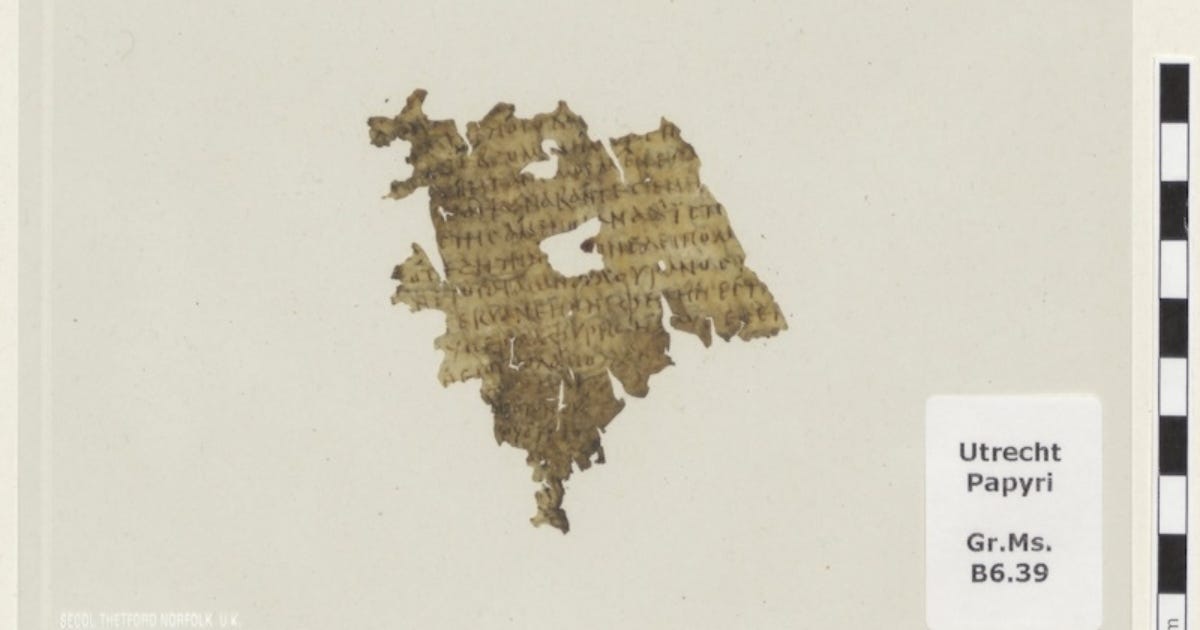
The passage is the cattle of the sun
Circe had warned Odysseus to keep away from Thrinakia, the island of Helios. He and his crew landed there anyway, after surviving Scylla and Charybdis, and he agreed to it on the condition that no one touch the cattle.
A month of storms followed and the food ran out. Eurylochus and the men killed and ate the sacred herd. Helios demanded redress, and Zeus destroyed the ship, drowning everyone aboard except Odysseus.
De Kreij’s own assessment is that the Odyssey contains a good many dull stretches, and that this is not one of them.
It came from a pocket-sized book
The parchment belonged to a codex made in Egypt in the third or fourth century AD, probably in the Fayum oasis, small enough to carry. Around thirty comparable fragments are known.
De Kreij suggests it survived because it sat in the middle of the book, protected by the pages on either side. How it ended up inside a collection of Egyptian texts is not known. Utrecht bought the material in the middle of the twentieth century, among early Christian manuscripts.
He found it in 2024. The full study appears shortly as a book, Hieratic, Demotic, Greek, and Coptic Texts in the Utrecht University Collection.
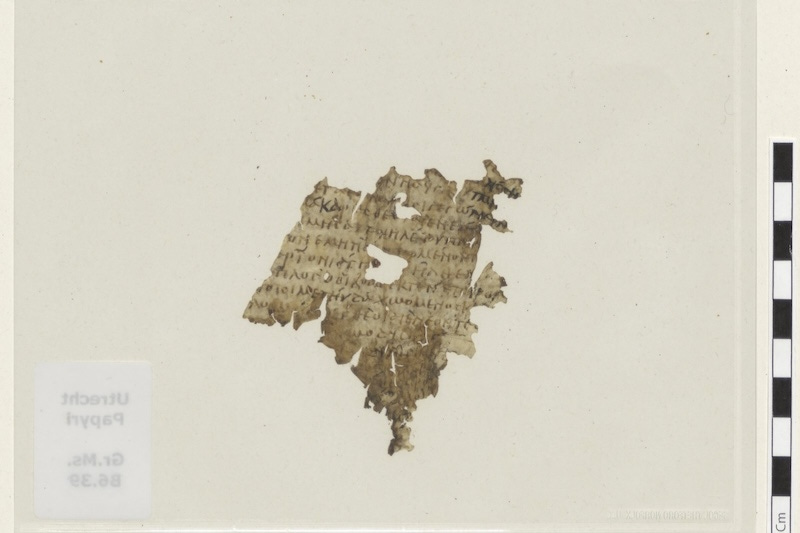
The reverse of the parchment fragment, about 6.6 by 7.7 centimeters, mounted between glass with a scale bar at right. The catalogue label reads Utrecht Papyri Gr. Ms. 66.39. Credit: Utrecht University
The second Homeric find this year
In the spring, archaeologists in Egypt recovered papyrus fragments of the Iliad from inside a Roman-period mummy.
Both epics were composed in the late eighth or early seventh century BC, the Iliad on the ten-year war at Troy and the Odyssey on the ten years Odysseus spent getting home to Ithaca.
Sources. Utrecht University. Live Science, 16 September 2026.
I love that this tiny scrap survived for roughly 1,700 years, ended up in a library collection, and then just sat there waiting for somebody to realize what the hell it was.
And a pocket-sized Odyssey! Somehow that makes it even better.
Glad this affirmation of Homer's actual existence is in good hands.