


In the hills of central Veracruz, near Mexico's Gulf coast, archaeologists have uncovered the remains of a mysterious settlement roughly 1,400 years old, and at its heart a discovery that has no parallel in the region. It is a great carved stela depicting two elaborately dressed figures seated face to face, receiving into a vessel what researchers believe is a sacred liquid poured down from a divine being above them.
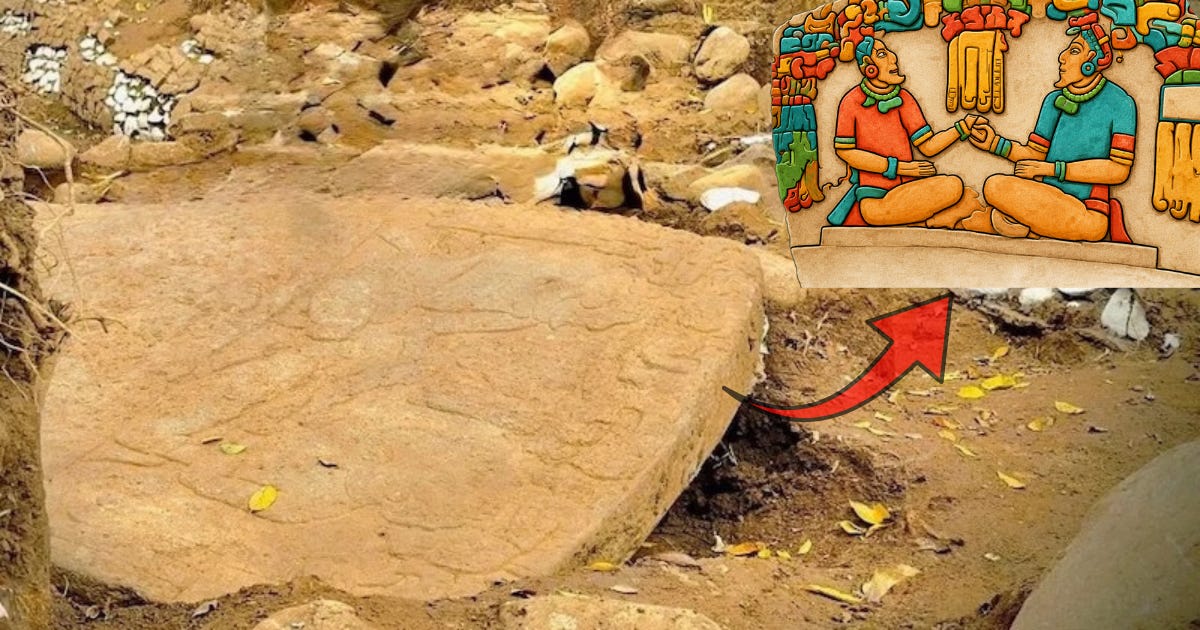
A Carved Stela Found in Mexico Shows Two Figures Receiving a Sacred Liquid. Credit: INAH
The find was announced by Mexico’s National Institute of Anthropology and History (INAH) and reported by Smithsonian Magazine on July 1, 2026. It emerged during a salvage excavation in Coatepec, on a plot of about 12 hectares slated for residential development, in the San Lucas subdivision near the long-studied archaeological site of Campo Viejo. For Lino Espinoza García, one of the INAH archaeologists coordinating the work, the discovery is unique and unprecedented, unlike anything previously recorded in this part of Veracruz.
A monolith buried face down
The stela is a substantial monument. It stands 1.88 meters tall, reaches 1.47 meters at its widest point, and varies between 22 and 25 centimeters in thickness. Strikingly, it was not found standing. According to INAH archaeologist Mireya Moreno Aguirre, the stone had been placed face down in antiquity, and later structures were built directly on top of it, a deliberate act of burial that preserved the carving in remarkably good condition.
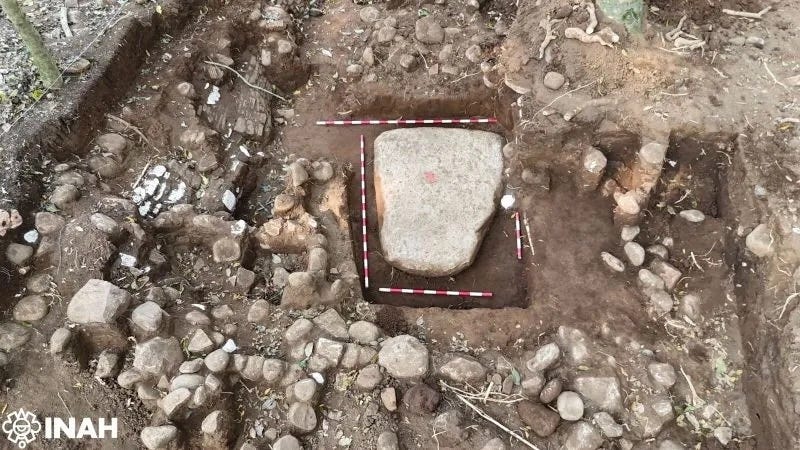
A monolith buried face down. Credit: INAH
The engraved scene shows two seated elite individuals, richly attired with headdresses and ear ornaments, gathered in what the researchers read as a ritual. Above them, an entity appears to emanate a substance flowing down toward the vessel the figures hold. Espinoza García says the team believes the liquid is water, and that in this context it is clearly a sacred fluid. He suggests the scene may commemorate a period of great drought in the region, a moment when the gift of water from a divine source would have carried enormous weight.
The team is careful about what the liquid actually represents. In Mesoamerican art, flowing substances can stand for water, blood, pulque, maize drinks, or rain, and without laboratory analysis or an inscription the safest reading is a sacred transfer of liquid rather than any single substance.
A composition never seen in the region
What makes the carving so unusual is not just its subject but its arrangement. Annick Daneels, an archaeologist at the National Autonomous University of Mexico, notes that a composition of two seated figures facing one another had never before been documented in central Veracruz. Adding to the intrigue, one of the two figures displays what researchers describe as possible Maya-like traits.
That detail matters because of where the site sits. Coatepec lies well beyond the Maya heartland of the Yucatán Peninsula, whose Classic period ran from roughly 250 to 900 AD. A Maya-looking figure on a Gulf coast stela does not mean the Maya lived here. It more likely points to long-distance contacts, shared visual conventions, or a local community absorbing elements from the wider Mesoamerican world.
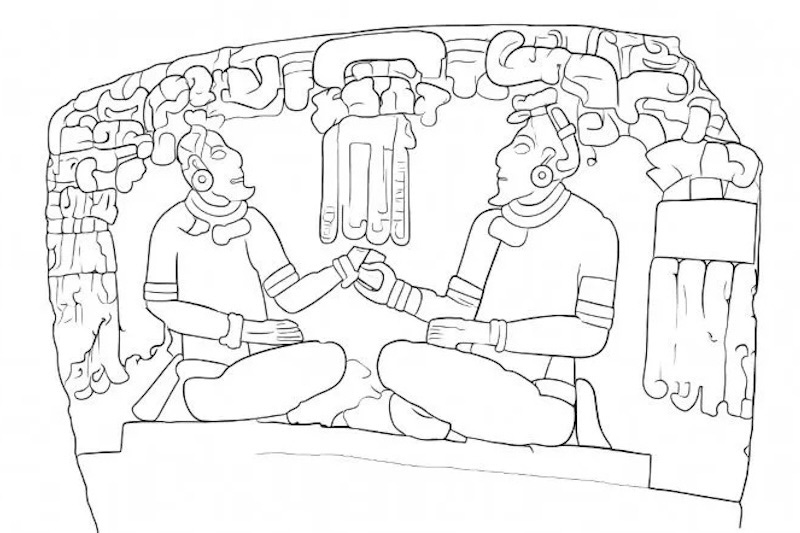
Illustrated rendering of the carvings on the stela. Credit: Lino Espinoza Garcia / INAH
A platform unlike its neighbors
The stela was associated with an equally puzzling structure, a civic-ceremonial platform some 30 meters long and 12 meters wide. It was built of stone slabs and white limestone with a plaster-like texture, which specialists attribute to an induced firing process applied intentionally to decorate the walls. Its ornamentation includes engraved lines and square-like shapes, along with circular stones set along two of its sides.
None of this matches the known building tradition of the area. INAH archaeologist Alberto Vázquez Domínguez, who co-directs the interdisciplinary team, says there is no record connecting the structure to other ancient sites. The site sits on the periphery of Campo Viejo, a major center of ceremonial plazas first identified in 1972 and systematically studied by the INAH Veracruz Center since 2000. Daneels describes Campo Viejo as the principal settlement of its era in the densely populated region around modern Xalapa, positioned near one of the routes that linked the Gulf coast to the central highlands and served as an axis of interaction from Preclassic times onward.
Offerings of maize and greenstone
Around the platform, excavators recovered traces of ritual activity. There were fragments of burnt maize, possibly deposited as offerings to higher powers, along with buried ceramic vessels and a greenstone bead broken into four pieces. Every recovered item is headed to the laboratory for analysis, which may sharpen both the dating and the interpretation of the site.
The chronology currently points to the Early Classic period, roughly 200 to 600 AD, with the settlement’s later phase matching the figure of about 1,400 years ago. As for who lived here, the honest answer is that no one yet knows. Totonac territory lies relatively nearby, but the excavation produced no evidence of Totonac presence at Coatepec. The researchers’ working hypothesis is a distinct local culture, separate from both the Totonac and the Maya, that shared traits with other ancient coastal groups.
Mexico’s Secretary of Culture, Claudia Curiel de Icaza, framed the discovery as a reminder that every structure and object recovered through archaeological research testifies to one of the deepest and most diverse cultural heritages in the world, and reaffirms the importance of protecting that heritage as a common good. For now, the two stone figures keep their secret, seated across from one another as they have been for fourteen centuries, sharing a drink poured from the hand of a god.
Source: National Institute of Anthropology and History (INAH), Mexico.
Soma? The four "characters" above the "drips" look like bubble letters... if you rotate the image 90 degrees left, the "drip" on the right looks like sanskrit... ?
Coffee!